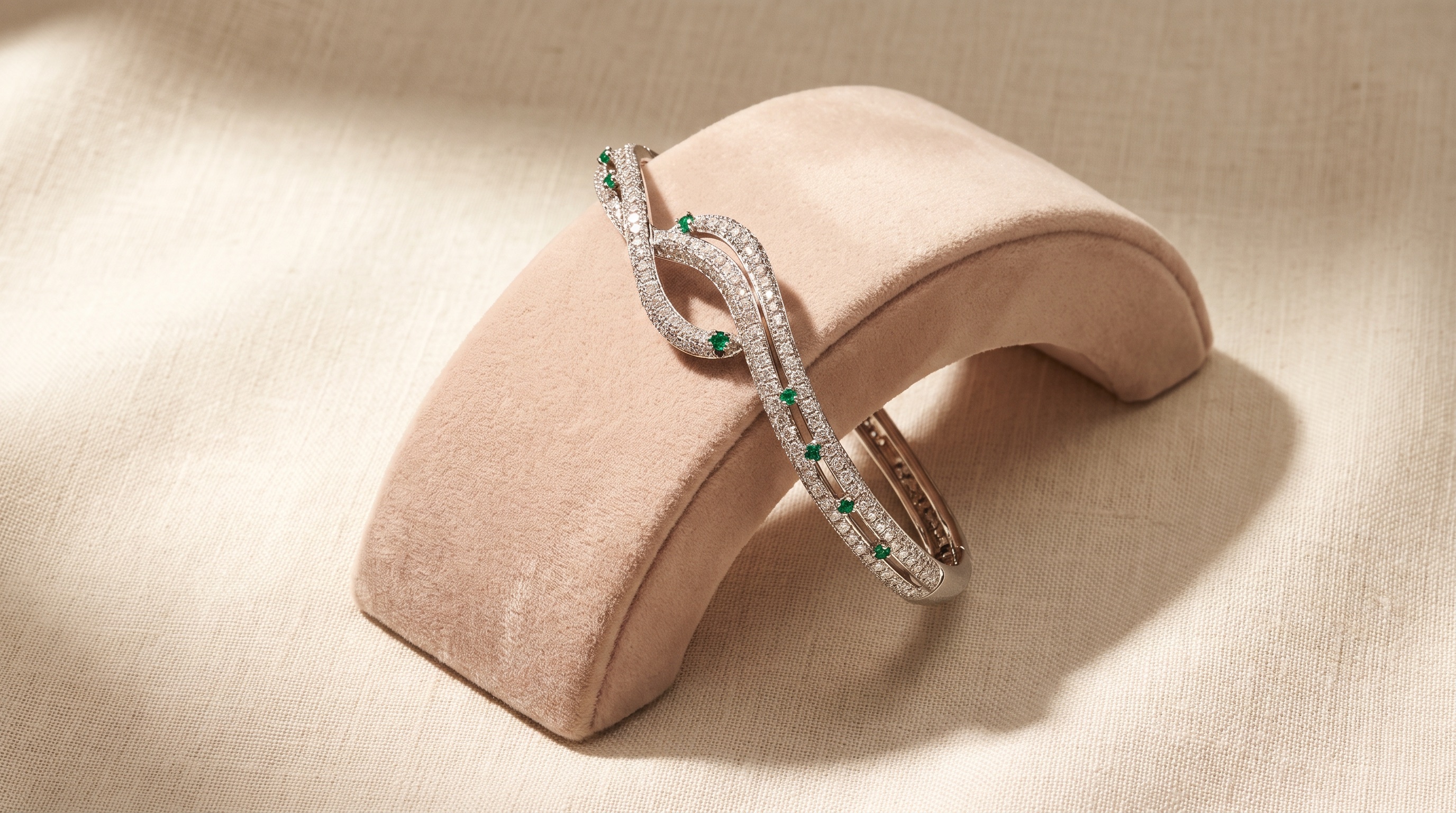
A diamond cuff bracelet is a rigid, open-back bracelet with a gap at the wrist that lets the wearer slip it on and gently flex it open rather than fastening it with a clasp, distinguishing it from both a closed-circumference bangle and a flexible, clasp-fastened chain or tennis bracelet. For a jeweler sourcing this category, the open-back construction is the defining engineering constraint: the metal has to be rigid enough to hold its shape and protect any diamonds set near the terminal ends, yet flexible enough at the opening to be worn comfortably without excessive force, which shapes sizing strategy, stone placement, and setting choice differently than either a closed bangle or a flexible line-set bracelet.
This guide is written for the trade — retailers, jewelers, and designers sourcing diamonds to build or expand a cuff bracelet line. It covers cuff construction types, sizing and fit, stone placement strategy around the open-back gap, setting styles, and what to look for in a wholesale diamond supplier for this category.
Cuff Construction Types
| Construction Type | Description | Stone Placement |
|---|---|---|
| Hinged cuff | A hidden hinge on one side lets the cuff open like a clamshell, with a safety catch on the opposite side | Full-circumference coverage possible since the hinge, not flex, allows opening |
| Flex-open cuff | A gap at the back with no hinge; the metal itself flexes open slightly to slip over the wrist | Stones typically concentrated at the front and sides, tapering off near the open ends |
| Wide statement cuff | A broader band, often flex-open, sized to cover more of the wrist as a statement piece | Full pavé or a central motif with clear metal margins near the terminal ends |
| Wire/thin cuff | A slim, minimalist flex-open band, often stacked in multiples | A single line of melee or a small cluster, rarely full coverage |
The hinged construction is the more structurally forgiving option for full stone coverage, since the hinge — not the metal's own flex — does the work of opening the piece, meaning the metal near the terminal ends doesn't need to flex repeatedly and can safely carry diamonds close to the opening. A flex-open cuff, by contrast, needs a stone-free or lightly-set margin near each open end, since that section of metal bears repeated flexing stress every time the piece is worn, and diamonds set too close to a flexing point are at meaningfully higher risk of loosening over time.
Sizing and Fit
Unlike a ring, which is sized to an exact finger circumference, a cuff bracelet is typically produced in two or three broad size categories (commonly labeled small/medium/large or petite/standard) rather than a full continuous size run, since the open-back design and the wrist's relative flexibility as a fit point tolerate a wider size range per piece than a closed circumference would. Manufacturers should specify both the cuff's internal gap width and its overall diameter when communicating sizing to a retailer, since two cuffs with the same overall diameter can fit noticeably differently depending on how wide the opening is and how much the metal flexes at that gap.
Stone Placement Strategy Around the Open-Back Gap
Because a flex-open cuff's terminal ends bear repeated flexing stress, most designs deliberately taper diamond density toward the ends — starting with full pavé or a feature motif at the front-center of the wrist and gradually reducing to plain, undecorated metal at the last section before each open end. This isn't purely a durability decision; it also reads visually as an intentional design choice rather than an afterthought, giving the piece a clear focal point at the front of the wrist. Manufacturers designing a new cuff style should map stone placement against the specific alloy and gauge of metal being used, since a thinner or softer metal needs a more conservative stone-free margin near the ends than a thicker, harder alloy would.
Setting Styles for Cuff Bracelets
Pavé Setting
Small diamonds set closely together across all or part of the cuff's visible surface, standard for a fuller, more finished look on hinged cuffs where the full circumference can safely carry stones.
Channel Setting
Stones set between two parallel metal rails, giving a smoother, more protected surface than pavé — a common choice for the front-facing section of a flex-open cuff since the channel walls themselves offer some added stone protection at a section of the piece that still sees regular wrist movement.
Center Motif with Plain Band
A concentrated cluster, halo, or single feature stone set only at the front-center of the cuff, with the rest of the band left plain — the most conservative and durable option for a flex-open cuff, since almost the entire flexing portion of the metal carries no stones at all.
Total Carat Weight by Style
| Cuff Style | Typical Stone Coverage | Common TCW Range |
|---|---|---|
| Wire/thin cuff, single line | Front third of the band | 0.15–0.40 TCW |
| Center motif cuff | Front-center cluster only | 0.30–1.00 TCW |
| Half-pavé flex-open cuff | Front half, tapering to plain ends | 1.00–3.00 TCW |
| Full-pavé hinged cuff | Entire visible circumference | 2.50–8.00+ TCW |
Full-circumference coverage is realistically achievable only on hinged constructions for the durability reasons described above, which is a meaningful sourcing distinction for a retailer comparing quoted prices across cuff styles — a full-pavé quote on a flex-open cuff design should prompt a question about how the ends are actually finished, since true edge-to-edge pavé on a flexing open-back piece is a durability compromise most reputable manufacturers avoid.
Certification Approach
Cuff bracelets built primarily from pavé or channel-set melee ship as graded parcel goods against a stated commercial standard, commonly DEF+/VS+, in line with standard melee practice. A cuff with a single larger center-motif stone at 0.30ct or above can have that specific stone individually certified through IGI, GIA, or GCAL, with the surrounding melee still following the standard parcel-grading approach. Retailers should confirm which stones, if any, in a given cuff design carry individual certification before quoting a finished price to a retail customer.
Natural vs. Lab-Grown Diamonds for Cuff Bracelets
Because full-pavé hinged cuffs carry meaningfully higher total carat weight than most other bracelet categories short of a full tennis bracelet, the dollar difference between natural and CVD lab-grown material is one of the more significant cost levers a manufacturer has in this category — choosing lab-grown melee on a full-pavé statement cuff can represent a substantial portion of the piece's total cost difference. Center-motif and wire-style cuffs, carrying lower total carat weight, see a smaller absolute dollar impact from the natural-versus-lab-grown decision, though the percentage savings remains consistent with lab-grown pricing generally.
What to Ask a Supplier When Sourcing for Cuff Bracelets
- What size range does the cuff ship in, and how is internal gap width specified alongside overall diameter?
- How is the stone-free margin near the open ends handled on flex-open designs, and is this margin consistent across production runs or does it vary piece to piece?
- Is hinge quality independently tested for repeated open-close cycles on hinged cuff constructions, since hinge failure is a common warranty issue specific to this category?
- What's the melee consistency guarantee across a production run for pavé and channel-set sections, particularly for a design intended as a standing retail item rather than a one-off piece?
Comparing Cuffs to Bangles and Tennis Bracelets for Sourcing Purposes
| Category | Construction | Sourcing Complexity |
|---|---|---|
| Diamond cuff bracelet | Rigid, open-back | Moderate-high — flex-point durability, tapered stone placement |
| Diamond bangle bracelet | Rigid or hinged, closed circumference | Moderate — closed-circumference sizing, hinge/clasp mechanics |
| Diamond tennis bracelet | Flexible, chain-link, clasp-fastened | High — long line, large stone count, strict color/size matching |
Cuffs sit between bangles and tennis bracelets in overall sourcing complexity — they don't require the strict long-line stone matching of a tennis bracelet, but the open-back flex point introduces a durability consideration neither a closed bangle nor a flexible chain bracelet has to manage in the same way.
Metal Choices and Gauge
Cuff bracelets are produced across standard fine jewelry metals — 14k and 18k white, yellow, and rose gold, and platinum for premium tiers — with metal gauge (thickness) mattering more for this category than for most others, since gauge directly determines how much the cuff can safely flex at its open ends without fatiguing or cracking over repeated wear. A manufacturer offering the same cuff design across multiple metals should confirm gauge is calibrated per metal rather than using one universal thickness, since platinum and 18k gold have different flex and fatigue characteristics at the same gauge.
Common Manufacturing Defects to Screen For
The open-back gap and, on hinged designs, the hinge itself are the two most common points of manufacturing defect in this category. A receiving inspection should check that the gap opens and closes smoothly without excessive force or visible metal stress marks, that any stones set near the terminal ends show no early signs of loosening, and — on hinged constructions — that the hinge moves freely through its full range without catching or binding. Retailers should also flex a small sample from each production batch through several open-close cycles before accepting a shipment, since a design that performs well on a single pre-production sample can still reveal hinge or flex-point weaknesses across a full production run that a one-off sample wouldn't catch.
Merchandising and Stacking
Thin and wire-style cuffs are commonly sold and worn as part of a stack alongside bangles or other cuffs, which is a relevant merchandising consideration for retailers — presenting a wire cuff as part of a stacking set tends to drive a higher average order value than selling it as an isolated standalone piece. Statement and full-pavé cuffs, by contrast, are more commonly merchandised and worn as a standalone piece given their scale, and retailers should stock and display these two cuff segments differently on the sales floor rather than presenting the full cuff category as one undifferentiated group.
Building a Cuff Bracelet Line Across Price Tiers
A well-built cuff line typically spans a wire or thin entry-tier piece for accessible, stackable pricing, a center-motif mid-tier design, and a premium full-pavé or hinged statement tier. As with other melee-driven bracelet categories, sourcing melee for the whole tier structure through one supplier relationship, rather than sourcing each tier independently, simplifies quality control and keeps certification and disclosure language consistent across every price point a customer might compare side by side.
Wholesale Pricing Structure and Order Quantities
Cuff bracelets are typically quoted per-piece inclusive of metal, melee, labor, and, on hinged designs, hinge and safety-catch hardware — with hinged cuffs commanding a meaningful labor premium over flex-open designs of comparable size and stone coverage, since hinge fabrication and testing add a manufacturing step a flex-open cuff doesn't require. A retailer placing a first wholesale order should ask for pricing broken out by construction type (wire, center-motif, half-pavé, full-pavé hinged) and separately confirm whether hinge testing and warranty terms are included in the quoted price or billed as an add-on, since hinge failure is one of the more common post-sale service issues in this category and it's worth knowing upfront what a supplier's standard warranty actually covers. Minimum order quantities should be confirmed per size and metal combination rather than assumed from a single quoted MOQ, since offering a cuff design across two or three sizes and multiple metals can multiply effective SKU count well beyond what a first-time buyer expects from one quoted minimum.
Quality Control Checklist on Receipt
Beyond flexing the gap and, on hinged designs, testing hinge movement through its full range, a receiving inspection should check for consistent gauge along the entire band — a cuff that's been ground or filed unevenly during finishing can develop a thin spot away from the intentional taper near the open ends, creating an unplanned weak point. Stones set near the transition from full coverage to plain metal should be checked closely under magnification, since this transition zone is where a design's stone-free safety margin is most likely to have been under-specified during production. As with other melee-set categories, checking a small sample from each production batch — not just a single pre-production sample — is the more reliable way to catch batch-level inconsistencies in gauge, hinge tolerance, or stone placement before pieces reach the sales floor.
Cuff Bracelets in Stacking and Layered Wrist Looks
The rise of layered, multi-piece wrist styling — stacking several bangles, cuffs, and flexible bracelets together rather than wearing a single statement piece — has shaped cuff bracelet design meaningfully over the past several years, with thinner, stackable cuff profiles seeing steady growth alongside the category's traditional single-statement-piece use case. A manufacturer designing a new cuff line should consider whether the piece is intended primarily as a standalone statement item or as one component of a stacked look, since the two use cases favor different widths, weights, and finishing choices — a stacking-oriented cuff generally performs better at a narrower width and lighter overall weight so it doesn't overwhelm the other pieces worn alongside it.
Custom and Personalized Cuff Designs
Cuff bracelets are a common candidate for personalization — engraved initials or a short phrase on the interior surface, a custom stone layout, or a bespoke width and metal combination built to a specific customer's wrist measurement. Because the open-back design already requires some degree of fit customization for larger or smaller wrists compared to a bangle's fixed circumference, retailers offering a custom cuff program have a natural opportunity to bundle personalization into that same fitting conversation rather than treating engraving as a separate add-on service requested after the fact.
Seasonal and Occasion-Based Demand
Cuff bracelets see fairly steady year-round demand relative to more occasion-driven categories, with modest lifts around gifting holidays (Mother's Day, the winter holiday season) and a secondary bump tied to statement-jewelry trend cycles rather than a single fixed calendar event. Retailers should treat cuff inventory planning more like a core, always-on category than a seasonal spike category, reordering based on sell-through velocity rather than anticipating a single major demand window the way some more occasion-specific pieces require.
Men's Diamond Cuff Bracelets
Cuff construction has a well-established men's category use case distinct from the fashion-forward women's segment — a men's diamond cuff typically favors a wider, heavier band, a more restrained stone layout (a single line, small cluster, or subtle pavé accent rather than a full-coverage design), and darker or more matte metal finishes. Retailers building a men's cuff offering should source this as a deliberately separate design brief rather than simply scaling down a women's cuff design, since proportions, stone density, and finish expectations differ enough between the two segments that a poorly adapted design reads as obviously repurposed rather than built for its intended wearer.
Frequently Asked Questions
What is a diamond cuff bracelet?
A rigid, open-back bracelet with a gap at the wrist that the wearer slips on and gently flexes open, rather than fastening with a clasp — distinct from a closed bangle and from a flexible, clasp-fastened chain bracelet. The category spans thin stackable wire designs through wide, full-pavé statement pieces.
How is a cuff bracelet different from a bangle?
A bangle has a closed circumference (or a hinge specifically engineered for opening), while a cuff has an open gap where the metal itself flexes to let the wearer slip it on, which changes sizing, stone placement, and durability planning across the whole design process.
Why do cuff bracelets often have plain metal near the ends?
The terminal ends of a flex-open cuff bear repeated flexing stress every time the piece is worn, so diamonds are typically kept away from that section to avoid loosening over time — full stone coverage is more achievable on hinged designs, where the hinge, not the metal's flex, allows opening.
What sizes do cuff bracelets come in?
Most cuffs are produced in two or three broad size categories rather than a continuous size run, since the open-back design and wrist flexibility tolerate a wider fit range per size than a closed bangle would fit comfortably across a similar range of customers.
Should cuff bracelet diamonds be lab-grown or natural?
Full-pavé statement cuffs carry high enough total carat weight that choosing CVD lab-grown melee represents a meaningful cost saving; center-motif and wire-style cuffs, at lower carat weight, see a smaller absolute dollar impact from the choice.
Are cuff bracelet diamonds certified?
Pavé and channel-set melee ships as graded parcel goods against a stated commercial standard like DEF+/VS+. A single larger center-motif stone at 0.30ct or above can be individually certified through IGI, GIA, or GCAL if the design includes one.
Can a diamond cuff bracelet be resized?
Some adjustment is possible by gently reshaping the metal at the open ends, but a cuff isn't resized the way a ring is — retailers should size to a customer's actual wrist at the point of sale rather than relying heavily on post-purchase adjustment.
Packaging and Point-of-Sale Presentation
Cuff bracelets present differently on the sales floor than clasp-fastened bracelets, since a customer generally needs to physically flex the piece open to try it on rather than simply having a clasp fastened for them — a detail worth training sales staff on directly, since an unfamiliar customer handling an unfamiliar open-back mechanism for the first time can be hesitant to apply the gentle pressure needed without guidance. Display fixtures that show the cuff already slightly open, rather than fully closed as if it were a bangle, help signal the try-on mechanism at a glance and reduce the need for a staff member to demonstrate it on every interaction.
Sourcing Diamonds for a Cuff Bracelet Line Wholesale
Guru Diam supplies calibrated CVD lab-grown and natural melee for pavé, channel, and center-motif cuff construction, alongside loose feature stones for premium statement designs, with IGI, GIA, and GCAL certification available at 0.30ct and above. Trade buyers can review current melee and matched-pair inventory through matching pairs and certified diamonds, and work with Guru Diam's custom jewelry team on gauge, hinge, and sizing specifications through custom jewelry. In-stock inventory ships same-day from Guru Diam's New York and Los Angeles locations. New trade accounts can apply through trade partner, with current terms available at the wholesale hub. For related sourcing fundamentals, see our diamond bangle bracelet guide and diamond tennis bracelet guide.
Guru Diam is a trade-only wholesale diamond supplier with locations in New York and Los Angeles, supplying calibrated CVD lab-grown and natural melee alongside certified loose diamonds, with IGI, GIA, and GCAL certification available, for jewelers building bracelet and finished jewelry lines. Browse current inventory in matching pairs or apply for a trade account through trade partner.