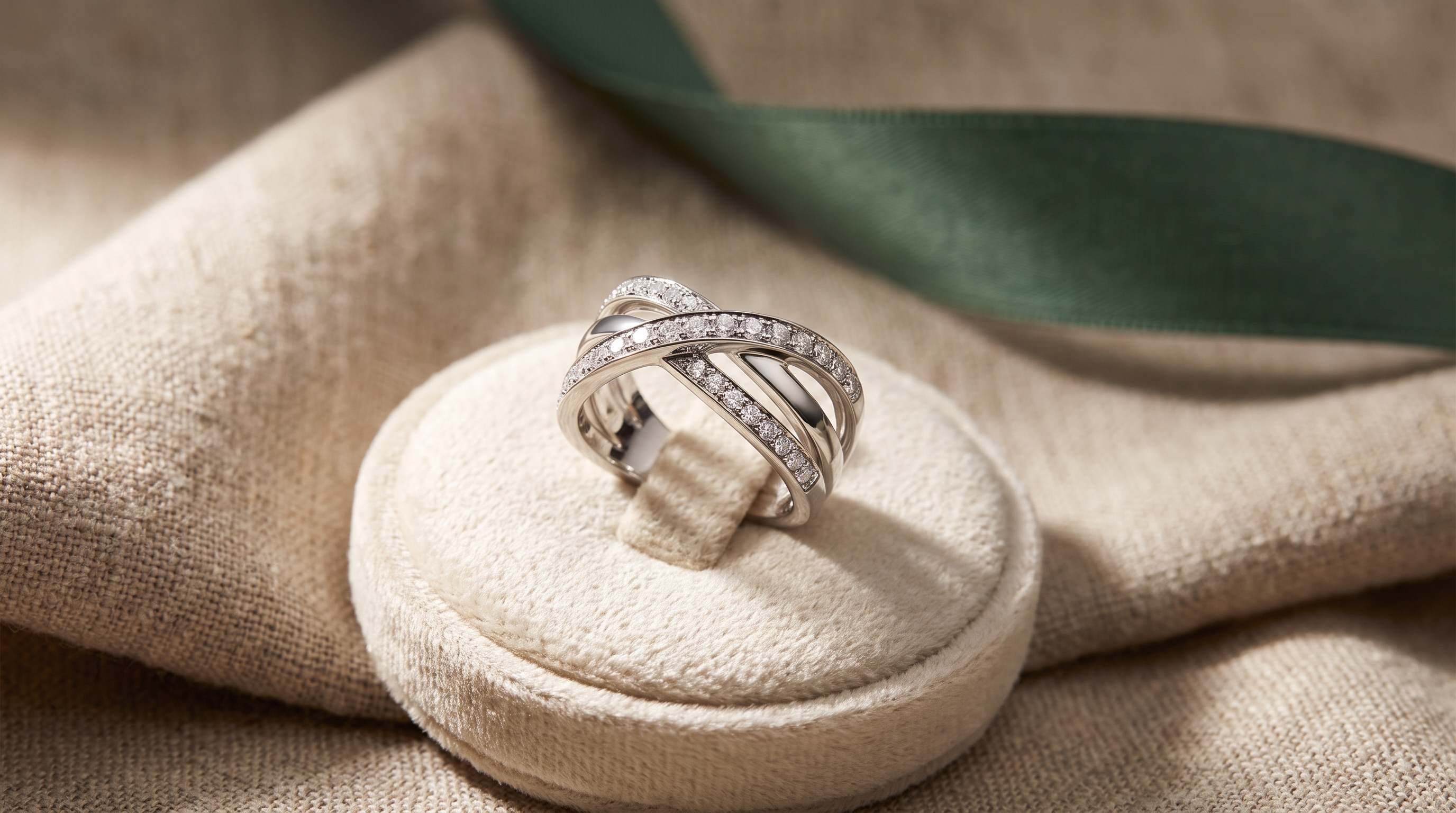
A diamond crossover ring sets two lines or clusters of diamonds so they visually cross at an angle across the finger, rather than running in a single straight or circular line the way a standard pavé or eternity band does. For a jeweler or manufacturer, sourcing for this category is fundamentally a melee-matching and setting-engineering problem, since the crossing point where the two lines meet has to be built to hold its shape and stone alignment under everyday wear.
This guide is written for the trade — jewelers, designers, and manufacturers sourcing diamonds and melee to build crossover ring designs for their own retail or wholesale lines. It covers what the crossover structure requires from a sourcing and engineering standpoint, melee sizing along two intersecting lines, common crossover formats, and what to ask a wholesale supplier before placing an order for this category.
Why the Crossover Structure Is a Distinct Sourcing Case
A standard pavé or channel band follows one continuous line around the finger, which makes stone sizing and spacing relatively predictable to plan. A crossover design instead runs two separate lines of stones that meet and cross at an angle — usually at the top of the finger — which means the ring has to be engineered so the crossing point is structurally sound (since it's often the ring's thinnest or most stressed section) while also keeping stone alignment visually clean where the two lines intersect. This makes crossover ring sourcing and setting closer in precision requirement to a fine pavé application, with an added structural-engineering consideration that a simple single-line band doesn't have to solve.
Melee and Accent Stone Sizing for Crossover Construction
Most crossover designs use small to moderate melee (commonly 1.0-2.0mm) along each of the two crossing lines, sometimes stepping up to a slightly larger accent stone at the point where the lines cross or at each line's outer terminus. Because the two lines have to read as visually balanced against each other, melee sourced for a crossover design should come from a single consistent lot for both lines rather than two separately sourced batches, since even a subtle size or color inconsistency between the two lines becomes obvious where they sit side by side near the crossing point, and a mismatch that would go unnoticed on a single straight band is far more visible once two lines are placed directly next to each other at an angle.
Total Carat Weight and Stone Count by Style
| Crossover Ring Style | Typical Stone Count | Common TCW Range |
|---|---|---|
| Delicate double-row crossover band | 16-24 stones | 0.15-0.35 TCW |
| Crossover with a center accent at the intersection | 18-26 melee + 1 accent | 0.30-0.60+ TCW |
| Wide statement crossover (multiple rows per line) | 30-50+ stones | 0.50-1.00+ TCW |
Jewelers building across price tiers should scale both crossing lines together rather than making one line more prominent than the other unless that asymmetry is a deliberate design choice, since an unintentionally uneven crossover reads as a construction flaw rather than a style decision.
Setting Styles for Crossover Rings
Pavé Crossover
Small stones set closely together with shared prongs or beads along both crossing lines, the most common approach for delicate crossover designs, maximizing brilliance while keeping the profile low.
Channel Crossover
Each line of stones sits within its own metal channel, giving a smoother, more protected setting than pavé at the cost of slightly less light entry — this approach also requires more precise metalwork at the crossing point, where two channels have to meet and align cleanly.
Bezel-Accented Crossover
A larger accent stone at the crossing point is individually bezel-set for added security and a more modern, geometric look, with pavé or channel-set melee continuing along both lines away from the center.
Structural Engineering at the Crossing Point
The crossing point is the section of a crossover ring most likely to develop stress-related issues over time, since it's frequently the ring's thinnest cross-section and bears repeated flexing from normal hand movement. Manufacturers should specify slightly thicker metal at the crossing junction than the design's overall visual weight might otherwise suggest, and should confirm with a setting partner that the junction is soldered or cast as one continuous, reinforced piece rather than two lines simply meeting at a visually thin point. A buyer sourcing crossover designs from an outside manufacturer should ask specifically how the crossing point is reinforced, since this is the detail most likely to differentiate a well-engineered crossover ring from one prone to bending or stone loss at that junction.
Certification Approach for Crossover Ring Diamonds
Because crossover rings are built predominantly from melee-range stones, the bulk of a crossover design's diamonds ship as graded parcel goods against a stated commercial standard (commonly DEF+/VS+) rather than individually certified. A design that includes a larger accent stone at the crossing point, at 0.30ct or above, can have that specific stone individually certified through IGI, GIA, or GCAL, with the surrounding crossover melee still following standard parcel grading. Buyers should confirm which parts of a given crossover design carry individual certification before quoting a finished price to a retail customer.
What to Ask a Supplier When Sourcing for Crossover Designs
- Can the supplier provide enough melee from a single consistent lot to complete both crossing lines without a visible transition between them?
- Is the melee sold for fine pavé or channel work specifically, where tight size and color consistency matters more than it would for a scattered cluster design?
- What's the reorder consistency for the specific melee size and grade used, if the crossover design becomes a standing retail item?
- Can a matching accent stone be sourced and certified separately for designs that place a larger stone at the crossing point?
Natural vs. Lab-Grown Diamonds for Crossover Designs
Given that crossover rings typically use moderate total carat weight concentrated in small melee, the cost gap between natural and CVD lab-grown material is meaningful in relative terms even though the absolute dollar difference stays modest at this scale. Lab-grown material is common in this category, particularly for designs aimed at a fashion or stackable-ring customer rather than a bridal-specific buyer, since it lets a jeweler offer a larger or more elaborate crossover pattern at an accessible price point. A buyer building both a bridal-context and a fashion-context crossover line should consider stocking natural material for the bridal tier and lab-grown for the fashion tier, which lets each line's price point match its actual target customer's expectations more closely than a single material choice applied uniformly across both contexts.
Crossover Rings in Bridal vs. Fashion Contexts
Crossover designs appear in two distinct retail contexts that call for slightly different sourcing priorities: as a bridal-adjacent piece (an alternative engagement ring band style, or a wedding band designed to cross over and frame a solitaire engagement ring), and as a standalone fashion ring meant to be worn independently or stacked with other pieces. A bridal-context crossover ring typically calls for higher-grade, more consistently matched melee since it's meant to be examined closely and worn daily as part of a matched bridal set, while a fashion-context crossover ring has more room for cost-driven material choices since the buying decision is driven more by design appeal than by grading precision.
Pairing a Crossover Wedding Band With a Solitaire Engagement Ring
One of the most common uses for the crossover format is a wedding band specifically designed to cross over and nestle against a solitaire engagement ring, framing the center stone from two angles rather than sitting as a plain straight band beside it. Manufacturers producing crossover wedding bands for this purpose need to account for a range of solitaire head shapes and prong configurations the crossover band might need to fit around, since a crossover band engineered for only one specific solitaire silhouette limits which engagement rings a retailer can successfully pair it with. A retailer offering a crossover band specifically for this pairing use should keep samples on hand in a few common prong-height variations so a customer can test the fit against their own engagement ring in-store before ordering, rather than relying on measurements alone to confirm the two pieces will sit flush together.
Origins of the Crossover Ring Format
The crossover ring style draws on a long tradition of asymmetric and toi et moi-style jewelry design, where two visual elements intersect or cross rather than sitting in simple parallel alignment, but its current popularity as a distinct named category owes more to the modern stackable-ring trend than to any single historical design movement. As stacking multiple thin bands became a mainstream styling approach, a crossover ring offered a way to get a similar "two lines" visual effect within a single ring, appealing to customers who wanted the stacked look without needing to buy, size, and maintain several individual bands.
Metal Choices and Finish for Crossover Designs
Crossover rings are produced across the standard range of ring metals — 14k and 18k white, yellow, and rose gold, and platinum — with metal choice driven mainly by fashion preference and by whether the piece is meant to pair with an existing bridal set in a specific tone. Because the crossing point is a visually prominent structural feature, some manufacturers finish that junction with a slightly higher polish than the rest of the band to draw the eye there deliberately, though this is a design choice rather than a technical requirement. Two-tone crossover designs, where each crossing line is set in a different metal color, are also a common variation that adds visual interest without requiring any change to the underlying melee-sourcing approach.
Photographing and Merchandising Crossover Rings
Because a crossover ring's defining feature is the angle at which its two lines meet, product photography that captures the ring from a slight top-down angle — rather than a straight side profile — shows the crossing structure far more clearly and is worth prioritizing over a generic angle used for simpler band styles. In-store, presenting a crossover ring alongside a plain stacking band of similar width helps a customer visually understand the "two lines in one ring" concept immediately, which shortens the sales explanation compared to describing the design verbally.
Comparing Crossover Rings to Other Line-Set Categories
| Category | Typical TCW | Sourcing Complexity |
|---|---|---|
| Diamond crossover ring | 0.15-1.00+ TCW | Moderate to high — two-line matching plus crossing-point engineering |
| Diamond infinity ring | 0.10-0.50 TCW | Moderate — small melee, tight crossover curve |
| Diamond eternity band | 0.50-2.00+ TCW | Moderate — full-circle consistent melee line |
Common Manufacturing Defects to Screen For
Because the crossing point concentrates structural stress and stone alignment into a small physical area, that section is the most common point of manufacturing defect in this category — an uneven junction where the two lines don't align cleanly, a thin spot in the metal at the crossing point, or melee spacing that noticeably tightens or loosens right where the lines meet are the issues most worth checking closely before accepting a finished piece from a setting partner. A physical inspection under magnification specifically at the crossing point, alongside a basic flex test to confirm the junction feels structurally solid, is the most efficient quality-control step for this category. Manufacturers running a recurring crossover production line should log defect rates specifically at the crossing point separately from general defect tracking elsewhere on the ring, since a rising defect rate isolated to that one junction usually points to a specific tooling or casting adjustment rather than a broader quality issue across the whole design.
Resizing Considerations for Crossover Rings
Because a crossover ring's design typically extends further around the band than a simple solitaire, resizing is more limited than it would be for a plain band — cutting and rejoining the shank at the back works fine when the crossover pattern sits mainly at the top of the ring but becomes visually and structurally more complicated on wider designs where the crossing lines extend further around the circumference. Retailers should confirm and communicate resizing limitations at the point of sale for any crossover design that wraps significantly around the band, and should note that a crossover ring intended to pair with a specific solitaire engagement ring may need to be resized in tandem with that piece rather than independently, to keep the two rings sitting flush against each other after either is adjusted.
Stackability and Styling Alongside Other Rings
Because a crossover ring already delivers a "two lines" visual on its own, it works both as a standalone statement piece and as one element in a larger stack alongside plain bands or other symbolic rings, giving a retailer real, practical flexibility in how the piece can be merchandised across a range of different customer preferences and budgets. A wider or more elaborate crossover design tends to work best worn alone or with minimal additional stacking, while a delicate double-row crossover leaves enough visual room to stack comfortably with one or two additional thin bands without looking crowded. Manufacturers designing a crossover line with stacking in mind should keep the band's overall height and width modest enough that it sits comfortably against a neighboring ring rather than catching or shifting a stack out of alignment during normal wear.
Seasonal and Gifting Demand Patterns
Crossover rings see demand patterns similar to other fashion-forward, moderately priced diamond categories — steady year-round interest with identifiable spikes around major gifting occasions (holiday season, Valentine's Day, and graduation/milestone gifting in late spring), rather than the sharper bridal-season concentration seen in engagement ring demand specifically. Retailers planning inventory for a crossover ring line benefit from timing melee reorders ahead of these known demand windows, since a supplier's lead time on a specific melee size and grade can extend beyond what a purely reactive, sold-out-triggered reorder approach leaves room for.
Building a Crossover Ring Line Across Price Tiers
A well-built crossover ring line typically spans a delicate entry-tier design with a single thin double-row crossover, a mid-tier version with a slightly wider pattern or a small accent stone at the intersection, and a premium tier featuring a larger certified accent stone alongside more elaborate melee coverage along both lines. Manufacturers should plan melee sourcing across the full tier structure at once, using a supplier who can deliver consistent grading across multiple specifications from one relationship, which simplifies quality control and keeps certification and disclosure language uniform across every price point a customer might compare in-store.
Sourcing Crossover Ring Diamonds Wholesale
Guru Diam supplies calibrated diamond melee suited to fine pavé and channel work, including the sizes commonly used in crossover ring construction, across natural and CVD lab-grown material. Melee ships as consistent, gradable lots at DEF+/VS+ and tighter tiers rather than mixed parcel stock, and larger accent stones for crossover designs incorporating one can be sourced and certified separately at 0.30ct and above. In-stock inventory ships same-day (before 6pm EST from New York, before 4pm PST from Los Angeles), and trade accounts can browse current melee stock in matching pairs or source certified accent stones in certified diamonds. Manufacturers building a custom crossover design can start at custom jewelry, and new trade accounts can apply through trade partner, with current terms at the wholesale hub. For general melee-sourcing background before building a specific fine line-set design, see our diamond infinity ring guide.
Frequently Asked Questions
What is a diamond crossover ring?
A diamond crossover ring sets two lines or clusters of diamonds so they visually cross at an angle across the finger, rather than running in a single straight or circular line like a standard pavé or eternity band.
What size diamonds are used in crossover rings?
Most crossover designs use small to moderate melee, commonly in the 1.0-2.0mm range, sometimes stepping up to a slightly larger accent stone at the point where the two lines cross.
Are crossover ring diamonds individually certified?
Most of a crossover ring's diamonds are melee-range and ship as graded parcel goods rather than individually certified. A design that includes a larger accent stone at 0.30ct or above can have that specific stone individually certified separately.
What makes the crossing point structurally important?
The crossing point is often the ring's thinnest or most stressed section and bears repeated flexing from normal wear. It should be reinforced with slightly thicker metal and built as one continuous, soldered or cast junction rather than two lines simply meeting at a thin point.
Can a crossover ring be used as a wedding band?
Yes — one common use is a wedding band specifically designed to cross over and nestle against a solitaire engagement ring, framing the center stone from two angles rather than sitting as a plain straight band beside it.
Should crossover rings use natural or lab-grown diamonds?
Either works and looks identical once set. Lab-grown material is common in this category, particularly for fashion-oriented designs, since it lets a jeweler offer a larger or more elaborate crossover pattern at an accessible price point.
Can a crossover ring be worn as part of a stack?
Yes — a delicate double-row crossover design leaves enough visual room to stack comfortably with one or two additional thin bands, while wider or more elaborate crossover designs tend to work best worn alone or with minimal additional stacking.
What's the difference between a crossover ring and a toi et moi ring?
A toi et moi ring pairs two co-equal stones or clusters side by side, while a crossover ring specifically features two lines or clusters that cross at an angle. The two concepts share a design lineage but describe different physical structures.
Guru Diam is a trade-only wholesale diamond supplier with locations in New York and Los Angeles, supplying calibrated diamond melee and certified loose stones — natural and CVD lab-grown — for jewelers and manufacturers producing crossover rings and other fine line-set jewelry. Browse current melee inventory in matching pairs or apply for a trade account through trade partner.