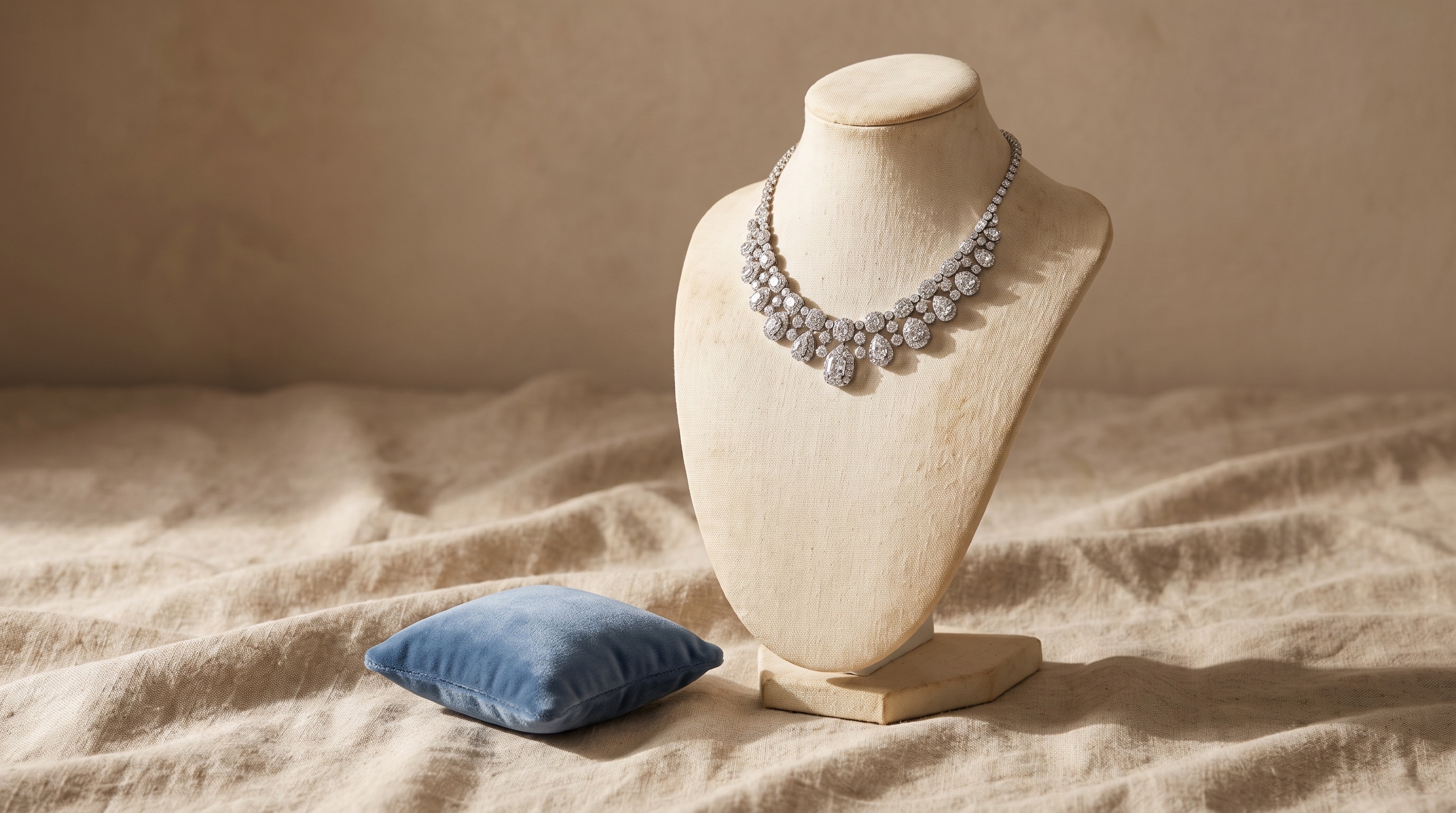
A diamond cluster necklace is a pendant or station necklace built around groupings of several smaller diamonds set closely together to visually read as one larger element, rather than a single center stone. For a jeweler, cluster construction is a distinct sourcing category from solitaire pendant work — it trades single-stone grading precision for melee consistency and setting-density skill, and buyers building a cluster line need to source accordingly.
This guide is written for the trade — retailers, designers, and manufacturers sourcing diamonds to build or expand a cluster necklace line — not a consumer buying guide. It covers cluster construction types, melee grading standards for cluster work, setting methods, and what to evaluate in a wholesale diamond supplier for this category.
What Defines a Cluster Necklace, Sourcing-Wise
A cluster necklace's defining sourcing characteristic is that visual impact comes from the combined effect of many smaller stones rather than the quality of any single stone — a well-executed cluster of consistently matched 1.5mm melee can read as visually substantial even though no individual stone in it would impress on its own. This shifts the sourcing priority from single-stone certification and cut precision toward melee consistency: uniform size, matched color and clarity across the full parcel, and setting density that leaves minimal visible metal between stones. A buyer used to sourcing solitaire center stones needs a different mental model for cluster work, since the unit of quality control is the parcel, not the individual stone.
| Factor | Solitaire Pendant Sourcing | Cluster Necklace Sourcing |
|---|---|---|
| Primary quality unit | Individual stone grade and certificate | Parcel-level consistency across many stones |
| Certification | IGI/GIA/GCAL individually certified (0.30ct+) | Uncertified parcel goods against a color/clarity baseline |
| Key risk | A flawed single stone | Uneven color or size across the cluster, visible once set |
| Setting skill required | Prong or bezel precision on one stone | Dense micro-pavé or cluster-setting technique across many stones |
Common Cluster Necklace Constructions
Halo Cluster Pendant
A small center stone surrounded by a ring of melee, designed to visually approximate a larger single stone at a lower cost. This is the most common cluster pendant format and the one most directly competing, in the customer's mind, with a solitaire pendant of comparable visual size but higher single-stone cost.
Cluster Station Necklace
Multiple cluster groupings spaced along a chain rather than concentrated in a single pendant, often used for layering pieces or as a more understated everyday alternative to a single statement pendant.
Flower or Cluster-Motif Pendant
Melee arranged in a deliberate decorative pattern — a flower, starburst, or geometric cluster — where the setting design itself, not just stone size, drives the finished look. This construction demands the most precise setting work of the three, since an uneven pattern is immediately visible in a symmetrical decorative motif.
Melee Grading Standards for Cluster Work
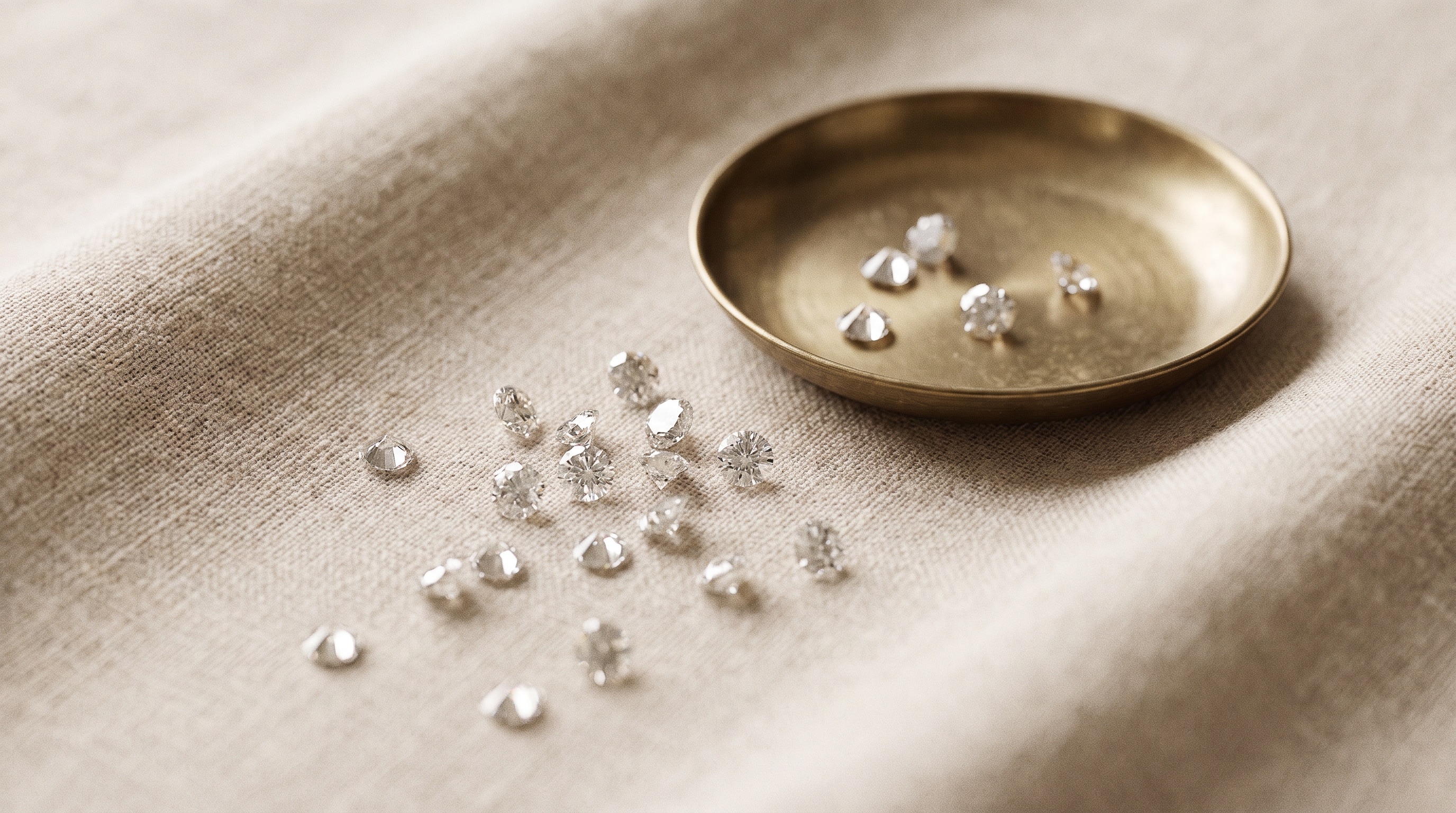
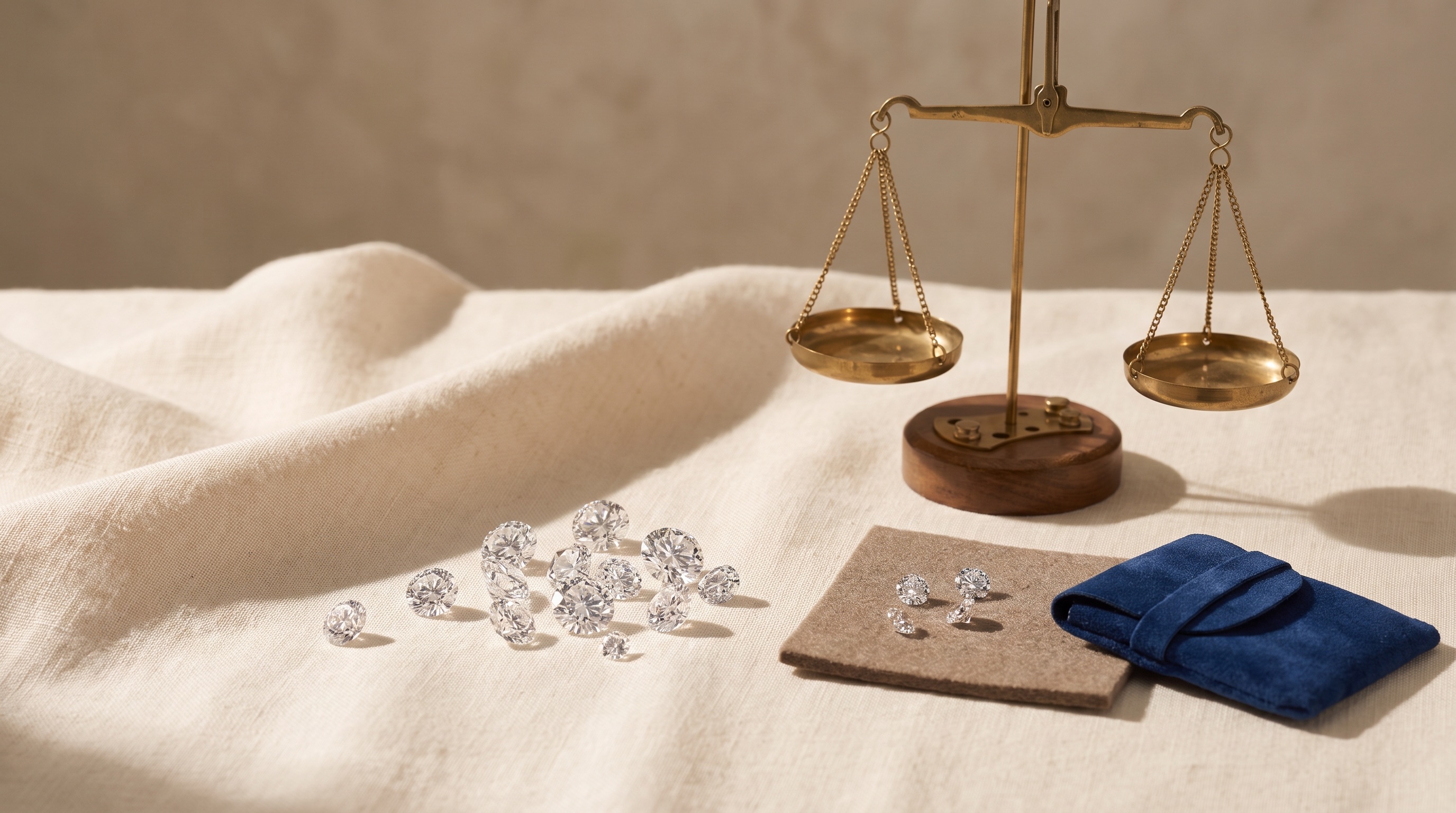
Melee for cluster necklaces is typically sourced against a DEF+/VS+ quality baseline as uncertified parcel goods, consistent with how melee is graded and sold across the wholesale trade generally — melee is not individually or parcel-certified the way loose stones at 0.30ct and above are. What matters most for cluster work specifically is consistency within the parcel: stones that vary noticeably in color or clarity will show as visible unevenness once densely set side by side, in a way that wouldn't be obvious if the same stones were sold individually or spaced further apart. A supplier who grades and matches melee specifically for cluster and pavé use, rather than selling from undifferentiated bulk parcels, materially reduces the risk of visible unevenness in a finished piece.
Diamond Shape Choices for Cluster Work
Round brilliant melee dominates cluster necklace construction, since round stones set edge to edge leave the least visible gap and create the most seamless combined surface. Calibrated fancy shapes — emerald, radiant, pear, and marquise cut to precise, matched dimensions — appear in more contemporary cluster designs, particularly flower and geometric-motif pieces where shape variety is part of the intended visual pattern, but require tighter size calibration than round melee to set cleanly together.
Setting Methods for Cluster Necklaces
Pavé setting — small beads or prongs securing each stone with minimal visible metal — is the most common method for dense cluster work, prized for maximizing perceived diamond coverage. Micro-pavé, using proportionally smaller stones and finer metalwork, achieves an even denser, more seamless look but demands higher setting precision and typically commands a higher labor cost. Bead-and-bright and channel-adjacent techniques appear in some cluster-motif designs where a more structured, geometric pattern is the goal rather than the organic density of pavé.
Wholesale Price Positioning by Cluster Type
| Cluster Type | Relative Price Position | Key Cost Driver |
|---|---|---|
| Halo cluster pendant | Mid | Center stone grade plus surrounding melee consistency |
| Cluster station necklace | Mid to high | Total melee weight across multiple stations, chain construction |
| Flower/motif cluster | Mid to high | Setting labor and precision, calibrated shape sourcing |
Lab-Grown vs. Natural Diamonds for Cluster Necklaces
CVD lab-grown melee has become the dominant sourcing choice for cluster necklace work at accessible and mid-market price points, since cluster designs depend on total stone count and consistency more than on any single stone's provenance, and lab-grown material allows a retailer to offer a visually denser, larger-reading cluster at a lower total cost than an equivalent natural-melee piece. Natural melee remains available and is typically positioned for premium cluster lines marketed specifically on natural provenance, but the visual difference between natural and lab-grown melee at cluster scale is not detectable without laboratory equipment, making the choice primarily a cost and positioning decision rather than a quality one.
Chain and Setting Metal Considerations
Cluster pendants place proportionally more visual weight on chain quality than a solitaire pendant does, since a cluster's density draws the eye to the full piece rather than a single focal stone — a thin or poorly finished chain can undercut an otherwise well-executed cluster. White metal (platinum or white gold) remains the most common choice for cluster work, since it minimizes visible metal contrast against closely set stones, though yellow and rose gold cluster pieces have grown as part of a broader mixed-metal jewelry trend, particularly in station necklace formats where warmer metal reads well against spaced-out clusters.
Retail Merchandising for Cluster Necklaces
Cluster necklaces benefit from macro or close-up product photography that lets a customer see the individual stone density driving the piece's overall sparkle — a flat, distant product shot underrepresents how a well-executed cluster actually performs in person compared to a single large stone. Retailers should also merchandise cluster pieces with clear language distinguishing "diamond cluster" construction from a single larger stone, since customers occasionally assume a cluster necklace's visual size corresponds to an equivalent single-stone weight, and setting that expectation correctly at the point of sale reduces returns and post-purchase disappointment.
Common Sourcing Mistakes in Cluster Necklace Programs
The most frequent mistake is sourcing melee from a general undifferentiated parcel rather than a parcel specifically graded and matched for dense-set cluster use, leading to visible color or size unevenness once the piece is finished and it's too late to swap stones cheaply. A second common mistake is under-specifying calibration tolerance when ordering calibrated fancy-shape melee for geometric cluster designs, resulting in stones that don't sit flush together and leave visible gaps in what's meant to be a seamless pattern. A third is treating chain and setting metal as an afterthought relative to stone sourcing, when cluster pieces specifically depend on overall finish quality to read as a cohesive, well-made piece rather than a collection of small stones.
Order Structure and Minimums for Cluster Melee
Cluster necklace programs typically consume melee in larger, more consistent volume than solitaire or drop-earring lines, since even a single moderately sized cluster pendant can require dozens of matched small stones. Wholesale suppliers commonly structure melee orders by total carat weight within a specified size and grade range rather than by individual stone count, which lets a retailer plan inventory around a target total weight per piece and reorder consistently as a cluster line scales. Retailers new to cluster sourcing should ask a prospective supplier about typical parcel size, reorder consistency (whether a second order months later will closely match the first in color and size), and whether melee is sold from continuously replenished stock or from a single finite parcel that won't be available again once sold through — the latter creates real risk for a retailer planning to reorder the same cluster design repeatedly over time.
Quality Control Checks Before Setting a Cluster Order
Because cluster construction magnifies any inconsistency across many closely set stones, a pre-setting quality check is worth the modest time investment it takes relative to the cost of discovering a problem after a piece is finished. A basic check involves spreading a melee parcel out under consistent lighting and visually scanning for any stones that stand out as noticeably whiter, more yellow, or differently sized than the surrounding group — outliers are far easier to spot and pull before setting than after. Retailers working with a supplier who pre-sorts and matches melee specifically for cluster and pavé use can generally skip an extensive independent re-check, but should still spot-check incoming parcels periodically as a basic quality assurance practice rather than assuming every shipment will be perfectly consistent without exception.
Cluster Necklace Length and Chain Style Considerations
Beyond the cluster element itself, chain length and style materially affect how a cluster necklace performs in a retail assortment. Shorter chains (16-18 inches) position a cluster pendant at or near the collarbone, the most common length for a standalone statement piece meant to be the clear visual focus. Longer chains (20-24 inches) suit cluster station designs meant to be worn layered with other necklaces, a styling trend that has grown substantially in recent years and that retailers building a cluster line should plan inventory around explicitly, offering multiple length options for the same cluster design rather than a single fixed length.
Sourcing Diamonds for a Cluster Necklace Line Wholesale
Guru Diam supplies CVD lab-grown and natural melee graded and matched for dense cluster and pavé work, alongside certified loose center stones for halo cluster designs, with IGI, GIA, and GCAL certification available at 0.30ct and above. Trade buyers can review current melee and matched-set inventory through matching pairs and certified diamonds, and work with Guru Diam's custom jewelry team on cluster and pavé setting construction through custom jewelry. In-stock inventory ships same-day from Guru Diam's New York and Los Angeles locations. New trade accounts can apply through trade partner, with current terms available at the wholesale hub. For related sourcing fundamentals, see our diamond cluster ring guide, diamond cluster earrings guide, and diamond tennis necklace guide.
Cluster Necklace Trends Shaping Wholesale Demand
Cluster designs have benefited from a broader jewelry trend toward maximalist, texture-rich pieces after several years of minimalist styling dominance, with dense pavé clusters and cluster-motif pendants specifically well positioned to serve that shift back toward more visually layered jewelry. At the same time, the layering trend that has driven strong demand for lighter station-style necklaces has extended into cluster construction, with retailers increasingly offering smaller, more restrained cluster stations designed specifically to be worn stacked with several other necklaces rather than as a single standalone statement piece. Retailers building a cluster line benefit from covering both ends of this range — a bold, dense single-pendant cluster for customers seeking a standalone statement piece, and a lighter, smaller-scale cluster station design for the layering-focused segment of the market — rather than committing to only one end of that spectrum.
Comparing Cluster Necklaces to Cluster Rings and Earrings
Cluster construction principles are largely shared across necklace, ring, and earring applications — melee consistency, dense pavé setting, and parcel-level rather than stone-level quality control — but necklaces carry their own distinct constraints. A cluster ring is subject to daily wear stress and needs setting security prioritized alongside appearance, while a cluster necklace pendant, worn away from the hands, faces meaningfully less physical impact risk and can prioritize visual density and setting openness somewhat more heavily. Retailers already sourcing cluster rings or cluster earrings from an established melee supplier can generally extend that same sourcing relationship to a necklace line without renegotiating quality standards from scratch, since the underlying melee specification (DEF+/VS+, matched for dense-set consistency) carries over directly across all three categories.
Working With a Custom Jewelry Partner for Cluster Designs
Original cluster-motif designs — flower, starburst, or other decorative arrangements beyond a standard round halo cluster — typically require working with a manufacturing partner capable of custom setting work rather than sourcing a pre-built cluster template, since the setting pattern itself is often as much a part of the design's identity as the stones it holds. Retailers developing an original cluster motif should expect a longer development cycle than a standard halo or station design, including at least one physical sample or CAD rendering review before committing to a production run, since setting density and pattern spacing are difficult to fully evaluate from a sketch alone. Working with a partner who can produce a wax or 3D-printed sample ahead of full production meaningfully reduces the risk of an expensive miscalculation in stone count or spacing once metal and stones are committed.
Pricing Cluster Necklaces for Retail: Perceived Value vs. Total Carat Weight
Cluster necklaces present a distinct retail pricing opportunity relative to solitaire pendants, since a well-executed cluster's perceived value often exceeds what its total carat weight alone would suggest if priced purely on a per-carat basis — the visual density and craftsmanship of the setting itself contributes meaningfully to perceived value in a way that's harder to achieve with a single solitaire stone. Retailers should price cluster pieces accounting for this perceived-value premium, factoring in setting labor and design complexity as legitimate value drivers alongside raw stone cost, rather than defaulting to a pure per-carat pricing model that undervalues the craftsmanship difference between a well-set cluster and a poorly set one using the same total stone weight.
Durability and Everyday Wear Considerations
Cluster pendants set with pavé melee generally hold up well to everyday wear since individual stones are small and well-protected by surrounding metalwork, but cluster designs with more open, less densely set patterns — particularly decorative motif clusters with visible gaps between stone groupings — can be more vulnerable to snagging on clothing or catching on hair than a fully dense pavé cluster. Retailers should set accurate customer expectations about wear durability based on a specific cluster design's density and setting style, and consider recommending a slightly more protected setting style for a customer describing an active, hands-on lifestyle rather than defaulting to whichever cluster design happens to be most visually striking in a showcase.
Comparing Cluster Necklaces Across Price Tiers
Entry-tier cluster necklaces typically use smaller, more commercial-grade melee in a simple halo or basic station format, prioritizing accessible price over intricate setting work. Mid-tier cluster pieces step up to better color and clarity consistency across the melee parcel and often introduce a double-halo or more developed cluster-motif design. Premium cluster necklaces combine the highest melee consistency with the most setting-labor-intensive constructions — dense micro-pavé, complex decorative motifs, or larger total stone counts — and represent the category's highest average price point. Retailers building a full cluster assortment benefit from clearly differentiating these tiers in both sourcing and merchandising, so customers can understand what specifically justifies a price difference between two visually similar cluster pieces rather than perceiving pricing as arbitrary.
Care and Maintenance Guidance to Pass Along to Customers
Cluster necklaces, particularly dense pavé designs, accumulate everyday grime — lotion, skin oil, dust — in the small gaps between closely set stones more readily than a single solitaire pendant does, since there's simply more total surface area and more crevices per piece. Retailers should pass along basic care guidance to customers at the point of sale: a soft brush and mild soap solution for routine at-home cleaning, and periodic professional ultrasonic cleaning and prong-tightening checks for pieces worn regularly, since a loose prong in a dense cluster setting is harder to visually spot before it results in a lost stone than a loose prong on a single larger stone would be. Setting this expectation early reduces both customer disappointment over a piece looking dull sooner than expected and the likelihood of a preventable lost-stone warranty claim down the line.
Frequently Asked Questions
What makes a necklace a "cluster" style?
A cluster necklace uses groupings of several smaller diamonds set closely together to read visually as one larger element, rather than relying on a single center stone. Visual impact comes from combined stone density rather than any individual stone's size or grade.
Is melee for cluster necklaces individually certified?
No — melee is sold as uncertified parcel goods graded against a color and clarity baseline, typically DEF+/VS+, rather than individually or parcel-certified. Loose stones at 0.30ct and above, like halo cluster center stones, are certified separately.
Should cluster necklace melee be lab-grown or natural?
Most cluster programs at accessible and mid-market price points use CVD lab-grown melee, since cluster designs depend on total stone count and consistency rather than provenance. Natural melee remains available for premium lines marketed specifically on natural sourcing.
What's the biggest sourcing risk in cluster necklace programs?
Inconsistent color or clarity within a melee parcel, which becomes visible once stones are densely set side by side. Sourcing from a supplier who grades and matches melee specifically for pavé and cluster use reduces this risk significantly.
What diamond shape is most common in cluster necklaces?
Round brilliant melee, since round stones set edge to edge minimize visible gaps and create the most seamless combined surface. Calibrated fancy shapes appear in more contemporary geometric or motif-driven cluster designs.
How is a cluster necklace different from a halo pendant?
A halo pendant is one specific cluster construction — a center stone surrounded by a ring of melee. "Cluster necklace" is the broader category that also includes station necklaces and decorative motif clusters without a single defined center stone.