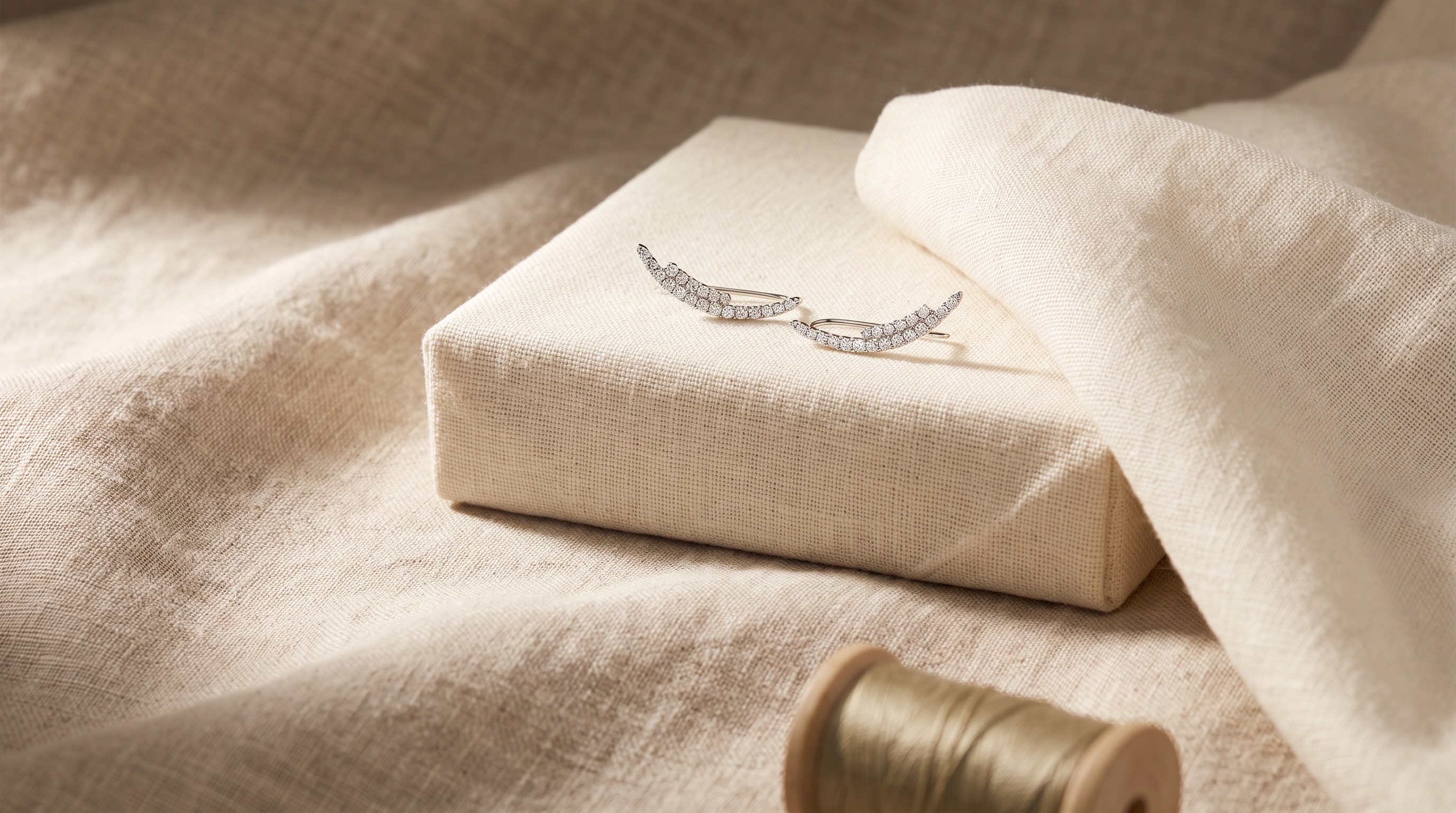
A diamond climber earring — also called an ear climber or ear crawler — is a style that follows the curve of the earlobe and ear upward rather than hanging straight down, typically set with a graduated line of diamonds that increases in size from the earlobe toward the top of the ear. For a jeweler or manufacturer, sourcing for a climber line is closer to sourcing for a graduated tennis bracelet than a standard stud: the design depends on a consistent size progression across several stones per earring, rather than any single stone's specifications, and the mounting itself has to hold that curved line securely against the natural pull of gravity along the ear.
This guide is written for the trade — retailers, designers, and manufacturers sourcing loose diamonds and diamond melee to build or expand a climber earring line, not a consumer shopping guide. It covers what makes climber sourcing distinct from other earring styles, graduation and stone-count planning, setting styles used on a curved mount, matched-pair consistency requirements, and what to look for in a wholesale diamond supplier for this category.
What Makes a Climber Earring Different From a Standard Stud or Drop
A standard stud earring is built around one stone, and a standard drop earring typically adds one or two accent stones above a hanging element. A climber earring instead runs a continuous or near-continuous line of graduated stones along a curved mount that traces the ear's natural shape from lobe to helix, meaning the design lives or dies on how well that whole line reads as one coherent piece rather than a set of individual stones. That shifts the sourcing question away from "how good is this one stone" and toward "how consistently can this whole graduated set be matched and how securely can it be mounted on a curved frame," which is a meaningfully different set of supplier questions than sourcing a single center stone.
Climbers are also almost always sold and worn as a fixed pair rather than styled as mismatched singles, which puts real pressure on left-right symmetry: not just matching color and clarity across the graduation within one earring, but matching the graduation curve and stone sizing between the two earrings in the pair closely enough that they read as a mirrored set once worn.
Stone Count and Graduation Planning
| Climber Length | Typical Stone Count (per earring) | Common Size Progression |
|---|---|---|
| Short climber (lobe only, ~1cm) | 3–5 stones | Roughly 1.5mm to 2.5mm graduated |
| Mid-length climber (partial ear curve) | 5–8 stones | Roughly 1.3mm to 3mm graduated |
| Full climber (lobe to upper ear) | 8–14 stones | Roughly 1.2mm to 3.5mm graduated |
These ranges are a planning baseline, not a fixed rule — the actual stone count and graduation curve a manufacturer chooses depends on the specific mount design and target price point. What matters more than any single number is that the graduation reads as smooth rather than stepped: a jump in size between adjacent stones that's too large breaks the visual line the whole design depends on, so most manufacturers plan graduation in small, consistent size increments across the full stone count rather than a few widely spaced size tiers.
Diamond Quality Standards for Climber Earrings
Because a climber earring displays a full line of stones close together and close to the eye — unlike a necklace or bracelet viewed from a greater distance — color and clarity consistency across the graduation matters more than it might for a longer line-set piece. A DEF+/VS+ commercial baseline (near-colorless to colorless, very slightly included or better) is a common standard for climber melee, giving a clean, bright look across the whole line without pricing the piece at fully certified-inventory cost. As with most melee-based pieces, individual stones below roughly 0.18ct in a climber design are not individually or parcel-certified — they're sourced and graded as a consistent commercial-quality lot rather than stone by stone. A larger anchor stone at the base of a climber design, closer to the lobe, can be certified individually at 0.30ct and above if the design calls for one.
Setting Styles Used on Curved Climber Mounts
Prong (Shared-Prong) Setting
Adjacent stones along the climber's curve share prongs, similar to how a tennis bracelet or necklace is constructed, maximizing light entry into each stone. On a climber specifically, prong settings also need to accommodate the curve of the mount itself, which requires more precise prong placement than a straight line does.
Bezel or Half-Bezel Setting
A metal rim, full or partial, surrounds each stone along the curve, offering more physical protection — a relevant consideration for a piece worn along the upper ear, where it's more exposed to catching on hair and clothing than a lobe-only stud. Bezel-set climbers also tend to read as more modern and architectural than a prong-set version of the same graduation.
Channel Setting
Stones sit between two parallel rails with no visible prongs, giving a smooth, low-profile curve. Channel-set climbers require tighter manufacturing tolerances to keep the graduated line properly aligned along a curved (rather than straight) mount, which is a meaningfully harder fabrication problem than a straight channel-set line.
Mount Construction: Why the Frame Matters as Much as the Stones
Unlike a stud, which is held by a single post and butterfly back, a climber's curved frame has to support the weight of a full line of stones along an unsupported arc that follows the ear rather than sitting flush against it. A poorly engineered climber mount can feel front-heavy or shift out of position through a day of wear, which is a common complaint on lower-quality climber production. Manufacturers sourcing climber mounts — whether casting in-house or ordering pre-fabricated frames — should confirm the frame gauge (metal thickness) is sufficient to hold the intended stone line rigid without excessive flex, since a frame that's too thin to save on metal cost is one of the more common corners cut in budget climber production.
Matched-Pair Sourcing: The Central Requirement for Climbers
- Is the graduated set sold as a matched lot, pre-sorted by size for a specific graduation curve, or does the buyer need to sort loose melee into a graduation themselves? A supplier who pre-sorts graduated lots for line-set jewelry saves meaningful production time versus sorting from mixed inventory.
- Can the left and right earring's graduations be matched to each other, not just internally consistent within one earring? This is the detail that most differentiates a well-sourced climber pair from a merely acceptable one.
- What's the size tolerance across the graduation steps? A tight, consistent step size between adjacent stones is what makes the line read as smooth rather than visibly stepped.
- Can physical samples of a graduated lot be reviewed before a full production order? For a first order with a new supplier, this is standard practice rather than an unusual request.
Lab-Grown vs. Natural Diamonds for Climber Production
Because a climber earring's total cost scales with the combined weight of several graduated stones per earring — multiplied by two for a pair — the natural-versus-lab-grown decision affects total piece cost more than it would for a single-stone stud. CVD lab-grown diamonds let a manufacturer offer a larger total graduation, or a higher-color/higher-clarity commercial standard across the full line, at a lower total cost than natural material of comparable specifications. Both origins can meet the same DEF+/VS+ commercial baseline described above and look identical once mounted; the choice is primarily a pricing and positioning decision for the retailer rather than a difference in finished appearance.
Metal Choices for Climber Frames
14k and 18k white gold and yellow gold are the most common metal choices for climber frames, with platinum used less often for this specific style given its added weight along an already gravity-challenged curved mount — a heavier metal makes it harder for the frame to sit securely against the ear over a full day of wear. Yellow and rose gold climbers have grown in popularity as a warmer alternative to the traditionally white-metal-dominated climber category, and metal choice should be confirmed with a setting partner before finalizing stone graduation, since some setters adjust prong or bezel dimensions slightly by metal to account for differences in malleability and finished durability.
Common Production Defects to Screen For
Because a climber mount involves multiple individual setting operations along a curved, load-bearing frame, a few defects show up more often in this category than in simpler earring styles: visible gaps in the graduation sequence where a stone reads noticeably smaller or larger than its neighbors, prongs or bezels that catch on hair or clothing due to insufficient finishing along the curve, and frame flex that lets the piece shift position during wear. Requesting a physical sample under magnification — and actually wearing a sample pair briefly to check how it sits and holds position — is a more meaningful quality check for climbers than for most other earring styles, given how much the finished feel depends on frame engineering rather than the stones alone.
Wholesale Pricing Structure for Climber Earrings
Climber earring diamonds are typically quoted per total carat weight across the full graduated set (both earrings combined), at a specified commercial quality standard, rather than per individual stone — similar to how a tennis necklace or bracelet is priced. Buyers ordering climber melee at production volume should expect per-carat pricing to improve with order size and with a looser graduation-matching tolerance, since a tighter matching requirement across the full pair requires more selective sorting from a supplier's available stock.
Building a Climber Line at Different Price Tiers
A retailer entering the climber category at an accessible price point typically sources shorter climbers (3–5 stones per earring) in a standard DEF+/VS+ commercial grade, prioritizing an approachable price over an extended graduation. A retailer positioning climbers as a premium statement piece typically extends the graduation to a full lobe-to-upper-ear line, tightens the color and clarity standard, and may add a bezel or half-bezel construction for a more architectural, elevated look. Both approaches are valid product strategies within the same broad category — the sourcing decisions simply scale with the price tier being targeted, and a manufacturer should be clear with their supplier about which tier they're building for before requesting quotes, since stone count, matching tolerance, and quality grade all move together.
Climber Earrings vs. Ear Cuffs and Standard Drops: Sourcing Differences
Climbers, ear cuffs, and drop earrings all occupy adjacent space in a retailer's "beyond the basic stud" earring assortment, but they pull on different sourcing skills. A drop earring's sourcing challenge is mostly about the single accent or dangle stone's cut and proportion, since the design typically doesn't depend on matching more than one or two stones per earring. An ear cuff — a piece that clips or wraps around the upper ear without piercing — usually carries fewer stones set into a rigid decorative frame, so its sourcing challenge leans toward frame fabrication and fit rather than stone-matching depth. A climber sits between the two in stone count but exceeds both in matching complexity, since it's the only one of the three built around a full graduated sequence that has to read as continuous. A manufacturer already sourcing successfully for a tennis bracelet or graduated pendant line has the closest existing skill set to apply directly to climbers, more so than a manufacturer whose experience is mostly in single-stone stud or drop production.
This distinction matters for how a retailer plans a broader earring assortment: climbers are worth introducing specifically to fill the gap between simple stud/drop styles and full statement pieces, rather than being treated as a like-for-like substitute for either. Retailers building out an earring wall that spans studs, drops, cuffs, and climbers should expect climber sourcing and matching to take meaningfully longer lead time per unit than the other three styles, given the graduation-matching requirement, and should plan initial production runs accordingly rather than assuming uniform lead times across the whole assortment.
What's Driving Climber Earring Demand
Climber earrings have grown alongside the broader shift toward curated, multi-piece ear styling — often described in retail as an "ear stack" or "curated ear" look, where a single ear carries several different earring styles at different piercings simultaneously rather than one matched pair per ear alone. A climber's shape makes it particularly well suited to this trend, since it visually anchors an upper-lobe or helix piercing with a design that reads as intentional and finished on its own, rather than needing to be paired with additional pieces to look complete. That's a meaningfully different demand driver than, say, a classic stud, which sells largely on its own stand-alone merits rather than as part of a styling system, and it's worth a retailer's marketing and merchandising teams keeping in mind when positioning a climber line — displaying it as part of a suggested ear-stacking combination alongside huggies or simple studs tends to perform better than displaying it in isolation.
This trend has also pushed demand toward climbers designed to sit comfortably alongside other simultaneously worn pieces, which has a practical sourcing implication: manufacturers should confirm that a climber's frame profile doesn't create pressure points or overlap conflicts with an adjacent piercing's jewelry when worn together, a fit consideration that's easy to overlook when a climber is designed and reviewed as a stand-alone piece rather than as part of a multi-piercing styling scenario.
Packaging and Presentation for a Climber Line
Because climbers are a less immediately familiar shape to many buyers than a stud or a simple drop, point-of-sale presentation carries more weight for this category than for more universally understood earring styles. Retailers commonly find that a climber displayed flat on a standard earring card — the way a stud or a small drop earring is typically packaged — doesn't communicate how the piece actually sits on the ear once worn, since the curved silhouette isn't obvious from a flat, unworn presentation. A three-dimensional ear-shaped display form, or clear before/after product photography showing the piece worn, meaningfully improves a buyer's ability to understand the style before purchase, and retailers introducing climbers to a case for the first time should budget for this presentation difference rather than assuming standard stud packaging and photography will translate directly.
Sourcing Climber Earring Diamonds Wholesale
Guru Diam supplies calibrated diamond melee sorted for graduated, line-set jewelry, alongside larger certified loose stones, across natural and CVD lab-grown material and across the color and clarity ranges used in commercial climber-earring production. Melee is available pre-sorted for matched, graduated lots rather than mixed parcel stock, which is specifically what a climber design needs from a supplier to keep both the internal graduation and the left-right pair consistent. In-stock inventory ships same-day from Guru Diam's New York and Los Angeles locations, and trade accounts can review current melee stock in the matching pairs category, browse larger certified anchor stones in certified diamonds, or check fancy color options for a colored climber line in fancy color loose diamonds. Manufacturers building a custom climber design can start at custom jewelry, and new trade accounts can apply through trade partner, with current terms available at the wholesale hub. For related sourcing guidance on other graduated, line-set jewelry categories, see our diamond tennis necklace sourcing guide.
Frequently Asked Questions
What is a diamond climber earring?
A diamond climber (or ear climber/ear crawler) earring is a style that follows the curve of the earlobe and ear upward, typically set with a graduated line of diamonds that increases in size from the lobe toward the top of the ear, rather than hanging straight down like a standard drop earring.
How many diamonds are in a typical climber earring?
It varies by length and design, but a short lobe-only climber commonly uses 3–5 stones per earring, a mid-length climber 5–8 stones, and a full lobe-to-upper-ear climber 8–14 stones. Sourcing and pricing are generally planned around total carat weight across the graduated set rather than stone count alone.
Are climber earring diamonds individually certified?
Individual melee-sized stones (typically below roughly 0.18ct) used in the graduation are not individually certified — they're sourced as a consistent, graded commercial lot. A larger anchor stone near the base of the design can be certified individually at 0.30ct and above if the design calls for one.
What setting style works best for climber earrings?
Shared-prong settings maximize brilliance and are the most common choice; bezel or half-bezel settings offer more physical protection along the more exposed upper-ear portion of the curve; channel settings give a smooth, low-profile line but require tighter manufacturing tolerances on a curved mount. The right choice depends on the target price point and design direction.
Should climber earrings use natural or lab-grown diamonds?
Either can meet the same commercial quality standard and look identical once mounted. Because a climber's cost scales with the combined weight of several graduated stones across a pair, CVD lab-grown diamonds let a manufacturer offer a longer graduation or a higher quality standard at a lower total cost, which is why lab-grown material is common in this category.
Why do climber earrings need matched pairs specifically?
Climbers are worn and sold as a fixed pair, and any mismatch in graduation curve, stone size, or quality between the left and right earring is far more visible in a worn pair than in a single earring viewed alone, which makes left-right matching a central sourcing requirement for this category specifically.
What causes a climber earring to feel unstable or shift during wear?
This is usually a mount engineering issue rather than a stone issue — a frame that's too thin or lightweight to hold the full stone line rigid along the curved, unsupported arc of the design can flex or shift position through a day of wear. Confirming adequate frame gauge with a setting partner before production helps avoid this defect.
Guru Diam is a trade-only wholesale diamond supplier with locations in New York and Los Angeles, supplying calibrated diamond melee sorted for graduated, matched-pair jewelry alongside certified loose stones — natural and CVD lab-grown — for jewelers and manufacturers producing climber earrings and other line-set pieces. Browse current melee inventory in matching pairs or apply for a trade account through trade partner.