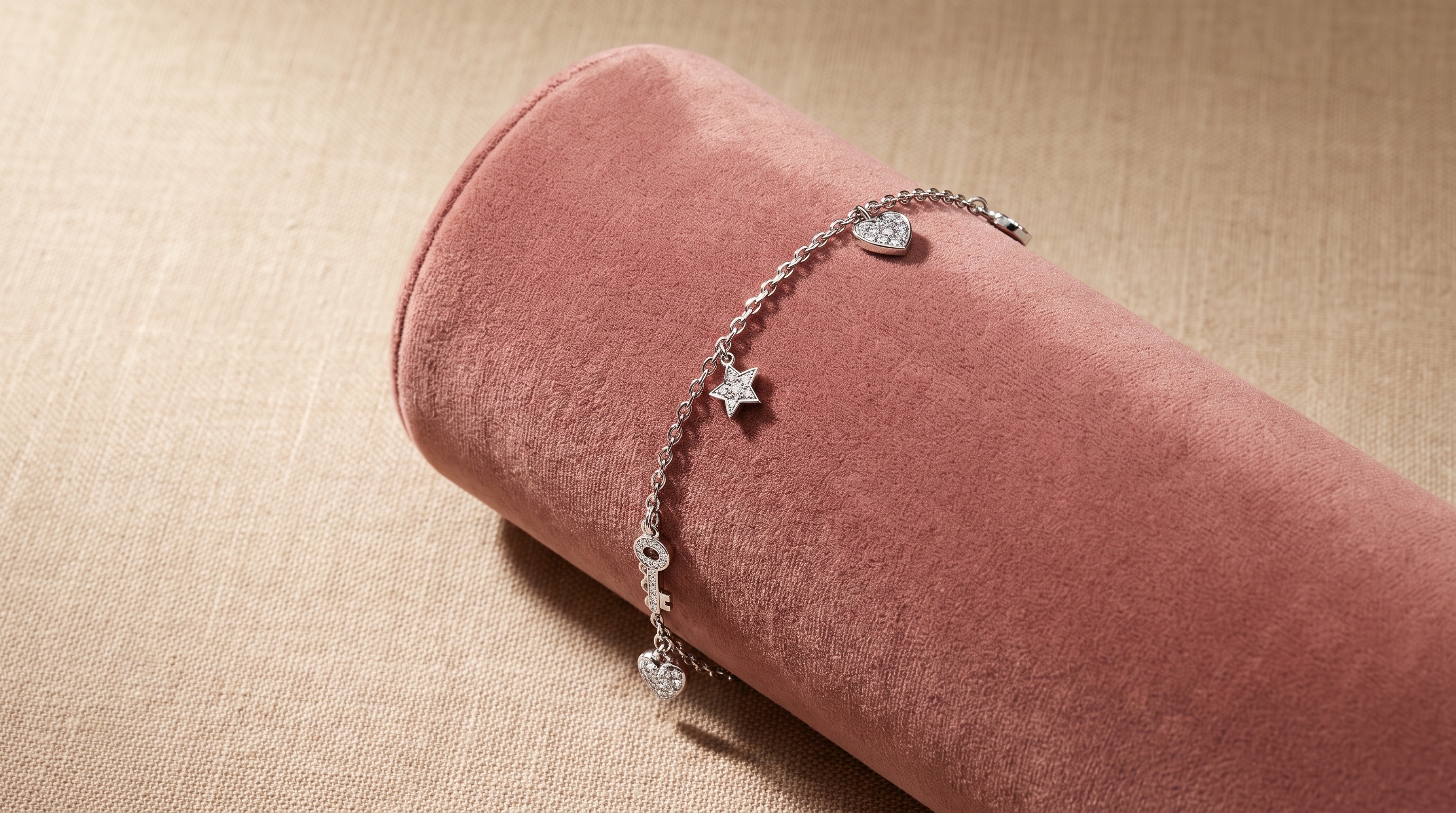
A diamond charm bracelet is a chain-based bracelet designed to carry one or more removable or fixed decorative charms, at least some of which are diamond-set, rather than presenting a single continuous line of stones the way a tennis bracelet does. For a jeweler sourcing this category, the base chain and the charms are effectively two separate sourcing decisions that come together into one finished piece — a structural difference that shapes everything from pricing to inventory planning.
This guide is written for the trade — retailers, jewelers, and designers building or expanding a charm bracelet line, not a consumer buying guide. It covers base chain types, charm attachment methods, diamond setting styles used on charms, how the category compares to other diamond bracelet formats, wholesale pricing structure, and what to watch for when sourcing this product line at scale.
What Separates a Charm Bracelet From Other Diamond Bracelet Formats
Unlike a tennis bracelet, bangle, or link bracelet — each built as one continuous, uniform design — a charm bracelet is inherently modular. The base chain functions as a platform, and charms are added, removed, or swapped over time, often accumulating individually rather than being purchased as a complete finished piece in one transaction. This modularity is the category's core commercial logic: it supports repeat purchases from the same customer over months or years, as new charms are added for birthdays, milestones, or gifts, in a way a single fixed-design bracelet doesn't.
Base Chain Types
| Chain Type | Link Structure | Best Fit for Charm Attachment |
|---|---|---|
| Curb chain | Flattened, interlocking oval links | Sturdy and widely used; charms typically attach via jump ring at any link |
| Cable chain | Uniform round or oval links | A classic, simple base that lets charms hang evenly and rotate freely |
| Belcher/rolo chain | Rounded, uniform links, slightly heavier gauge | Popular for permanent and semi-permanent charm bracelets due to link strength |
| Box chain | Square, boxy links forming a smooth, rigid line | Less common for charm attachment; used more for minimalist single-charm designs |
| Chain-link with fixed diamond stations | Diamonds set directly into select links, charms added between them | A hybrid design combining a diamond-set base with removable charm capacity |
Curb and belcher chains dominate the category because their link structure gives a charm an obvious, secure attachment point without needing a specialized fitting — a meaningful production-cost consideration when a bracelet is expected to accept charms added well after the original sale.
Charm Attachment Methods
- Jump ring attachment. The most common and lowest-cost method — a small soldered or open-and-close metal ring links the charm to a chain link. It allows charms to be added or removed relatively easily, which supports the category's repeat-purchase model but also means a poorly soldered jump ring is a real loss risk.
- Lobster clasp charms. Each charm carries its own small lobster clasp, letting a customer attach and detach charms without tools — the most consumer-friendly method, at a modest added cost per charm for the clasp hardware itself.
- Screw-on or threaded attachment. Used on some higher-end designs, a threaded post secures the charm more permanently than a jump ring while still technically allowing removal — a middle ground between permanence and flexibility.
- Permanent/welded attachment. A growing trend, particularly in the "permanent jewelry" retail experience, where a charm or the entire bracelet is welded closed on the customer's wrist at time of sale, with no clasp at all. This creates a distinct in-store service model (and a distinct wholesale sourcing need for pre-cut, weld-ready chain lengths) compared to a traditional clasped bracelet sold off a display case.
Diamond Setting Styles on Charms
Diamonds appear on charm bracelets in a narrower set of setting styles than on other jewelry categories, largely because charm pieces tend to be small and need to withstand more incidental handling than a fixed setting does:
Bezel-Set Charms
A full or partial metal rim surrounds the diamond, protecting the girdle from the kind of incidental knocks a charm takes as it swings and moves against a wrist. Bezel setting is the most common approach for individual diamond charms specifically because of this added protection, and it gives designs a cleaner, more graphic silhouette than a pronged charm.
Pavé-Set Charms
Small calibrated melee set closely together across a charm's surface — common on letter, symbol, and shape charms where the diamonds are meant to read as texture or sparkle across the whole form rather than as a single focal stone.
Prong-Set Focal Stones
Used less frequently than bezel or pavé on charms specifically, given the added snag and chip risk prongs carry on a piece that moves freely, but still seen on higher-end charm designs built around a single larger center stone as the charm's primary feature.
Personalization and Milestone Charms
A significant share of charm bracelet demand is driven by personalization — initial charms, birthstone charms (frequently paired with a small diamond accent), and milestone charms marking a birth, graduation, anniversary, or other life event. This personalization angle is what most differentiates charm bracelets commercially from other diamond bracelet formats: a retailer selling initial or birthstone charms is effectively selling an ongoing collecting relationship with a customer, not a single transaction, and benefits from stocking a broad enough charm range (letters, common birthstone months, a handful of milestone symbols) to support repeat visits as customers build out a bracelet over time. See our diamond birthstone jewelry guide for more on sourcing birthstone-specific inventory.
Charm Bracelets vs. Bangles and Tennis Bracelets: Sourcing Comparison
| Factor | Charm Bracelet | Tennis Bracelet | Bangle |
|---|---|---|---|
| Design model | Modular — base chain plus individually added charms | Fixed, continuous diamond line | Fixed, rigid or hinged frame |
| Repeat-purchase potential | High — customers return to add charms over time | Low — typically a single complete purchase | Low — typically a single complete purchase |
| Sizing after production | Adjustable via chain length and charm count | Adjustable by adding/removing links | Not adjustable — must be made or stocked to size |
| Diamond content per piece | Varies widely — from a single small accent to many charms | Uniform, continuous stone line around the full length | Varies by construction, but fixed at time of sale |
As covered in our diamond bangle bracelet guide, bangles and tennis bracelets are both sold as complete, finished pieces. Charm bracelets are the outlier in this comparison specifically because the business model depends on an ongoing relationship rather than a single sale — a distinction that should shape how a retailer merchandises and staffs this category, not just how it sources the diamonds themselves.
Diamond Quality Standards for Charm Work
Given the small stone sizes typical across most charm designs, a DEF+/VS+ calibrated melee standard — consistent with the melee quality baseline used across most of Guru Diam's calibrated categories — delivers bright, clean results appropriate to the scale of most charm pieces. For a larger focal-stone charm using a certified loose diamond at 0.30ct or above, standard certification practices apply the same way they would to any other certified center stone.
Lab-Grown Diamonds for Charm Bracelet Production
Because charm bracelets are frequently purchased incrementally and at a range of price points — a single small charm as a modest gift, a larger diamond-pavé charm as a bigger occasion purchase — CVD lab-grown diamonds give retailers meaningful pricing flexibility across that range without compromising on brightness or consistency at the calibrated-melee scale most charms are built around. This flexibility matters more in this category than in a single fixed-price bracelet format, since a charm bracelet program's success depends on offering charms across multiple price tiers that a customer can realistically add to over time.
Wholesale Pricing Structure for This Category
Charm bracelet sourcing differs from most other bracelet categories in that pricing has to be planned at two levels: the base chain (priced by metal weight, chain type, and length) and each individual charm (priced by charm size, diamond content, and attachment hardware). Retailers should request pricing broken out this way from a supplier rather than a single blended per-bracelet quote, since it lets a retail program price a starter chain affordably while pricing individual charms — the actual repeat-purchase revenue driver — as a distinct, ongoing product line.
Common Sourcing and Production Mistakes in This Category
- Underspecifying jump ring quality. A poorly soldered or thin-gauge jump ring is the single most common point of charm loss — retailers should confirm jump ring gauge and soldering standard explicitly with a supplier rather than treating it as an incidental hardware detail.
- Launching with too narrow a charm range. Because the category's value depends on repeat purchases, a retailer launching with only a handful of charm designs limits the collecting behavior that drives return visits. A broader initial range — even at modest per-charm diamond content — supports the model better than a small assortment of higher-content charms.
- Not planning for permanent-jewelry service capability. Retailers entering the growing welded/permanent bracelet trend need pre-cut, weld-appropriate chain stock and staff training for the welding service itself — a distinct sourcing and operational need from a traditional clasped charm bracelet program.
- Treating charm attachment hardware as interchangeable with the diamond setting quality standard. A beautifully set charm with a weak jump ring or clasp is still a functional failure waiting to happen — hardware quality control deserves the same attention as stone setting quality control in this category specifically.
Building a Modular Charm Collection Strategically
Retailers building out a charm bracelet program benefit from sequencing the collection deliberately, similar to the sequencing logic covered for stackable rings and bangles in our related guides. A practical approach starts with a small number of proven base chain options (typically one or two chain types in the most common lengths) alongside a moderate initial charm range covering the most universally requested categories — initials, common birthstone months, and one or two milestone symbols — then expands the charm range based on which categories sell through fastest. This avoids overcommitting inventory to charm designs that may not resonate with a given customer base before real sell-through data is available.
Seasonal Demand Patterns
Charm bracelet demand follows a distinct seasonal rhythm compared to most other diamond jewelry categories, driven heavily by gifting occasions tied to personalization: Mother's Day and graduation season both see strong demand for milestone and initial charms specifically, while the winter holiday season drives demand across the category broadly, both for starter bracelets purchased as a first gift and for individual charms added to an existing bracelet as a smaller, budget-friendly gift option. Retailers should plan charm inventory depth around these peaks specifically, since a stockout on a popular initial letter or birthstone charm during graduation or holiday season represents a lost sale in a way that's harder to recover than a similar stockout in a less seasonally concentrated category.
Charm Bracelet Materials Beyond Diamonds and Gold
Not every charm on a bracelet needs to carry a diamond, and a well-planned collection typically mixes diamond-set charms with plain metal or gemstone charms at a range of price points. Sterling silver and gold-vermeil (silver plated with a heavier gold layer than standard gold-filled work) options give retailers an accessible entry price point for a starter bracelet, while 14k and 18k gold charms — diamond-set or plain — serve the higher end of the same collection. Structuring a charm range this way lets a single bracelet program serve customers across a wide budget spectrum without diluting the diamond-specific merchandising that drives the category's higher-margin sales.
Compatibility With Existing Bracelet Systems
Some charm bracelet systems in the broader market use proprietary threading or clip mechanisms specific to one brand's chain, meaning charms from one system generally don't fit another brand's bracelet. Retailers building an independent charm bracelet program should decide deliberately whether to use a universal, standard jump-ring-compatible system (which maximizes flexibility and lets customers mix charms from multiple sourcing channels) or a more proprietary attachment design, and should be clear with customers about which approach a given bracelet uses, since compatibility expectations are a common source of customer confusion in this category specifically.
Merchandising and Display Considerations for Charms
Because individual charms are small, low-cost relative to a complete bracelet, and often purchased on impulse or as an add-on to a larger sale, in-store and online merchandising matters more in this category than in most other diamond jewelry lines. Physical retailers benefit from a dedicated charm display that groups options by category (initials, birthstones, milestones) rather than scattering them across a general case, making it easy for a customer already wearing a starter bracelet to quickly find and add a relevant new charm. Online, detailed photography showing scale relative to a worn bracelet — since charm size is hard to judge from a product photo alone — meaningfully reduces the returns and sizing confusion that can otherwise affect this category.
Quality Control Considerations Specific to Charm Bracelets
Because charm bracelets see more physical handling and movement than a fixed-design piece — charms swing, catch on clothing, and get added and removed over the bracelet's life — quality control should specifically test attachment point durability, not just diamond setting security. A supplier's standard QC process for this category should include checking jump ring closure integrity and clasp function under normal handling stress, in addition to standard diamond-setting inspection.
Warranty and Repair Policies for a Charm Program
Because charm bracelets accumulate value over multiple purchases and are worn and handled more actively than a single fixed-design piece, a clear warranty and repair policy specific to this category is worth establishing upfront rather than applying a generic jewelry warranty. Retailers should decide in advance how they'll handle a lost charm (whether due to a failed jump ring or clasp), whether repair or replacement of attachment hardware is covered under warranty, and how that policy is communicated to customers at the time of the original purchase — since a customer who loses a sentimental milestone charm due to a hardware failure is a meaningfully different service situation than a standard jewelry repair request, and is worth planning for explicitly rather than handling reactively the first time it happens.
Sourcing Diamond Charm Bracelets at Wholesale
Guru Diam supplies certified CVD lab-grown diamonds and calibrated melee suited to charm bracelet production, from bezel-set individual accent charms to fuller pavé designs, with cutting, setting, and polishing handled in-house and finished custom pieces delivered in 4-6 days. Retailers can source calibrated melee and matched charm sets through matching pairs, review certified focal stones for larger charm designs through certified diamonds, and work through custom jewelry for a multi-charm program's design and hardware planning. Trade accounts can review terms at the wholesale hub or apply through trade partner. For related bracelet sourcing, see our guides on diamond bangle bracelets and diamond tennis necklaces.
Gifting Occasions and How to Merchandise Around Them
Because charm bracelets are so closely tied to specific life events and gifting occasions, retailers benefit from organizing at least part of their merchandising calendar around the category's natural gifting cycle rather than treating it as a year-round, undifferentiated product line. A dedicated graduation-season push featuring milestone and initial charms, a Mother's Day assortment emphasizing birthstone and family-themed charms, and a holiday-season starter-bracelet promotion each target a distinct purchase motivation, and framing the category this way in marketing and in-store signage tends to perform better than a generic "charm bracelets available" display that doesn't speak to any specific occasion a shopper has in mind.
Frequently Asked Questions
What makes a diamond charm bracelet different from a tennis bracelet?
A charm bracelet is modular — a base chain designed to carry removable or added charms over time — while a tennis bracelet is a single, fixed continuous line of diamonds sold as one complete piece. Charm bracelets support ongoing, repeat charm purchases in a way tennis bracelets don't.
How are charms attached to the chain?
Most commonly via a jump ring, a small metal ring soldered or closed onto a chain link. Other methods include lobster clasps on individual charms for easy self-attachment, threaded/screw-on posts, and permanent welded attachment used in the growing "permanent jewelry" retail model.
What diamond setting style is most common on charms?
Bezel setting is the most common for individual diamond charms, since the surrounding metal rim protects the stone's girdle from the incidental knocks a charm takes as it moves. Pavé setting is common on letter, symbol, and shape charms where diamonds are meant to read as texture across the whole piece.
Why do charm bracelets support repeat purchases better than other bracelet formats?
Because the design is inherently modular — a customer can add a new charm for a birthday, milestone, or gift occasion without replacing the bracelet itself, unlike a fixed-design tennis bracelet or bangle that's typically purchased as one complete piece.
Should charm bracelets use lab-grown or natural diamonds?
CVD lab-grown diamonds give retailers pricing flexibility to offer charms across a wide range of price points — important in this category since customers add charms incrementally over time at varying budgets — without compromising brightness at the calibrated-melee scale most charms use.
What is "permanent jewelry" and how does it affect charm bracelet sourcing?
Permanent jewelry is a retail service where a chain or charm is welded directly onto a customer's wrist with no clasp. It requires pre-cut, weld-ready chain stock and in-store welding capability — a distinct sourcing and operational consideration from a traditional clasped charm bracelet.
What's the most common failure point on a charm bracelet?
A poorly soldered or thin-gauge jump ring is the most common cause of charm loss. Retailers should confirm jump ring quality and soldering standard explicitly with their supplier rather than treating attachment hardware as an incidental detail.
How should a retailer plan initial charm bracelet inventory?
Start with one or two proven base chain types in common lengths, paired with a broad-but-modest initial charm range covering initials, common birthstone months, and a couple of milestone symbols, then expand based on which charm categories sell through fastest.
Do charm bracelets need diamonds on every charm to sell well?
No — a well-planned collection typically mixes diamond-set charms with plain metal or gemstone charms across a range of price points, which lets the same bracelet program serve customers across a wider budget spectrum while still highlighting diamond-set pieces as the higher-margin, more premium option within the range.