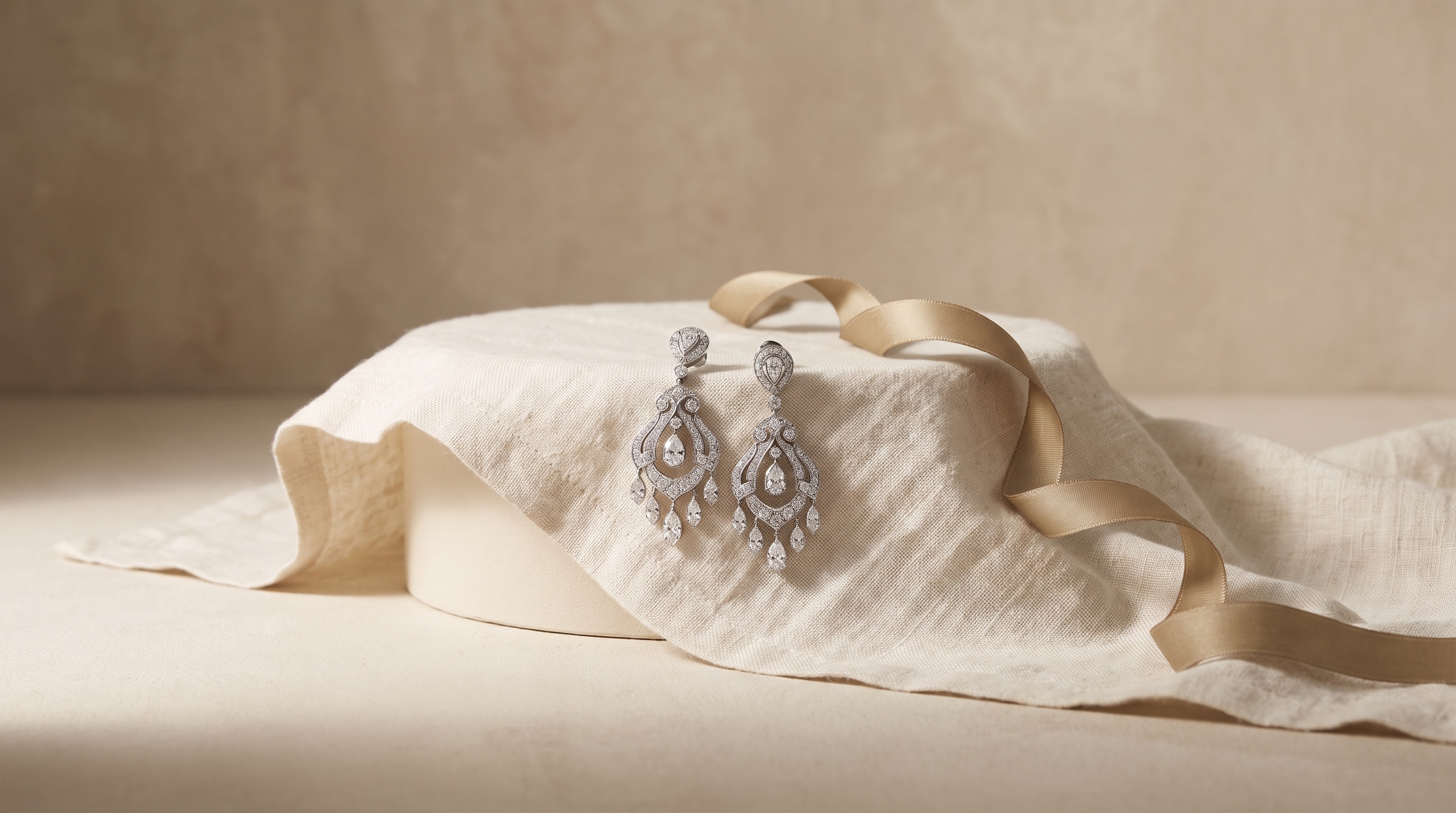
Diamond chandelier earrings are a multi-tiered earring style with several cascading rows or clusters of diamonds extending well below the earlobe, distinguished from a simpler drop earring by their layered, branching construction. For a jeweler, chandelier earrings represent the most structurally and sourcing-complex earring category to build well, requiring coordination across multiple stone sizes, tiers, and weight-balance points in a single piece.
This guide is written for the trade — retailers, designers, and manufacturers sourcing diamonds to build or expand a chandelier earring line — not a consumer buying guide. It covers tiered construction types, stone and melee sourcing by tier, weight and comfort considerations, and what to evaluate in a wholesale supplier for this category.
What Distinguishes Chandelier Earrings, Sourcing-Wise
Chandelier earrings differ from drop or dangle earrings primarily in structural complexity: rather than one hanging element, a chandelier design typically layers two or more tiers of stones at different lengths, often widening or branching as it descends. This multi-tier structure means a single earring can require several distinct stone specifications — a larger feature stone or cluster at the base, medium stones in a middle tier, and smaller melee connecting the structure together — all of which need to be sourced, matched, and set with consistent quality across the full piece rather than concentrated in one focal point.
| Factor | Drop Earrings | Chandelier Earrings |
|---|---|---|
| Structure | Single hanging element | Multiple cascading tiers, often branching |
| Stone specifications per earring | Typically 1-3 | Often 4 or more across tiers |
| Weight/comfort engineering | Moderate consideration | Critical — total weight distribution across a larger structure |
| Matched-pair complexity | Match two earrings | Match two earrings AND match tiers within each earring |
Common Chandelier Earring Constructions
Graduated Tier Chandelier
Stone size decreases from top to bottom (or, less commonly, increases toward a larger feature stone at the base), creating a visually structured taper. This is the most classic chandelier format and the one most dependent on precise size grading across the melee used at each tier.
Branching Fringe Chandelier
Multiple strands of melee fan out from a central point, creating a fringe-like curtain effect rather than a single vertical line. This construction uses the highest total stone count of the common chandelier formats and depends heavily on melee consistency across a large parcel.
Cluster-and-Drop Chandelier
A cluster element at the top transitions into one or more solitaire or small-cluster drops at the bottom, combining cluster-necklace-style density with drop-earring-style focal stones in one piece.
Sourcing by Tier: A Layered Specification Problem
Because chandelier earrings combine multiple stone roles in a single piece, sourcing needs to be planned tier by tier rather than as one undifferentiated stone order. The top tier, closest to the ear and most visible at rest, often benefits from slightly higher color and clarity grading since it's viewed at closer range; lower tiers, seen more in motion and from a greater distance, can commonly use a more commercial grade without a visible quality difference to the eye. Retailers who source a single uniform grade across all tiers are often either overpaying for grade quality that won't be noticed in the lower tiers, or underdelivering on the top tier where quality is most visible — tier-differentiated sourcing gets the balance right without inflating total cost.
Weight and Comfort: The Defining Engineering Challenge
Chandelier earrings carry meaningfully more total stone and metal weight than drop or stud styles, making comfortable, secure wear a genuine engineering consideration rather than an afterthought. Poorly balanced chandelier earrings pull uncomfortably on the earlobe or tilt forward rather than hanging straight, both common complaints that drive returns in this category. Retailers sourcing for chandelier lines should prioritize suppliers and setters who account for weight distribution during design — often achieved by using progressively lighter, smaller stones toward the bottom tiers and reinforced findings at the ear — rather than treating a chandelier design purely as a scaled-up drop earring.
Diamond Shape Choices Across Tiers
Round brilliant melee remains the dominant choice across most tiers for its consistent light performance at small sizes and ease of matching within a large parcel. Marquise and pear-shaped melee appear frequently in the lower, more visible tiers of graduated designs, since their elongated silhouette reinforces the cascading visual direction the style is built around. Baguette-cut stones appear in more architectural, Art-Deco-influenced chandelier designs, used as structural connecting elements between tiers rather than as the primary visual feature.
Matched-Pair Complexity in Chandelier Design
Matching a chandelier pair is meaningfully more complex than matching a simple stud or drop pair, since both the overall pair and the internal tier-to-tier proportions within each individual earring need to align. Two chandelier earrings can match acceptably at the top tier while diverging in a lower tier's stone count or size, an inconsistency that's often more visible in a multi-tier piece than a simple size mismatch would be in a single-stone drop earring. Buyers should confirm a supplier matches chandelier pairs holistically, tier by tier, rather than only comparing the two earrings' total weight or overall length.
Wholesale Price Positioning by Construction Type
| Construction | Relative Price Position | Key Cost Driver |
|---|---|---|
| Graduated tier | Mid to high | Melee grading consistency across tiers |
| Branching fringe | High | Total stone count, setting labor complexity |
| Cluster-and-drop | High | Combined cluster melee plus feature stone grade |
Lab-Grown vs. Natural Diamonds for Chandelier Programs
Because chandelier earrings require a high total stone count relative to other earring styles, CVD lab-grown diamonds have become the practical default for most chandelier lines, letting a retailer offer a visually substantial, high-stone-count piece at a price point that would be difficult to hit with an equivalent natural-stone specification. Natural diamonds remain viable for premium chandelier lines, typically executed with a lower total stone count and larger feature stones per tier rather than matching a lab-grown design's full stone density at natural pricing.
Findings and Ear-Support Hardware
Given the total weight involved, chandelier earrings depend more heavily on quality ear-wire or post-and-butterfly hardware than lighter earring styles — a standard-gauge post designed for stud earrings is often inadequate to comfortably and securely support a full chandelier structure over a full day of wear. Retailers building this category should source findings rated for the actual finished weight of the piece, and consider offering a screw-back or lever-back option specifically for heavier chandelier designs to reduce the risk of an earring shifting or falling out during wear.
Retail Merchandising for Chandelier Earrings
Chandelier earrings photograph and sell best shown in motion or on a model, since a flat product shot compresses the tiered depth that defines the style and can make a piece look flatter and less dimensional than it appears when worn. Retailers should also merchandise chandelier pieces with clear total-length and approximate-weight information, since buyers new to the category may not intuitively understand how much larger and heavier a chandelier earring is compared to the drop or stud styles they're more familiar with.
Common Sourcing Mistakes in Chandelier Earring Programs
The most frequent mistake is sourcing a uniform stone grade across all tiers rather than differentiating grade by tier visibility, leaving cost on the table at the bottom tiers or under-delivering visible quality at the top. A second common mistake is under-specifying findings and ear-support hardware relative to the finished piece's actual weight, leading to comfort complaints and returns that a heavier-rated finding would have prevented. A third is matching pairs only at the total-weight or total-length level without confirming tier-by-tier consistency within each earring, which can leave a technically matched pair looking subtly uneven once worn.
Seasonal and Occasion-Driven Demand for Chandelier Earrings
Chandelier earrings see a distinctly more event-concentrated demand pattern than everyday earring styles like studs or small hoops, driven heavily by formal-event calendars: bridal season (spring through early fall), the holiday party season, and prom and formal-event windows in spring. Retailers stocking chandelier inventory should plan depth around these windows specifically rather than maintaining flat year-round stock levels, since chandelier earrings, more than most jewelry categories, are frequently purchased or rented for a specific occasion rather than as an everyday accessory purchase. Bridal-specific chandelier designs, often in a more restrained graduated-tier construction rather than a maximalist branching-fringe style, represent a meaningful and distinct sub-segment worth sourcing and merchandising separately from evening or formal-event chandelier inventory.
Manufacturing Complexity and Setting Labor
Chandelier earrings require meaningfully more setting labor per piece than simpler earring styles, since each tier's stones need to be set, and the connections between tiers need to be soldered or linked, before the piece can be finished and quality-checked as a whole. This higher labor content is a real cost driver independent of stone cost, and retailers pricing chandelier inventory should account for it explicitly rather than pricing primarily off total stone weight the way a simpler stud or solitaire design might be priced. Manufacturing partners experienced specifically in multi-tier construction are worth prioritizing over general jewelry manufacturers without that specific experience, since tier alignment, weight balance, and connection durability are all skills that benefit from repetition on this particular construction type rather than general jewelry-making competence alone.
Packaging and Presentation for a Premium Category
Given their higher average price point and event-driven purchase occasion, chandelier earrings benefit from presentation and packaging that matches the category's premium positioning — a meaningful share of chandelier purchases are gifts or self-purchases tied to a specific significant occasion, and packaging that reflects that occasion's importance supports the price point in a way that generic standard packaging does not. Retailers building out a chandelier program should treat packaging and presentation as part of the category's overall value proposition rather than an afterthought applied uniformly across an entire catalog regardless of price tier.
Sourcing Diamonds for a Chandelier Earring Line Wholesale
Guru Diam supplies CVD lab-grown and natural diamonds across the size range and shapes needed for multi-tier chandelier construction, including melee graded and matched specifically for cluster and cascading-tier work, with IGI, GIA, and GCAL certification available at 0.30ct and above. Trade buyers can review current melee and matched-pair inventory through matching pairs and certified diamonds, and work with Guru Diam's custom jewelry team on tiered setting construction through custom jewelry. In-stock inventory ships same-day from Guru Diam's New York and Los Angeles locations. New trade accounts can apply through trade partner, with current terms available at the wholesale hub. For related sourcing fundamentals, see our diamond drop earrings guide, diamond cluster earrings guide, and diamond hoop earrings guide.
Comparing Chandelier Earrings to Other Statement Earring Categories
Chandelier earrings sit at the most structurally complex end of the statement-earring spectrum, distinct from hoop, drop, and cluster earrings in requiring coordination across multiple tiers rather than a single design element. Retailers already sourcing drop or cluster earring lines can leverage much of that same melee-grading and matched-pair infrastructure when expanding into chandelier construction, but should expect materially higher per-piece setting labor and a steeper design learning curve, since getting weight balance and tier proportion right across a multi-part structure is a different skill from setting a single drop or cluster element cleanly. Retailers new to statement earrings entirely are often better served starting with drop or cluster construction to build sourcing and quality-control experience before taking on chandelier's added complexity.
Custom and Made-to-Order Chandelier Programs
Because chandelier earrings involve more design variables than simpler earring styles — tier count, stone size progression, total length, and branching pattern — they're a natural fit for a made-to-order or semi-custom retail program rather than a purely off-the-shelf catalog approach. A retailer offering customers a choice of tier count, stone grade tier, and total drop length within a defined chandelier template can serve a wider range of customer budgets and occasions from a smaller base set of components than stocking a full range of pre-configured finished pieces would require, while still delivering a piece that reads as considered and intentional rather than generic. This approach also reduces finished-inventory carrying risk for the retailer, since components can be held in a more flexible, unassembled state until a specific order is placed.
Quality Control for Multi-Tier Production Runs
Quality control for a chandelier earring production run needs to check both individual tier quality and overall structural consistency across the batch, since a defect in a chandelier piece can occur at the melee-grading level, the setting level, or the tier-connection level, and each requires a different inspection approach. Connection points between tiers — typically small jump rings, hinges, or soldered links — are a common failure point worth specific inspection, since a weak connection may pass an initial visual check but fail under the repeated flexing a chandelier earring experiences during normal wear. Retailers working with a manufacturing partner on chandelier production should request a documented QC process that explicitly covers tier connections, not just stone setting and overall finish, given how much a chandelier's structural integrity depends on those connection points specifically.
Pricing Chandelier Earrings for Retail
Chandelier earrings command among the highest average price points in the earring category, reflecting both higher total stone content and significantly higher setting labor relative to simpler earring styles. Retailers should price chandelier inventory transparently around these two cost drivers — stone grade and total weight on one side, tier count and construction complexity on the other — since customers evaluating a chandelier earring's price against a simpler stud or drop earring's price per carat may need context on why a chandelier piece costs meaningfully more even at a comparable total stone weight. Framing the price around visible construction complexity, rather than stone cost alone, generally resonates well with customers already drawn to the category's inherent visual drama.
Chandelier Earrings in Bridal Assortments
A distinct, more restrained chandelier design — typically a graduated tier construction in white metal with a moderate total length — has become a standard bridal accessory offering alongside engagement rings and wedding bands, worn by brides seeking a statement earring for the wedding day itself without the maximalist scale of an evening-event chandelier design. Retailers building out bridal assortments should consider stocking at least one chandelier option specifically scaled and styled for bridal wear — generally shorter and less densely built than a formal-event chandelier design — as a complementary category to bridal rings and bands rather than treating chandelier earrings purely as a general fashion-jewelry category disconnected from the bridal assortment.
Comparing Chandelier Earrings Across Price Tiers
Entry-tier chandelier earrings typically use two to three tiers with commercial-grade melee throughout, prioritizing overall length and visual drama over top-tier stone quality. Mid-tier pieces introduce tier-differentiated grading — better stones where they're most visible, more commercial melee lower down — along with sturdier findings rated for comfortable all-evening wear. Premium chandelier earrings combine the highest consistency across every tier with the most complex branching or cluster-and-drop constructions, typically finished with reinforced, higher-grade hardware throughout. Retailers building a full chandelier assortment benefit from stocking across this range deliberately, since the category's buyers span both budget-conscious formal-event shoppers and higher-spending customers seeking a genuine statement piece for a significant occasion.
Care and Maintenance Guidance to Pass Along to Customers
Given their weight and multi-tier structure, chandelier earrings benefit from more frequent connection-point inspection than simpler earring styles — retailers should recommend customers have tier connections and ear-support hardware checked periodically by a jeweler, particularly for pieces worn often, since a weakened connection can fail suddenly during normal wear rather than showing obvious warning signs beforehand. Customers should also be advised to remove chandelier earrings before activities involving significant movement or contact, such as exercise or changing clothing overhead, since the earrings' greater length and swing radius make them more prone to snagging than compact stud or small hoop styles. Passing this guidance along at the point of sale reduces both accidental loss and premature hardware failure, protecting both the customer's investment and the retailer's after-sale service relationship.
Photographing Chandelier Earrings for E-Commerce
Because tiered depth is central to how a chandelier earring reads, product photography shot at a slight angle — or shown as a short video clip capturing natural sway — communicates the piece's dimensionality far better than a single flat, top-down photo, which tends to compress the tiers into what can look like a much simpler, flatter design than the actual piece delivers in person. Retailers should also photograph chandelier earrings both at rest and against a neutral background that lets the full length and branching structure read clearly, since inconsistent or overly busy backgrounds can obscure exactly the structural detail a shopper needs to see to justify the category's higher price point.
Frequently Asked Questions
What makes an earring a "chandelier" style?
Chandelier earrings have multiple cascading tiers of diamonds, often branching or fanning out, distinguishing them from a single-element drop earring. This layered structure typically requires several distinct stone specifications within one earring.
Why is weight balance such an important sourcing consideration?
Chandelier earrings carry significantly more total weight than drop or stud styles, and poorly balanced pieces can tilt or pull uncomfortably on the earlobe. Sourcing progressively lighter stones toward the lower tiers and using reinforced findings addresses this.
Should every tier of a chandelier earring use the same stone grade?
Not necessarily. Higher-visibility top tiers often justify better color and clarity grading, while lower, more distant tiers can commonly use a more commercial grade without a visible difference — tier-differentiated sourcing balances cost and visible quality.
Are chandelier earrings usually lab-grown or natural diamonds?
CVD lab-grown diamonds are the practical default for most chandelier lines given the high total stone count required. Natural diamonds remain viable for premium lines, typically with fewer, larger stones rather than matching lab-grown stone density.
What findings should be used for chandelier earrings?
Findings rated for the piece's actual finished weight, not standard stud-earring hardware. Screw-back or lever-back options are commonly used for heavier chandelier designs to reduce the risk of shifting during wear.
Why is matching a chandelier pair more complex than a drop earring pair?
Both the overall pair and the tier-to-tier proportions within each individual earring need to align. Two earrings can match at the top tier while diverging in a lower tier's stone count or size, an inconsistency more visible in multi-tier pieces.