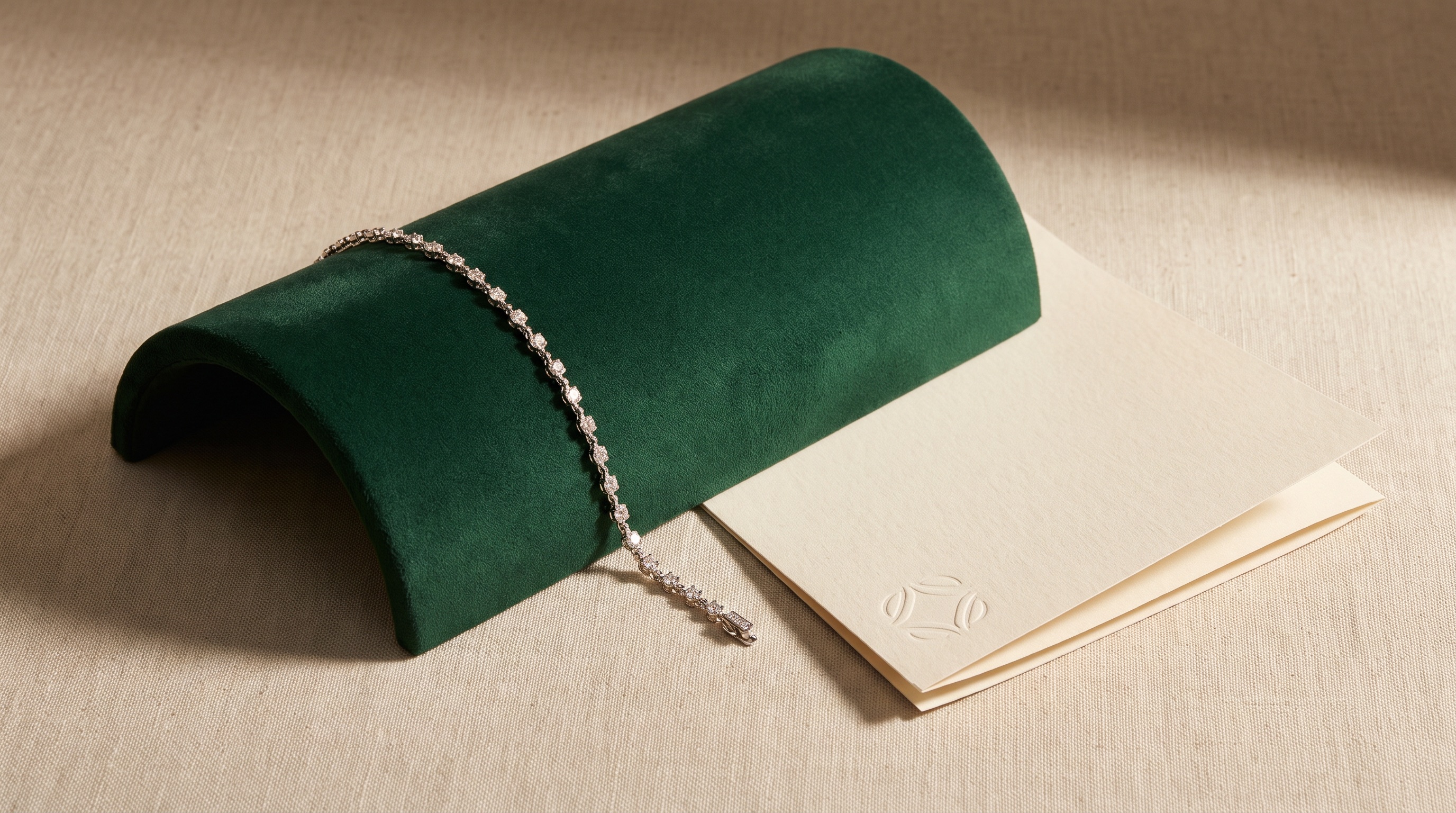
A diamond chain bracelet is built on a visible metal link chain — curb, cable, figaro, or rope, among others — with diamonds set into or along the links rather than on a continuous prong-set line the way a tennis bracelet is. For a jeweler or manufacturer sourcing diamonds for this category, the chain construction itself is the starting point: link style, gauge, and pattern determine how much diamond content a design can carry and where it can physically go, which makes chain selection a decision that has to happen before a diamond order can be properly specified.
This guide covers diamond chain bracelet sourcing from a trade perspective — how link style drives diamond placement and quantity, quality and certification norms for this category, setting approaches used on chain links specifically, and what to look for in a wholesale diamond supplier for chain-based line work.
How Chain Construction Shapes Diamond Sourcing
Unlike a tennis bracelet's uniform prong-set line, a chain bracelet's underlying link pattern — curb's twisted flat links, cable's rounded interlocking ovals, figaro's alternating long-and-short links, rope's tightly twisted strands — creates a structural template that dictates where diamonds can realistically sit and how many a given chain length can hold. A manufacturer briefing a diamond order needs to settle chain style and gauge first, since the same total carat weight target can require very different stone counts and individual stone sizes depending on whether diamonds are set into every link, every other link, or concentrated at select points along a chain that's otherwise left plain. This sequencing — chain first, diamond spec second — is the most common process mistake buyers new to this category make, ordering diamonds before finalizing which chain construction the piece will actually use.
Diamond-Set Density: Fully Set vs. Accent Chain Designs
Chain bracelets span a wide density range, from a plain chain with a handful of diamond-set links as accents, to a fully iced-out chain with every link carrying stones. This range matters enormously for diamond sourcing volume and cost: a fully set chain bracelet at a moderate length can require several times the stone count and total carat weight of an accent-only design on the identical chain style and length. Manufacturers should specify density explicitly to a supplier — not just "diamond chain bracelet" as a category, but the target percentage of links carrying stones — since this single variable drives diamond quantity more than almost any other design choice in the category.
| Density Style | Approx. % of Links Set | Typical Sourcing Volume |
|---|---|---|
| Accent chain (select links only) | 10–25% | Low — smaller stone count, faster to source |
| Alternating pattern | ~50% | Moderate |
| Fully iced chain | 90–100% | High — largest stone count and TCW, longest matched-lot sourcing lead time |
Diamond Quality Standards for Chain Bracelets
Most commercial chain bracelet production standardizes on a DEF+/VS+ melee baseline — near-colorless to colorless, very slightly included or better — the same commercial standard used broadly across calibrated melee categories, since a chain bracelet displays many small stones simultaneously and a consistent, clean-reading baseline matters more than any individual stone's exceptional grade. Premium and fully iced designs sometimes tighten to a whiter, cleaner tier specifically because full density leaves no plain metal to visually break up an inconsistent stone, making color and clarity variation across the piece more obvious than it would be in a lower-density accent design.
Certification Norms
Chain bracelet diamonds are, in the large majority of designs, melee-sized — generally below roughly 0.18ct — which ships as uncertified parcel goods graded against a stated quality baseline rather than with individual paperwork. This is standard practice across the melee category broadly and reflects the practical reality that certifying each of potentially hundreds of stones on a fully iced chain isn't cost-effective for either side of a wholesale transaction. Designs that incorporate a larger anchor stone — a pendant charm or focal element attached to the chain — can and typically should have that specific stone individually certified through IGI, GIA, or GCAL at 0.30ct and above, treating it as a distinct sourcing line separate from the chain melee itself.
Setting Methods Used on Chain Links
Pavé Setting
Small stones set with shared or individual small prongs directly into a link's flat or curved surface, the most common approach for a fully iced chain since it maximizes diamond coverage per link while keeping individual setting operations relatively simple and fast for a setting partner working at production volume.
Channel Setting on Flat Links
Where a chain style includes wider, flatter links (common in some curb and figaro variants), a channel-set row of stones can run across or along the link's flat face, producing a cleaner, more architectural look than pavé and offering somewhat better stone protection against catching.
Bezel-Set Accent Points
For accent-density designs, individual stones bezel-set at select points along an otherwise plain chain give strong physical protection to the relatively few stones on the piece, appropriate for a design where those accent stones need to hold up well over years of daily wear without much surrounding metal to shield them.
Chain Gauge and How It Constrains Stone Size
Link size directly caps the maximum diamond size a chain bracelet can carry at any given point, since a stone set into or onto a link can't meaningfully exceed the link's own dimensions without looking disproportionate or compromising the link's structural integrity. A fine, delicate chain gauge limits diamond content to very small melee throughout, while a heavier, chunkier chain gauge — increasingly popular in current chain bracelet styling — can accommodate proportionally larger stones per link, which changes the sourcing conversation from "how many tiny stones" to "how many moderately larger stones," a meaningfully different order profile for a supplier to fill. Confirming chain gauge before finalizing stone size specifications avoids a costly mismatch discovered only once diamonds and chain arrive at a setting partner together.
Lab-Grown vs. Natural Diamonds for Chain Bracelet Production
As in other high-stone-count bracelet categories, the lab-grown-versus-natural decision has an outsized effect on finished-piece pricing given how directly cost scales with total stone count and carat weight across a fully or densely set chain. CVD lab-grown diamonds let a manufacturer offer a higher density — more links set, or larger stones per link — at a given price point than natural material of comparable color and clarity would support, which matters specifically in a category where "fully iced" styling has become a meaningful consumer preference. Both natural and lab-grown stones can meet the same DEF+/VS+ commercial standard described above; origin is a pricing and positioning decision for the retailer rather than a difference in how the finished chain looks or wears.
Matched-Lot Consistency: What to Ask a Supplier
- Is chain melee sold as a matched, graded lot, sized specifically for the link dimensions this design uses, or pulled from general mixed inventory that will need extra sorting before setting?
- What's the size tolerance across the lot, and does it match this chain's specific link size, not just a generic melee size range?
- Can this exact density and grade be reordered consistently for an ongoing SKU, particularly important for a fully iced design where any visible batch-to-batch shift in stone color or size reads clearly across so many links?
- What's the realistic lead time for a fully iced density order versus an accent-density order, given the meaningfully larger stone count and tighter sorting requirements the fully set version requires?
Wholesale Pricing Structure
Chain bracelet diamonds are typically quoted per total carat weight at a specified quality standard once a density target is set, letting a manufacturer estimate finished-piece diamond cost directly from the density and chain-length decision made during design. Because stone count on a fully iced design can run dramatically higher than an accent design of the same chain length, buyers should request pricing scenarios at more than one density level early in the sourcing conversation — this makes it far easier to model a finished-piece price point across a planned product range (accent, half-set, fully iced) rather than pricing each SKU as an entirely separate sourcing exercise later.
Chain Bracelet Length and Stacking Considerations
Chain bracelets are commonly produced in a standard length range with an adjustable extender, similar to other bracelet categories, but the chain-link format also lends itself particularly well to stacking multiple bracelets of varying chain styles and diamond density on the same wrist — a styling trend that has grown alongside the category's broader popularity. Manufacturers planning a chain bracelet line should consider whether individual SKUs are designed to be sold and worn as standalone pieces, as a coordinated stacking set, or both, since a stacking-oriented line benefits from planning diamond density and chain gauge variation across SKUs so the set reads as intentionally layered rather than repetitive.
Common Manufacturing Defects to Screen For
Beyond standard setting-quality checks, chain bracelets carry a category-specific risk worth screening for directly: link-to-link consistency in how securely stones are held, since a fully iced chain involves potentially hundreds of individual small setting operations and any single weak setting becomes a stone-loss risk over the piece's lifetime. Retailers and manufacturers should request a sample tested under magnification specifically for setting security across a representative sample of links, not just visual brilliance, before approving a full production run from a new setting partner — a defect concentrated in even a small percentage of links across a fully set chain can translate into a meaningful warranty and repair burden at scale.
Repair and Warranty Considerations
A densely diamond-set chain bracelet carries a structurally higher lifetime repair rate than a lower-density piece, simply because more individual settings mean more individual points of potential failure over years of wear — a realistic, expected part of owning a fully iced chain piece rather than a sign of poor original construction. Retailers building a chain bracelet program, particularly at higher density tiers, should plan for this by keeping a small reserve of matching replacement melee from the original production lot, and by communicating a clear repair policy to end customers at the point of sale given how directly density affects expected lifetime service needs.
Seasonal Demand and Stacking-Driven Reorders
Chain bracelets see the same general seasonal gifting lift as other bracelet categories around the winter holidays and Valentine's Day, but the stacking trend adds a second, less seasonal demand pattern worth planning around: customers who already own one chain bracelet frequently return to add a second or third in a different chain style or density as a stacking piece, generating a more continuous reorder pattern than a single-purchase category typically sees. Retailers who track which chain styles and densities their existing customers already own can use that data to target follow-up offers for complementary stacking pieces, which has real implications for how a manufacturer should plan standing diamond melee inventory — not just for new-customer volume, but for predictable, ongoing stacking-driven reorders from an existing base.
Charm and Pendant Attachments on Chain Bracelets
A meaningful share of chain bracelet designs incorporate a removable or fixed charm, initial pendant, or small figural attachment alongside the diamond-set chain itself, and buyers sourcing for this sub-category should treat the charm as its own distinct sourcing line rather than an extension of the chain melee order. A diamond-set charm typically carries its own small cluster or pavé surface independent of the chain's link-by-link setting pattern, and if the design allows the charm to be swapped or added after initial purchase — an increasingly common retail feature that supports repeat-purchase behavior — the charm's attachment loop needs to be sized to the specific chain gauge from the outset, another reason chain gauge should be finalized before any downstream diamond ordering begins. Retailers building a charm-compatible chain program should discuss both the base chain melee order and a rotating or seasonal charm assortment with a supplier as two coordinated but separate conversations.
Two-Tone and Mixed-Metal Chain Designs
Chain bracelets lend themselves particularly well to two-tone and mixed-metal construction — alternating white and yellow gold links, or a diamond-set section in one tone against a plain chain in another — since the link-by-link structure naturally supports visual segmentation in a way a continuous prong-set line does not. This styling choice doesn't change diamond sourcing specifications directly, but manufacturers planning a mixed-metal design should confirm with a setting partner which links will carry diamonds before finalizing metal-tone placement, since it's generally more visually effective to concentrate diamond-set links within one metal tone rather than scattering them across both, keeping the piece's diamond content read as a clear, deliberate design element rather than a scattered accent.
Diamond Chain Bracelets vs. Diamond Link Bracelets Sourcing
"Chain bracelet" and "link bracelet" overlap significantly as terms in the trade, but a link bracelet more often refers to a design built around larger, individually distinct link shapes (each link itself is the visual feature) rather than a fine chain carrying diamond accents throughout. The sourcing principles above — link-first specification, density planning, matched-lot consistency — carry over directly between the two categories, with the main practical difference being stone size and setting approach relative to the larger individual link shapes a link bracelet design typically uses. For sourcing guidance specific to that category, see our diamond link bracelet sourcing guide.
Men's vs. Women's Chain Bracelet Sourcing Differences
Chain bracelets sit in one of the few diamond jewelry categories with a genuinely large, established men's market alongside the women's side, and the sourcing profile differs meaningfully between the two. Men's chain bracelets typically use heavier chain gauges and larger, bolder link styles — Cuban and figaro links in particular — which supports proportionally larger individual stones and a chunkier overall diamond footprint compared to the finer chains and smaller melee common in women's chain bracelet designs. Buyers building a line spanning both should plan two distinct diamond specifications rather than a single unified order, since applying a women's-line melee size to a men's-scale chain typically looks visually undersized, and the reverse — full men's-scale stones on a delicate women's chain — is structurally impractical.
Working With a New Chain Bracelet Setting Partner
Because chain bracelet setting involves a distinct skill set — securing stones into or onto pre-formed links, often at high volume for a fully iced design — buyers working with a new setting partner for this category specifically should request a small trial run before committing diamonds to a full production order, even if that partner has strong experience in other jewelry categories. A trial run surfaces link-specific setting issues (stone security on a particular link style, consistency across a long run of similar operations) that don't necessarily show up in a partner's general portfolio of ring or pendant work. This upfront step is a modest time investment relative to discovering a setting security issue only after diamonds for a full production order have already been committed and set.
Sourcing Chain Bracelet Diamonds Wholesale
Guru Diam supplies calibrated diamond melee and certified larger stones for jewelers and manufacturers building chain bracelet lines at any density, across natural and CVD lab-grown material — CVD is the only lab-grown category Guru Diam carries, with no HPHT material anywhere in the catalog. Melee is available in round brilliant at DEF+/VS+ and tighter tiers, sold as consistent, gradable lots sized appropriately for chain-link setting rather than mixed parcel stock, and larger anchor or charm stones can be certified individually through IGI, GIA, or GCAL. In-stock inventory ships same-day from Guru Diam's New York and Los Angeles locations, and trade accounts can review current melee stock in matching pairs or browse certified stones in certified diamonds. Manufacturers developing a custom chain bracelet design can start at custom jewelry, and new trade accounts can apply through trade partner, with current terms at the wholesale hub.
Frequently Asked Questions
What is a diamond chain bracelet?
A diamond chain bracelet is a metal link chain — curb, cable, figaro, or rope, among other styles — set with diamonds into or along the links, ranging from a few accent stones to a fully diamond-covered "iced out" design. Diamond placement and quantity are shaped directly by the underlying chain's link style and gauge.
How many diamonds are in a diamond chain bracelet?
It varies enormously by density style — an accent design with select set links might use a few dozen stones, while a fully iced chain of the same length can require several times that count. Density should be specified explicitly to a supplier rather than assumed from the category name alone.
Are diamond chain bracelet stones individually certified?
Most chain bracelet diamonds are melee-sized (generally below roughly 0.18ct) and ship as graded parcel goods without individual certification. A larger anchor or charm stone attached to the chain, at 0.30ct or above, can be individually certified through IGI, GIA, or GCAL as a separate sourcing line.
What quality grade is standard for chain bracelet diamonds?
A DEF+/VS+ baseline — near-colorless to colorless, very slightly included or better — is the common commercial standard. Fully iced designs sometimes tighten this since full density leaves less plain metal to visually offset an inconsistent stone.
Should chain bracelet diamonds be natural or lab-grown?
Either can meet the same quality standard and look identical once set. CVD lab-grown diamonds let a manufacturer offer higher density or larger stones per link at a given price point, which is why lab-grown material is common in this category, particularly for fully iced designs. The choice is primarily a pricing and positioning decision.
How is chain bracelet diamond pricing quoted wholesale?
Typically per total carat weight at a specified quality standard, once a density level (accent, alternating, or fully set) is settled. Buyers should request pricing at more than one density level early in sourcing to model a planned product range accurately.
Guru Diam is a trade-only wholesale diamond supplier with locations in New York and Los Angeles, supplying calibrated diamond melee and certified loose stones — natural and CVD lab-grown — for jewelers and manufacturers producing chain bracelets and other line-set jewelry. Browse current melee inventory in matching pairs or apply for a trade account through trade partner.