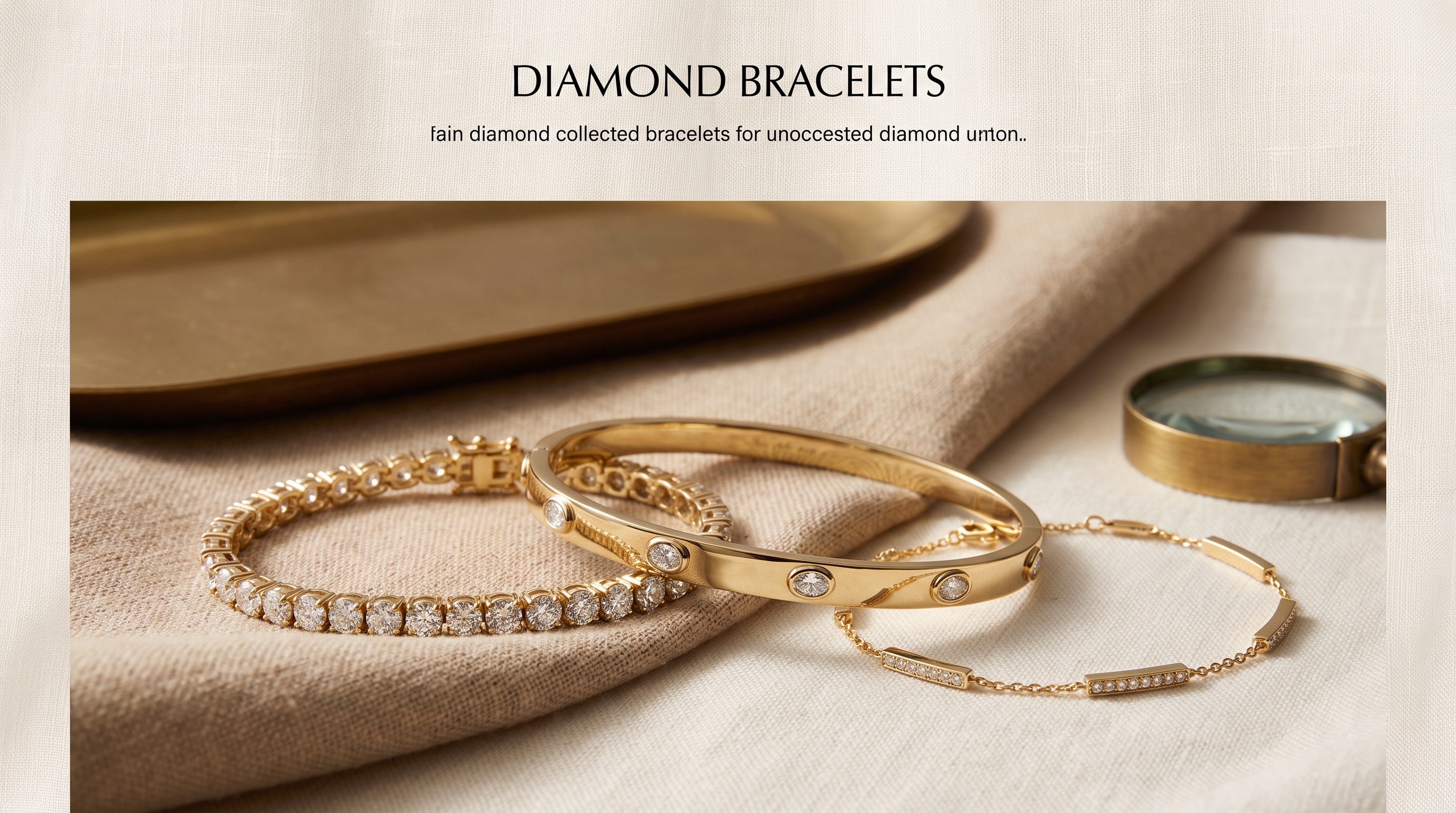
Diamond bracelet styles fall into a handful of distinct construction categories — tennis, bangle, cuff, chain-and-station, and a few specialty formats — each built around a different way of joining diamonds and metal into a wearable piece. The style names describe the underlying construction, not just the surface look, which matters for a jeweler stocking or building a bracelet assortment, since construction drives cost, durability, and resizing options as much as it drives appearance.
This guide walks through the main diamond bracelet styles, how each is actually built, the wear and durability tradeoffs that come with that construction, and what to know when sourcing or specifying bracelets for a retail assortment or a custom build.
Tennis Bracelet
A tennis bracelet is a continuous line of individually set diamonds of roughly equal or graduated size, connected link by link around the wrist, each stone typically held in its own prong or bezel setting joined to the next by a small flexible link. The name comes from a widely told (and only loosely verifiable) story of a tennis player's bracelet coming loose and stopping play on court — regardless of the story's exact accuracy, the name has stuck as the standard trade term for this construction style. Tennis bracelets are prized for their continuous line of brilliance, since every stone is set individually rather than sharing space with other design elements, and they remain one of the best-selling diamond bracelet formats across price points.
Construction quality varies significantly across the market: the connecting mechanism between links (a box clasp, safety clasp, or hidden clasp) and the security of each individual prong setting are the two areas most likely to cause a return or repair if under-built. A well-made tennis bracelet distributes flex evenly across its full length rather than concentrating stress at a few weak points, which is part of why manufacturing quality varies more than the basic design concept might suggest.
Bangle Bracelet
A diamond bangle is a rigid, typically circular or slightly oval band, either fully set with diamonds around its circumference or partially set with a diamond section against plain metal. Unlike a tennis bracelet's flexible link construction, a bangle holds a fixed shape and slides over the hand rather than closing with a clasp, though hinged bangles with a clasp mechanism are also common, particularly for fully diamond-set designs where sizing precision matters more. Bangles read as more architectural and substantial than a flexible chain-based bracelet, and a fully pave-set bangle in particular reads as a significant statement piece given the density of stones and metal involved.
Sizing is the main practical consideration with rigid bangles: an unhinged bangle has to be sized closely enough to slide over the hand but not so loose that it spins or slides off, which makes made-to-order sizing more important for bangles than for most other bracelet styles.
Chain and Station Bracelet
A station bracelet places individual diamonds or small diamond clusters ("stations") at intervals along an otherwise plain metal chain, rather than setting stones continuously along the entire length the way a tennis bracelet does. This construction is generally lighter and less expensive than a full tennis bracelet of comparable length, since it uses meaningfully less diamond material for a similar overall visual effect, and it reads as a more everyday, layerable piece than a fully set tennis bracelet or bangle.
Station spacing and the chain link style beneath it both affect how the finished piece drapes and moves on the wrist — a finer chain with widely spaced stations gives a delicate, minimal look, while closer station spacing on a slightly heavier chain reads as more substantial without going to a fully continuous diamond line.
Cuff Bracelet
A diamond cuff is an open-backed rigid bracelet, typically with a gap at the back allowing it to be slightly flexed open and closed around the wrist rather than sliding on like a closed bangle or clasping like a chain. Cuffs are usually wider and more substantial in profile than other bracelet styles, giving a designer more surface area for pave work, sculptural metal detailing, or a graduated diamond pattern than a narrower band allows.
Because a cuff's fit depends on the flex and spring of the open metal band rather than a precise closed circumference, cuffs are somewhat more forgiving of small wrist-size variation than a closed bangle, though a poorly sized cuff can still feel loose or require repeated readjustment throughout a day of wear.
Line Bracelet vs. Tennis Bracelet
"Line bracelet" is sometimes used interchangeably with "tennis bracelet" in casual trade conversation, but more precisely, a line bracelet describes any continuous line-set construction, which can include stones other than a uniform round-diamond line — a line bracelet might use graduated stone sizes, mixed shapes, or a single row of fancy-shape stones, where "tennis bracelet" more specifically implies the classic uniform round-diamond line format the name originally described. In practice, most retailers use the terms interchangeably, and a buyer specifying either term should confirm exactly what stone arrangement they mean rather than assuming the terminology alone settles it.
Comparing the Main Bracelet Styles
| Style | Construction | Typical Weight/Feel | Sizing |
|---|---|---|---|
| Tennis / Line | Continuous line of individually set stones, flexible links | Moderate to heavy, depending on stone size | Made-to-length, clasp closure |
| Bangle | Rigid circular/oval band, hinged or unhinged | Substantial, especially fully pave-set | Precise circumference sizing critical |
| Chain/Station | Diamonds or clusters at intervals on a plain chain | Light, everyday, layerable | Adjustable length common |
| Cuff | Open-backed rigid band, flexes open to wear | Substantial, wide profile | More forgiving of size variation than a closed bangle |
Clasp Types and Why They Matter
Clasp construction is one of the most under-discussed but practically important elements of a diamond bracelet, since it's the single point of failure most likely to cause a lost bracelet if it fails. A box clasp with a simple tongue mechanism is common but relies entirely on spring tension to stay closed; a box clasp with a figure-eight safety adds a secondary latch that has to be separately opened, meaningfully reducing accidental-opening risk; and a fully hidden clasp integrates the closure into the bracelet's design so it isn't visually distinguishable from the rest of the piece, which is popular for tennis bracelets and station bracelets where an exposed clasp would interrupt the line. Retailers stocking bracelets at a range of price points should know which clasp type each SKU uses, since it's a legitimate, practical differentiator to explain to a customer beyond stone quality alone. A safety chain — a short secondary chain connecting the two ends of a bracelet independent of the main clasp — is an additional, lower-cost security feature worth offering on higher-value pieces, giving a backup connection point if the primary clasp were ever to fail during wear.
Metal and Stone-Setting Considerations Specific to Bracelets
Bracelets see more flex and mechanical stress in daily wear than most other diamond jewelry categories, since a bracelet moves continuously with wrist motion rather than sitting in one relatively fixed position the way a ring or a pair of stud earrings does. This makes metal choice and setting security especially important: platinum and 18k gold both hold up well under repeated flex, while very thin-gauge metal in a lower-cost bracelet is more prone to fatigue and eventual link or prong failure over years of regular wear. A well-constructed diamond bracelet accounts for this by using slightly heavier link and setting gauges than the equivalent stone size might use in a stationary piece like a pendant.
Carat Weight and Stone Count Across Styles
Total carat weight (TCW) is the standard way diamond bracelets are described and compared across styles, since a full tennis bracelet or bangle involves many individual stones rather than a single center stone the way an engagement ring does. Buyers and retailers comparing two bracelets at the same advertised TCW should still check individual stone size and count, since a bracelet built from more, smaller stones reads differently than one built from fewer, larger stones at the same total weight — smaller stones generally read as more delicate and continuous, while larger stones read as bolder with more visible individual sparkle points. This distinction matters more for tennis and line bracelets, where stone size is a primary visual driver, than for station or cuff styles where metal and design elements share more of the visual weight. Graduated tennis bracelets, which step stone size up toward the center and back down toward the clasp, use this same TCW-versus-stone-count distinction to create visual emphasis at the top of the wrist without requiring uniformly large stones across the entire length, which can make a graduated design more cost-efficient at a given TCW target than an equivalent uniform-size line.
Layering and Stacking Considerations
Chain, station, and thinner bangle styles are increasingly purchased with layering and stacking in mind — worn together in multiples rather than as a single statement piece — which has shifted some retail demand toward lighter-weight, more affordable individual pieces meant to be combined rather than a single substantial bracelet worn alone. Retailers building an assortment around this trend benefit from offering complementary chain lengths, finishes, and station spacing across several SKUs designed to stack well together, rather than treating each bracelet as an independent, standalone purchase decision.
Common Manufacturing Quality Issues to Check For
A handful of construction shortcuts account for most of the durability complaints jewelers see on lower-quality diamond bracelets. Thin or undersized connecting links on a tennis bracelet can stretch or deform under repeated flex over time, gradually loosening the overall line even if no individual stone comes loose. Prongs sized too small relative to stone weight — the same issue that affects rings — is equally common on bracelets and arguably more consequential, since a bracelet flexes with every wrist movement in a way a ring generally doesn't. And solder joints on chain and station bracelets, if done inconsistently, can become the weakest point in an otherwise well-built piece, failing at the joint well before the chain material itself would wear through. Buyers sourcing bracelets wholesale benefit from asking a supplier directly about link gauge, prong sizing relative to stone weight, and solder joint quality control, rather than assuming a bracelet described only by carat weight and metal type meets a consistent construction standard. Requesting a physical sample before committing to a larger production run remains the most reliable way to verify these details firsthand, since gauge and joint quality are difficult to assess accurately from a spec sheet or photo alone.
Custom and Made-to-Order Bracelet Considerations
Bracelets are one of the more common finished-jewelry categories built to custom specification, particularly for exact wrist sizing on bangles and cuffs, custom total-carat-weight targets on tennis bracelets, or combining stone shapes and metal tones that aren't available in standard retail stock. A CAD-based custom process lets a manufacturer confirm exact stone placement and total weight before production, which is particularly useful for bangles given how much sizing precision affects the finished piece's fit and comfort. Custom orders also give a retailer the option to specify shape mix and metal tone combinations that aren't practical to keep on hand across a full standard retail assortment, filling a specific customer request without carrying that exact configuration as ongoing stock.
Specialty Bracelet Formats
Beyond the four core construction categories above, several specialty formats appear regularly enough in retail assortments to be worth knowing by name. A diamond charm bracelet uses a chain base with removable or fixed diamond-set charms, letting a customer build a personalized piece over time rather than buying a single finished design outright. A diamond infinity bracelet features an infinity-symbol motif, either as the bracelet's central focal element on a chain or repeated as a station pattern, and trades on the motif's symbolic association with continuity rather than a distinct construction method of its own — mechanically, an infinity bracelet is usually a station or chain-based build with that specific charm shape. A double or triple-row tennis bracelet stacks two or three lines of stones side by side within a single connected piece rather than requiring a customer to stack separate bracelets, giving a bolder look while still functioning as one bracelet with one clasp.
How Bracelet Length Is Determined
Bracelet length is measured around the wrist rather than using a ring-size-style sizing system, with most adult bracelets falling in a roughly 6.5 to 8-inch range depending on wrist size and how loosely or snugly the wearer prefers the piece to sit. Chain and station bracelets often include an adjustable extender chain, letting one piece fit a small range of wrist sizes without requiring an exact custom length. Bangles and cuffs, by contrast, don't have this flexibility built in the same way, which is why precise wrist measurement matters more for those two styles specifically than for adjustable chain-based designs. Retailers offering made-to-order bracelets should always confirm exact wrist measurement (and preferred fit — snug versus looser) before finalizing a custom length, since this is one of the more common sources of a return or resize request after the fact. A simple paper-strip or soft-tape measurement taken directly at time of sale, rather than relying on a customer's self-reported estimate, meaningfully reduces the odds of a length-related return on a custom or semi-custom order.
Gender-Neutral and Men's Diamond Bracelet Trends
Diamond bracelets have grown as a men's category alongside their traditional positioning as women's jewelry, with cuban-link and box-chain diamond bracelets, along with diamond-accented cuffs, seeing increased demand as part of a broader trend toward men's fine jewelry generally. These pieces typically use heavier link gauges and larger, often single-row diamond placement compared to more delicate women's chain and station designs, reflecting both a different aesthetic preference and the practical reality that men's jewelry in this category is often worn alongside a watch and other accessories, favoring a bolder, more substantial look. Retailers building out a men's jewelry assortment benefit from stocking at least one or two diamond bracelet options in heavier gauges specifically, rather than assuming existing women's styles will translate directly to that customer base. Black or dark-finished metal pairings, and lower-color melee set flush against a darker chain, are also more common design choices in men's diamond bracelets than in women's pieces, reflecting a general preference for a more understated sparkle in this category.
Sourcing Diamond Bracelets Wholesale
Guru Diam supplies finished diamond bracelets across these core styles, along with certified loose diamonds — natural and CVD lab-grown — for jewelers building custom bracelet orders to their own specification. Custom engagement ring and finished-jewelry builds finish in 4-6 days, and trade accounts can source loose stones and finished pieces through the same relationship rather than coordinating separate vendors for stones and completed bracelets.
Merchandising a Diamond Bracelet Assortment
Retailers building out a bracelet case benefit from organizing the assortment around occasion and wear pattern rather than construction type alone, since most customers shop by intent — an everyday layering piece, a gift, or a statement item — before they think in terms of "tennis bracelet" versus "bangle." A well-rounded assortment typically covers at least one everyday chain or thin bangle option at an accessible price point, a mid-tier tennis or line bracelet as the assortment's volume driver, and one or two statement bangle or cuff pieces at a higher price point to anchor the case. Cross-merchandising bracelets alongside matching earrings or a pendant in the same stone size and metal tone also tends to lift attachment-rate sales, since bracelets are one of the more common categories purchased as part of a coordinated set rather than as a single standalone piece. Seasonal timing matters too: bracelets see a reliable lift around graduation and Mother's Day gifting periods specifically, distinct from the engagement-season demand curve that drives most bridal categories, which is worth factoring into inventory and promotional timing separately from a retailer's broader diamond jewelry calendar.
Frequently Asked Questions
What's the difference between a tennis bracelet and a line bracelet?
The terms are often used interchangeably in the trade. More precisely, "tennis bracelet" traditionally refers to a continuous line of uniform round diamonds, while "line bracelet" can describe any continuous line-set construction, including graduated sizes or mixed shapes.
Why do bangle bracelets need more precise sizing than other styles?
A rigid, closed bangle has to be sized closely enough to slide over the hand without spinning or sliding off, unlike a flexible tennis bracelet or adjustable chain, which is why bangles are more often made or ordered to a specific wrist measurement.
What clasp type is most secure for a diamond bracelet?
A box clasp with a figure-eight safety adds a secondary latch beyond simple spring tension, meaningfully reducing accidental-opening risk compared to a basic box clasp alone. Fully hidden clasps offer similar security while staying visually integrated into the design.
How is diamond bracelet quality usually described?
Total carat weight (TCW) is the standard measure for comparing bracelets across styles, though buyers should also check individual stone size and count, since bracelets with the same TCW can look quite different depending on how that weight is distributed across the stones.
Are diamond bracelets more prone to damage than rings?
Bracelets see more continuous flex and mechanical stress from wrist movement than most other jewelry categories, which is why metal choice and link or prong gauge matter more for long-term durability in bracelets than in more stationary pieces like pendants.
Can diamond bracelets be custom made to a specific length or carat weight?
Yes, bracelets are commonly built to custom specification, particularly for exact wrist sizing on bangles and cuffs or a target total carat weight on tennis bracelets, using a CAD-based process to confirm placement and weight before production, and to review the design digitally before any metal is cut.
Guru Diam is a trade-only wholesale supplier of certified natural and CVD lab-grown loose diamonds and custom finished jewelry, with locations in New York and Los Angeles. Trade accounts can review certified inventory in certified diamonds, source matched stones for bracelet work through matching pairs, or build a custom bracelet through custom jewelry. Current wholesale terms are available at the wholesale hub.