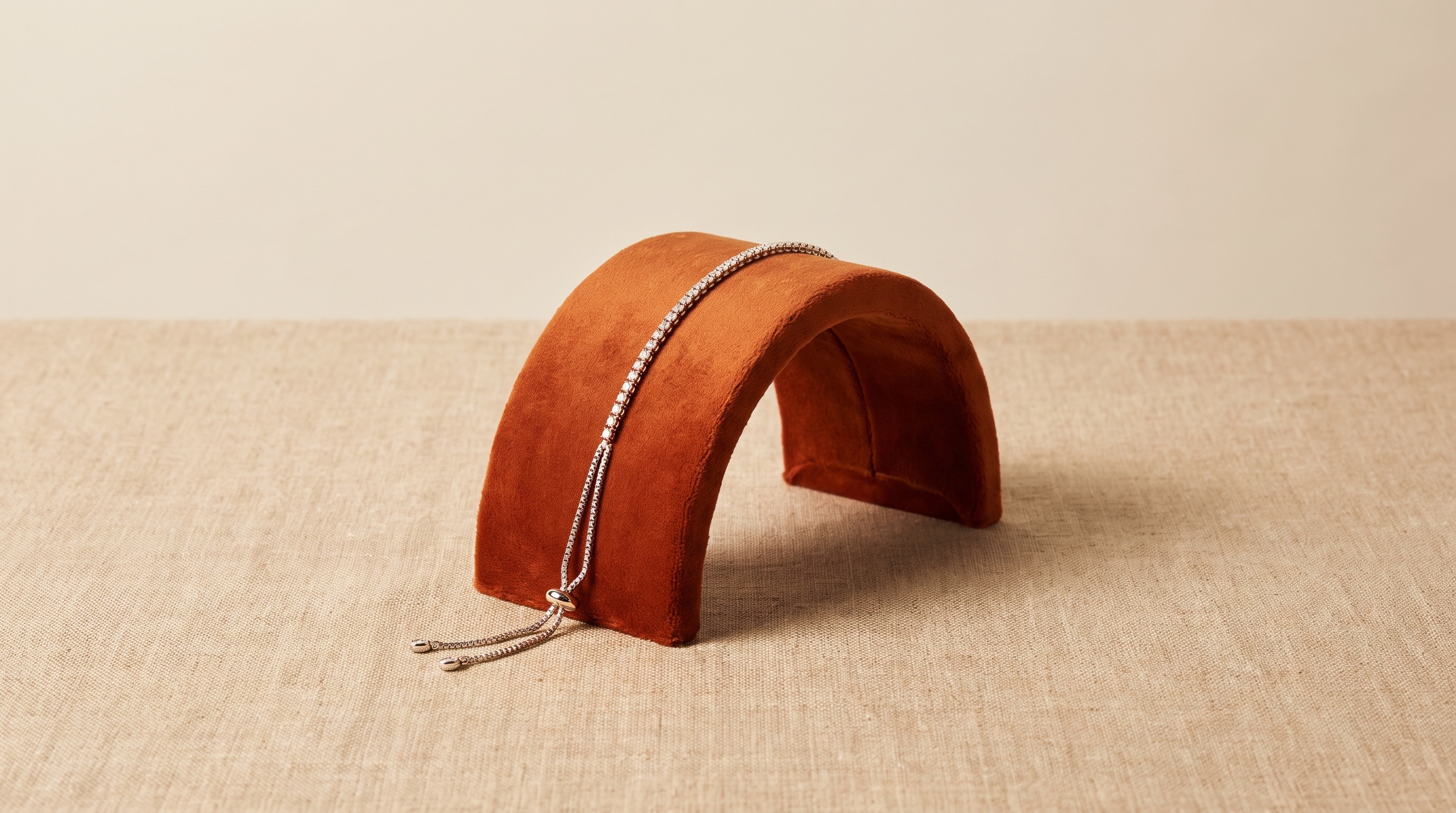
A diamond bolo bracelet is a bracelet built around a sliding-clasp or drawstring-style adjustable mechanism — most often a bead-and-loop or sliding-knot design borrowed from Western bolo-tie hardware — set with diamonds along the chain or at a central slide. For a jeweler or manufacturer sourcing diamonds for a bolo bracelet line, the defining sourcing challenge isn't a single hero stone; it's coordinating diamond placement with a moving mechanical component, which changes both stone-setting decisions and wholesale specification compared to a fixed-length line-set piece.
This guide covers bolo bracelet sourcing from a trade perspective — how the adjustable mechanism affects diamond and setting choices, what to specify when ordering loose diamonds or melee for this category, quality and certification norms, and what to look for in a wholesale supplier building toward this growing style.
What Makes a Bolo Bracelet Different From a Standard Line Bracelet
A conventional tennis or chain bracelet has a fixed length, sized to the wearer before the piece leaves the workshop. A bolo bracelet instead uses a sliding mechanism — typically a bead that slides along an open-ended chain, or a drawstring-style loop — that lets the wearer adjust fit after the fact, without resizing. This single mechanical difference cascades into several sourcing decisions a manufacturer wouldn't otherwise need to make: the open, adjustable end of the chain generally can't carry the same continuous diamond line a closed tennis bracelet does, which shifts diamond placement toward a fixed, set section (often near the clasp or slide) plus, in higher-end designs, smaller accent stones along the adjustable chain itself. Understanding this structural constraint up front changes what a buyer should be asking a diamond supplier for, compared to sourcing for a standard fixed-length piece.
Where Diamonds Go in a Bolo Design
Most commercial bolo bracelets concentrate their diamond content in one of two places: a fixed pendant-style cluster or pavé section near the slide mechanism, or a shorter run of prong- or bezel-set stones along the portion of the chain that stays visible regardless of adjustment. Higher-end and fully diamond-set bolo designs extend stones further along the adjustable chain itself, using smaller melee that can flex with the chain's movement without loosening settings — a construction detail that has real implications for stone size and setting method, not just aesthetics. A manufacturer briefing a diamond order should specify up front which of these placement styles the design calls for, since a fixed-cluster design and a fully-set adjustable-chain design draw on meaningfully different stone counts, sizes, and setting specifications from a supplier.
Diamond Quality Standards for Bolo Bracelets
Because bolo bracelets are typically positioned as an accessible, everyday-wear category rather than a formal statement piece, most commercial production standardizes on a DEF+/VS+ melee baseline — near-colorless to colorless, very slightly included or better — the same commercial standard used across most calibrated melee categories. This grade reads clean and bright at normal wearing distance without pushing the finished piece into premium-tier pricing that would work against the category's accessible positioning. Retailers building a higher-end bolo line, or one built around a larger center stone at the slide, sometimes tighten color or clarity specifically on that anchor stone while keeping the surrounding chain melee at standard commercial grade — a mixed-tier approach that's common in this category precisely because the center stone and the chain stones aren't seen at the same visual weight.
Certification and the Bolo Bracelet's Mixed Stone Sizes
A bolo bracelet's stone-size range often spans both certification tiers in a single piece, which is worth flagging explicitly to a buyer new to sourcing this category. Melee-sized diamonds — generally below roughly 0.18ct — ship as uncertified parcel goods graded against a stated quality baseline rather than with individual paperwork, since certifying dozens of small chain stones individually isn't practical for either side of a wholesale transaction. A larger center or slide stone at 0.30ct or above, by contrast, can and typically should be individually certified through IGI, GIA, or GCAL, since it functions as the piece's visual anchor and buyers reasonably expect paperwork on a stone at that size. A manufacturer ordering diamonds for a bolo design with both a center stone and chain melee should expect two separate sourcing conversations with a supplier — one for certified anchor stones, one for graded parcel melee — rather than a single unified order.
| Stone Role | Typical Size | Certification Norm |
|---|---|---|
| Slide or center stone | 0.30ct and up | Individually certified (IGI/GIA/GCAL) |
| Chain accent melee | Below ~0.18ct | Graded parcel goods, DEF+/VS+ baseline |
| Transitional mid-size stones (occasional design element) | ~0.18ct–0.29ct | Varies by supplier; confirm before ordering |
Mechanism Sourcing: A Finished-Jewelry Decision That Affects Diamond Setting
The sliding bead-and-loop or drawstring hardware itself is a findings and manufacturing decision, not a diamond sourcing one, but it directly constrains how diamonds near the mechanism can be set. A slide bead carrying pavé or a small cluster needs enough surface area and metal thickness to hold secure prongs or bezels without weakening the slide's ability to move smoothly along the chain — a tension that a setting partner experienced in bolo-specific construction will already understand, but one worth confirming before finalizing a diamond order sized for that slide. Manufacturers new to the category should request a physical prototype of the mechanism with sample stones set before committing to a full production run, since mechanism-and-setting fit issues are far cheaper to catch at the prototype stage than after diamonds have already been purchased for a full order.
Setting Styles Suited to Bolo Construction
Bezel Setting at the Slide
A full metal rim around the center or slide stone offers strong physical protection and a clean, modern look that pairs well with a bolo's minimalist, everyday-wear positioning. Bezel construction also tends to sit lower and flatter against the chain, reducing catching during the sliding adjustment itself.
Prong Setting for Chain Accent Stones
Where a design extends diamonds along the flexible chain section, small shared-prong settings are common because they add the least rigidity to what needs to remain a flexible, adjustable length. The tradeoff is the same one prong settings carry in any category — more exposure to catching and wear than a bezel — which matters more here given the chain's constant movement during adjustment.
Pavé Clusters
A pavé cluster at the slide or a fixed section near the clasp is a common way to concentrate visual diamond weight without extending stones the full length of an adjustable chain, keeping mechanism engineering simpler while still delivering a diamond-forward look at the piece's focal point.
Metal and Chain Construction
Bolo bracelets are most commonly built on box chain, curb chain, or a similar flexible link style capable of sliding smoothly through a bead or loop mechanism without kinking. 14k and 18k gold in yellow, white, and rose all appear regularly in this category, more evenly split across tones than in more formal fixed-length bracelet styles, since the bolo's casual, everyday positioning draws from a broader stylistic range than a bridal-adjacent piece would. Chain gauge and link style should be settled before finalizing diamond sizing for chain-set accent stones, since a heavier chain gauge can accommodate slightly larger stones than a fine, delicate chain without looking disproportionate.
Lab-Grown vs. Natural Diamonds for Bolo Production
As with most calibrated-melee-driven categories, the lab-grown-versus-natural decision has a real effect on finished-piece pricing without changing how the finished bracelet looks or wears. CVD lab-grown diamonds let a manufacturer offer a larger center stone or a more fully diamond-set chain at a given price point than natural material of comparable color and clarity would allow — relevant in a category positioned toward accessible, everyday pricing rather than a high-ticket formal piece. Both natural and lab-grown stones can meet the same DEF+/VS+ commercial standard described above; the origin decision is a pricing and positioning call for the retailer, not a visual difference in the finished piece.
Sizing Range and Why It Matters for Sourcing
The bolo mechanism's main commercial advantage is that a single SKU can fit a wider range of wrist sizes than a fixed-length bracelet, reducing the number of distinct sizes a retailer needs to stock and reducing at-the-counter resizing requests. This has an indirect but real sourcing implication: because one design covers more of the customer base, a manufacturer can plan diamond orders around fewer total SKUs at potentially higher volume per SKU, rather than the fragmented small-batch ordering that fixed multi-size lines often require. Buyers evaluating whether to add a bolo bracelet to a line should factor this SKU-consolidation benefit into the sourcing conversation, not just the piece's styling.
Matched-Lot Consistency for Chain-Set Designs
- Is chain melee sold as a matched, graded lot, or pulled from general mixed inventory? A fully diamond-set bolo chain needs the same lot consistency a tennis bracelet does, since inconsistent stones along a visible chain read as a defect.
- What's the size tolerance on the slide or center stone versus the chain melee? These are typically sourced separately and should be confirmed as distinct specifications, not assumed to match automatically.
- Can the supplier reproduce this exact grade on reorder? Bolo bracelets sold as an ongoing SKU benefit from a supplier who can consistently match quality across repeat production runs, not just a one-time initial order.
- Are mechanism-compatible chain stones available in the gauge this design requires? Not every melee lot is cut and calibrated to sit well on the specific chain link size a bolo mechanism uses.
Wholesale Pricing Structure
Bolo bracelet diamonds are typically quoted as two separate line items in a wholesale order: a per-stone or per-carat price on the certified center/slide stone, and a per-total-carat-weight price on the chain accent melee at a specified quality standard. Buyers should request pricing broken out this way rather than as a single blended figure, since it makes it much easier to model cost changes if a design later shifts center stone size or extends (or shortens) the diamond-set portion of the chain. As with most calibrated melee, per-carat pricing on the chain stones typically improves with order volume and with looser size-tolerance requirements.
Fully Diamond-Set vs. Accent-Only Bolo Designs
The category spans a real range from a simple metal chain with a small diamond slide, to a fully pavé-set chain with diamonds visible along the entire adjustable length. A fully set design multiplies diamond content substantially compared to an accent-only piece and raises the lot-consistency bar accordingly, since inconsistency is far more visible across a long diamond-set run than in a small isolated cluster. Manufacturers deciding where on this spectrum to position a new bolo SKU should model both the diamond cost delta and the setting labor delta between the two approaches before committing, since a fully set design is a meaningfully more complex — and more expensive — sourcing and manufacturing project than an accent-forward one.
Common Manufacturing Defects to Screen For
Beyond the standard setting-quality checks that apply to any diamond jewelry piece, bolo bracelets carry a category-specific defect risk worth screening for directly: a slide mechanism that binds, sticks, or moves unevenly along the chain, often caused by a bead or loop bored slightly off-tolerance for the chain gauge it's meant to run on. This is a mechanical defect rather than a diamond-quality one, but it directly affects customer satisfaction and return rates in this category more than in a fixed-length piece, since the sliding action is the entire functional premise of the design. Requesting a physical sample tested for smooth mechanism action — not just visual inspection — is worth building into quality control for a new bolo SKU or new setting partner.
Retail Positioning and Why Buyers Are Adding This Category
Bolo bracelets have grown as a category in part because the adjustable mechanism removes a real friction point in bracelet retail — sizing uncertainty at the point of sale, and the return or exchange volume that comes with getting bracelet length wrong. Retailers adding a bolo option alongside fixed-length lines report the adjustable format appeals particularly to gift purchases, where the buyer may not know the recipient's exact wrist size, and to a younger, more casual-jewelry customer for whom a single flexible piece that layers easily reads as more versatile than a formal fixed bracelet. Framing a new bolo SKU around this practical sizing advantage, rather than styling alone, is a useful angle for buyers pitching the addition internally.
Seasonal and Gifting Demand Patterns
Like most accessible-price bracelet categories, bolo bracelets see a real demand lift around major gifting periods — the winter holidays, Valentine's Day, and graduation/Mother's Day season in the spring — and the format's one-size-fits-most sizing advantage makes it a disproportionately popular gift purchase within those windows specifically, since a buyer shopping for someone else doesn't need to know an exact wrist measurement. Retailers and manufacturers planning to have bolo inventory in stock ahead of these periods should place diamond orders with enough lead time to cover both certified center-stone sourcing and matched melee lot assembly, rather than assuming a quick reorder will be possible during the peak weeks themselves, when supplier lead times across the trade tend to lengthen along with everyone else's seasonal demand.
Repair and Warranty Considerations for the Sliding Mechanism
Because a bolo bracelet's core functional feature is a moving mechanical part, its warranty and repair profile differs somewhat from a fixed-length piece with no moving components. The most common service issue in this category isn't a lost stone — though that remains possible on any set piece — but mechanism wear: a slide that loosens and no longer holds its position securely, or a drawstring loop that stretches or frays with repeated adjustment over years of daily use. Retailers building a bolo line should set customer expectations around this at the point of sale and confirm with their setting or findings partner what a mechanism repair or replacement actually involves before a warranty claim arrives, since a mechanism swap on a fully diamond-set chain is a more involved repair than restringing a simple beaded piece would be. Keeping a small reserve of matching chain melee from the original production lot, the same practice recommended for other line-set categories, makes any stone-related repair faster and keeps a repaired piece visually consistent with the original.
Diamond Bolo Bracelets vs. Standard Chain Bracelets Sourcing
The core diamond-quality and certification principles carry over directly from standard chain bracelet sourcing, but the adjustable mechanism is the real point of difference worth understanding before placing a first order in this category. Buyers already comfortable sourcing for fixed-length chain-set pieces should treat a bolo addition as an extension of that knowledge rather than an entirely new sourcing category, with the mechanism itself as the one genuinely new variable to account for. For sourcing guidance on the fixed-length chain bracelet category specifically, see our diamond chain bracelet sourcing guide.
Sourcing Bolo Bracelet Diamonds Wholesale
Guru Diam supplies both certified loose diamonds for center and slide stones and calibrated diamond melee for chain-set accent work, across natural and CVD lab-grown material, for jewelers and manufacturers building bolo bracelet lines — CVD is the only lab-grown category Guru Diam carries, with no HPHT material anywhere in the catalog. Certified anchor stones at 0.30ct and above are available through IGI, GIA, and GCAL, and melee is sold as consistent, gradable lots at DEF+/VS+ and tighter tiers rather than mixed parcel stock. In-stock inventory ships same-day from Guru Diam's New York and Los Angeles locations, and trade accounts can review current stock in certified diamonds for slide and center stones or matching pairs for chain melee. Manufacturers developing a custom bolo design can start at custom jewelry, and new trade accounts can apply through trade partner, with current terms at the wholesale hub.
Frequently Asked Questions
What is a diamond bolo bracelet?
A diamond bolo bracelet uses an adjustable sliding-bead or drawstring-style mechanism, borrowed from Western bolo-tie hardware, set with diamonds at a fixed center point, along the visible chain, or both. The adjustable mechanism lets the wearer change fit without resizing, unlike a standard fixed-length bracelet.
Are bolo bracelet diamonds certified?
It depends on stone size and placement. A center or slide stone at 0.30ct and above is typically individually certified through IGI, GIA, or GCAL. Smaller chain accent melee, generally below 0.18ct, ships as graded parcel goods without individual certification, the same as melee in other bracelet categories.
What quality grade is standard for bolo bracelet diamonds?
Most commercial bolo production uses a DEF+/VS+ baseline — near-colorless to colorless, very slightly included or better — for chain melee, with some designs tightening color or clarity specifically on a larger center stone while keeping surrounding chain stones at standard commercial grade.
Should bolo bracelet diamonds be natural or lab-grown?
Either can meet the same quality standard and look identical once set. CVD lab-grown diamonds let a manufacturer offer a larger center stone or a more fully diamond-set chain at a given price point, which fits the category's typically accessible, everyday-wear positioning — making origin primarily a pricing and positioning decision rather than a visual one.
How is bolo bracelet diamond pricing quoted wholesale?
Typically as two separate line items — a per-stone or per-carat price on the certified center or slide stone, and a per-total-carat-weight price on the chain accent melee at a specified quality standard — rather than a single blended figure, since center-stone size and chain diamond content are usually sourced and priced independently.
Why are retailers adding bolo bracelets to their lines?
The adjustable mechanism removes sizing uncertainty at the point of sale, which reduces return and exchange volume compared to fixed-length pieces and appeals particularly to gift purchases where the buyer doesn't know the recipient's exact wrist size.
Guru Diam is a trade-only wholesale diamond supplier with locations in New York and Los Angeles, supplying certified loose diamonds and calibrated melee — natural and CVD lab-grown — for jewelers and manufacturers producing bolo bracelets and other adjustable and line-set jewelry. Browse current inventory in certified diamonds or apply for a trade account through trade partner.