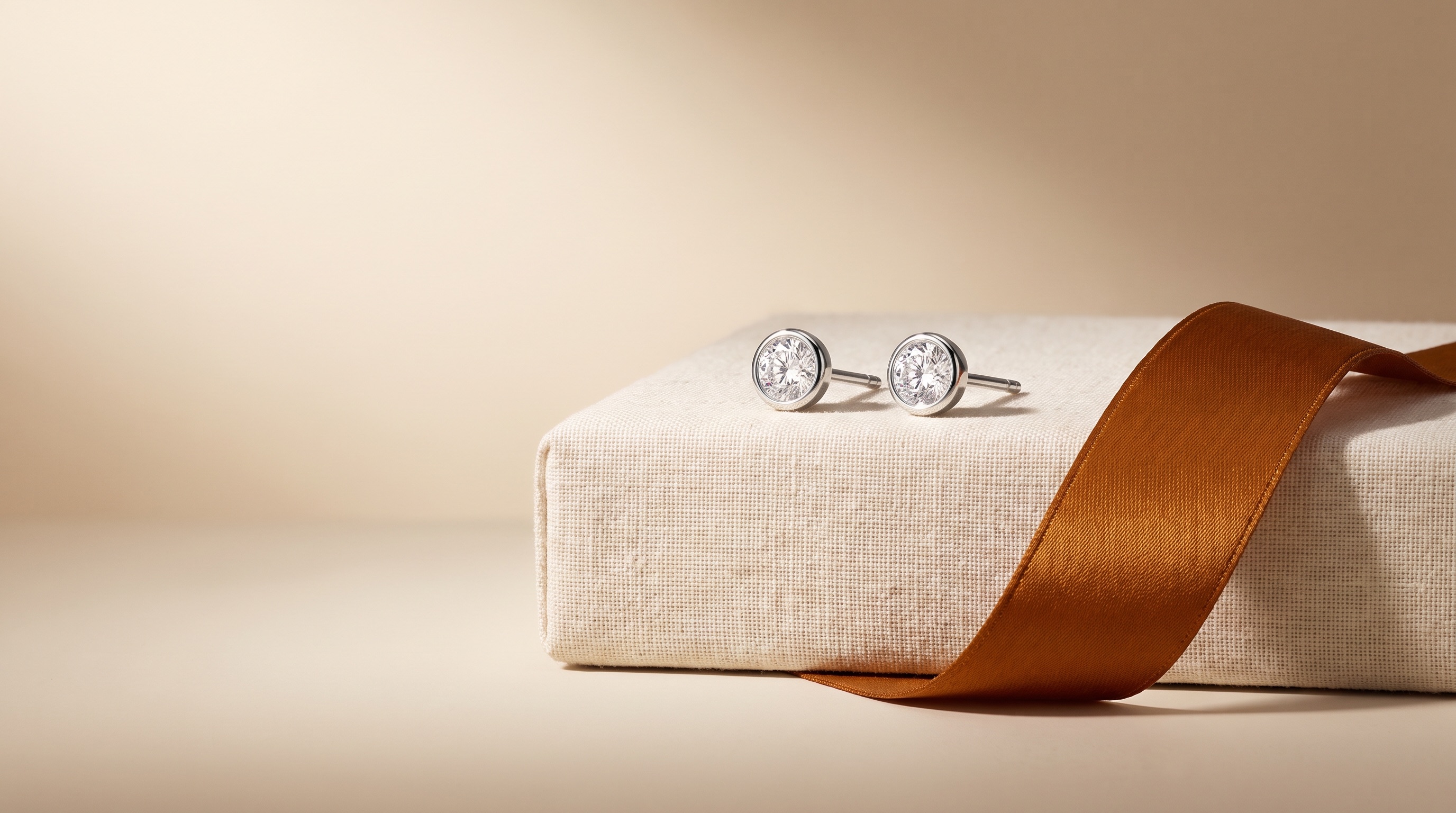
A bezel setting surrounds a diamond with a continuous metal rim rather than holding it with individual prongs, and diamond bezel earrings — studs, drops, or huggies built around this setting style — have grown into one of the most consistently requested earring categories in modern minimalist and everyday-wear jewelry. For a jeweler, bezel construction changes several sourcing decisions relative to prong-set earrings: stone shape and proportion tolerances matter differently, metal usage per piece is higher, and the visual weight of the finished earring is driven as much by the bezel's width and profile as by the stone itself. This guide covers bezel construction types, stone selection for bezel work, durability and sizing tradeoffs, and what to look for in a wholesale diamond supplier for bezel earring production.
This guide is written for the trade — retailers, designers, and manufacturers sourcing loose diamonds to build or expand a bezel earring line — not a consumer buying guide. It covers bezel styles, stone shape and cut considerations specific to bezel work, matched-pair sourcing, and wholesale pricing dynamics for this category.
Why Bezel Settings Are Growing in Earring Demand
Bezel settings have benefited from the same minimalist jewelry trend that's driven demand for bar necklaces, thin stacking rings, and other pared-back styles: a bezel-set stone reads as clean and architectural rather than ornate, with no visible prongs breaking up the line of the metal against the stone. Bezels also carry a practical durability advantage that resonates with everyday-wear buyers specifically — the continuous metal rim protects the stone's girdle from chips and catches far better than open prongs do, which matters more for earrings than for rings since earrings are worn against hair, clothing, and pillows constantly through the day and night. Retailers positioning a bezel earring line specifically on durability and everyday-wear practicality, rather than purely on its minimalist look, are tapping into a real functional advantage rather than a purely aesthetic one.
| Setting Type | Stone Protection | Visual Character | Light Performance |
|---|---|---|---|
| Prong | Lower — exposed girdle and edges | Stone appears larger, more exposed | Maximum light entry from all angles |
| Bezel (full) | Highest — girdle fully enclosed | Clean, architectural, slightly smaller face-up look | Reduced light entry from the sides |
| Half-bezel | Moderate — partial edge protection | Balances exposure with some protection | More light entry than full bezel |
Bezel Construction Types for Earrings
Full Bezel
A continuous metal rim encircles the entire stone with no gaps, offering maximum protection and the cleanest, most minimal line. This is the most common bezel style for stud earrings specifically, since a full bezel stud reads as a single smooth architectural element from any viewing angle.
Half-Bezel or Partial Bezel
Metal covers roughly half the stone's girdle, typically the sides, while the top and bottom remain open — a compromise that keeps most of the protective benefit of a full bezel while letting slightly more light into the stone than a fully enclosed setting allows. This style appears more often in drop and dangle bezel earrings, where the open portions let the stone catch light as it moves.
Floating Bezel
A bezel-set stone mounted with the rim itself nearly invisible from the front, often achieved with a very thin rim profile or a rim set slightly behind the stone's girdle line, creating the visual effect of a stone floating without visible metal. This is a premium, more labor-intensive bezel variant and commands a meaningfully higher setting cost than a standard full bezel.
Diamond Shape Selection for Bezel Settings
Round brilliant is the most commonly bezel-set shape for earrings, since a round bezel is the simplest to fabricate precisely and the least prone to visible gaps between metal and stone. Bezel-setting a fancy shape — oval, pear, marquise, emerald — requires the bezel rim to be hand-fitted or cast to that specific stone's exact outline, since fancy shapes have far less manufacturing tolerance for a slightly imprecise bezel fit than a round stone does; a poorly fitted fancy-shape bezel shows visible light gaps or an uneven metal line around the stone's perimeter, which is one of the most common quality defects buyers encounter in lower-cost bezel earring production. Retailers sourcing fancy-shape bezel earrings should confirm that bezels are fitted to the actual stone being set rather than a standard casting sized to an average shape profile, since the latter approach is a frequent source of the visible-gap defect.
Depth Percentage and Bezel Fit
A stone's depth percentage affects how it sits within a bezel more than it affects prong-set stones, since the bezel rim height needs to be matched to the stone's pavilion depth for the stone to sit flush and secure rather than sitting too high (leaving a visible gap at the base) or too low (risking pavilion damage against the rim). Retailers buying loose stones specifically for bezel production should request depth percentage figures alongside carat weight and should communicate depth ranges to their setting workshop rather than assuming any stone within a standard commercial cut-grade range will sit correctly in a fixed bezel specification — this is a detail that matters more in bezel work than in prong work, where the setting can accommodate more depth variation.
Metal Usage and Weight Considerations
Bezel settings use meaningfully more metal per stone than prong settings, since a continuous rim requires more material than four or six individual prongs — this raises the finished piece's metal cost and total weight relative to a prong-set earring of the same stone size, a factor that matters for wholesale pricing conversations, particularly in platinum where metal cost per gram is highest. Retailers should factor the higher metal usage into cost modeling for bezel lines rather than pricing them identically to a prong-set piece of the same carat weight, since the finished-goods margin on a bezel piece will run lower unless the metal cost difference is reflected in the retail price.
Matched-Pair Sourcing for Bezel Studs
Bezel stud pairs need matching on stone size, color, and — specific to bezel construction — bezel rim width and height, since two visually similar stones set in bezels of slightly different proportions can read as a mismatched pair even when the stones themselves are well matched. Retailers should source stone pairs intended for bezel work with confirmed matching depth percentages specifically, not just carat weight and color, given how directly depth affects bezel fit discussed above, and should have both stones in a pair set by the same setter in the same production run to avoid subtle rim-height inconsistencies between two bezels made at different times.
Bezel Earrings Beyond Studs
While bezel studs are the category's core product, bezel construction also appears in drop, huggie, and climber earring styles — a bezel-set drop earring pairs the durability of a bezel with the visual movement of a hanging design, and bezel huggies have grown alongside the broader huggie hoop trend as a durable, everyday alternative to pavé-set huggies. Retailers building a full bezel earring program should consider offering the setting style across more than just the stud format, since customers drawn to bezel construction for its durability and clean look often want that same construction across multiple earring types in their collection, not just a single stud pair.
Lab-Grown vs. Natural Diamonds for Bezel Earring Programs
Bezel construction works equally well with lab-grown and natural diamonds, since the setting technique doesn't interact with stone origin — but CVD lab-grown material lets a retailer offer bezel earrings at a larger stone size or higher color/clarity grade at a given price point, which matters in this category since a bezel setting's clean, minimal look tends to draw more attention to stone size and clarity than a prong setting with more visual complexity around it. Retailers targeting an everyday-wear, accessible price point for bezel studs commonly lean toward lab-grown material, while natural stones remain a strong choice for bezel earrings positioned as a heirloom-adjacent or premium everyday piece.
Wholesale Price Positioning by Bezel Style
| Bezel Style | Relative Price Position | Key Cost Driver |
|---|---|---|
| Full bezel (round) | Entry to mid | Standard casting, moderate metal usage |
| Half-bezel | Mid | Additional setting labor for partial rim |
| Fancy-shape full bezel | Mid to high | Custom-fitted rim per stone shape |
| Floating bezel | High | Precision thin-rim fabrication, specialized setting labor |
Building a Bezel Earring Program: Inventory Planning
- Lead with round bezel studs as the accessible entry point before expanding into fancy-shape and floating-bezel variants.
- Request depth percentage data on stones sourced specifically for bezel work, not just carat weight and color.
- Confirm fancy-shape bezels are fitted to the actual stone, not a standard casting sized to an average outline.
- Price bezel pieces to reflect higher metal usage rather than matching prong-set pricing at the same carat weight.
- Extend the bezel construction across drop, huggie, and climber formats, not just studs, to capture customers drawn to the setting style specifically.
Merchandising Bezel Earrings on Durability and Everyday Wear
Because bezel construction's core practical advantage — better stone protection for constant, all-day wear — is a genuine differentiator rather than a purely aesthetic claim, retailers get more mileage merchandising this category on that functional benefit than on look alone. Point-of-sale and product copy that explains why a bezel protects a stone better for daily wear (versus a purely descriptive "clean, modern setting" line) tends to resonate particularly well with buyers shopping for a piece they intend to wear constantly rather than for occasional or evening use, which is a meaningfully different buyer motivation than the one driving statement or occasion-specific earring purchases.
Bezel Rim Profiles and Finish Options
Beyond the basic full, half, and floating bezel categories, the rim itself can be fabricated in several profiles that affect both cost and finished appearance: a straight, flat-topped rim is the simplest and least expensive to produce; a rounded or "bombe" rim profile reads as softer and slightly more substantial and is common in higher-end bezel work; and a milgrain-edged rim adds a fine beaded texture along the top edge for a more vintage-influenced look. Finish also matters more visibly in bezel earrings than in prong settings, since the entire rim is a continuous visible surface rather than a series of small points — a high-polish bezel reads as sleek and contemporary, while a brushed or satin-finished bezel has grown in popularity for retailers targeting a quieter, more understated aesthetic. Retailers should decide on a primary rim profile and finish standard for their core bezel line rather than offering an unmanaged number of variations, since rim and finish choices affect tooling and setting labor costs across a production run. It's also worth noting that finish durability varies by profile: a high-polish rim shows wear scratches more readily over years of daily contact with hair and clothing than a brushed or satin finish does, which is a genuine practical consideration worth raising with buyers who are choosing a finish primarily on current styling preference without factoring in how the piece will look after extended everyday wear.
Setting Workshop Selection for Bezel Production
Not every jewelry manufacturing partner is equally skilled at bezel work specifically — because a bezel's fit depends on precise fabrication rather than a more forgiving prong bend, a workshop accustomed primarily to prong-set production can produce visibly inconsistent results when asked to switch to bezel work without dedicated tooling and setter experience in the technique. Retailers vetting a manufacturing partner for a new bezel line should ask specifically about the workshop's bezel-setting volume and request sample pieces in the exact stone shapes planned for the line, rather than assuming general setting competency translates directly to strong bezel results. This matters most for fancy-shape and floating-bezel work, where fabrication precision has the largest visible impact on the finished piece, and matters least for standard round full-bezel studs, which are the most forgiving and widely produced bezel format across most manufacturing partners. A practical way to vet a new workshop partner before committing to a full production run is to order a small pilot batch across the specific shapes and bezel styles planned for the line, inspect the pilot pieces under magnification for rim-to-girdle gaps and finish consistency, and only scale to a full order once the pilot confirms the workshop's bezel work meets the standard the line requires — a small upfront pilot cost is far less expensive than discovering a systemic fit or finish problem across a full production run, and it also gives a retailer a concrete, physical reference sample to hold new production batches against as the line scales beyond its first order.
Sizing Bezel Studs for a Retail Assortment
Bezel stud earrings are commonly stocked across a carat range from roughly 0.10ct to 1.00ct+ per stone, and because a bezel setting visually reduces a stone's apparent face-up size slightly compared with an open prong setting — the rim itself takes up some of the visual field a customer's eye would otherwise read as stone — retailers should expect and communicate that a bezel-set stone of a given carat weight will look marginally smaller than the same stone in a prong setting. This is worth addressing directly in product education or sales training, since a customer comparing a bezel stud against a prong stud of the identical carat weight may otherwise perceive the bezel piece as a lesser value if the size difference isn't explained as a setting effect rather than an actual stone-size shortfall.
| Carat Range | Typical Use Case | Bezel Width Consideration |
|---|---|---|
| 0.10–0.25ct | Everyday minimal studs, second-piercing pairs | Thin rim to avoid overwhelming a small stone |
| 0.25–0.50ct | Core everyday-wear assortment | Standard rim width, balanced proportions |
| 0.50–1.00ct | Elevated everyday or gifting tier | Slightly wider rim reads intentional, not undersized |
| 1.00ct+ | Statement bezel studs | Rim width scaled carefully to avoid visually shrinking the stone |
Bezel Earrings in a Second-Piercing and Curated-Ear Assortment
Small bezel studs, typically in the 0.05-0.15ct range, have become a staple of the curated-ear and multi-piercing trend, where customers build an arrangement of several small pieces across multiple piercings rather than a single pair. This has created real wholesale demand for very small, precisely fabricated bezel studs sold individually rather than exclusively as matched pairs, since curated-ear customers frequently mix single pieces across different piercings rather than buying identical pairs for symmetric ear placement. Retailers building a curated-ear assortment should consider stocking small bezel studs as singles as well as pairs, and should be prepared to source these very small stones with tight consistency across a parcel, since minor size variation is more visually obvious at this small scale than in a standard 0.25ct+ stud range.
Common Sourcing Mistakes in Bezel Earring Programs
The most frequent defect in bezel earring production is a poorly fitted fancy-shape bezel that leaves a visible light gap or uneven metal line around the stone, typically the result of using a standard casting rather than fitting the bezel to the specific stone being set. A second common mistake is failing to account for depth percentage when sourcing stones for bezel work, leading to stones that sit too high or too low within a fixed bezel specification. A third is underpricing bezel pieces relative to their actual metal cost, since the higher material usage compared with prong settings isn't always obvious to a retailer pricing primarily off stone cost and carat weight, and can quietly compress margin on an entire bezel line if not corrected.
Sourcing Diamonds for a Bezel Earring Line Wholesale
Guru Diam supplies loose CVD lab-grown and natural diamonds — round and fancy shapes, sold individually or as pre-matched pairs with confirmed depth and proportion data — suited to bezel setting work, with IGI, GIA, and GCAL certification available at 0.30ct and above. Trade buyers can review current matched-pair and certified inventory through matching pairs and certified diamonds, and work with Guru Diam's custom jewelry team on bezel fabrication through custom jewelry. In-stock inventory ships same-day from Guru Diam's New York and Los Angeles locations. New trade accounts can apply through trade partner, with current terms available at the wholesale hub. For related sourcing fundamentals, see our diamond stud earrings guide, diamond huggie earrings guide, and diamond drop earrings guide.
Frequently Asked Questions
What is a bezel setting?
A bezel setting surrounds a diamond with a continuous metal rim rather than holding it with individual prongs, fully or partially enclosing the stone's girdle for added protection and a clean, minimal visual line.
Are bezel-set diamond earrings more durable than prong-set earrings?
Yes — the continuous metal rim protects the stone's girdle from chips and catches better than open prongs, which matters especially for earrings worn constantly against hair, clothing, and pillows.
Which diamond shapes work best in bezel settings?
Round brilliant is the simplest and most common shape for bezel work. Fancy shapes require the bezel to be custom-fitted to that specific stone's outline, since they have far less tolerance for an imprecise bezel fit.
Do bezel settings cost more than prong settings?
Bezel settings use more metal per stone than prong settings, which raises finished-piece cost and weight, particularly in platinum. Retailers should price bezel pieces to reflect this rather than matching prong-set pricing.
Should bezel earring diamonds be lab-grown or natural?
Both work well. CVD lab-grown diamonds let a retailer offer a larger stone or higher grade at an accessible price point for everyday-wear bezel pieces, while natural stones suit premium or heirloom-adjacent positioning.
What is a floating bezel?
A bezel setting with a very thin or recessed rim that creates the visual effect of the stone floating with minimal visible metal. It's a premium, more labor-intensive bezel variant that commands a higher setting cost.
Does a bezel setting make a diamond look smaller?
Slightly — the rim occupies part of the visual field a prong setting would leave open, so a bezel-set stone can read marginally smaller face-up than the same carat weight in a prong setting. This is a setting effect, not an actual size difference, and is worth explaining to buyers comparing the two styles.
Guru Diam is a trade-only wholesale diamond supplier with locations in New York and Los Angeles, supplying loose natural and CVD lab-grown diamonds — sold individually or as pre-matched pairs — with IGI, GIA, and GCAL certification available, for jewelers building earring, ring, and finished jewelry lines. Browse current inventory in matching pairs or apply for a trade account through trade partner.