A diamond's anatomy is the set of named structural parts — table, crown, girdle, pavilion, and culet — that together determine how light enters, bounces, and exits the stone, which is the physical basis for everything graded on a cut report. Understanding these parts individually, rather than just glancing at an overall cut grade, lets a buyer spot exactly which proportion is driving a stone's brilliance, or its problems, before committing to a purchase — and it's the same vocabulary graders, cutters, and setters all use, so it's worth learning regardless of which side of a transaction someone sits on.
The Five Named Parts of a Diamond
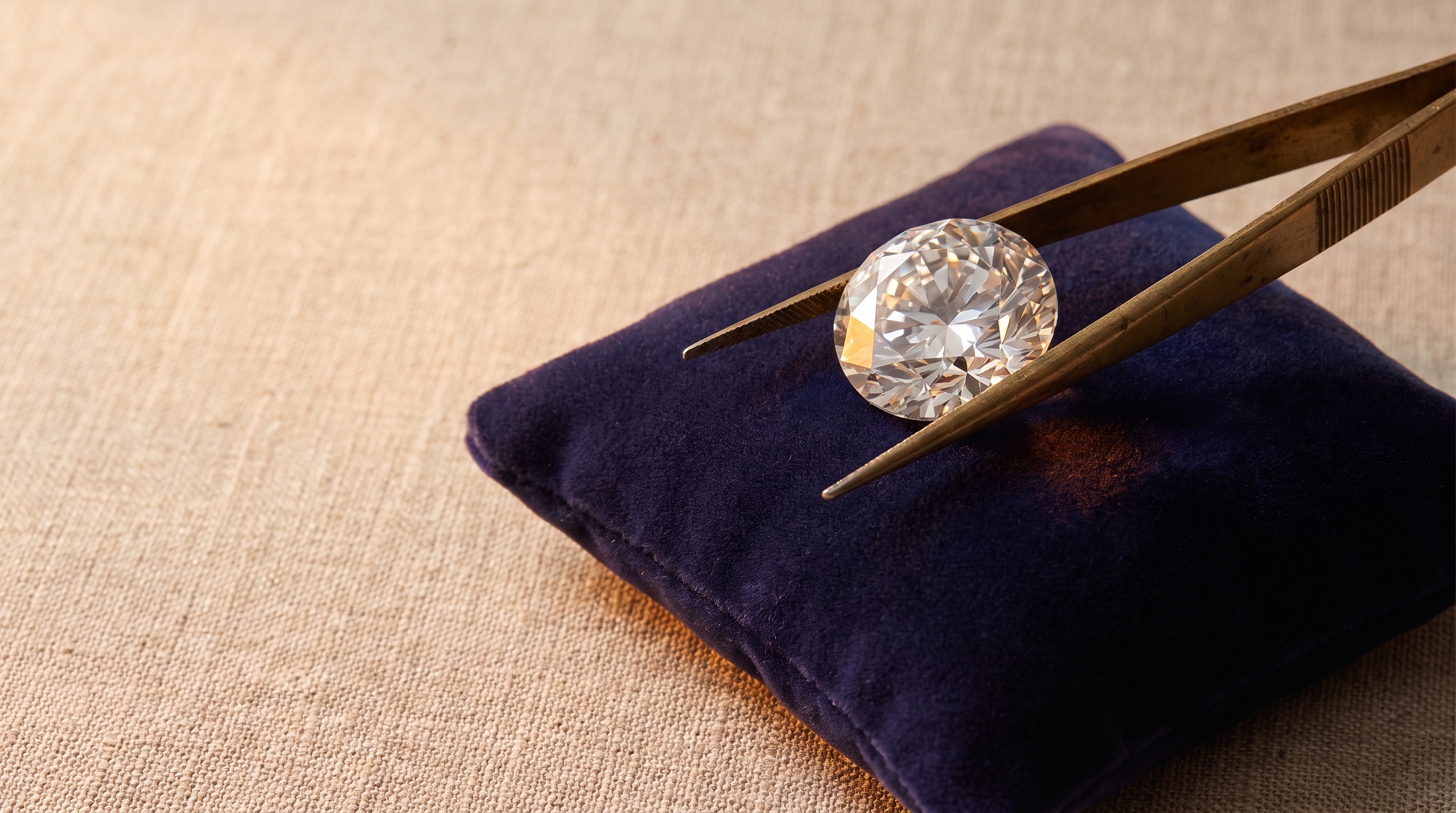
Every polished diamond, regardless of shape, is described using the same five structural regions. The table is the large, flat facet on top, the widest single facet on the stone and the main entry point for light. The crown is the upper, sloped portion between the table and the girdle, made up of angled facets that bend incoming light. The girdle is the narrow band running around the stone's widest point, separating the crown above from the pavilion below. The pavilion is the lower, cone-shaped portion beneath the girdle, whose angled facets reflect light back up through the table. The culet is the very bottom point of the pavilion — ideally a sharp point in modern well-cut stones, though older cuts often show a small flat facet there instead.
The Girdle: The Diamond's Structural Waistline
The girdle is the thin, unpolished or lightly faceted band that forms the stone's outer edge at its widest point — effectively the diamond's waistline, and the section a setting's prongs or bezel actually grip. Girdle thickness is graded on a scale from extremely thin to extremely thick, and it matters for two separate reasons: durability and how the finished stone wears its carat weight.
Girdle Thickness and Durability
A girdle that's too thin is fragile and vulnerable to chipping during setting, wear, or an accidental knock — the edge simply doesn't have enough material to absorb an impact. A girdle that's too thick adds weight (and therefore cost) without adding visible size, since that extra material sits hidden under the setting rather than contributing to the stone's face-up appearance. The generally preferred range for durability and value is thin to slightly thick, which balances structural strength against paying for weight the eye never sees.
Faceted vs. Polished vs. Bruted Girdles
Girdles are finished in one of three ways. A faceted girdle has small polished facets running around its circumference, which is standard on well-cut modern diamonds and gives the girdle a slightly frosted-but-sparkling look under magnification. A polished girdle is smooth and non-faceted, less common on new production. A bruted girdle has a rougher, matte, unpolished finish, more common on older or lower-cost production. Faceted girdles are generally preferred in the modern trade for their cleaner look and slightly better light performance at the girdle edge.
Table Percentage: How Much Light Enters
Table percentage is the table facet's width expressed as a percentage of the stone's total diameter, and it's one of the two proportions (alongside depth percentage) that most directly drives a stone's brilliance and fire. A larger table lets in more light and creates larger, bolder flashes, but too large a table reduces the angled crown facets' ability to disperse that light into colorful fire, giving the stone a flatter, glassier look. Too small a table has the opposite problem — plenty of fire and dispersion, but a comparatively dim, less brilliant overall appearance.
For round brilliant diamonds, the generally preferred table percentage range is roughly 53-58% for an excellent-cut grade, though the ideal range shifts somewhat by shape — step cuts like emerald and Asscher, for instance, are built around a much larger table by design, since their faceting style relies on broad, flat flashes of light rather than the scintillation pattern of a brilliant cut.
Depth Percentage: How Light Travels Through the Stone
Depth percentage is the stone's total height (table to culet) expressed as a percentage of its diameter, and it governs the angle at which light entering the table travels down through the pavilion and either reflects back up through the crown (good) or leaks out the bottom or sides (bad). A diamond cut too shallow lets light escape through the pavilion before it can reflect back to the eye, creating a washed-out, less brilliant look, often visible as a dark, unlit ring near the girdle called a "fish-eye" effect in extreme cases. A diamond cut too deep traps light that reflects at the wrong internal angles and exits through the pavilion's sides rather than back through the table, creating a dark center or "nail-head" effect that also reduces brilliance.
For round brilliants, the generally preferred depth percentage range for an excellent-cut grade is roughly 59-62.5%. Table and depth percentage interact closely — a cutter adjusting one to preserve carat weight from the rough stone often has to compensate with the other, which is part of why a diamond's overall cut grade considers the full combination of proportions rather than any single number in isolation.
The Culet: A Small Detail With an Outsized History
The culet is the diamond's bottom-most point, where the pavilion facets converge. In an ideally cut modern diamond, the culet comes to a sharp point with essentially no visible flat facet — graded simply "none" or "very small" on a cut report. Older cutting styles, particularly antique cuts like the Old Mine and Old European cut, deliberately included a larger, visible flat culet facet, both as a practical measure against chipping the vulnerable bottom point and as a stylistic feature of the era's cutting technology.
When a Larger Culet Is a Problem
On a modern brilliant-cut diamond, a culet large enough to be visible face-up (through the table, without magnification) is generally considered a cut flaw — it appears as a small dark or reflective dot at the stone's center and pulls the eye away from the surrounding brilliance. Culet size beyond "slightly large" typically drags a stone's overall cut grade down, since it represents wasted material that doesn't contribute to light return and, in visible cases, actively detracts from face-up appearance.
When a Larger Culet Is Expected and Correct
On genuine antique cuts, a visible culet facet isn't a flaw — it's a period-correct structural feature, and grading antique-cut stones against modern brilliant-cut culet standards misunderstands what the style is actually going for. Buyers and appraisers familiar with antique cuts expect and look for this feature rather than treating it as a defect, since removing it entirely would mean re-cutting the stone into a different (and less historically faithful) profile.
How These Proportions Interact With Each Other
None of these measurements should be evaluated in total isolation — a diamond's overall light performance comes from how table percentage, depth percentage, girdle thickness, crown angle, and pavilion angle all work together. A stone can have an individually "ideal" table percentage and still underperform if its depth percentage or pavilion angle is off, and cutters constantly trade off between these proportions to balance light performance against preserving carat weight from the rough material. This is why an overall cut grade (Excellent, Very Good, Good, and so on) is a more reliable single signal than fixating on any one proportion — but knowing what each individual measurement means lets a buyer understand why a particular grade landed where it did, and spot a specific issue (an oversized culet, an unusually thick girdle) that a summary grade alone might not flag clearly.
Diamond Anatomy Proportions at a Glance (Round Brilliant)
| Proportion | What It Measures | Generally Preferred Range | Effect When Off-Range |
|---|---|---|---|
| Table % | Table width vs. diameter | ~53-58% | Too large: flatter look. Too small: dimmer look |
| Depth % | Total height vs. diameter | ~59-62.5% | Too shallow: light leaks out bottom. Too deep: dark center |
| Girdle thickness | Width of the outer band | Thin to slightly thick | Too thin: chip risk. Too thick: hidden extra weight/cost |
| Culet | Size of the bottom-point facet | None to very small (modern cuts) | Visible face-up: distracting dark spot, lower cut grade |
The Girdle as an Inscription Surface
Beyond its structural role, the girdle is also where a diamond's laser inscription lives — a microscopic engraving, typically the certificate number, applied to the girdle's surface for identification without affecting the stone's appearance to the naked eye. This matters practically for buyers verifying a stone against its paperwork: matching the inscribed number under a jeweler's loupe or microscope to the certificate is the fastest way to confirm a specific physical stone is the one the report actually describes, rather than relying on measurements alone, which can coincidentally match more than one stone of similar size and grade. A girdle finished too thin can occasionally make an inscription harder to apply cleanly, which is one more practical reason extremely thin girdles are avoided in production even before durability is considered.
How Anatomy Proportions Affect Price Beyond the Cut Grade Label
Two stones can carry the same headline cut grade — both "Excellent," for instance — while pricing differently in the market because their underlying proportions sit in different parts of the acceptable range. A stone with a table and depth percentage close to the center of the ideal range, a girdle in the thin-to-slightly-thick zone, and a culet graded "none" typically commands a premium over a stone that technically qualifies for the same grade but sits nearer the edges of each acceptable range. Buyers comparing two similarly priced, similarly graded stones should pull the individual proportion numbers rather than assuming the shared grade label means the stones are functionally identical — this is one of the more common ways a buyer can identify genuinely better relative value within the same grade tier.
Common Anatomy-Related Buying Mistakes
- Judging cut quality from carat weight or price alone. A heavier or more expensive stone isn't automatically better cut — proportions have to be checked directly on the certificate, since a poorly proportioned stone can still carry significant carat weight and price.
- Assuming "Excellent" cut grade means identical proportions across stones. As covered above, the grade is a range, not a single fixed set of numbers, and two "Excellent" stones can differ meaningfully in exactly how close they sit to the ideal center of that range.
- Grading antique cuts against modern brilliant-cut standards. A period-correct visible culet or a girdle finish typical of early-20th-century cutting technology isn't a flaw on an antique-style stone — it's an expected feature of the style, and treating it as a defect misreads the category entirely.
- Ignoring girdle thickness because it's a smaller number than table or depth percentage. Girdle thickness has a direct, practical durability implication for how the stone will hold up under a setting's daily grip — it's not a minor cosmetic detail.
How Cutting Technology Has Shaped These Proportions Over Time
Early diamond cutting, working entirely by hand with comparatively primitive tools, produced cuts like the Old Mine and Old European with deeper pavilions, smaller tables, and larger, more visible culets than modern cutting standards would recommend — not because early cutters were working to a different ideal, but because their tools and understanding of light behavior were less precise than what computer-assisted modern cutting now allows. Modern cutting technology, including laser precision measurement and computer modeling of light paths through a planned cut, lets today's cutters hit tighter, more consistent proportion targets across large volumes of stones, which is part of why proportion consistency has become a meaningful differentiator between suppliers rather than a given. This same technological gap is why antique-style cuts produced today are a deliberate stylistic choice referencing historical proportions, not simply what cutting technology of the era was limited to.
How to Check These Proportions on a Certificate
Every major grading lab report (GIA, IGI, GCAL) lists table percentage, depth percentage, girdle description, and culet size explicitly in the stone's proportions section, alongside the overall cut grade. Buyers comparing two stones with the same overall cut grade can use these individual numbers as a tiebreaker — a stone sitting closer to the center of the preferred ranges on all four measurements is generally the more consistently well-cut stone, even if both carry the same headline grade.
Why These Terms Matter Beyond Grading
Beyond grading and light performance, these anatomy terms come up constantly in practical trade conversations: a jeweler describing a chip near the girdle to a repair customer, a setter confirming a stone's girdle thickness before choosing prong pressure, or a buyer negotiating price based on a stone sitting at the edge of the acceptable depth-percentage range. Having precise vocabulary for each part of the stone — rather than describing everything as "the edge" or "the bottom" — makes these conversations faster and more accurate on both sides of a transaction.
This vocabulary also matters when training newer sales staff. A team member who can point to a stone under a loupe and explain, specifically, that its girdle is graded "thin" rather than "very thin" and why that's a meaningfully different durability profile builds more customer trust than one reciting a memorized "it's a good cut" line. Retailers investing even a short internal training session on these five terms tend to see it pay off directly in how confidently staff can answer detailed customer questions at the counter.
Anatomy Terms Across Different Shapes
The five-part anatomy applies to every diamond shape, but the specific proportions considered ideal shift by shape. Step cuts (emerald, Asscher) run larger tables by design and are more forgiving on depth percentage because their broad, flat facets create a different light-return pattern than a brilliant cut's small, angled facets. Elongated shapes (oval, marquise, pear) introduce an additional consideration — the "bow-tie effect," a dark shadow across the stone's center caused by light leakage related to depth and angle proportions specific to elongated outlines, distinct from but related to the same table/depth/pavilion interactions described above for round stones.
Antique fancy shapes carry their own proportion norms layered on top of the standard anatomy. A Kite or Hexagonal-cut stone, for instance, is evaluated on the same table, depth, girdle, and culet basics, but the acceptable ranges for each shift to reflect the shape's own historical cutting conventions rather than round-brilliant benchmarks — comparing a Kite cut's proportions against round-brilliant ideal ranges will misread the stone every time, since the two shapes are optimized for different light-return geometries entirely. Buyers working across multiple shapes are better served learning each shape's own proportion norms than applying one universal ideal-proportions checklist to every stone that crosses their desk.
Sourcing Well-Proportioned Diamonds Through Guru Diam
Every diamond Guru Diam sells — natural or CVD lab-grown, round or fancy shape — ships with full proportions listed on its IGI, GIA, or GCAL certificate, including table percentage, depth percentage, girdle description, and culet size, so buyers can evaluate cut quality on the specific proportions covered here rather than relying on a summary grade alone. Guru Diam's antique-cut inventory (Old Mine, Old European, and other period styles) is graded with the correct antique-cut expectations in mind, including period-appropriate culet sizing that shouldn't be penalized against modern brilliant-cut standards. Sales staff sourcing through Guru Diam can request proportion data alongside standard 4Cs details when comparing multiple stones for a specific customer request, rather than working from grade summaries alone.
Browse certified loose stones with full proportion data through certified diamonds, or the broader catalog through the wholesale hub. Trade accounts can be set up through trade partner. For shape-specific proportion considerations, see GD's engagement ring shapes guide, and for how these proportions interact with setting choice, see the engagement ring settings guide. Matched pairs sourced for earrings or side stones, where consistent proportions across two stones matter as much as the individual grade, are available under matching pairs.
Frequently Asked Questions
What is a diamond girdle?
The girdle is the narrow band running around a diamond's widest point, separating the crown (top) from the pavilion (bottom). It's the section a setting's prongs or bezel typically grip, and its thickness affects both the stone's durability and how much of its carat weight is visible versus hidden under the setting.
What is a good table percentage for a diamond?
For a round brilliant diamond, roughly 53-58% is generally considered the range for an excellent cut grade. Table percentage ideals shift for other shapes — step cuts like emerald and Asscher are built around larger tables by design.
What does depth percentage mean on a diamond certificate?
Depth percentage is the stone's total height (table to culet) expressed as a percentage of its diameter. It's one of the main drivers of how well light travels through the stone and reflects back to the eye — too shallow or too deep and light leaks out rather than returning as brilliance.
Is a visible culet bad on a diamond?
On a modern brilliant-cut diamond, yes — a culet visible face-up without magnification typically shows as a small dark spot and lowers the overall cut grade. On genuine antique cuts (Old Mine, Old European), a visible culet facet is a correct, expected period feature, not a flaw.
Why does girdle thickness matter?
Too thin a girdle is fragile and prone to chipping; too thick a girdle adds hidden weight and cost without adding visible size, since the extra material sits under the setting. Thin to slightly thick is generally the preferred balance for both durability and value.
Where do I find these measurements for a specific diamond?
Every major grading report (GIA, IGI, GCAL) lists table percentage, depth percentage, girdle description, and culet size in the stone's proportions section, alongside its overall cut grade — all four numbers are printed explicitly, not something a buyer needs to estimate visually.
Can I see a diamond's girdle thickness without a loupe?
Not reliably with the naked eye — girdle thickness is typically evaluated under 10x magnification by a trained grader, and the resulting description (extremely thin through extremely thick) is printed on the certificate. A jeweler's loupe can give a general impression, but the certified grading is the accurate reference for buying decisions.