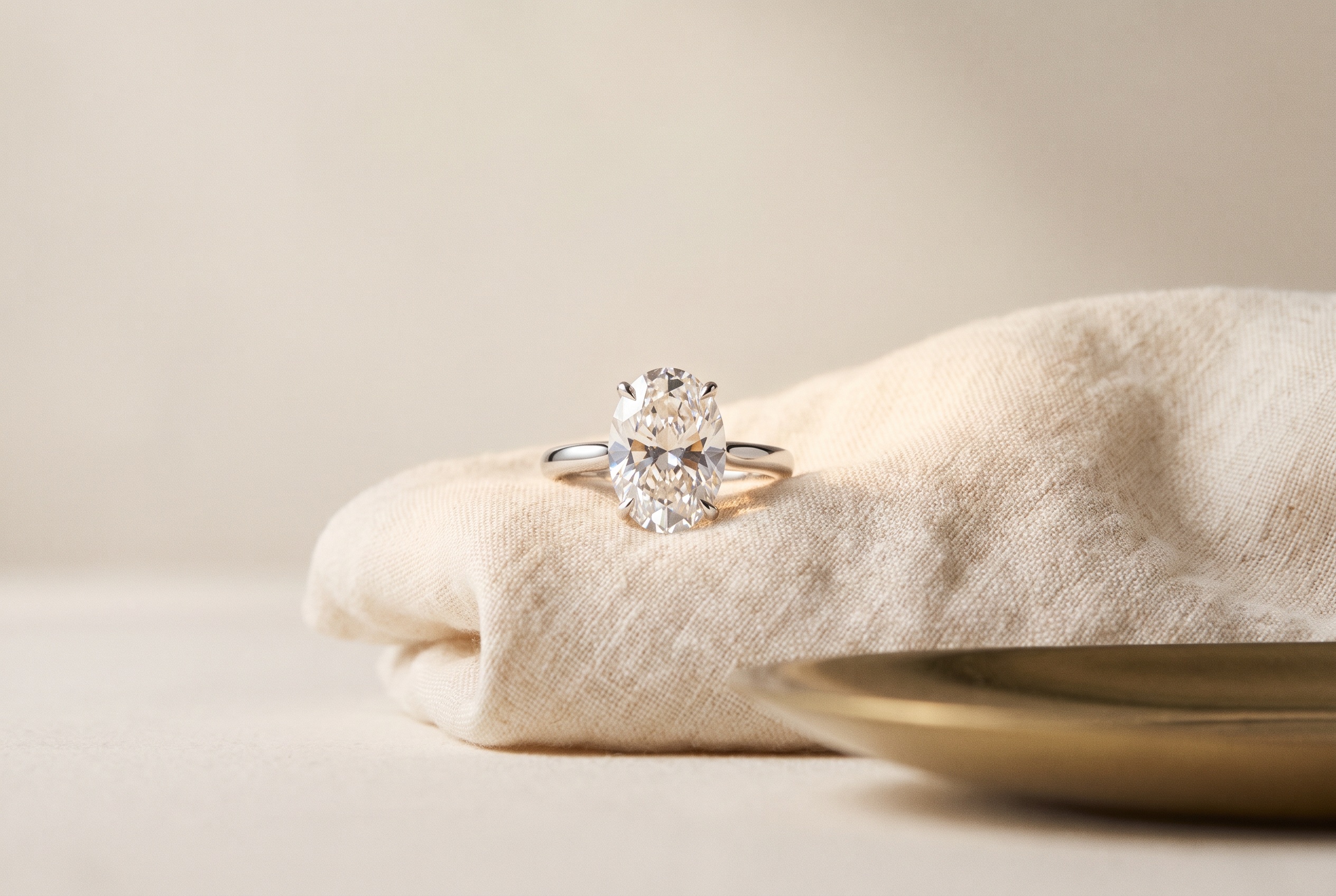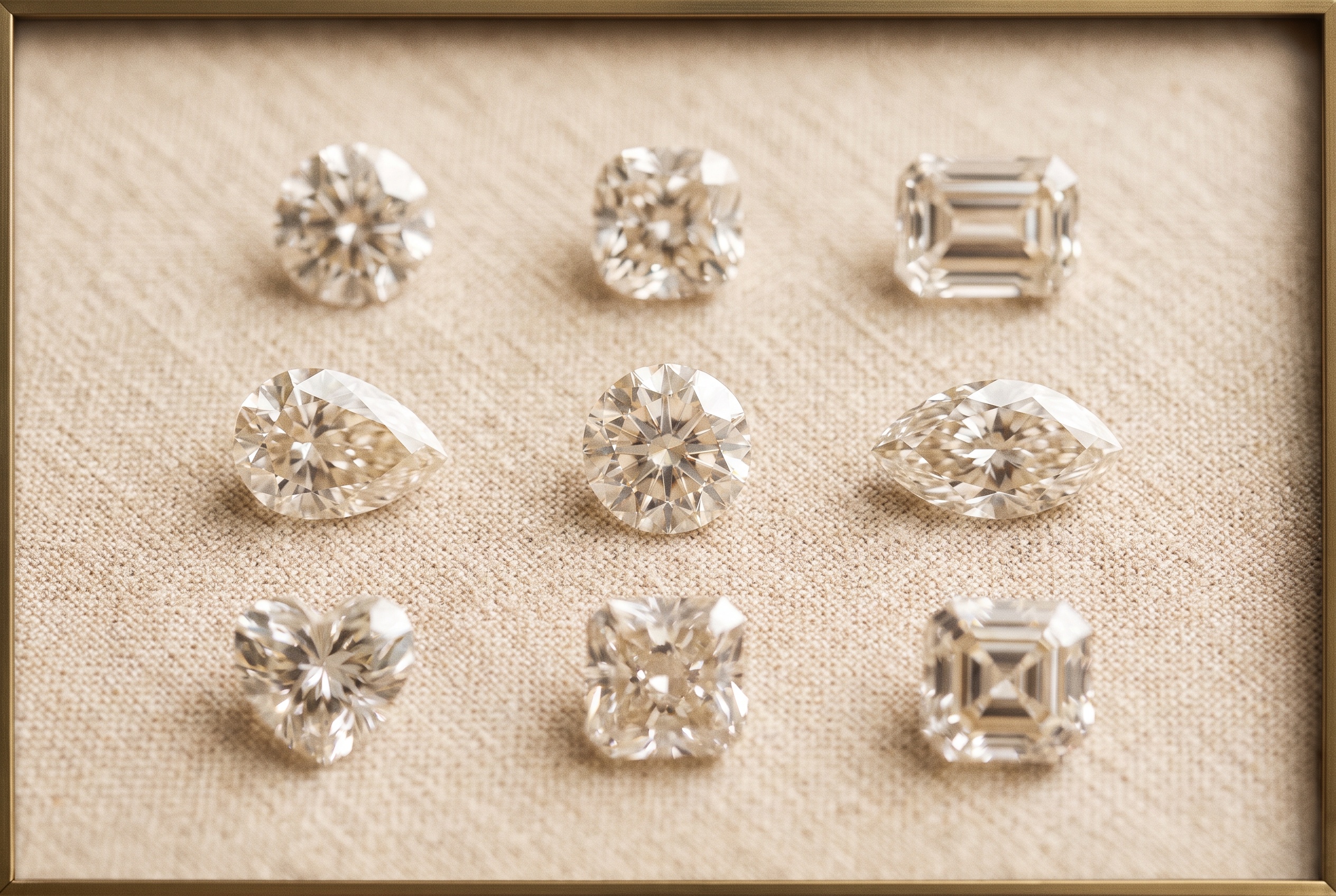


A customer-supplied stone — an heirloom center diamond, a stone pulled from an old mounting, anything the retail customer already owns — gets handled as memo goods, not inventory. That means it is never commingled with a manufacturer's own certified stock, it gets a written condition report with photos before anyone touches it, it carries a chain-of-custody number through every production stage, it is insured in transit and in production at its appraised value (not under a blanket studio policy), and there is a pre-agreed plan for what happens if the stone doesn't fit the approved design once it's actually in hand. If your manufacturing partner can't describe that process to you in specific terms before you ship a client's stone, that's the question to press on before you send anything.
This is a different workflow than ordering a piece built around certified diamonds from a supplier's own stock. The stone isn't being sold to you. It's being handed to a third party for a service — cutting a seat, setting it, sometimes recutting or re-polishing it — and then handed back. The manufacturing partner never owns it, never invoices for it, and treats it as a liability on their books the entire time it's in the building.
Why This Comes Up in Custom Orders
Retail jewelers run into customer-supplied stones constantly: a grandmother's engagement diamond going into a new setting, a stone salvaged from a marriage that didn't work out, an inherited pendant stone the customer wants reset as a ring. The jeweler sells the design and labor. The stone itself is the customer's property from start to finish.
The mistake some shops make is treating that stone the same way they'd treat a diamond drawn from certified inventory — same intake, same tracking, same casual handling. It isn't the same. A stone from inventory that gets scratched or chipped in production is a loss the manufacturer absorbs and replaces from stock. A customer's stone that gets damaged is a claim against a piece of property that can't be replaced, and often can't be fully valued after the fact if there's no documentation of its condition beforehand.
What Counts as Memo Goods — and When a Partner Should Decline the Job
The word "memo" does double duty in the diamond and jewelry trade. The older, more common usage is consignment: a wholesaler ships stones or finished pieces to a retailer "on memo," the retailer displays and sells them without paying up front, and anything unsold goes back by an agreed date — title stays with the supplier throughout, tracked with a memo slip listing item, value, and return terms. That has nothing to do with a customer's own property. The usage this article covers is different: a customer's own stone entrusted to a manufacturing partner for a job, with no sale happening in either direction. What links the two is the underlying risk question, not the transaction — someone is holding an asset that isn't theirs, on a temporary and documented basis, with an obligation to return it in the condition it was received.
In the customer-supplied-stone sense, memo goods typically means: an heirloom or inherited stone, a stone salvaged from a prior setting the customer is repurposing, or a stone the customer already owns from any other source and wants incorporated into a new piece. What it doesn't mean is a stone purchased new from the manufacturer's own catalog — that's ordinary inventory, invoiced and sold in the normal course of business, with none of the custody obligations described here. It's worth being explicit about that distinction on the job ticket itself, because "memo" and "inventory" should never read as ambiguous on the same order.

Not every job that comes through the door as a customer-supplied stone should be accepted as-is. A manufacturing partner with a serious memo process will pause — and sometimes decline or refer the job back to the retail jeweler for more information — when any of the following show up:
- The stone has a visible fracture or feather reaching close enough to the surface that ordinary bench heat or pressure during setting risks propagating it, and the customer hasn't been told about that risk in writing beforehand
- There's no way to establish a credible declared value — no appraisal, no prior certification, nothing comparable to reference — which makes it impossible to price insurance coverage honestly
- The chain of custody arriving at the manufacturer is already broken — the stone shows up with paperwork that doesn't match what's physically in hand
- The customer or jeweler wants to skip the intake condition report to save time — the single request a manufacturing partner should never agree to, since it removes the one record protecting everyone if a dispute comes up later
None of this is about distrust of any individual customer. It's about the fact that once a manufacturer has physical custody of property it doesn't own and can't fully value, the only protection available is the documentation trail built before work starts.
The Memo Agreement: What Should Be in Writing Before the Stone Moves
Before a stone is even packed for shipment, there's a paperwork layer that should exist separately from the physical condition report described in the next section. A memo agreement is the commercial and legal side of the arrangement — signed before the stone leaves the retail counter, not after it arrives at the bench. At minimum, it should specify:
- A description of the item precise enough to be unmistakable — shape, approximate carat weight, any identifying marks or known history
- A declared value, agreed by both sides, that becomes the basis for insurance coverage on both legs of the trip and for resolving any dispute if something goes wrong
- The scope of the job — reset, recut, resize, repair — stated plainly enough that "work performed" can't later be read more broadly than intended
- Which party carries insurance liability at each stage: in transit each direction, and while the stone is physically on-site at the manufacturer
- A statement that title never transfers — the manufacturer is a custodian for a service, not a buyer, at any point in the process
- Signatures from an authorized person releasing the stone and an authorized person receiving it, on both the outbound and return legs
The memo agreement and the intake condition report answer different questions and shouldn't be treated as the same document. The agreement covers what was agreed to and who is liable for what. The condition report, covered next, covers what the stone actually looked like the moment it physically arrived. A shop that only has one of the two is missing half the protection.
Intake: Condition Report and Chain of Custody
The intake step is where most of the risk in a memo-goods job gets managed or mismanaged. A serious manufacturing partner does this before the stone goes anywhere near a bench.

What Gets Documented at Intake
- Photographs of the stone loose, under magnification, from multiple angles, showing any existing inclusions, chips, or wear at the girdle or culet
- Weight taken on a calibrated scale at intake, not estimated from a prior appraisal
- Measurements — diameter, depth, table percentage — recorded independently of whatever paperwork came with the stone
- Cut identification — this matters more than people expect. An heirloom stone is frequently an Old Mine or Old European cut, sometimes a Rose Cut or another antique-era style, and the condition report should describe the actual cut observed, not just copy a label from an old receipt
- Existing certification, if any — a lab report from IGI, GIA, GCAL, or another grading lab traveling with the stone, logged and photocopied, not just glanced at
- A unique job/lot number assigned to the stone that follows it through every stage — CAD, wax, casting, setting, QC, shipping — so at any point someone can answer "where is this stone right now" without asking around
That condition report is signed off by both sides before work starts. It's the reference point if any dispute comes up later about whether damage existed before the job began or happened during production.
Many heirloom stones don't travel with a lab report at all — plenty were cut and set before third-party certification became standard practice. In that case, an in-house gemologist typically records an informal working estimate of color and clarity range for internal reference: useful for the declared-value conversation and for judging whether the stone can safely take heat and pressure during setting, without commissioning a new grading report. Sending a customer's own stone out to a lab adds another shipment and another custody gap for a job where nobody is buying or selling against a grade — the customer is only getting their own stone reset. If the client separately wants a full certificate for insurance purposes, that's a request the jeweler can make on their behalf through IGI, GIA, or GCAL, independent of the manufacturing job itself.
Chain of Custody Through Production
Once intake is done, the stone should never move between departments without a logged handoff. In practice that looks like a stone travel bag or vial with the job number on it, checked in and checked out at each station: design/CAD confirmation, stone-setting, polishing, final QC. This isn't paperwork for its own sake — it's how a shop can tell you, with certainty, which bench the stone was on at any given hour, and it's what prevents a memo stone from getting mixed into a bin with certified inventory or another customer's job.
Insurance During Transit and Production
Two separate exposure windows need separate coverage, and jewelers should ask about both explicitly rather than assuming a manufacturer's general liability policy covers a customer's stone.
Transit coverage applies from the moment the stone leaves the retail counter until it's signed for at intake, and again on the return trip once the finished piece ships back. This is typically handled through insured courier services (registered mail with declared value, or a jeweler's carrier like the ones used for memo shipments industry-wide) rather than standard parcel shipping. The declared value should match a current appraisal, not a guess.
In-production coverage applies while the stone is on-site — during CAD fitting, casting, setting, and polishing. This should be a specific rider or endorsement tied to the appraised value of that individual stone, not an assumption that a shop's general policy automatically extends to customer property. Ask your manufacturing partner directly: is there a policy that covers customer-supplied stones by name, and what's the per-item limit? If they can't answer that in one sentence, get it in writing before you ship anything.
| Stage | Who typically holds risk | What should be in place |
|---|---|---|
| Retail counter to manufacturer | Shipping carrier / jeweler | Insured, trackable shipment with signature required at intake |
| Intake and condition report | Manufacturing partner | Photos, weight, measurements, signed acknowledgment |
| CAD, casting, setting, polishing | Manufacturing partner | In-production insurance rider at appraised value, chain-of-custody log |
| QC and outbound shipping | Manufacturing partner | Final condition check against intake photos before it leaves the building |
| Manufacturer back to retail counter | Shipping carrier / jeweler | Insured, trackable shipment, signature required |
Pricing the Service: How Memo Work Gets Quoted

Because the manufacturer never owns or invoices the stone itself, a memo job is quoted purely on the service side: CAD design time, cutting a new seat or basket to the stone's actual measurements, setting labor, polishing and finishing, and the in-production insurance rider as its own line item tied to the declared value agreed in the memo agreement. A higher declared value means a higher rider cost, which is one more reason an honest, current appraisal matters — it isn't just about protection, it directly affects what the job costs.
A deposit before work begins is standard on a memo job, same as any custom order — but that deposit covers the manufacturer's own labor and materials (new metal, bench time, any newly purchased accent stones), never a deposit against the customer's own stone. New stones added to the design — halo diamonds, side stones, melee for pavé — get quoted and invoiced on ordinary wholesale terms, itemized separately rather than folded into a single "memo job" number. Ask for labor, the insurance rider, and any newly purchased stones broken out on the quote before approving it — a lump sum that doesn't separate those categories makes it hard to tell what's being charged for what.
What Happens If the Stone Doesn't Fit the Intended Design
This comes up more than people expect. A customer's stone can differ enough from its original paperwork — in diameter, in depth, in the exact placement of the culet — that the CAD design approved on paper doesn't seat the actual stone correctly once it's in hand. Common triggers:
- The stone is a fraction of a millimeter off from the dimensions used to build the CAD model
- An antique cut (Old Mine, Old European, or similar) has a deeper pavilion or different proportions than a modern round of the same carat weight, which changes prong height and basket depth
- The girdle has more wear or an irregularity that changes how a bezel or channel needs to be cut
- The customer's stone is slightly smaller or larger than what they remembered, changing the halo or shoulder-stone layout around it
A manufacturing partner should catch this at the CAD-fitting stage — ideally before casting, never after setting. The standard sequence is: intake measurements get compared against the CAD file before the design is finalized, and if there's a mismatch, the design goes back for a quick revision rather than forcing a stone into a seat it wasn't built for. This is exactly why the CAD-approval step in the how it works process exists as its own checkpoint — it's the last point where a fit problem is cheap and reversible.
If a mismatch is only caught after casting, the fix is almost always on the metal side — reworking the setting, deepening a basket, adjusting prong height — not on the stone. A customer's stone should never be recut or altered to fit a design without separate, explicit sign-off, because that's an irreversible change to someone else's property and a decision that belongs to the retail jeweler and their client, not the manufacturing partner.
Working Alongside Certified Inventory
Memo jobs frequently aren't just "reset this one stone." A customer wants their inherited center stone in a new setting with a halo, or updated to a three-stone design with new side stones. That means the finished piece combines the customer's memo stone with newly purchased material — typically drawn from a supplier's own certified inventory or melee stock for accent work.
These two categories need to stay clearly separated on the job ticket and in billing:
- The memo stone is never invoiced. It's a service line item (cutting the seat, setting, polishing) plus insurance, and it ships back as the customer's own property.
- New stones added to the design — halo diamonds, side stones, melee for pavé — are ordered and invoiced normally, whether that's certified stones 0.30ct and up from cert diamonds or uncertified melee parcels for accent work. Melee is graded to a color/clarity baseline as parcel goods; it isn't individually certified the way a 0.30ct+ solitaire is, and a condition report shouldn't imply otherwise.
Keeping those two ledgers distinct avoids the single most common billing dispute in memo jobs: a retail jeweler getting an invoice that looks like it's charging for the customer's own stone. It's also worth noting on the design side: because heirloom center stones are so often antique cuts with proportions modern CAD libraries don't default to, the basket and prong geometry around them usually needs to be built custom rather than pulled from a standard mounting — one more reason the CAD-fit checkpoint above matters as much for the newly purchased stones as it does for the memo stone itself.
How Guru Diam Handles Memo and Customer-Supplied Stone Orders
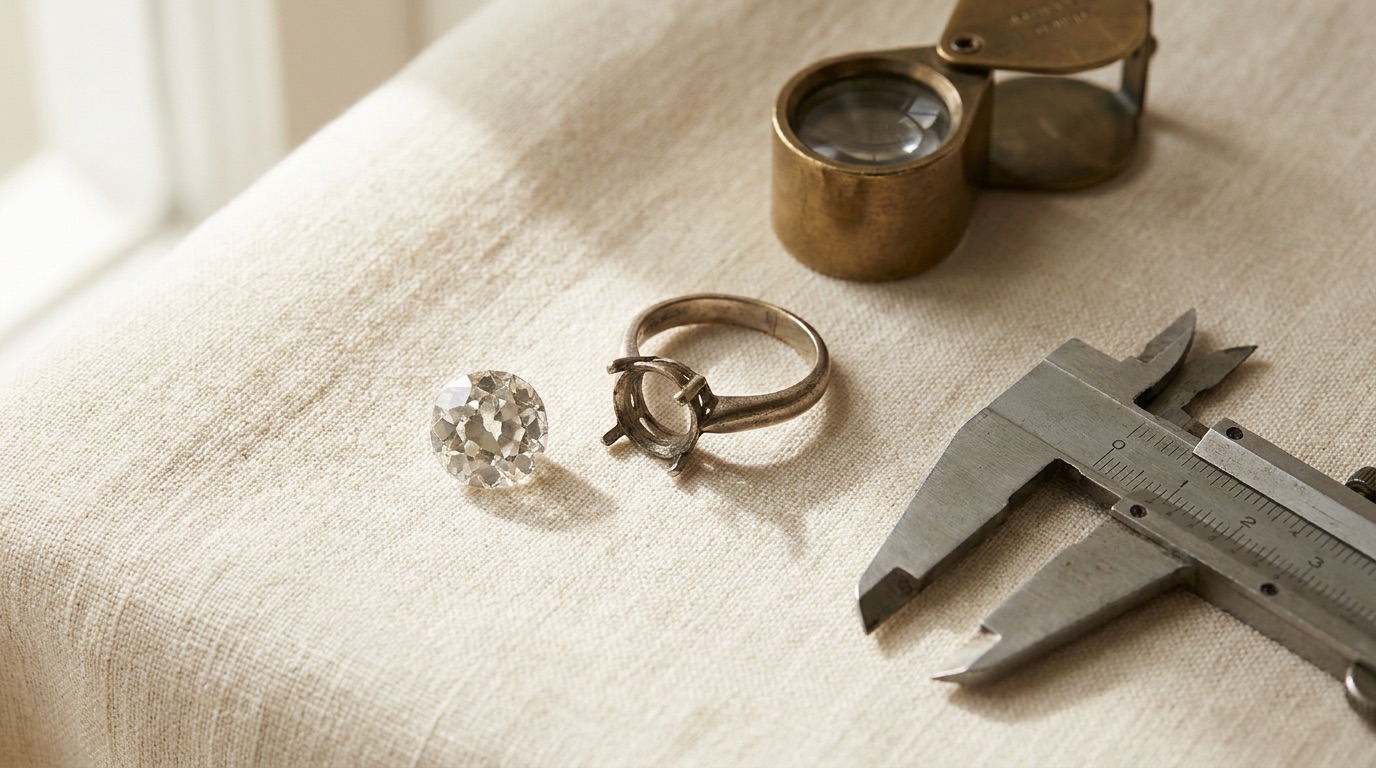
Memo work runs through the same production line as any other order here, not a separate side process. A stone arriving as customer-supplied property gets the intake condition report and job number at receipt, a custody log through CAD confirmation, and cutting, setting, and polishing all in-house — the same standard used on stock inventory — followed by a final QC check against the intake photos before anything ships back out. The memo agreement, with declared value and insurance coverage confirmed in writing, is settled before a client's stone is accepted for shipment, not worked out after the fact.
Once a memo job is CAD-approved, it enters standard production on the same 4-6 day timeline quoted for any custom piece, since intake and fit verification for a customer-supplied stone happen before that clock starts. Any newly purchased stones going into the same piece — halo, side stones, or a full three-stone build around an heirloom center — carry IGI, GIA, or GCAL certification as needed, invoiced and tracked separately from the memo stone itself. This is routine intake for a trade account, not a special-case request. Jewelers with a specific stone or job to discuss can reach out through contact us, message directly on WhatsApp at +1 347 812 2006, or apply for trade access to walk through how it would be handled.
A Practical Checklist for Jewelers
Before shipping a client's stone to any manufacturing partner, confirm:
- A written intake process exists — photos, weight, measurements, cut identification — and you'll receive a copy
- A specific job/lot number will track the stone through every production stage
- In-production insurance is confirmed in writing, with a stated limit tied to the stone's appraised value
- Transit insurance is arranged on both legs of the shipment, with signature confirmation at each end
- There's a defined checkpoint — before casting — where stone dimensions are verified against the CAD file
- Any fit problem gets resolved on the metal side by default, with your explicit sign-off required for anything that touches the stone itself
- The memo stone and any newly purchased stones in the same piece are billed and documented separately
- A written memo agreement states the declared value, the scope of work, and confirms that title to the stone never transfers
- The quote breaks out labor, the insurance rider, and any newly purchased stones as separate line items — not a single lump sum
If a manufacturing partner treats these as unusual questions rather than routine ones, that's worth noting before you commit a client's stone to them. For a partner set up to run memo work alongside standard custom jewelry production under one process, this is routine intake, not a special exception — reach out through contact us or apply for trade access to walk through how a specific job would be handled.
Frequently Asked Questions
Is a customer-supplied stone treated as inventory once it arrives at the manufacturer?
No. It's logged as memo goods — property in the manufacturer's custody for a service, not stock the manufacturer owns or can sell. It's tracked separately from certified inventory at every stage, from intake through shipping, and it never appears on an invoice as a purchased item.
Who pays for insurance on a customer's stone while it's in production?
This should be spelled out before the job starts, not assumed. Most manufacturing partners carry a specific in-production insurance rider for customer-supplied stones and build that cost into the service quote, separate from any general shop policy. Ask for the coverage limit and confirm it matches the stone's current appraised value, not an old or estimated figure.
What if the stone is damaged during setting?
A documented condition report from intake is what makes this resolvable. If damage occurs during production, it's assessed against the original photos and measurements, and the manufacturer's insurance is what covers the claim — not the customer's or retailer's own policy. Without an intake record, there's no reliable way to prove when damage occurred, which is why skipping that step is the biggest risk in handling memo goods.
Can the manufacturer recut or repolish a customer's stone if it doesn't fit the setting?
Only with explicit, separate sign-off from the retail jeweler and their client. The default response to a fit problem is to adjust the metalwork — the basket depth, the prong height, the bezel width — not the stone. Any change to the stone itself is treated as a distinct decision because it's an irreversible alteration to property the manufacturer doesn't own.
Does a memo stone job still get a fast turnaround?
The 4-6 day window some manufacturing partners quote applies to CAD-approved custom jewelry production — the span from an approved design to a finished piece. Intake, condition reporting, and CAD-fit verification for a customer-supplied stone happen before that clock starts, since the design can't be finalized until the actual stone's measurements are confirmed against it.
Can new certified stones be added to a piece alongside a customer's memo stone?
Yes — this is common for halo or three-stone designs built around an inherited center stone. The memo stone and any newly purchased stones (certified diamonds or melee for accent work) are tracked and invoiced on separate lines, so the finished piece combines both without conflating what the customer already owned with what they're buying new.