
Yes, in almost every case you can say yes to a customer who brings in a photo of a ring they saw online or on a red carpet — but what you're agreeing to build is the design language in the photo, not the photo itself. The workable path is to separate the general design elements (setting style, stone shape, band profile, halo configuration) from anything that's actually protected (a brand name, a logo, a patented mechanism, a named collection), rebuild the piece as your own custom SKU through a manufacturing partner that can take a photo and a rough spec sheet to a produceable CAD file, and price it like the custom build it is. Done this way, "can you match this ring?" turns from an awkward moment at the counter into one of the more profitable conversations you'll have all week — even if you don't own a bench.
Why Customers Show Up With a Screenshot
A customer scrolls a feed, a proposal photo goes around, a red-carpet shot gets reposted with a caption identifying the stone shape and setting style, and by the following weekend three different people are pulling up the same saved image asking if you can "make one like this." A few patterns are worth recognizing before the conversation starts, because they change how you respond:
- The Pinterest board customer has usually collected several images, not one, and the ring they eventually want is a composite — the halo from one photo, the band from another. Ask to see the whole board, not just the single image they lead with.
- The Instagram screenshot customer often has one low-resolution image saved from a story or a repost, with color and proportion distorted by compression. Treat it as a rough impression, not a precise spec.
- The celebrity-engagement-ring customer is reacting to a moment, not a maker — a well-known bridal style or a widely photographed celebrity engagement ring that circulated after an announcement. They rarely know or care who designed it; they know the shape, the color, and the feeling they want to recreate.
None of these customers are asking you to counterfeit anything, and almost none would describe what they want as a "copy." They're asking for a feeling, translated into metal and stone, at a price and timeline that works for them.
"Can You Match This Ring?" Is a Design Brief, Not a Copy Request
Most customers who ask this question aren't asking you to counterfeit anything. They don't know or care what studio made the ring in the photo — they're reacting to proportions, a stone shape, a halo, a color combination, or the way light hits a particular setting style. What they're really handing you is an unstructured design brief: "I like this, can you get me something like it."
Your job is to translate that brief into two buckets:
- What's actually the design — the elements you can rebuild freely: prong style, shank width, halo or side-stone layout, stone shape and cut tier, metal tone, overall silhouette.
- What's incidental branding — the name of the retailer or designer the customer mentions, a logo stamped somewhere, a marketing story attached to the piece. None of that is part of the ring's construction, and none of it needs to survive into your build.
Once you've made that split, the request stops being "copy this ring" and becomes "build a ring with these design characteristics" — which is exactly the kind of brief a custom jewelry manufacturing partner is set up to execute. Say this reframing out loud to the customer, too. Telling them "we're going to build something inspired by that, in your size and your budget" sets the right expectation from the first sentence, instead of letting them assume they're getting a duplicate.
The Legal Gray Area: "Inspired By" vs. Direct Copying
Jewelry design sits in an odd spot in intellectual property terms. A specific, original combination of elements can potentially be protected — through trade dress, design patents, or copyright on a truly distinctive ornamental design — but the individual building blocks almost never are. A prong count isn't proprietary. A halo shape isn't proprietary. A stone cut isn't proprietary. What can occasionally cross the line is reproducing the whole combination, closely enough, of a design that's still actively marketed and identifiable as someone else's.
Three factors tend to matter most when deciding how closely to follow a reference photo: how distinctive the design is (a plain six-prong solitaire isn't distinctive enough to belong to anyone; a highly unusual, instantly recognizable silhouette tied to one maker is different), whether the piece is still actively sold, and how closely the finished build matches — a pixel-for-pixel reproduction reads very differently than a piece that borrows the general silhouette but changes proportions or detail enough to be its own thing.
None of this is legal advice — it's the general shape of how the trade thinks about the issue day to day. If a reference photo is an unusually distinctive, currently marketed design and the customer wants an exact match down to the last detail, that's the specific case worth a call to an intellectual property attorney before committing to the build. For the large majority of requests — a stone shape, a halo style, a general silhouette borrowed from a photo — the "rebuild as your own interpretation" approach below is standard practice across the custom jewelry trade.
What You Can and Can't Replicate
There's no universal rule that covers every design on the market, but a few practical lines hold up in day-to-day bench and CAD work:
| Element in the photo | Generally safe to rebuild | Handle with care |
|---|---|---|
| Stone shape (oval, cushion, pear, etc.) | Yes — shapes themselves aren't proprietary | — |
| Prong count/style, halo layout, split shank | Yes — these are common construction elements used across the trade | — |
| Overall silhouette / general aesthetic | Yes, when rebuilt from scratch as your own file | Avoid producing a piece that's a pixel-for-pixel match to a still-in-production design from a named collection |
| Brand name, logo, or engraved marks | No | Strip these from the brief entirely — never reference them in your quote, CAD notes, or marketing |
| A patented setting mechanism (specific tension-set locks, engineered hidden-halo mounts) | — | Confirm with your manufacturing partner whether the mechanism is a generic construction method or a protected one before committing to build it exactly as shown |
| A named, currently-marketed design from an identifiable maker | — | Treat the photo as inspiration only — change proportions, stone shape, or halo detail enough that the result is your own interpretation, not a duplicate |
The safest operating habit: never write a brand or designer name into a quote, purchase order, or CAD file — describe the ring by its design elements only ("oval center, hidden halo, tapered baguette shoulders"), and let your manufacturing partner's design team flag anything that looks close enough to a specific, currently-sold piece to warrant a deliberate variation.
Setting Expectations: Why an Exact Replica Isn't the Goal
Part of handling these requests well is managing what "match" actually means before the customer walks out the door. An exact, atom-for-atom replica of a photographed ring is rarely possible and rarely advisable:
- A photo isn't a spec sheet. Lighting, camera angle, and screen compression all distort proportion and color — what looks like a 2-carat stone in a tightly cropped photo might read closer to 1.5 carats in person.
- Every hand is different. A setting photographed on someone else's hand and knuckle size will sit differently on your customer's hand — sometimes enough that a faithful copy of the proportions looks wrong once it's built.
- Exact duplication invites the legal question you don't want to answer. The closer you get to a literal copy of a distinctive, currently-marketed design, the more the "handle with care" column above applies.
- The best version is usually a better fit than the reference photo anyway. Once a CAD team adjusts proportions for the actual stone, hand, and budget in front of them, the finished piece routinely reads better in person than a slavish copy would have.
Frame this as good news, not a disappointment: the customer isn't losing anything by getting an inspired-by build instead of a replica — they're getting a piece designed around their own hand, stone, and budget.
The Three Things Your Manufacturing Partner Actually Needs
If you don't have your own bench, the quality of what comes back depends entirely on what you hand off up front. Skip any of these three and you'll burn a design round on guesswork.
1. The photo — or better, photos. One image from the customer's phone is a start, but if you can get a second angle (profile view of the setting, a close-up of the halo or gallery), the CAD team has far less to reconstruct from memory. If the customer only has one low-resolution screenshot, say so — the design team will fill gaps with reasonable assumptions, but flag it rather than let it pass as certain.
2. Approximate specs. Metal type and karat, target total carat weight, preferred stone shape (or "match the shape in the photo"), ring size, and any must-haves the customer has already stated (a family stone to reset, a color preference, an aversion to prongs). You don't need exact numbers — approximate is fine, and part of what CAD and quoting solves for.
3. A budget range. This is the one jewelers most often skip, and it's the one that causes the most rework. A photo of a 3-carat halo ring with no budget attached leads a design team to spec it as shown — then the quote comes back at a number nobody discussed. Get a range from the customer before you submit the brief. It lets the manufacturing partner recommend the right stone size, cut tier, and metal choice to hit that number instead of guessing and revising.
A short intake conversation covering these three points, before the photo ever leaves your counter, is the single biggest predictor of whether the first CAD round lands close or misses wide.
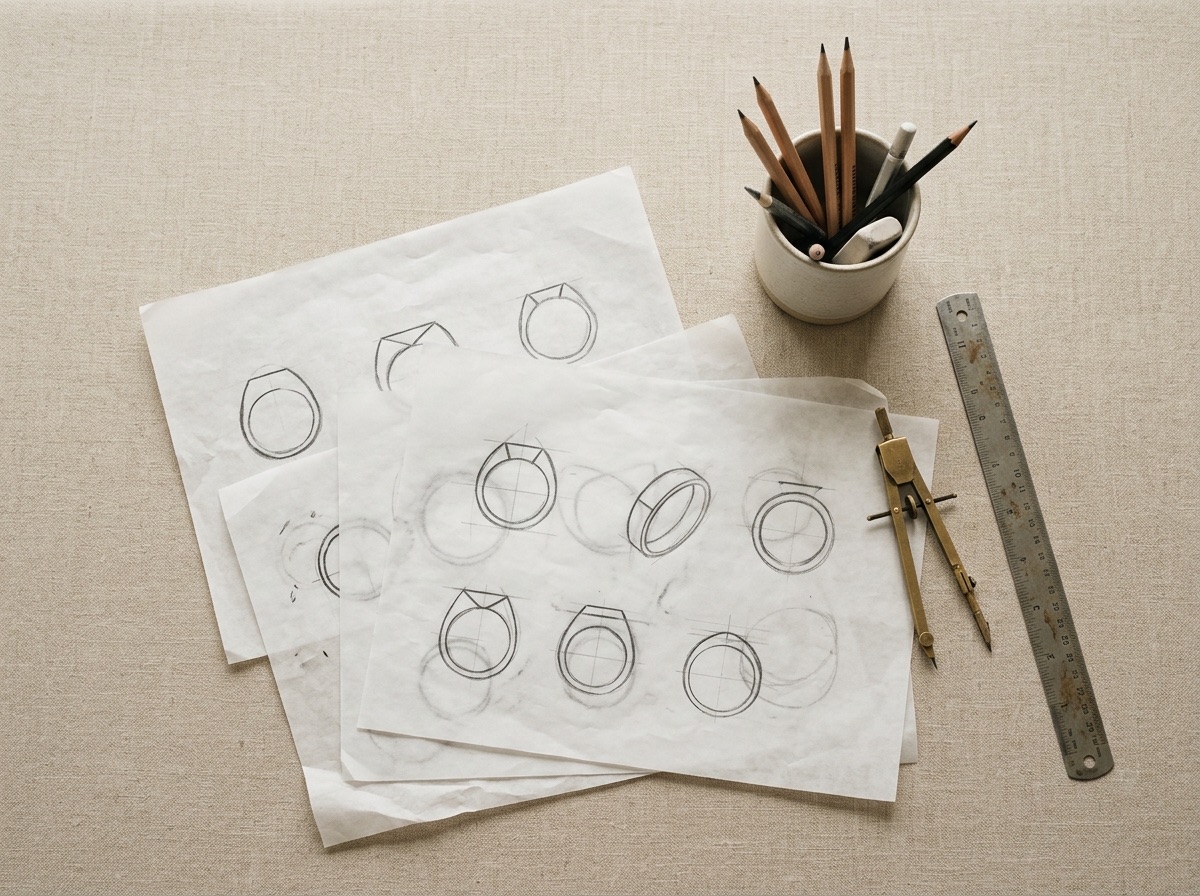
How a Photo Turns Into a Produceable File
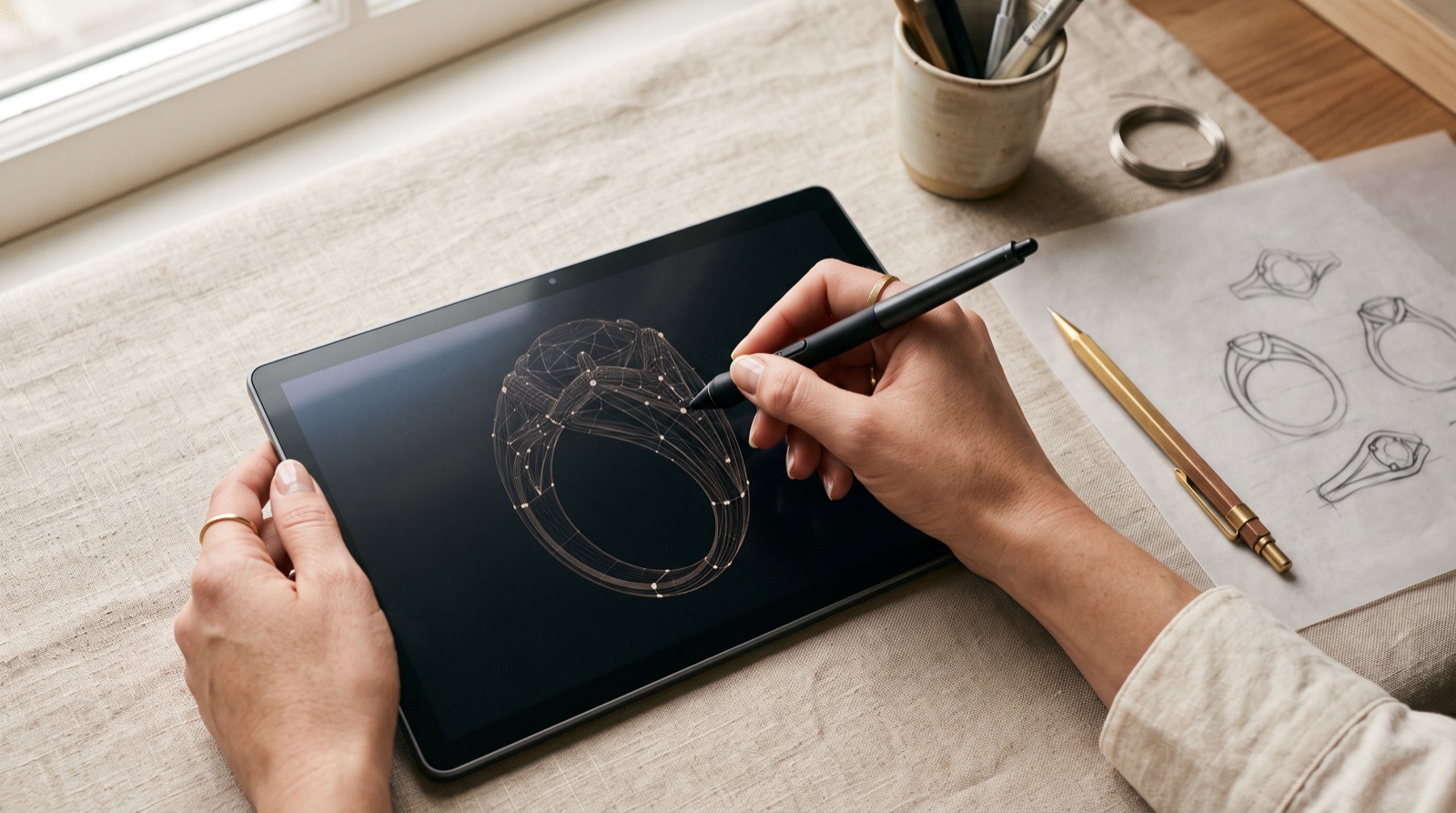
This is the part that feels like magic to a jeweler without in-house CAD, but it's a straightforward sequence:
- Design review. The photo and your notes go to a CAD/design team, who identify the actual construction elements at play — not just "pretty ring" but "six-prong oval center, thin pavé shank, cathedral setting." This is also the stage where anything that looks close enough to a specific, currently-marketed piece gets flagged for a deliberate change before any modeling starts.
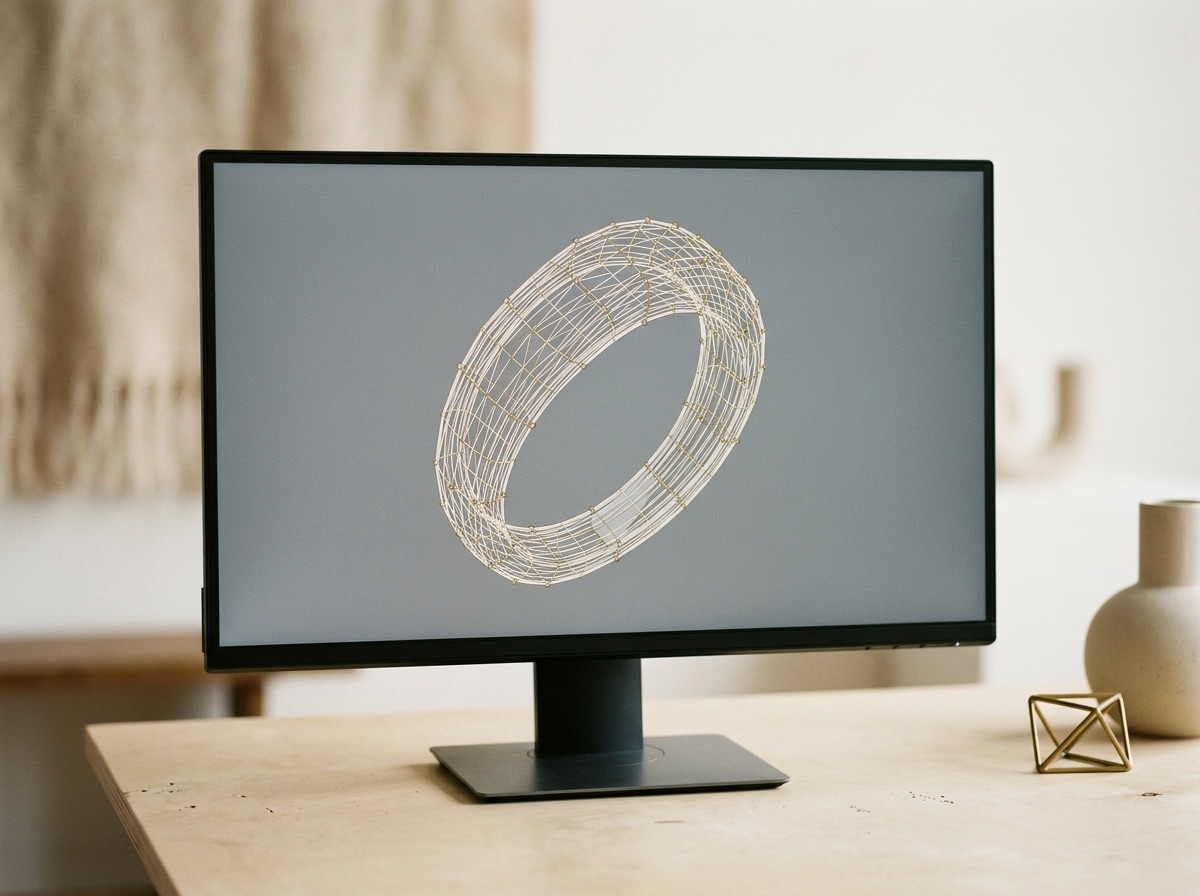
- Concept build. The team builds a 3D CAD model reflecting those elements at the specs and budget you provided — this is where a look-alike issue gets caught and adjusted, before anything is produced. The CAD file is an original model built from the design elements identified in review, not a scan or trace of the reference photo.
- Render approval. You and the customer review a rendered image (or turntable) of the CAD file. This is the checkpoint — change stone size, swap a shape, adjust the halo, before production starts. It's also the natural moment to walk the customer through anywhere the finished piece will differ from their reference photo, and why.
- Production. Once the CAD is approved, the piece moves to build. For finished custom jewelry, approved CAD to finished piece typically runs 4-6 days — that clock starts at CAD approval, not at the initial photo submission, since design rounds vary by how close the first pass lands.
That render-approval step is doing double duty: it's your customer sign-off, and it's the point where a design that's drifted too close to a specific named piece gets nudged into its own identity — a different halo shape, a resized stone, a shank change — before it's ever cut in metal.
Getting the Stone Shape (and Tier) Right
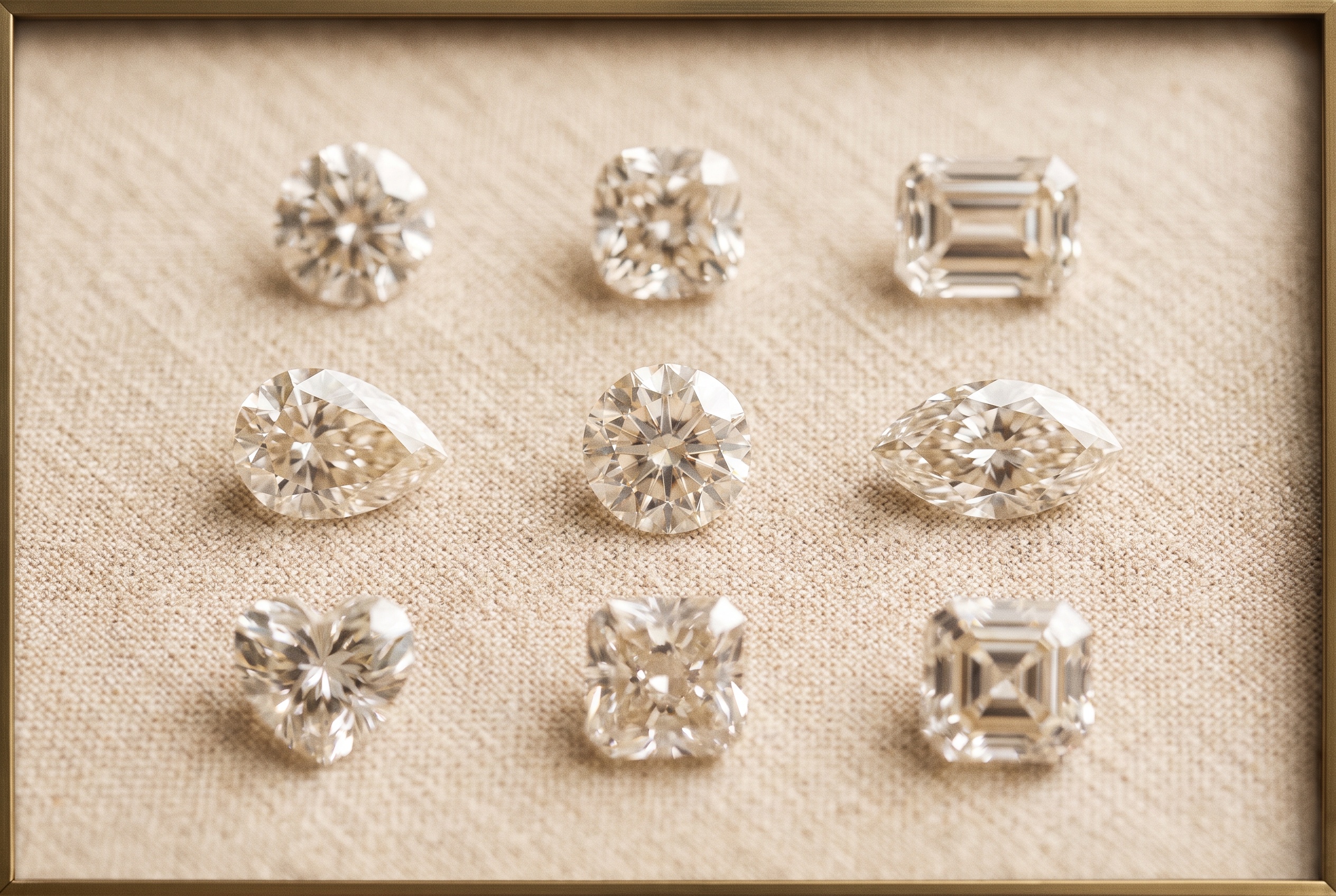
Customers describing an inspiration photo will often get the shape wrong — "it's kind of square" could mean cushion, princess, or radiant. Since cut tier affects sourcing, pricing, and lead time, it's worth knowing the map before you pass the brief along:
- Commodity tier: Round Brilliant.
- Regular fancy tier (modern cuts): Emerald, Asscher, Cushion, Oval, Pear, Marquise, Radiant, Princess, Heart.
- Antique/premium tier: Old Mine, Old European, Hexagonal, Moval, Lozenge, Kite, Trillion, Criss-Cut, Padparadscha.
A lot of "vintage-looking" inspiration photos are actually Old Mine or Old European cuts, not standard cushions — worth confirming with the customer, since it changes both the look and the sourcing conversation. If the piece uses a fancy color stone (a common ask after a celebrity fancy-color engagement photo goes around), that's a separate sourcing lane from a colorless center stone, and worth flagging early rather than after CAD.
For loose center stones 0.30ct and up, both IGI and GIA certification are available, so the customer can choose based on preference or resale expectations. If the inspiration design uses a pavé or halo of small calibrated stones, those are melee — sourced as uncertified parcel goods matched to a color/clarity baseline, not individually or parcel certified, so don't promise a melee certificate on the quote. A supplier that covers antique and exotic fancy shapes, standard cert diamonds, fancy color stones, and melee under one roof means you're not splitting one build across three vendors to get the full look.
Pricing It Like a Custom Build, Not a Favor
The fastest way to lose margin on these requests is treating them like a courtesy quote instead of a real custom order. A few habits that protect the transaction:
- Quote the budget conversation before the first CAD round, not after — it saves a redesign cycle.
- Price the piece on your standard custom-build markup (diamond + metal + labor + your margin), the same as any other custom order — an inspiration photo isn't a reason to discount.
- If the piece ships unbranded by default, you're free to present it as your own custom work to the customer — no third-party marks to explain or work around.
- If the inspiration ring is an eternity-style band, remember full, three-quarter, and half eternity, along with diamond wedding and plain wedding bands, are all sub-variants of the same product family — the customer's "eternity band" ask and a "wedding band" ask are often the same conversation with different proportions.
- Separate the design-round cost from the piece itself if you're doing multiple concept passes for a picky customer — most jewelers absorb the first CAD round into the quote and price additional rounds separately, which keeps a customer from treating unlimited revisions as part of the deal.
If you're setting this up for the first time, how it works walks through the submission-to-delivery sequence, and becoming a trade partner covers the verified-trade access required to submit builds in the first place — this workflow is built for jewelers and designers, not retail customers ordering direct.
Common Mistakes That Turn a Good Lead Into a Bad Build
Most of the friction on these orders comes from a short list of avoidable errors, repeated across the trade:
- Quoting off the photo alone, before a budget conversation. This locks in expectations around a carat weight and metal choice that may not match what the customer is actually prepared to spend, and the correction happens after the fact instead of before.
- Writing the brand or designer name into the paperwork. Even a note to yourself or a line in a purchase order — a named reference has no reason to exist in a quote, CAD brief, or production file. Describe the design elements instead.
- Promising an exact match instead of an interpretation. "We'll match it exactly" sets up a comparison you can't fully control, given photo distortion and hand differences. "Inspired by, built for you" is both more accurate and easier to deliver against.
- Skipping the render-approval step to save time. This checkpoint catches both design drift toward a specific existing piece and simple customer dissatisfaction, before metal gets cut.
- Treating a single blurry screenshot as a confirmed spec. That limitation belongs in the brief, not buried. A design team that knows an assumption is a guess will flag it for confirmation instead of building on it as fact.
- Discounting the build because it started from someone else's photo. A custom build is a custom build regardless of where the inspiration came from — pricing it below your standard margin undervalues the design and sourcing work behind it.
Replica Request vs. Inspired-By Custom Design: A Side-by-Side
It helps to have language ready that draws a clean line between the request as the customer first frames it and the process you'll actually run:
| Process step | "Replica" framing (avoid) | Inspired-by custom design (use) |
|---|---|---|
| How the request is described | "Copy this exact ring" | "Build a ring with these design elements" |
| What goes in the brief | The reference photo and brand/designer name, taken at face value | Stone shape, prong style, halo layout, silhouette — described independently of any brand reference |
| What the CAD team produces | A file aiming to match the photo as closely as possible | An original model built from the identified design elements, adjusted for the customer's specs and budget |
| How it's priced | Often under-quoted as a "favor," with vague scope | Priced as a standard custom build — diamond, metal, labor, margin |
| What the customer is told to expect | An exact match to the photo | A piece inspired by the photo, built for their hand, stone, and budget |
| Legal exposure | Higher, especially for distinctive, currently-marketed designs | Low — general design elements rebuilt as an original file |
The right-hand column isn't just the safer approach — it's also the more profitable one, since it's positioned and priced as the custom design work it actually is, instead of a discounted favor.
How Guru Diam Supports Jewelers on Inspiration-Based Custom Orders — Plus a Counter-Ready Script
A supplier that covers antique and exotic fancy shapes, standard cert diamonds, fancy color stones, and melee under one roof means an inspiration-based build doesn't have to be split across three vendors to source the full look — the round brilliant for a simple solitaire, the Old European or Old Mine cut for a vintage-styled reference photo, the fancy color center stone for a celebrity-inspired piece, and the calibrated melee for a pavé halo can all come from the same relationship. One vendor, one shipment, one relationship keeps a multi-element inspiration build from turning into a sourcing project on top of a design project.
For finished custom jewelry, once a CAD render is approved, production runs 4-6 days to a finished piece. Custom rings ship unbranded by default, so whatever gets built off an inspiration photo goes out under your name, not a manufacturing partner's.
None of that replaces having the right words ready at the counter. A short script, adapted to your own voice, keeps the conversation moving in the right direction:
- When the photo comes out: "I love that you brought a picture — this gives us a great starting point. We'll build something inspired by this look, sized and priced for you, rather than a literal copy. Let's talk through what you like most about it."
- When they name a brand or designer: "Let's set the name aside and focus on what you like about the piece — is it the stone shape, the halo, the band? That's what we'll actually be building from."
- When they ask if it'll look "exactly like the photo": "It'll be built around the same design language — but a photo doesn't capture every detail, and every hand is different, so we'll fine-tune proportions on the CAD render first. You'll see and approve that render before anything goes into production."
- When they ask about budget: "Before we send this to design, let's set a range you're comfortable with — that way the first concept is already in the right neighborhood instead of something we scale back later."
- When the render comes back: "Here's the concept — walk me through anything you want adjusted before we move to production."
Printed on an index card at the counter or built into a staff training sheet, a script like this keeps these conversations profitable and low-risk before a single CAD file gets opened.

Frequently Asked Questions
Is it legal to build a ring "inspired by" a design I saw online or on a celebrity?
In most cases, yes. General design elements — stone shape, prong style, halo layout, band profile — aren't protected, and rebuilding a piece around those elements as your own CAD file is standard custom-jewelry practice. What you want to avoid is reproducing a specific, currently-marketed design closely enough that it reads as a duplicate, or referencing a brand or designer name anywhere in your quote or production notes. This isn't legal advice — for an unusually distinctive, still-in-production design where a customer wants an exact match, a quick conversation with an intellectual property attorney is worth the time before you commit to the build.
What if the customer specifically names a brand or designer?
Drop the name from the brief entirely. Ask the customer what they actually like about the piece — the stone shape, the setting, the color — and build the quote around those descriptive elements instead. The name is marketing, not construction detail, and it has no place in a CAD file or purchase order.
How many reference photos should I collect before submitting the request?
One is workable, but two or three angles (a straight-on shot and a profile or close-up of the setting) cuts down on guesswork significantly. If a customer only has a single low-resolution image, say so when you submit — the design team will note it as an assumption rather than treat it as a confirmed detail.
Can a manufacturing partner match the exact carat weight and stone shape from a photo?
Approximate specs are normal and expected — photos don't give you a precise carat weight, and customers usually don't know it either. Give a target range and let the budget conversation and CAD render narrow it down. If the customer has a hard minimum or maximum, say so up front so it's built into the first design round instead of a revision.
How long does a custom piece take once the design is approved?
For finished custom jewelry, once the CAD render is approved, production typically runs 4-6 days to a finished piece. That clock starts at approval — the design rounds before approval vary depending on how close the first CAD pass lands to what the customer had in mind.
Will the finished ring have the manufacturer's branding on it?
No — custom pieces are delivered unbranded by default, which means you can present the finished ring as your own custom work without any third-party marks to account for.