
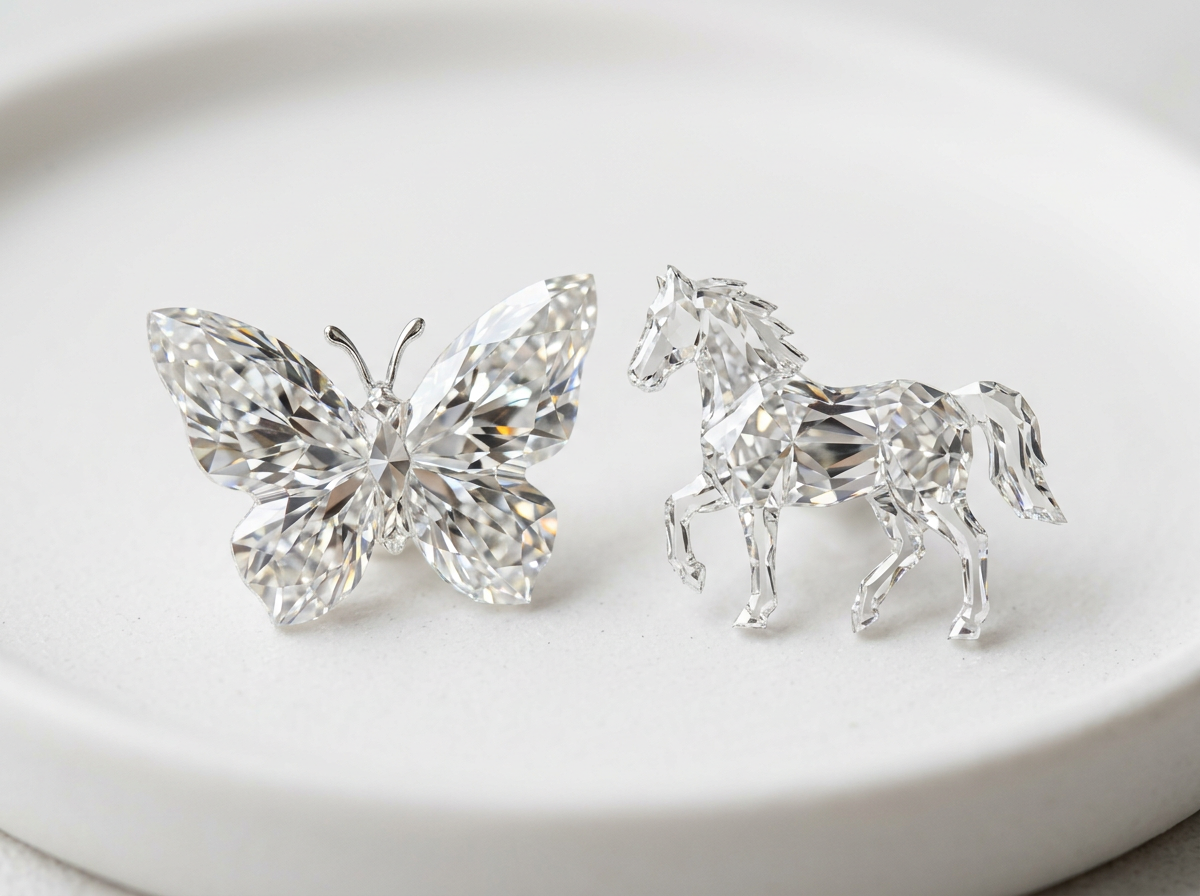
Beyond standard shapes, Guru Diam's cutting floor has produced diamonds shaped like a bull, a duck, a cloud, a lily, a butterfly, a car, a horse, and a calf — one-off custom cuts made to a buyer's exact sketch or logo. If you can draw the outline, it's worth asking whether we can cut it.
Most wholesale diamond pages exist to sell you a standard shape faster. This one exists to answer a different question: what happens when a client wants something that isn't a shape at all — a mascot, a logo, an animal, a keepsake silhouette. Short answer: we've already cut several, and this page is the honest record of what that capability actually looks like — what it means in trade terms, how the process runs from sketch to finished stone, how a one-off cut gets graded, what actually drives the price, and how to bring us your own outline.
Yes, we've cut a diamond shaped like a bull
This isn't a novelty photo op — it's a genuine capability that most wholesalers won't touch, because faceting a recognizable animal or object outline while still keeping the stone structurally sound and reasonably brilliant is a real cutting problem, not a gimmick. Every shape listed below was a one-off, cut against a specific buyer request rather than pulled off a shelf, which is the honest way to frame this capability: it's evidence of what our cutting floor can do, not a stocked product line.
What we've cut so far
| Shape | Notes |
|---|---|
| Bull | Logo/mascot request |
| Duck | Custom whimsical piece |
| Cloud | Personalized design element |
| Lily | Floral custom silhouette |
| Butterfly | Custom whimsical piece |
| Car | Logo/mascot request |
| Horse | Logo/mascot request |
| Calf | Custom whimsical piece |
Each was produced in quantities of one to a few pieces, to order, and none are held as ongoing stock — the table above is a capability record, not a catalog. The range is deliberate: logo and mascot commissions (bull, car, horse) sit alongside purely decorative silhouettes (duck, cloud, butterfly, calf) and one botanical request (lily). That spread is roughly what we see in real demand — brand-driven requests on one side, personal or whimsical requests on the other.
What "custom" and "novelty" shape cutting actually means in the trade
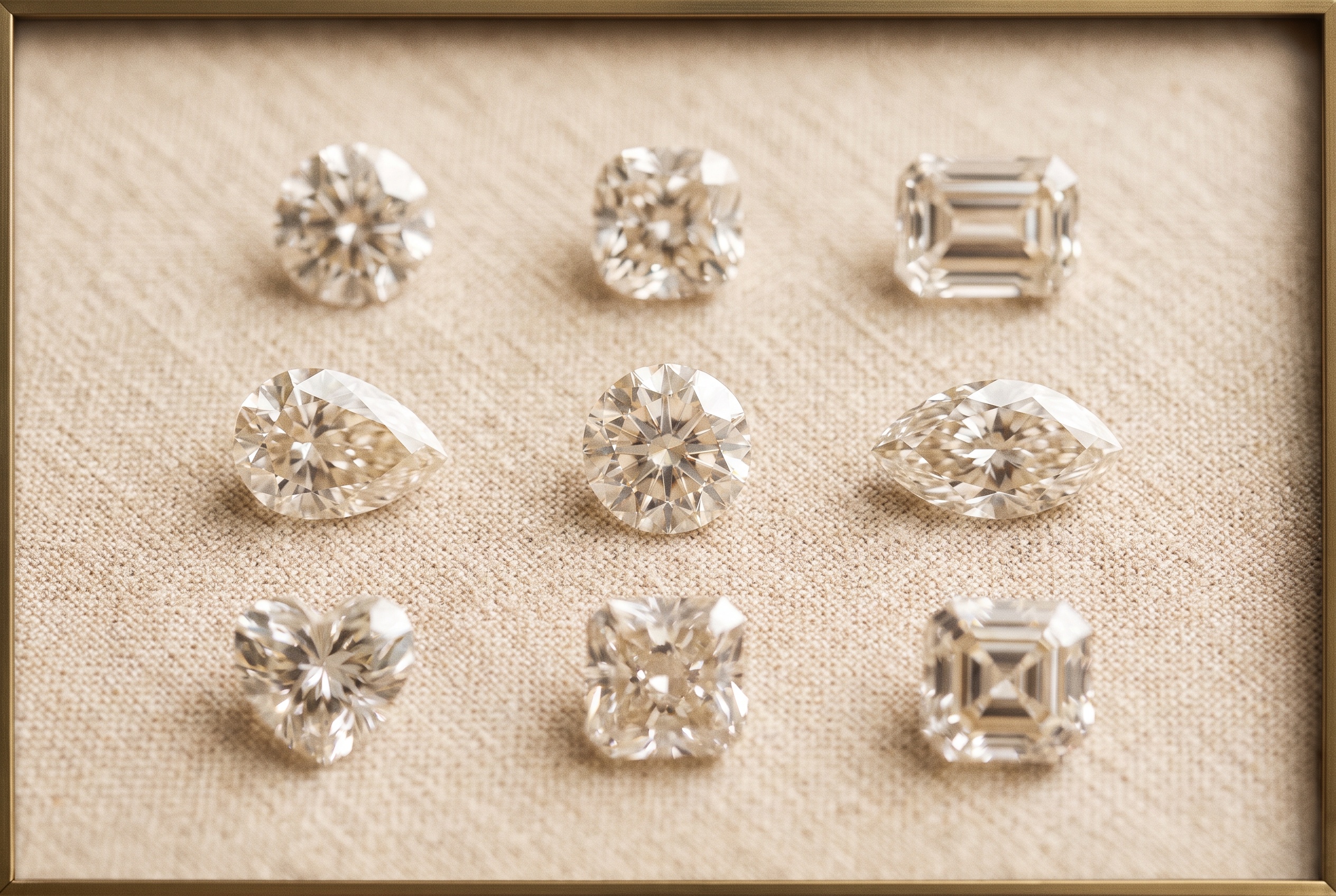
In the diamond trade, "shape" almost always means one of a fixed, named list. The regular fancy tier — emerald, asscher, cushion, oval, pear, marquise, radiant, princess, heart — covers the modern cuts most buyers reorder against. The antique tier — old mine, old European, hexagonal, moval, lozenge, kite, trillion, criss-cut, and Padparadscha-style cuts — covers historically established cuts with their own proportion conventions. Round brilliant sits below both as the commodity shape. Every one of those names describes a facet arrangement that's been standardized for decades, sometimes centuries, which is exactly why a wholesaler can hold them as calibrated stock: cutters are working from a known template, not inventing one.
"Custom" and "novelty" shape cutting is the category that falls outside that list entirely. It isn't a named cut with fixed proportions — it's an outline. A bull, a duck, a company logo, a family crest: none of those have a facet template anyone has cut before, at least not in the specific form a given buyer wants. The cutter has to derive a facet plan from scratch for that one outline, on that one piece of rough, for that one order. That's the real distinction between "fancy shape" and "novelty shape" — one is a name you can order against a spec sheet, the other is a design problem you solve once. It's also why almost no wholesaler offers it: standardized shapes scale, one-off design work doesn't, and most cutting operations are built for the former.
It's worth separating "novelty" from "custom" too, since the trade uses them loosely and they're not quite the same request. A novelty shape is usually representational — an animal, an object, a recognizable form meant to read as that thing at a glance. A custom shape can be representational or purely geometric: a buyer wanting a non-standard silhouette that isn't trying to depict anything, just a proportion or outline that doesn't exist on the standard list. Both route through the same feasibility-and-quote process described below; the distinction mostly matters for how the cutter thinks about facet symmetry, since a representational outline has to preserve recognizability above facet balance, where a geometric custom shape has more room to optimize for brilliance within its outline.
From sketch to finished stone: how in-house custom cutting works
The process is closer to bespoke manufacturing than to picking a shape off an order form. It runs in five stages, and every one of them happens in-house rather than being handed off to a third party.
Step 1 — Submitting the outline
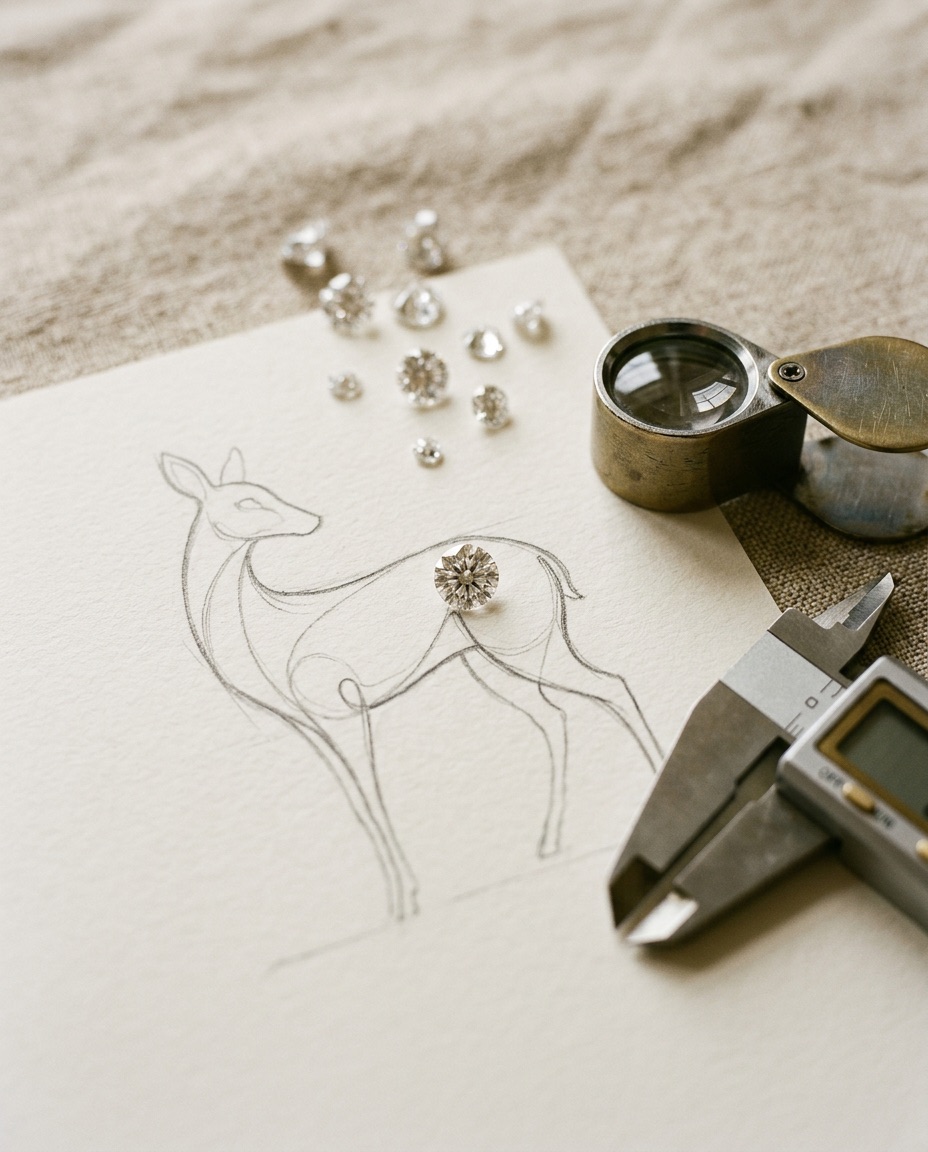
It starts with whatever reference the buyer has on hand: a hand sketch, a vector logo file, a reference photo of a pet or an animal, or sometimes just a written description of the object or shape wanted. There's no required format — the more precise the outline, the faster the feasibility read, but a rough sketch is enough to start the conversation.
Step 2 — Feasibility read against the outline
Our cutting team evaluates that outline against what's actually cuttable. Some designs translate cleanly into a facetable diamond; others need adjustment before they'll hold up structurally once cut. The usual failure points are fine interior detail (a mascot's individual claws or feather lines, for instance), thin extended points (a tail, a wingtip, a car's hood line), and sharp interior angles that would leave the stone fragile at the junction. We'll tell you plainly, before you commit to anything, if an element needs to be simplified to survive faceting — this is the step that actually determines whether a design is doable, not a guess made from the sketch alone.
Step 3 — Rough selection and facet planning
Once the outline is confirmed cuttable, the cutter maps it onto available rough and plans the facet layout. This is where a novelty cut diverges hardest from a standard shape: with a round or a cushion, the cutter is optimizing a known template against the rough's natural crystal habit to minimize waste. With a custom outline, the outline is fixed and non-negotiable, so the cutter is instead solving for how much brilliance and symmetry can be preserved within that fixed silhouette — waste is no longer the primary variable being optimized.
Step 4 — Cutting, faceting, and finishing
Cutting and polishing happen entirely in-house, hand-finished rather than run through a calibrated machine jig, because no jig exists for a shape that's never been cut before. The stone is checked against the original outline as faceting progresses, with adjustments made in real time rather than corrected after the fact.
Step 5 — Grading, certification, and delivery
Once finished, the stone goes through the same grading and certification path as any other loose diamond we sell (see the grading section below), then ships to the buyer.
Grading and quality considerations for one-off cuts
A custom or novelty shape diamond gets graded on clarity and color exactly the same way any other diamond does — the 4Cs framework doesn't change because the outline is unusual. Cut quality is where it diverges. GIA's numeric cut-grade scale (Excellent through Poor) is built around round brilliant proportions; it has no equivalent for a shape that's never existed as a named cut before. For a novelty piece, cut quality gets assessed qualitatively — symmetry, polish, and how well the finished stone preserves brilliance relative to what the design allowed — rather than benchmarked against a published proportions table the way a round or a princess cut would be.
That has a real consequence buyers should set expectations around before reselling: a novelty shape reads as a recognizable silhouette first and a high-brilliance stone second. Sharp interior corners and elongated points scatter light differently than a round brilliant's symmetric facet pattern, so a bull or a car silhouette will never throw fire the way a same-carat round would — that trade-off is inherent to the category, not a defect in a specific stone. It's worth saying plainly to your own client rather than letting them expect round-brilliant performance from a custom silhouette.
Durability is the other consideration. Sharp exterior points — an ear tip, a wingtip, a car's hood line — are more vulnerable to chipping at the point than a rounded facet junction would be, which is a setting decision more than a cutting one (more on that below). On certification: every custom cut is IGI-certified as the trade default, with GIA and GCAL both available on request — the same certification flexibility that applies across our catalog, not a reduced option set for one-off pieces.
How a lab actually documents an outline that doesn't match a standard shape category is worth knowing before you quote a client on paperwork. Grading reports have a shape field, and for a genuinely novel outline that field typically reads "fancy," "modified," or "other" rather than a named cut — the report still carries full measurements, weight, clarity plot, and color grade, it just won't carry a cut-grade score the way a round or a princess-cut report would, for the reasons above. Flag that to a client up front rather than letting them expect the report to name the shape outright; it's a paperwork quirk of grading something without precedent, not a gap in the stone's documentation.
What drives the price: yield loss, labor, and iteration
Bespoke cutting to a custom outline runs above a standard shape of comparable carat weight, and it's worth understanding why rather than treating it as an arbitrary premium.
Yield loss. Standard shapes are partly chosen because they yield well from typical rough crystal habits — a round or a cushion is optimized to keep as much of the rough as possible. A fixed outline like a bull or a car forces the cutter to discard rough that a standard shape would have kept, since the silhouette is non-negotiable and the crystal habit isn't. More rough lost per finished carat means a higher cost basis before labor even enters the calculation.
Labor. There's no calibrated jig for a one-off, so more hand-cutting and hand-polishing time goes into the stone, on top of the upfront design time spent translating a 2D outline into a 3D facet plan that will actually hold together once cut.
Iteration. If an outline needs simplification to survive faceting, that's a back-and-forth with the buyer before cutting even starts — time that a standard shape order skips entirely because the design question was solved decades ago.
Carat weight. Larger custom stones compound the above: more rough at risk, more hand-finishing surface area, more time on the facet plan. On the small end, there's a practical floor worth knowing about too — the design and feasibility work is close to identical whether the finished stone lands at a quarter carat or two carats, so cutters generally steer buyers toward a minimum size where the outline can still register as recognizable once faceted. Below that floor, the design cost stops scaling down with the stone, which is usually the deciding factor in whether a very small novelty request makes economic sense at all.
None of that means custom cutting is priced as a black box — contact us directly for a quote and a cutting-feasibility read on your specific design rather than assuming a flat multiplier over standard-shape pricing. Because every outline is different, so is the yield and labor math behind it.
Styling and use-case guidance: where custom shapes fit
Custom and novelty shape diamonds tend to land in one of two buckets, and the styling guidance differs slightly for each.
Brand and corporate commissions. Logo or mascot pieces — the bull, the car, the horse in our own cutting record are all examples of this category — get commissioned for launch gifts, executive awards, and retail window statement pieces. These usually work best set as a standalone feature rather than buried among other stones, since the point is legibility: a viewer should recognize the shape at a glance.
Personal and bespoke commissions. Pet silhouettes, family crests, initials rendered as a shape, and keepsake pieces built around a personal reference tend to come through jewelers working directly with an end client on a one-of-one piece. These read better paired with a small halo or accent of standard round or fancy melee around the custom center stone — the surrounding calibrated stones give a casual viewer a frame of reference, which helps an unusual silhouette register as intentional rather than simply irregular.
Setting matters more here than on a standard shape. Because sharp exterior points are more chip-prone than a rounded facet junction, a bezel or gypsy setting that protects the vulnerable edges tends to hold up better in daily wear than an open prong setting that exposes them. That's a setting recommendation worth passing to your own client, particularly if the custom stone is going into a ring rather than a pendant or a display piece that sees less daily contact.
Worth being direct about one thing: a novelty shape is best positioned as a conversation piece or a statement commission, not as an everyday-wear engagement-ring center stone competing on brilliance with a round or a cushion. Nothing stops a buyer from setting one that way — but the honest pitch to a client is "this is a shape no one else has," not "this throws more fire than a round."
Custom and novelty shapes vs. standard fancy shapes
The two categories solve different problems for a buyer, and it's worth being clear on where each one wins.
| Consideration | Standard fancy shape | Custom / novelty shape |
|---|---|---|
| Availability | Held as calibrated stock, ships from on-hand inventory | Made to order, available on request — not stocked |
| Design basis | Named cut with established proportions | Buyer-supplied outline, no prior template |
| Cutting cost driver | Optimized for yield from typical rough | Yield loss plus hand-labor and design time |
| Cut grading | Benchmarked against published proportion standards | Assessed qualitatively — no fixed benchmark exists |
| Best use case | Reorderable production, calibrated matching sets | One-off statement or bespoke commission |
| Resale / re-setting | Fungible — resets easily into other designs | Single-purpose, value tied to the original design intent |
The antique tier — old mine, old European, hexagonal, moval, lozenge, kite, trillion, criss-cut, Padparadscha-style — sits in its own category alongside both of these. Antique cuts share the "not off-the-shelf" feel of a novelty shape, but they're historically established cuts with their own proportion conventions, not buyer-invented outlines. Treat antique-cut sourcing and custom-shape commissioning as two separate conversations with our team, even though both are specialties beyond the standard fancy-shape list.
Who commissions custom shape diamonds
Three buyer profiles account for most of the requests we see. Independent jewelers bring us a specific client brief — a pet silhouette, an initial, a family crest — and resell the finished stone or set piece as their own design, which is how the majority of custom commissions actually reach an end customer. Brands and companies commission logo or mascot pieces for launch moments, executive recognition gifts, or retail display pieces meant to draw a customer into a showroom conversation. Private collectors and individual buyers occasionally commission a piece directly for a personal milestone or a keepsake that a standard shape simply can't represent. All three routes start the same way: an outline and a conversation with our cutting team, not a catalog browse.
Sourcing a custom or novelty shape diamond
This is a made-to-order conversation, not an inventory lookup — Guru Diam doesn't hold novelty shapes as standing stock, by design. Every custom cut is CVD lab-grown and cut in-house, graded with IGI as the trade default and GIA or GCAL available on request, then sold trade-only with no retail markup out of our New York Diamond District and Los Angeles offices.
How to order a custom cut from Guru Diam
The path is the same whether the request is a brand mascot, a pet silhouette, or a family crest: send us the outline — a sketch, a logo file, a reference photo, or a plain description — through /book-appointment, or open a wholesale account at /signup to start the conversation with our cutting team directly. From there, expect a feasibility read on the design, a quote based on the rough and labor a design that specific will actually take, and — once you sign off — an in-house cut, graded and certified before it ships. Every custom stone sells trade-only and unbranded, so you price it, set it, and present it as your own commission.
FAQ
Can Guru Diam cut a diamond into any shape?
Most outlines are at least worth a feasibility conversation — our cutting floor has already produced bull, duck, cloud, lily, butterfly, car, horse, and calf shapes as one-off custom pieces. Some designs need adjustment to survive faceting; send your outline and we'll give you a direct read.
What novelty shapes has Guru Diam actually cut before?
Bull, duck, cloud, lily, butterfly, car, horse, and calf — each produced as a one-off custom order, not as stocked inventory. These are shown here as evidence of cutting capability, not a product catalog.
Is a custom novelty shape diamond more expensive than a standard shape?
Yes, generally. Bespoke cutting to a custom outline takes more rough, more design time, and more hand-finishing labor than a standard shape of comparable carat weight, so pricing runs higher. Contact us for a quote specific to your design.
Can I get a logo or brand mascot cut as a diamond?
Yes — this is one of the more common reasons buyers request custom shape cutting. Send your logo or mascot outline through /book-appointment and our cutting team will assess feasibility and quote it.
Does Guru Diam keep any novelty shapes in stock?
No. Novelty and custom shapes are produced to order against a specific request; nothing on this page is held as standing inventory.
Can jewelers resell a custom shape diamond as their own design?
Yes. Every custom cut sells trade-only, unbranded, and with no retail markup from Guru Diam, so the piece carries your name and your pricing, not ours — the same white-label approach we apply across the catalog.