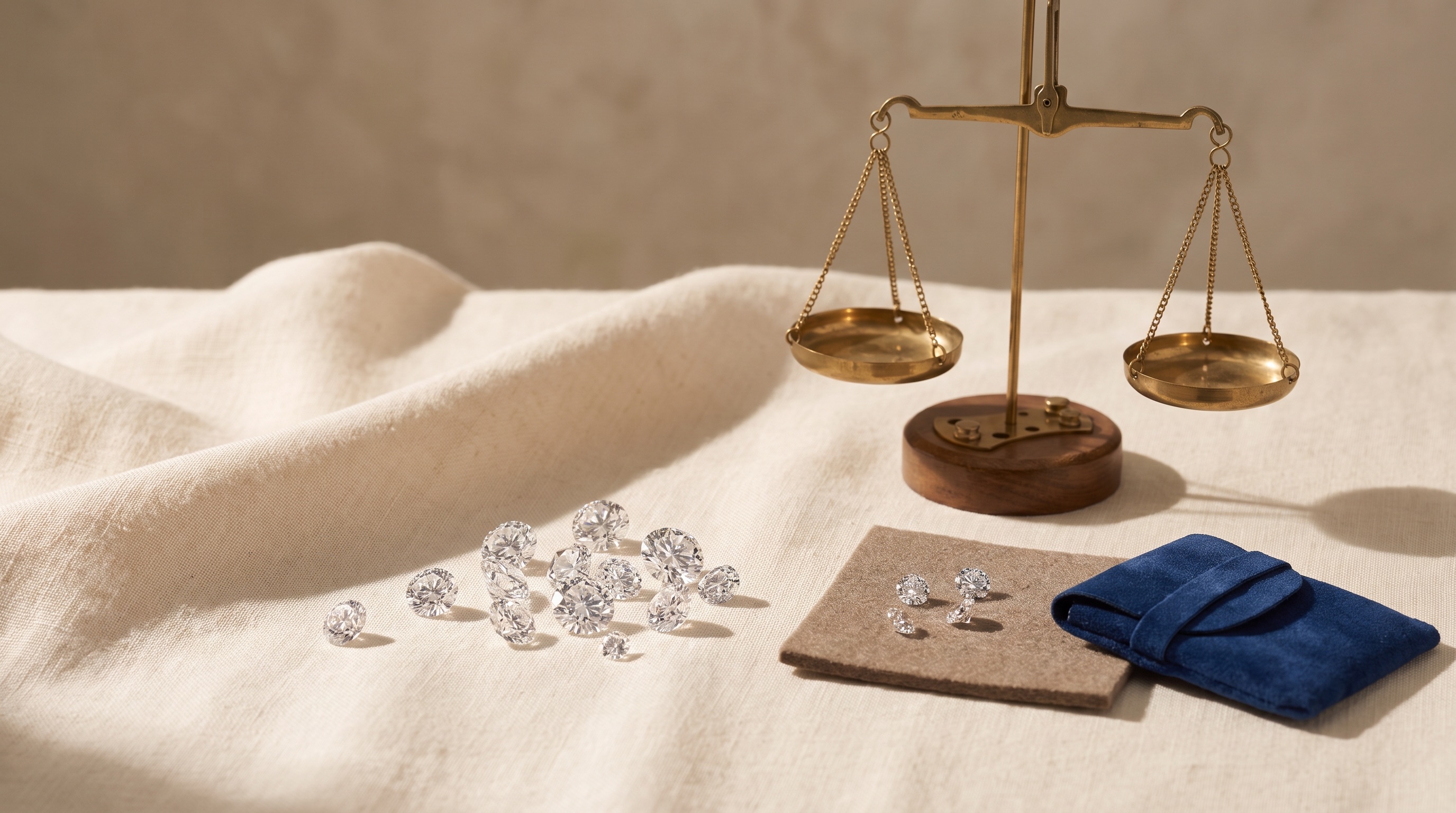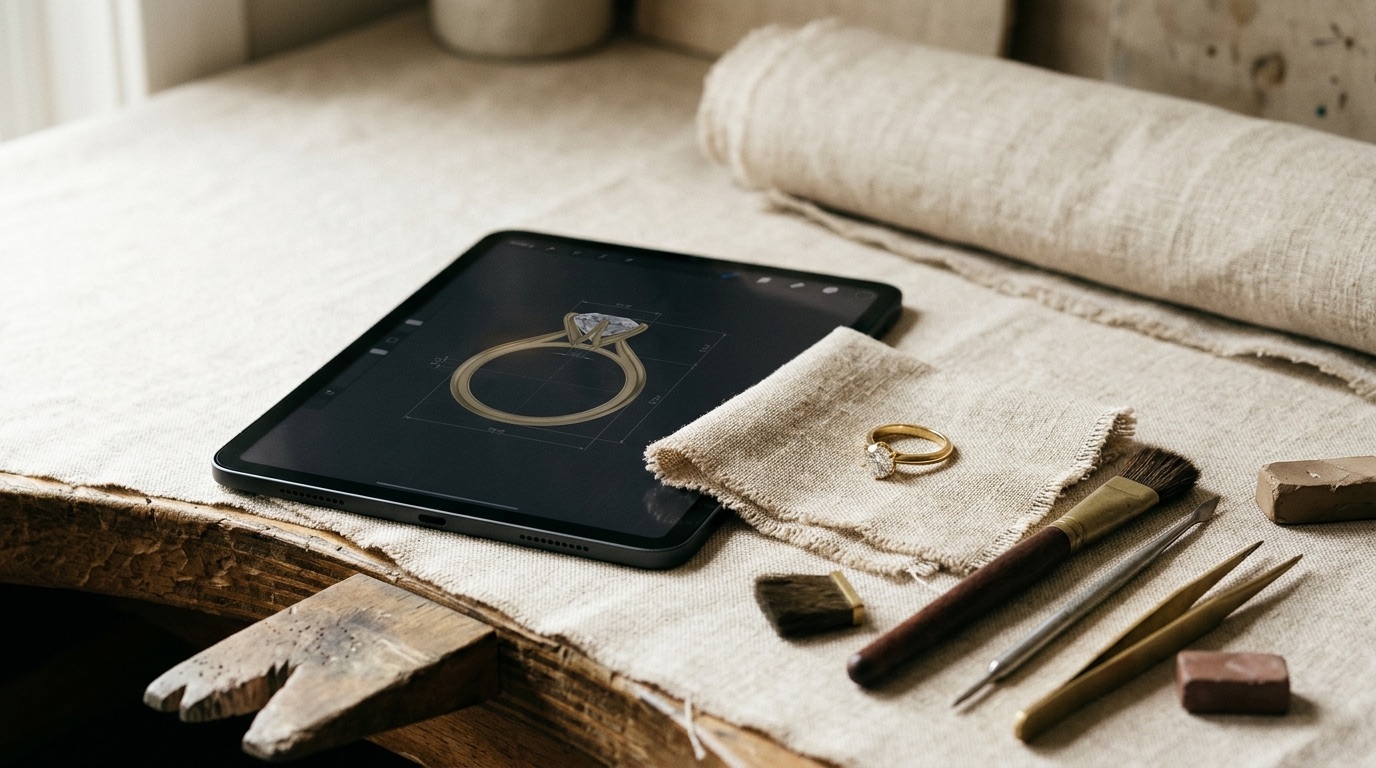
Custom jewelry manufacturers in the USA are domestic production shops — casting, setting, and finishing custom pieces to a design brief on US soil — as distinct from manufacturers who design and quote domestically but subcontract or import the physical production overseas. For a retail jeweler or designer, "USA" isn't just a geographic preference; it changes turnaround realism, quality-control access, communication speed, and what a business can honestly tell its own customers about where a piece was made.
This guide covers what "USA-based" actually means across different custom manufacturing setups, the country's real manufacturing hubs, the tradeoffs between domestic and overseas custom production, what US truth-in-labeling rules actually require before a jeweler can call a piece "Made in the USA," and how to identify a genuinely domestic manufacturer versus a broker presenting an overseas relationship as a domestic one.
What "USA" Actually Means for a Custom Manufacturer
Not every company that quotes in dollars, answers a US phone number, and ships from a US address is actually manufacturing on US soil. In practice, "custom jewelry manufacturer USA" covers at least three distinct arrangements, and the difference matters more than it might seem at the quoting stage:
- Fully domestic production. Design, casting, stone setting, and finishing all happen inside the same US facility, under the manufacturer's direct supervision.
- US-based design and quality control, overseas casting or setting. A domestic team handles CAD, client communication, and final inspection, while some or all physical production happens at an overseas workshop under the manufacturer's own contract.
- US-based broker, fully overseas production. A US company takes the order and manages communication, but has no direct production relationship — it resells capacity from a third-party overseas shop it doesn't operate or directly supervise.
None of these three models is inherently wrong for every buyer, but they carry meaningfully different turnaround times, quality-control visibility, and cost structures — and a buyer who assumes "USA" means fully domestic production, without confirming it, can end up with a longer and less predictable timeline than expected.
Where US Custom Jewelry Manufacturing Actually Concentrates
Domestic jewelry manufacturing in the US is not evenly distributed — it clusters in a handful of historic and current trade hubs, each with a somewhat different specialty:
- New York City's Diamond District (West 47th Street, Manhattan). The largest concentration of diamond dealers, setters, and custom bridal manufacturers in the country, built around decades of trade infrastructure — cutting houses, setters, casters, and finishers often working within blocks of each other.
- Los Angeles's Jewelry District (downtown LA, around Hill Street). The country's second-largest jewelry manufacturing and trade hub, with a strong concentration of casting houses and custom bridal shops serving West Coast retailers.
- Providence, Rhode Island. Historically the center of US costume and fine jewelry manufacturing, with a legacy of casting and finishing infrastructure that still supports a meaningful share of domestic production, though the industry there has consolidated significantly since its mid-20th-century peak.
A manufacturer's physical location inside or near one of these hubs is a reasonable, though not definitive, signal of genuine production infrastructure — it's much easier to build a real in-house casting and setting operation where the supply chain (metal, findings, skilled labor) already exists locally.
Domestic vs. Overseas Custom Production: The Real Tradeoffs
| Factor | Domestic (US) Production | Overseas Production |
|---|---|---|
| Typical turnaround | Faster for standard bridal work — fewer shipping legs, no customs clearance | Often longer once international freight and customs are factored in, even with lower unit labor cost |
| Communication | Same time zone or close to it, easier real-time mid-production questions | Time-zone gap can add a full day to a simple back-and-forth question |
| Quality-control visibility | A buyer or the manufacturer's own team can physically inspect work in-progress | QC typically relies on photos/video and trust in the overseas partner's own inspection |
| Cost basis | Generally higher labor cost per piece | Often lower unit labor cost, though freight, duties, and QC overhead offset some of that gap |
| "Made in USA" labeling eligibility | Can qualify if the FTC's "all or virtually all" standard is met | Cannot be labeled or marketed as "Made in USA" |
| Best fit for | Time-sensitive bridal orders, buyers who want direct QC access, brands building a domestic-manufacturing story | Buyers prioritizing unit cost over turnaround speed and willing to manage a longer production cycle |
The "Made in USA" Label: What US Rules Actually Require
The FTC's "Made in USA" standard is strict, and it's worth understanding before a jeweler repeats a manufacturer's own marketing claim to a customer: to be labeled or advertised as "Made in USA" without qualification, a product generally needs to be "all or virtually all" made in the United States — meaning all significant parts, processing, and labor are domestic, with only negligible foreign content. A piece where the metal is domestically sourced and cast, but the center diamond was cut overseas (as most diamonds globally are, since major cutting centers are concentrated in India, Belgium, and Israel, not the US), doesn't automatically fail the standard on the stone alone — cut diamonds are generally treated as a component, and the standard focuses on where the jewelry itself — the casting, setting, and finishing — actually happens. A manufacturer that casts and sets in the US but is vague about where the metal or major components originate is worth a direct, specific question before a jeweler repeats a "Made in USA" claim to their own customer, since a jeweler making that claim downstream carries some of the same regulatory exposure the manufacturer does.
Why Turnaround Is the Biggest Practical Difference
For a genuinely custom engagement ring — CAD design, casting, center-stone setting, finishing — the industry-standard turnaround at a typical manufacturer runs roughly two to six weeks from approved design to finished piece, regardless of where production happens. What domestic production usually removes from that timeline isn't the production steps themselves, but the shipping and customs legs that stack on top of an overseas build: international freight, customs clearance, and the buffer most manufacturers build in for delays at either stage. A domestic shop with tightly controlled in-house casting and setting can compress the full cycle meaningfully further, since there's no international shipping or clearance step to plan around at all.
Quality Control: What Proximity Actually Buys a Buyer
Distance changes how quality control actually works in practice, not just in theory. A domestic manufacturer within driving distance, or reachable same-day by a courier, lets a buyer request an in-person look at a piece mid-production — after casting, after setting, before final polish — rather than relying entirely on photos the manufacturer chooses to send. This matters most on a complex or unusual design, where a photo can miss a detail (a slightly off prong angle, a stone seated a fraction high) that's obvious in hand. Overseas production isn't inherently lower quality, but it does shift QC almost entirely onto trust in the manufacturer's own inspection process and photo/video documentation, since a buyer generally can't drop by to check work in progress.
Domestic Production and Tariff Exposure
Import duties and tariff policy on finished jewelry and jewelry components can shift, sometimes with limited notice, and a business relying heavily on overseas-manufactured finished pieces carries that policy risk directly in its landed cost. A domestic manufacturer's pricing is less exposed to that specific variable, since the finished jewelry itself never crosses a border as a finished good — though it's worth noting metal and stone inputs sourced internationally still carry their own duty exposure regardless of where final assembly happens. For a buyer weighing domestic against overseas custom manufacturing purely on cost, it's worth asking a US-based manufacturer directly how much of their own cost basis is exposed to the same import variables, since "domestic manufacturing" doesn't automatically mean zero tariff exposure if the raw inputs themselves are imported.
Communication and Time-Zone Practicalities
A same-time-zone or near-same-time-zone manufacturer relationship removes a specific, recurring friction point in custom work: the multi-day round-trip that a simple clarifying question can turn into when a manufacturer is 10-12 time zones away. A design revision that could be resolved in a same-day phone call with a domestic manufacturer can instead cost two or three days of back-and-forth with an overseas one, purely from each side only being awake to respond once a day. For a buyer managing a customer's own expectations around a delivery date — an engagement ring with a proposal date already set, for example — that communication lag compounds directly into schedule risk.
How to Verify a Manufacturer Is Actually US-Based (Not Just US-Fronted)
- Ask directly where casting, setting, and polishing physically happen — a manufacturer confident in a genuine domestic production line answers this plainly and specifically, by city or facility, not with a vague "we're a US company."
- Ask whether a facility visit or video walkthrough is possible. A manufacturer with real production infrastructure generally has no reason to decline a reasonable request to see the actual shop, in person or on video.
- Check how the company describes its own supply chain in trade materials — specificity about which stages happen domestically versus which (if any) are subcontracted overseas is a good sign; vagueness on this specific point is worth following up on directly.
- Confirm turnaround against an actual past order, not a marketing claim — a genuinely domestic operation should be able to point to realistic delivery windows on comparable recent work.
What Doesn't Change Based on Domestic vs. Overseas Production
Regardless of where the physical casting and setting happen, the core evaluation criteria for any custom manufacturer stay the same: minimum order requirements, certification options for center stones (GIA, IGI, and GCAL are the standard trade certifications worth confirming), whether the finished piece ships white-label for resale under the retailer's own name, and clear written terms covering stone damage, remakes, and payment structure. Domestic location solves for turnaround and QC visibility specifically — it doesn't substitute for the same due diligence a buyer should apply to any manufacturer relationship, wherever production physically happens.
When Overseas Production Is a Reasonable Choice Anyway
Domestic manufacturing isn't automatically the right answer for every buyer or every order. A retailer building a lower-price-point line where unit cost matters more than a compressed turnaround, or one placing large production runs of a repeatable style rather than one-off bridal custom work, may find an established overseas relationship delivers better economics without meaningfully hurting the customer experience — a repeatable style doesn't carry the same mid-production communication demands as a genuinely one-off custom piece. The right choice depends on the specific order pattern, price point, and how much a buyer's own customers value speed versus price on a given category of piece.
A Realistic Custom Production Timeline, Stage by Stage
Understanding where time actually goes in a custom build helps explain why domestic location moves the needle where it does, and doesn't, along the way:
- Design and CAD approval (typically 2-5 days): largely unaffected by manufacturer location — a US-based and an overseas team both work from the same digital files and revision process, though time-zone gaps can stretch this stage's back-and-forth.
- Casting (typically 1-3 days): a mechanical process whose duration depends more on the shop's equipment and queue than on geography.
- Stone setting and finishing (typically 2-5 days): skilled hand labor; quality depends on the individual setter's skill, not the country.
- Quality inspection (same day to 1 day): this is where domestic proximity offers the clearest advantage, since a buyer or the manufacturer's own QC team can physically examine the piece rather than relying solely on photos.
- Shipping to the retailer (same day to 1 day domestic; several days to weeks overseas once customs clearance is included): the single largest source of the timeline gap between domestic and overseas custom manufacturing.
Laid out this way, the actual production labor — design, casting, setting, finishing — takes a broadly similar number of working days whether the shop is in Manhattan or overseas. The meaningful gap opens almost entirely at the shipping and customs stage, which is exactly why domestic manufacturers can credibly offer materially faster door-to-door turnaround without necessarily working any faster at the bench.
Common Mistakes Buyers Make When Choosing "USA" Manufacturing
- Assuming a US mailing address means US production. A US-registered company, a US phone number, and even a US warehouse address for finished-goods storage don't confirm where the actual casting and setting happen. Always ask directly and specifically.
- Treating "domestic" and "premium quality" as the same thing. Location affects turnaround and QC access; it doesn't automatically guarantee better craftsmanship than a well-run overseas operation with strong internal quality control.
- Not asking about the metal and stone supply chain separately from the labor location. A domestically cast-and-set piece can still involve internationally sourced metal or a diamond cut overseas — worth understanding clearly before repeating any "Made in USA" language to a customer.
- Comparing quoted turnaround numbers without confirming what they include. "Two weeks" from one manufacturer might mean design-to-ship-ready; from another it might exclude the shipping leg entirely. Always confirm whether a quoted timeline is door-to-door or production-only.
Cost Comparison: Domestic vs. Overseas on a Comparable Custom Order
On a like-for-like custom engagement ring build — same metal weight, same setting complexity, same center-stone certification tier — a domestic US manufacturer's quote typically runs higher on labor alone, reflecting the higher cost of skilled bench labor in the US relative to major overseas manufacturing centers. That gap narrows, and sometimes closes, once a buyer accounts for the full landed cost of an overseas order: international freight, customs duties and broker fees, the buffer time (and associated carrying cost on tied-up deposit capital) built in for potential customs delays, and the practical cost of resolving a quality issue after the piece has already crossed a border once. A fair comparison prices out the full door-to-door cost and timeline on both sides, not just the manufacturer's quoted unit price, since the hidden costs of an overseas order tend to surface after the order is already placed rather than at the quoting stage.
Insurance, Liability, and In-Transit Risk
Location also affects who bears risk while a piece is in transit and how quickly a problem gets resolved if something goes wrong. A domestic shipment between a US manufacturer and a US retailer typically involves one domestic carrier, one insurance policy, and a claims process both parties understand and can resolve within days. An overseas shipment adds international carriers, customs holds, and a claims process that can take considerably longer to resolve if a piece is lost, damaged, or delayed at a border — a real consideration for a high-value custom piece where a customer is waiting on a specific delivery date. Buyers working with an overseas manufacturer should confirm explicitly who carries in-transit insurance, what the claims process actually looks like, and how a delay at customs is handled if it pushes past a committed delivery date.
Sourcing Custom Jewelry Manufacturing in the US
Guru Diam operates custom jewelry manufacturing entirely in-house from its New York and Los Angeles locations — casting, setting, and polishing all handled directly rather than subcontracted domestically or overseas — with custom engagement rings finished in 4-6 days from approved design, well ahead of the two-to-six-week industry norm for comparable custom bridal work. Pieces ship white-label by default, and center stones are available with IGI, GIA, or GCAL certification across both CVD lab-grown and natural material, or a retailer's own supplied stone can be set directly.
Buyers can start a custom build through custom jewelry, browse certified center-stone inventory in the certified diamonds category, or apply for a trade account at trade partner. The wholesale hub and matching pairs category cover related sourcing options for retailers building out a broader custom program.
Frequently Asked Questions
What counts as a US-based custom jewelry manufacturer?
A manufacturer where design, casting, stone setting, and finishing happen at a US facility under the company's own direct supervision — as distinct from a US-based broker whose actual production is subcontracted or imported from overseas.
Is domestic custom jewelry manufacturing faster than overseas?
Generally yes, primarily because domestic production removes the international shipping and customs clearance legs that stack on top of an overseas build's production time, not because the physical casting and setting steps themselves are inherently faster.
What does "Made in USA" actually require for jewelry?
Under FTC rules, an unqualified "Made in USA" claim generally requires the product to be "all or virtually all" made domestically — all significant parts, processing, and labor performed in the US with only negligible foreign content. A manufacturer vague about where materials or components originate is worth a direct follow-up question before repeating the claim to a customer.
Where is most custom jewelry manufacturing concentrated in the US?
New York City's Diamond District and Los Angeles's downtown Jewelry District are the two largest current hubs, with Providence, Rhode Island historically significant as well, though its manufacturing base has consolidated since its mid-20th-century peak.
Does domestic manufacturing guarantee better quality than overseas?
Not automatically — but it does give a buyer more practical ability to inspect work in progress, in person or via a facility visit, rather than relying entirely on the manufacturer's own photos and inspection process, which matters most on complex or unusual designs.
Is overseas custom manufacturing ever the right choice?
Yes, particularly for buyers prioritizing unit cost over turnaround speed, or placing larger production runs of a repeatable style rather than one-off bridal custom work, where the communication demands of a genuinely custom build matter less.
Does a US manufacturer's higher quoted price always mean it's more expensive overall?
Not necessarily — a domestic quote is typically higher on labor alone, but an overseas order's full landed cost often includes freight, customs duties, and delay-related carrying costs that don't show up in the initial unit quote. Comparing full door-to-door cost and timeline gives a fairer picture than comparing unit prices alone.
Can a manufacturer be part-domestic and part-overseas?
Yes — some manufacturers handle design and quality control domestically while subcontracting casting or setting to an overseas partner. This is a legitimate model, but a buyer should understand which stages happen where before assuming a fully domestic production line.