
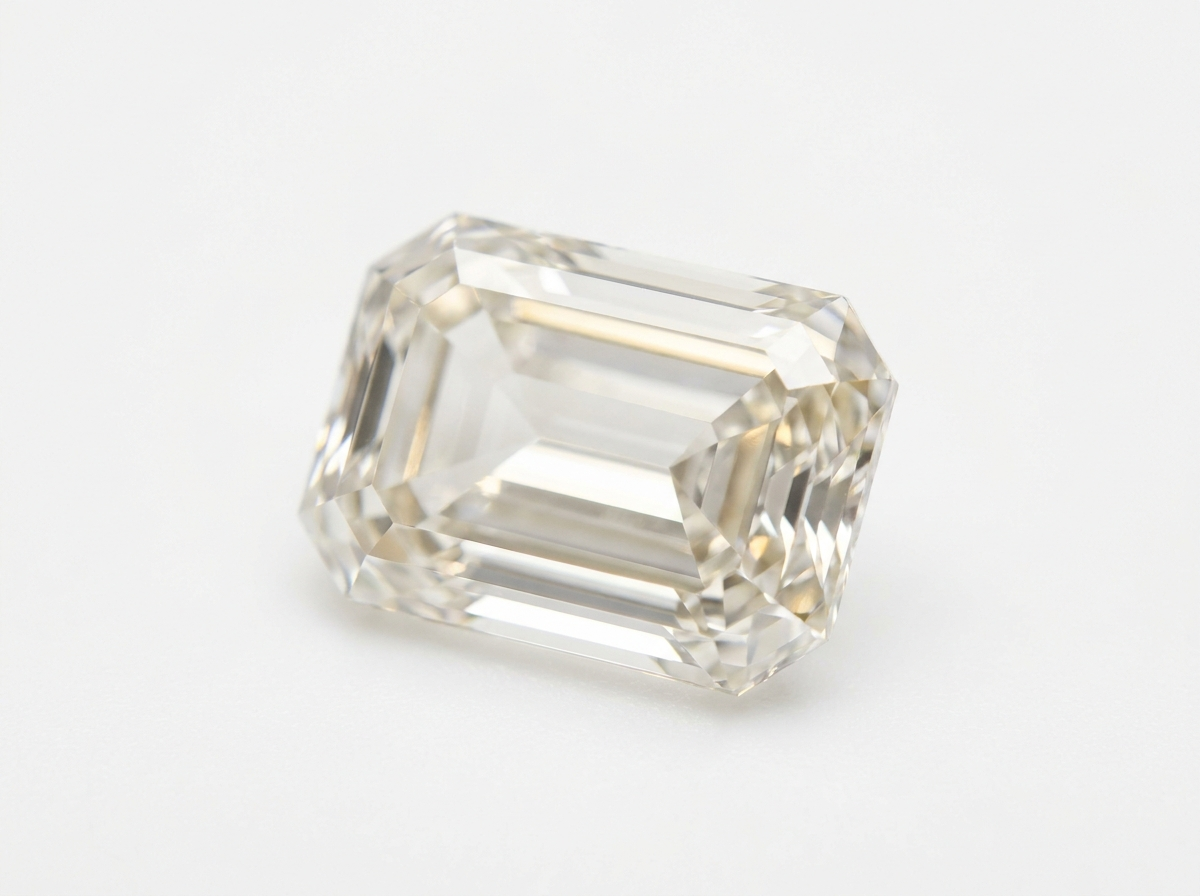
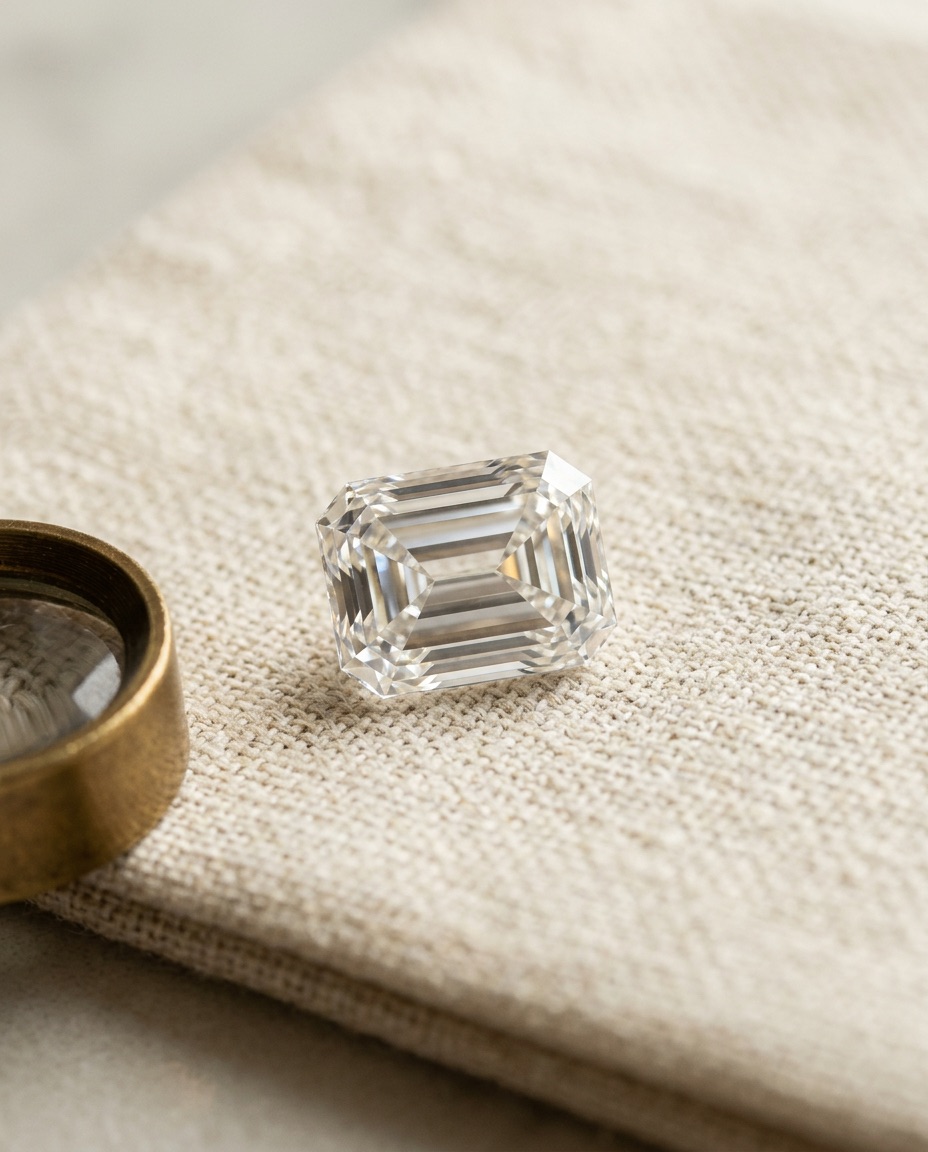
A Criss-Cut diamond is a modified emerald/rectangular step cut with a distinctive crisscross faceting pattern added at the corners, giving noticeably more brilliance than a standard emerald cut while keeping the same clean rectangular silhouette. Guru Diam stocks 228 Criss-Cut diamonds on hand, CVD lab-grown and cut in-house, gradable by IGI, GIA, or GCAL, from our New York Diamond District desk.
What is a criss-cut diamond?
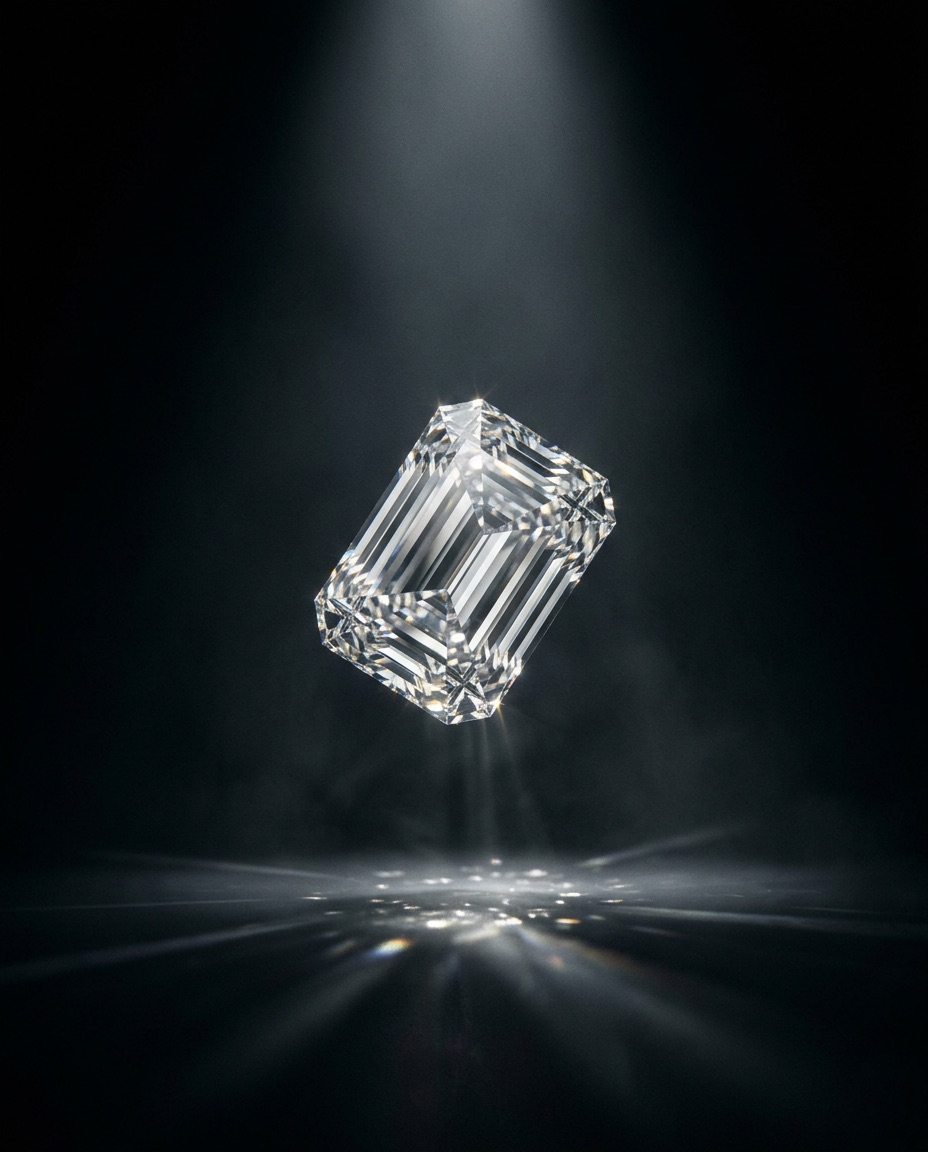
A criss-cut starts from the same base as an emerald cut — a rectangular outline with cropped corners and broad, flat step-cut facets running down the pavilion — but breaks from it at the corners, where an additional crisscross pattern of small facets is cut in. That corner detail is what gives the shape its name and its function: a standard emerald cut relies entirely on its broad flat planes, producing wide, slow flashes of light (the "hall of mirrors" look) but relatively little sparkle. The crisscross corners on a criss-cut break up that flat geometry just enough to add real scintillation, without turning the stone into a full brilliant cut and losing the rectangular, architectural line that buyers choose an emerald-style shape for in the first place.
The result is a step-cut diamond that reads as more lively and forgiving of small inclusions than a pure emerald cut, while still photographing and setting like a classic rectangular stone. It's recognized in the trade as its own named step-cut variant rather than a generic "fancy emerald," and buyers searching for it are usually looking specifically for that added brilliance, not a substitute for a standard emerald cut.
Because a criss-cut sits between two established categories — the architectural restraint of a step cut and the added sparkle usually associated with a brilliant — it tends to appeal to a specific kind of buyer: someone who likes the clean rectangular line for a ring, pendant, or earring design but has found that a pure emerald cut looks flat or "sleepy" under typical retail lighting. For a wholesale buyer, that makes criss-cut a useful shape to stock alongside standard emerald inventory rather than instead of it — the two solve different customer objections.
Facet structure: how the crisscross corner pattern works
Understanding why a criss-cut behaves the way it does starts with the facet map. A standard emerald cut is built from concentric rectangular and trapezoidal step facets — usually two or three rows on the crown and three or four on the pavilion — arranged in parallel bands around a large, flat table. Light entering that table either reflects back cleanly (producing the broad "flash" the cut is known for) or exits through the pavilion facets and is lost, depending on the cutter's angle choices. There's very little facet-to-facet light-bouncing of the kind that produces sparkle in a round brilliant.
A criss-cut keeps that same core step-cut architecture through the body of the stone but replaces the plain corner facets — normally just a single small bevel at each of the four corners — with a cluster of smaller triangular and kite-shaped facets arranged in an X or crisscross pattern. Each corner cluster typically adds somewhere in the range of six to eight extra facet planes beyond what a standard emerald-cut corner carries, depending on the exact cutting house's facet map. Multiplied across all four corners, that's a meaningful increase in total facet count for the stone as a whole, concentrated exactly where the eye tends to catch movement — the corners and edges of a rectangular outline, not the center of the table.
The practical effect is a stone that still reads as one continuous rectangular shape from a normal viewing distance, but that throws small, quick flashes of light from the corners as the piece moves — a contrast to the slow, wide flash of the open table. Because those corner facets are smaller and more numerous, they also do a modest amount of work breaking up the visibility of minor inclusions near the stone's edges, which is part of why criss-cut is often positioned as a slightly more forgiving cut than a pure emerald for a given clarity grade. The center of the stone, however, still behaves like an open emerald-cut table — large step facets with nowhere to hide anything — so clarity in the middle of the stone still matters as much as it would on a standard emerald cut.
A brief trade history of the criss-cut
The rectangular step cut itself is one of the oldest cutting traditions in the diamond trade, tracing back to the square and rectangular "table cuts" used on colored gemstones for centuries before diamond cutting caught up technically. The modern emerald cut as jewelers know it today — clipped corners, concentric step facets, a broad open table — took its recognizable form in the early 20th century, when Art Deco design was pushing jewelers toward cleaner geometric lines and away from the ornate mixed-cut work that had dominated the previous century. That period is when the rectangular step cut moved from a shape used mostly on colored stones to a standard diamond cut in its own right, prized for exactly the architectural, understated look that made it a natural fit for the era's design language.
The crisscross corner variant is a later refinement on that base cut, developed by cutters looking to solve the one recurring criticism of a pure emerald cut: that its broad, flat facets, while elegant, produce comparatively little sparkle next to a round brilliant. Adding a structured facet pattern at the corners — rather than reworking the whole stone into a brilliant cut and losing the rectangular silhouette — became the trade's answer, and it's the same logic that produced other step-cut hybrids over time. Today "criss-cut" functions in the trade as a descriptive name for this facet treatment rather than a single proprietary cut controlled by one house; different cutters execute the corner pattern with slightly different facet counts and angles, which is why length-to-width ratio and corner symmetry (covered below) matter more when evaluating a specific stone than the name alone.
For a wholesale buyer, the history matters less than the category it created: criss-cut sits in the antique cut family alongside old mine, old European, and other true period-style cuts that lab-grown production now makes available at trade-friendly volume and price, rather than only as rare estate finds.
Criss-cut vs. standard emerald cut
| Spec | Criss-Cut | Standard Emerald Cut |
|---|---|---|
| Outline | Rectangular, cropped corners | Rectangular, cropped corners |
| Base faceting | Step-cut (broad, flat planes) | Step-cut (broad, flat planes) |
| Corner faceting | Added crisscross facet pattern | Plain step facets, no crisscross |
| Light behavior | Broad flashes plus added sparkle at the corners | Wide, slow flashes ("hall of mirrors"), minimal sparkle |
| Inclusion visibility | Somewhat more forgiving due to broken-up faceting | Highly visible — inclusions show clearly in the open table |
| Best for | Buyers who want the emerald silhouette with more brilliance | Buyers who want the purest, most architectural step-cut look |
Both shapes share the same core proportions and setting requirements, so choosing between them comes down entirely to how much sparkle the design calls for. A jeweler stocking both isn't duplicating inventory — a customer who tries on a standard emerald cut and says it looks "too plain" or "too dark" under store lighting is very often sold by seeing the same silhouette in criss-cut a few minutes later, without ever having to move to a different shape family.
Criss-cut vs. asscher cut
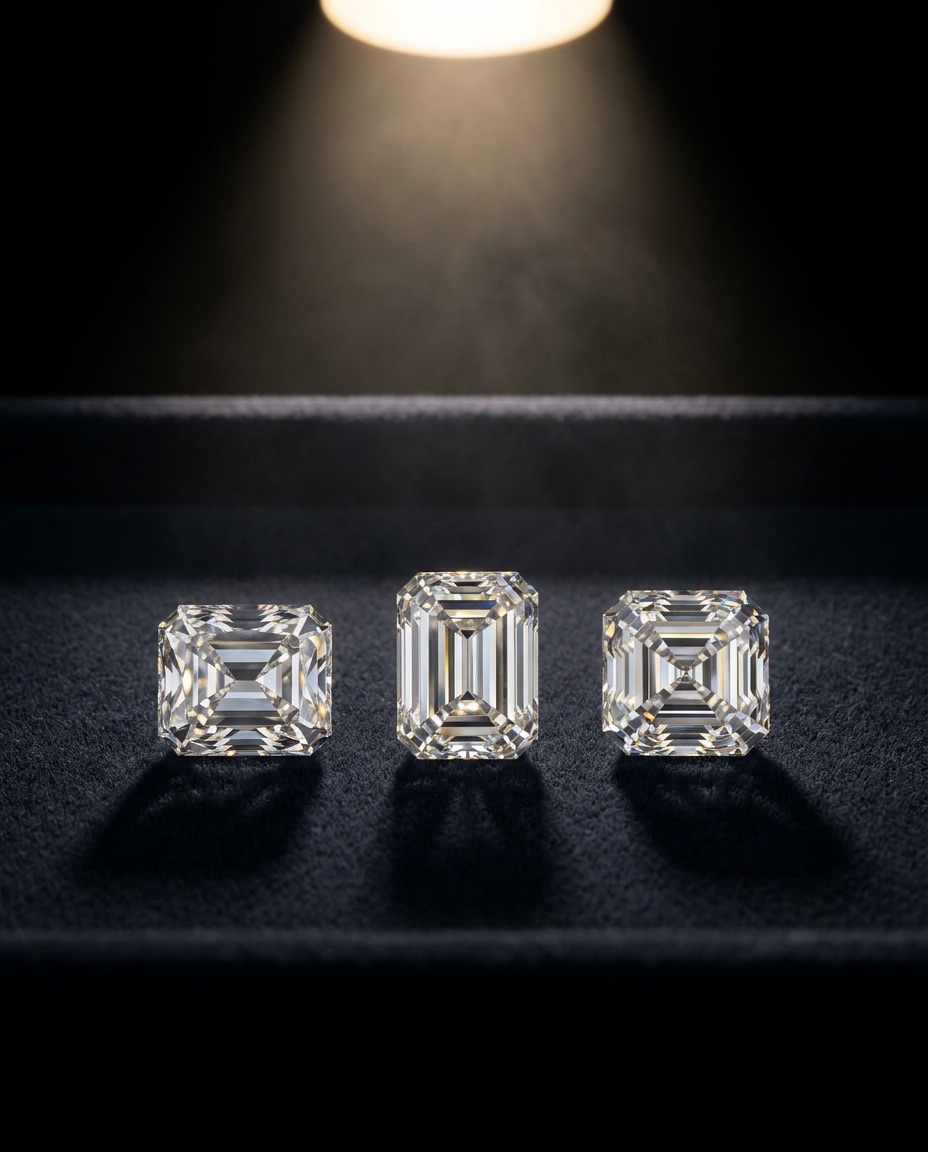
Asscher is the other step cut buyers most often compare against criss-cut, and the comparison is worth being precise about because the two solve different problems. Asscher is a square (or near-square) step cut with a higher crown, a deeper pavilion, and larger corner crops than an emerald cut — proportions that concentrate its step facets into a tighter, more contained "hall of mirrors" pattern. Criss-cut is built on the emerald cut's elongated rectangular proportions and adds brilliance through corner faceting rather than through the cut's basic geometry.
| Spec | Criss-Cut | Asscher Cut |
|---|---|---|
| Outline | Elongated rectangle, cropped corners | Square, larger cropped corners |
| Crown height | Standard step-cut crown | Higher crown, deeper pavilion |
| Sparkle source | Structured corner facet clusters | Concentrated step geometry, tighter facet spacing |
| Silhouette read | Elongated, lengthening on the finger | Compact, squared, vintage-coded |
| Typical use | Center stone or elongated side stones | Center stone in vintage-inspired settings |
In practice, a buyer choosing between criss-cut and asscher is usually choosing an outline first — elongated versus square — before thinking about facet structure. Criss-cut wins with buyers who want a finger-lengthening rectangular line with more life than a plain emerald cut; asscher wins with buyers chasing a compact, vintage-coded square silhouette. Both are antique-style step cuts, and both carry the same clarity sensitivity that comes with large, flat facets — guidance that applies to any step cut a jeweler stocks.
Grading and quality considerations for criss-cut diamonds
Guru Diam's Criss-Cut inventory is CVD-grown and cut in-house, gradable by IGI, GIA, or GCAL. A few things matter more here than on a standard emerald cut, and they're worth walking through individually before quoting a customer or committing to a stone for a build.
Clarity and color
Neither IGI nor GIA assigns an overall cut grade to fancy shapes the way they do to round brilliants — cut grade is a round-brilliant-only field on a certificate. For a criss-cut, the report carries color, clarity, symmetry, and polish, and those four drive how the stone actually performs. Clarity still matters more than it would on a brilliant cut of comparable size, because the center of the table remains a large, flat, open facet where inclusions have nowhere to hide — the crisscross corners soften visibility near the edges but don't change that. Most trade buyers work a VS2-and-up floor for criss-cut center stones, since the combination of an open table and added corner brilliance tends to draw more eye contact than a plain emerald cut of the same clarity. Color behaves the way it does on any step cut — body color pools more visibly in broad flat facets than it does in a brilliant's broken-up facet pattern — so many buyers tighten their color floor by a grade versus what they'd accept in a round brilliant of the same carat weight.
Corner facet symmetry
The crisscross detail is the defining feature of the cut, which makes symmetry the single most important quality check specific to criss-cut. Confirm the corner faceting is even and matched across all four corners — not just present, but cut to the same angle and depth on each one — before committing to a stone. Uneven corner faceting is the most common quality issue buyers report on criss-cut stones sourced from mixed-lot inventory, and it's often visible to the naked eye once a buyer knows to look for it: one or two corners will throw noticeably less sparkle than the others under the same light.
Length-to-width ratio
As with any elongated step cut, confirm the exact length-to-width measurements against the design rather than relying on the shape name alone. A criss-cut intended to sit in a narrow cathedral setting or a three-stone build needs a specific L:W ratio to look proportioned once mounted — the same nominal carat weight can produce a noticeably wider or narrower stone depending on how the rough was cut, and that variance matters more visually on an elongated rectangular shape than it does on a round or square stone.
Same-lab comparisons and certification flexibility
Compare color and clarity grades from the same certifying lab when evaluating multiple stones side by side — IGI and GIA grading isn't directly interchangeable, and a small perceived color or clarity difference between two stones can simply be a grading-house difference rather than a real difference in the stones themselves. Guru Diam grades Criss-Cut inventory through IGI as standard, with GIA and GCAL available on request, so buyers comparing multiple stones for a single project can request matched certification across the set.
What drives criss-cut diamond pricing
Pricing on a criss-cut diamond follows the same core levers as any fancy-shape stone, with a couple of cut-specific factors layered on top.
Carat weight is still the largest single driver, and it behaves non-linearly the way it does across the trade — price per carat steps up at the common psychological breakpoints (0.50ct, 1.00ct, 1.50ct, 2.00ct, and so on) rather than climbing smoothly. Because a criss-cut is an elongated rectangular shape, two stones at the same carat weight can differ meaningfully in face-up size depending on their length-to-width ratio, which affects perceived value even when the certificate weight is identical.
Clarity and color carry more pricing weight on a criss-cut than on a brilliant cut of the same size, for the reasons covered above — the open table makes inclusions and body color more visible, so the jump in price between adjacent clarity or color grades tends to be sharper on step cuts than on rounds.
Cut and symmetry quality is where criss-cut diverges most from a standard emerald cut on price. Because the corner faceting is the defining feature of the cut, a stone with clean, matched, well-executed corner facets commands a real premium over a stone with the same carat/clarity/color numbers but uneven or shallow corner work — even though "cut grade" doesn't appear as a formal field on the certificate for fancy shapes. This is a case where the certificate alone doesn't tell the full pricing story, and it's part of why buying from a supplier that can show the actual stone (or detailed imagery) before quoting matters more on criss-cut than on a round brilliant.
Certification lab has a modest effect on price and a larger effect on buyer confidence — IGI-graded stones are typically priced slightly below GIA-graded stones of comparable specs, reflecting differences in grading cost and market positioning between the labs rather than a difference in the stones themselves. GCAL grading, where requested, sits in a similar band. None of that changes the physical stone; it changes what a customer is willing to pay for the paperwork behind it.
Sourcing model is the last lever, and it's the one a wholesale buyer has the most control over. Buying from on-hand inventory at a fixed price avoids the premium (and lead time) attached to a made-to-order cut against a specific size, ratio, or corner-facet spec, which is why most trade buyers default to in-stock pulls for standard sizes and reserve custom cutting for projects where the design genuinely requires an off-catalog dimension.
How Guru Diam sources and cuts criss-cut diamonds
Guru Diam's Criss-Cut program is built on CVD lab-grown rough, cut in-house to the corner-facet spec described above, and held as on-hand inventory rather than cut to order against incoming purchase orders. That's a deliberate choice: because the crisscross corner pattern is the part of the stone most sensitive to cutting quality, controlling the cutting step in-house — rather than buying finished stones from mixed third-party lots — is what lets Guru Diam guarantee corner symmetry across the stones it stocks, instead of inspecting each incoming lot for the uneven-corner problem described above.
Every criss-cut stone that enters inventory is checked for corner facet symmetry and length-to-width ratio before it's listed, and the catalog is gradable by IGI, GIA, or GCAL — buyers can request whichever lab fits their market or their customer's preference rather than being locked to a single certifying house. That certification flexibility extends across Guru Diam's broader antique and fancy-shape catalog, not just criss-cut, and it's one of the more common reasons trade accounts consolidate multiple shape categories onto a single supplier rather than sourcing each cut family from a different vendor.
Because criss-cut sits in the antique cut tier alongside old mine, old European, kite, and other true period-style shapes, it's part of the category Guru Diam treats as a core specialty rather than a peripheral SKU — stocked in production-relevant depth (228 stones on hand at time of writing) rather than as a handful of samples pulled to fill out a catalog page. For a buyer building a program around antique-style cuts specifically, that depth is the practical difference between being able to fill a real order today and having to wait on a custom cut for a shape that should be readily available.
Styling and use-case guidance
Criss-cut's rectangular, elongated silhouette makes it a natural center stone for the same design families that favor emerald cut — cathedral settings that let the stone's length read clearly against the finger, three-stone rings that flank it with trapezoid or tapered baguette side stones, and simple bezel or East-West settings that lean into the architectural line rather than dressing it up. Because the added corner brilliance gives criss-cut more visual activity than a plain emerald cut, it also holds up well in slightly busier settings — a halo, for instance — where a pure emerald cut can sometimes look flat next to a ring of smaller brilliant melee, but a criss-cut's own corner sparkle keeps pace with the halo instead of getting visually flattened by it.
As a side stone, criss-cut is less common than trapezoid or straight baguette shapes simply because its added faceting is designed to draw attention rather than recede — but it does show up in matched-pair earring and three-stone builds where a jeweler specifically wants both flanking stones to carry real sparkle rather than serving a purely supporting role. In those builds, corner symmetry matters even more than it does for a single center stone, since any mismatch between the two stones' facet execution is immediately obvious side by side.
On metal pairing, criss-cut's crisper, more faceted corners tend to photograph well against both white metals (platinum, white gold) and warmer tones (yellow gold, rose gold) — the added brilliance keeps the stone from reading as flat against a warmer metal the way a plain emerald cut sometimes can. Prong placement typically follows the same logic as a standard emerald cut: four corner prongs (or a low-profile double-claw at each corner) to protect the cropped corners, since that's structurally the most vulnerable point on any rectangular step cut, criss-cut included. For buyers doing custom work, Guru Diam's design team can also set criss-cut stones with fancy color melee — available in yellow, pink, blue, and green — as accent stones for buyers building a more colorful finished piece around a white or fancy-colored criss-cut center.
How to order criss-cut diamonds wholesale from Guru Diam
Guru Diam carries Criss-Cut as on-hand CVD lab-grown inventory, cut in-house, from our New York Diamond District desk and Los Angeles office, with real-time online inventory for trade accounts. In-stock pieces ship same-day from New York; a custom size, length-to-width ratio, or color outside current stock moves through CAD to a finished piece in 4–6 days.
Trade accounts get access to live pricing, real-time inventory counts by size and quality tier, and the ability to request IGI, GIA, or GCAL certification on individual stones before purchase. For center-stone or side-stone projects that need a specific corner-facet spec, size, or matched set, booking time with a gemologist ahead of the order is the fastest way to confirm a stone (or a pulled selection of candidates) meets the design before it ships.
Open a wholesale account at /signup and book time with a gemologist at /book-appointment to source Criss-Cut diamonds for a center-stone or side-stone project.
FAQ
What is a criss-cut diamond? A criss-cut is a modified emerald/rectangular step-cut diamond with an added crisscross facet pattern at the corners, giving more brilliance than a standard emerald cut while keeping the same rectangular silhouette.
How is a criss-cut different from a regular emerald cut? Both share the same rectangular outline and broad step-cut facets, but a criss-cut adds a crisscross pattern of small facets at the corners. That extra faceting produces more sparkle and can make small inclusions slightly less visible near the edges than they'd be in a standard emerald cut's open table.
How does a criss-cut compare to an asscher cut? Asscher is a square step cut with a higher crown and a more concentrated facet pattern; criss-cut is built on the emerald cut's elongated rectangular proportions with added corner faceting for brilliance. The choice usually comes down to outline first — elongated versus square — before facet structure.
Is a criss-cut diamond a good alternative to an emerald cut for more sparkle? Yes. If a buyer likes the rectangular, architectural line of an emerald cut but wants more brilliance, criss-cut is built specifically to answer that — same silhouette, added scintillation from the corner faceting.
Are Criss-Cut diamonds certified? Guru Diam's Criss-Cut inventory is CVD-grown and cut in-house, gradable by IGI as standard, with GIA and GCAL certification available on request for individual stones.
How fast can I get a Criss-Cut stone or a finished custom piece? In-stock loose stones ship same-day from New York. A finished custom piece — CAD to jewelry — runs 4–6 days from our New York and Los Angeles desks.