
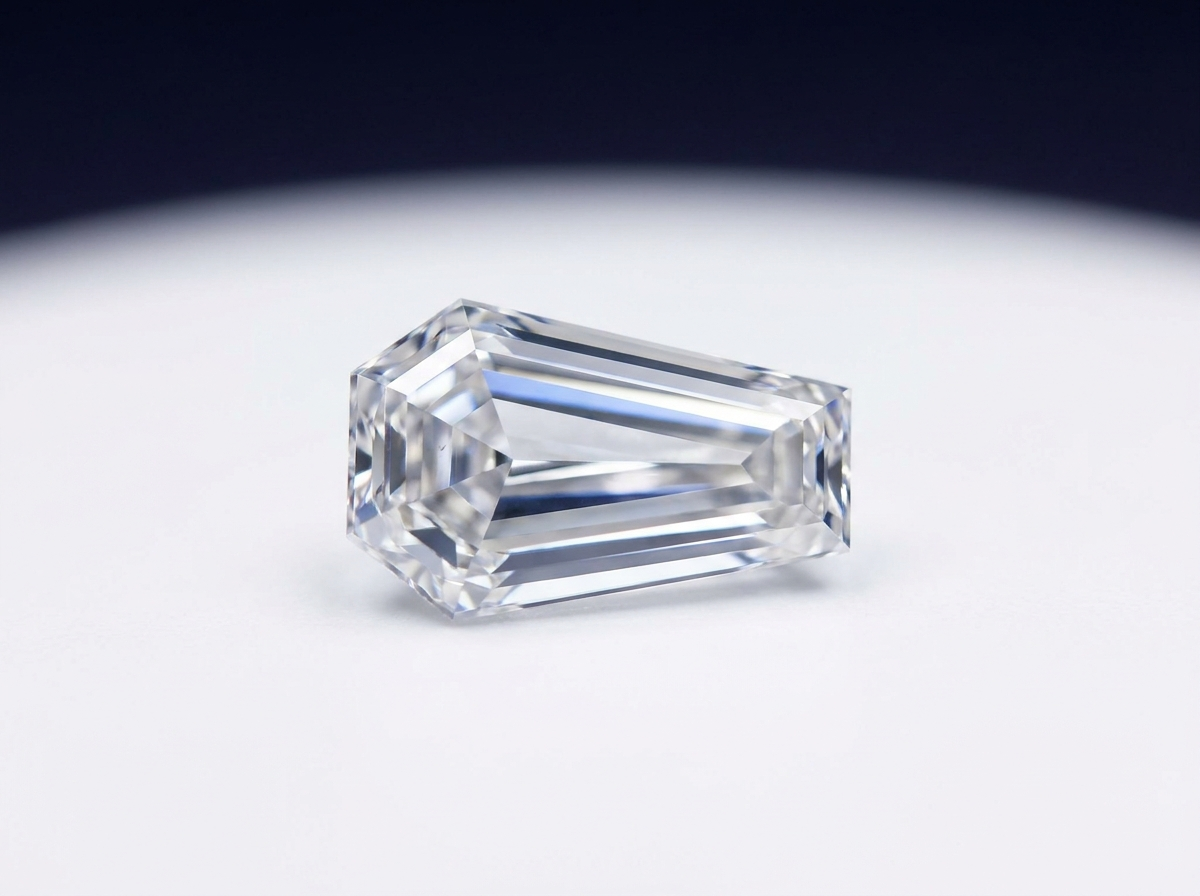
"A Coffin cut diamond is an antique step-cut shape with an elongated, six-sided outline — wider through the shoulders and tapering toward each end rather than curving or coming to a sharp point — named for its resemblance to a casket silhouette."
Search "Coffin cut diamond" and you'll mostly find forum threads asking what the shape even is, plus one or two dealer listings with a photo and a price and nothing else. That's not because demand doesn't exist — antique-cut buyers ask for it by name — it's because almost no one stocks it deep enough to write anything real about it. This guide covers what the shape actually is, how it compares to the antique cuts you already know, how it's faceted, what drives its price, where it fits in a finished piece, and where to source it in stock.
What is a Coffin cut diamond?
A Coffin cut is a hexagonal-family antique shape: six sides, broadest across the shoulders, narrowing gradually toward each end into a flattened tip rather than a sharp point. The faceting is step-cut — broad, flat, rectangular facets running in parallel rows — which gives the stone the same quiet "hall of mirrors" light behavior as an emerald cut, rather than the fire and scintillation of a brilliant-faceted shape.
That faceting is the main thing separating a Coffin cut from a Dutch Marquise, which shares the elongated hexagonal family but is brilliant-faceted with pointed ends. A Coffin cut is the step-cut cousin: quieter light performance, tapered rather than pointed ends, and an outline that reads more architectural than sparkling. Both are genuine antique shapes with real Art Deco and Edwardian-era pedigree, and both fell out of common production for the same reason — cutting a clean, symmetrical outline with true step faceting by hand is slow and unforgiving, so the trade mostly stopped stocking it even though the shape never stopped being requested.
Looked at face-up, the outline breaks into three zones: two long parallel sides forming the shoulders at the widest point, then four shorter angled sides that taper the stone inward toward each end, closing into a flattened tip rather than a point. On the pavilion side, the step facets mirror the crown down to a short keel line at the base instead of the single culet point you'd see on a round or square stone — an elongated outline doesn't have one low point, it has a line. Table size, crown height, and depth percentage all move within the same workable ranges as any step cut, but small shifts in those proportions show up faster on this outline than they would on a simpler shape, because the eye is reading symmetry across six corners and a length-to-width ratio, not just a single set of four matching sides.

A brief history: step cuts, Art Deco, and the antique revival
Step-cut faceting predates the brilliant cut by centuries — early lapidaries were cutting flat, table-style facets long before the mathematically optimized triangular and kite-shaped facets of a modern round brilliant were worked out. By the 1920s and 1930s, step-cut geometry had become the signature look of the Art Deco period: emerald cuts, baguettes, trapezoids, half-moons, kites, and elongated hexagonal shapes like the Coffin cut all turned up together in the same pieces, valued for clean architectural lines that let a design read as geometry first and sparkle second.
Coffin cut specifically shows up in period trade catalogs and pattern books as one of several elongated hexagonal options alongside the Dutch Marquise, typically used as a distinctive center stone or as a side stone flanking a larger emerald or old mine cut. Like most step cuts, it fell out of mainstream production after the mid-20th century, when round brilliant cutting — cheaper to produce at scale and higher-yield from typical rough — became the default for engagement rings, and most other outlines settled into a long decline outside the antique and estate market.
What's changed more recently is a broader swing back toward antique-style cuts in fine jewelry — old mine, old European, and step-cut fancy shapes are back in circulation as buyers look for pieces that don't default to a round solitaire. That revival is exactly where the sourcing problem resurfaced: a shape like Coffin cut was already scarce in its original era, so demand outpacing estate supply was inevitable the moment buyers started asking for it by name again.
Coffin cut was never a high-volume shape even in its original antique-market era, so the supply problem is the same one that hit Dutch Marquise, Old Mine, and Old European cuts: an estate parcel either happens to contain the right stone or it doesn't, and there's no way to order more of it. CVD-grown rough removes that constraint entirely — a cutter can produce a true Coffin cut to spec (correct taper, correct shoulder width, correct proportions) in a target size and color on demand, instead of waiting for the right antique stone to turn up.
That makes two things possible that the antique market never could: matched pairs (two Coffin cuts cut to the same spec for side stones, versus trying to match two dissimilar estate stones) and repeatable reorders if a Coffin cut piece sells.
For independent jewelers and designers, that shift matters more than it sounds. A client asking for something outside the standard round-cushion-oval rotation used to mean either talking them out of it or spending weeks hunting an estate dealer network for a single usable stone with no guarantee of a match if a second was ever needed. On-demand cutting turns that into a normal order: a shape a client saw in a period photograph or an old auction listing becomes something a jeweler can actually quote and deliver against.
Coffin cut vs. Hexagon, Kite, and Octagon: how the antique step cuts compare
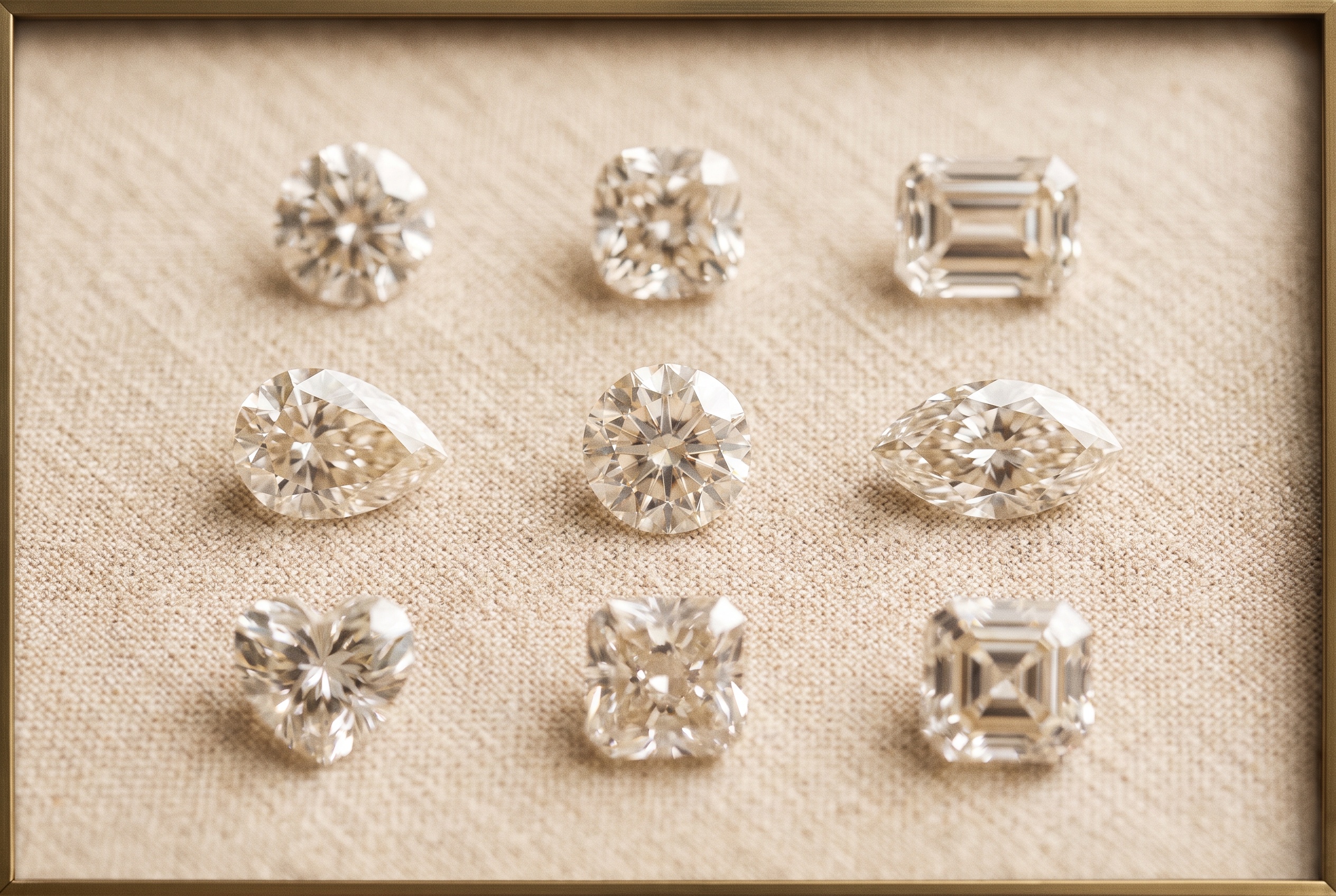
Coffin cut belongs to a small family of angular antique and antique-adjacent shapes that get confused with each other constantly, mostly because none of them are common enough for most buyers to have handled more than one or two side by side. The distinctions come down to how many sides the outline has, whether the ends taper or stay flat, and where the shape is meant to sit in a finished piece — center stone versus flanking accent.
| Spec | Coffin | Hexagon (step-cut) | Kite | Octagon |
|---|---|---|---|---|
| Sides | 6 | 6 | 4 | 8 |
| Outline | Elongated hexagon, tapered to a flattened tip at each end | Flat-sided hexagon, no taper | Elongated rhombus, pointed top and bottom | Rectangular outline with truncated corners, symmetric all around |
| Faceting | Step-cut | Step-cut | Typically step-cut | Step-cut |
| Typical role | Center stone or side stone | Center stone | Accent stone flanking a center | Center stone, close cousin of the emerald cut |
| Rarity in trade | Very low — most wholesalers don't stock it | Uncommon | Uncommon | More available than the others |
Kite is the odd one out structurally — four sides instead of six — but it earns a place in this comparison because it's the shape most often paired with a Coffin cut or a Dutch Marquise as a flanking accent stone in a three-stone or cluster setting; a buyer sourcing one of these shapes often ends up sourcing the other. Octagon sits closer to the emerald-cut family than to the true antique shapes above — it's a useful reference point for the comparison, but it isn't part of the same antique-shape category as Coffin, Hexagon, and Kite.
How a Coffin cut is faceted, and why calibration matters
Step faceting arranges facets as broad, flat, rectangular or trapezoidal panels in concentric rows running parallel to the girdle outline, rather than the small triangular and kite-shaped facets a brilliant cut uses to break light into scintillation. On a Coffin cut, the crown carries a handful of large, wide facets that follow the six-sided outline, and the pavilion mirrors that stepped structure down to the keel line at the base. The result is a stone that reads as broad, clean planes of light rather than a field of small sparkle points — the same visual language as an emerald cut, just wrapped around a different outline.
The six corners are where the cut lives or dies. Each of the two shoulder-to-taper transitions has to be symmetric on both sides of the stone, and the flattened tip at each end has to be cut cleanly without leaving a visible seam or rounding off into something closer to an oval. A step cut also has nowhere to hide a proportion mistake the way a brilliant cut can mask minor asymmetry in its facet pattern — the flat planes show every irregularity in the outline directly.
Calibration is what turns a one-off Coffin cut into something a wholesale buyer can actually plan around. For a matched pair, calibration means holding face-up length-to-width ratio, depth, and shoulder width to the same spec across both stones, so they read as a true pair rather than "close enough." For a repeat setting or a CAD-driven piece, it means a stone ordered against a spec months later drops into the same mounting without a custom resize. Because the rough is grown to spec rather than found in an existing crystal, a cutter can plan the outline against the rough's structure before cutting starts, which is what makes holding that kind of tolerance realistic on a shape this unforgiving.
Certification and what to check when buying wholesale
Neither IGI nor GIA assigns an overall cut grade to fancy shapes the way they do to round brilliants — that grade only exists for round stones. A Coffin cut report will list color, clarity, measurements, symmetry, and polish, but not a single "cut" score to sort by. That makes symmetry and polish the closest available proxy for cut quality on this shape, and it's worth checking them specifically rather than assuming a strong color and clarity grade tells you the outline itself is clean.
Guru Diam's Coffin cut inventory is IGI-certified, CVD-grown. It's also worth checking any report against the issuing lab's own online database before finalizing a purchase, rather than relying on the printed or PDF copy alone — the report number should pull up matching color, clarity, and measurement data directly from the lab. On a shape this uncommon, that extra step catches the rare case of a mismatched or altered document faster than comparing paperwork by eye.
Because the outline is non-standard, check the same things that matter on any antique or fancy shape before committing:
- Shoulder width and taper symmetry. The shape lives or dies on the two ends tapering evenly from the same shoulder width — ask for exact measurements, not just the shape name.
- Facet alignment at the tapered ends. The narrow ends are the most failure-prone part of the cut; check symmetry and chip risk under magnification before setting.
- Symmetry and polish grade on the certificate. With no overall cut grade available for this shape, symmetry and polish are the nearest thing to a cut-quality signal the report gives you.
- Same-lab comparisons. Compare color and clarity grades from a single certifying lab — IGI and GIA don't map directly grade-for-grade.
What drives Coffin cut pricing
Rough utilization is the first factor. An elongated hexagonal outline with tapered ends yields more waste when it's cut from a given volume of rough than a round or square outline does, which pushes effective cost per carat above a comparably graded round or princess stone.
Cutting labor is the second. Six precise corners plus two symmetric taper transitions take meaningfully more cutter time and more re-checking against spec than a standard four-corner emerald or a round brilliant, and that labor cost carries through to price.
Clarity requirements behave differently on a step cut than on a brilliant. Wide, flat step facets are more transparent and show inclusions more readily than the broken-up facet pattern of a brilliant cut, which tends to scatter light in a way that can visually soften small inclusions. That means a clean face-up look on a Coffin cut generally calls for a relatively higher clarity grade than the same visual result would need in a brilliant-faceted stone of the same carat weight.
Matched pairs carry their own premium on top of the single-stone price, since two stones have to match face-up size, color, and symmetry closely enough to sit convincingly side by side — that's a meaningfully tighter bar than sourcing or cutting one stone on its own.
Carat and size tier compound the same scarcity from a different angle. A larger elongated outline needs a larger volume of clean rough to cut from without hitting an inclusion near one of the six corners, so the jump in price from a smaller Coffin cut to a noticeably larger one tends to be steeper than the same jump would be on a round stone, where more of the finished trade runs through a narrower, better-supplied size range.
Finally, because there's no official cut grade to sort by, symmetry and polish act as a real value driver in practice: two Coffin cuts at the same carat, color, and clarity can trade at different prices once one has a visibly cleaner taper and the other doesn't.
Best jewelry applications for Coffin cut diamonds
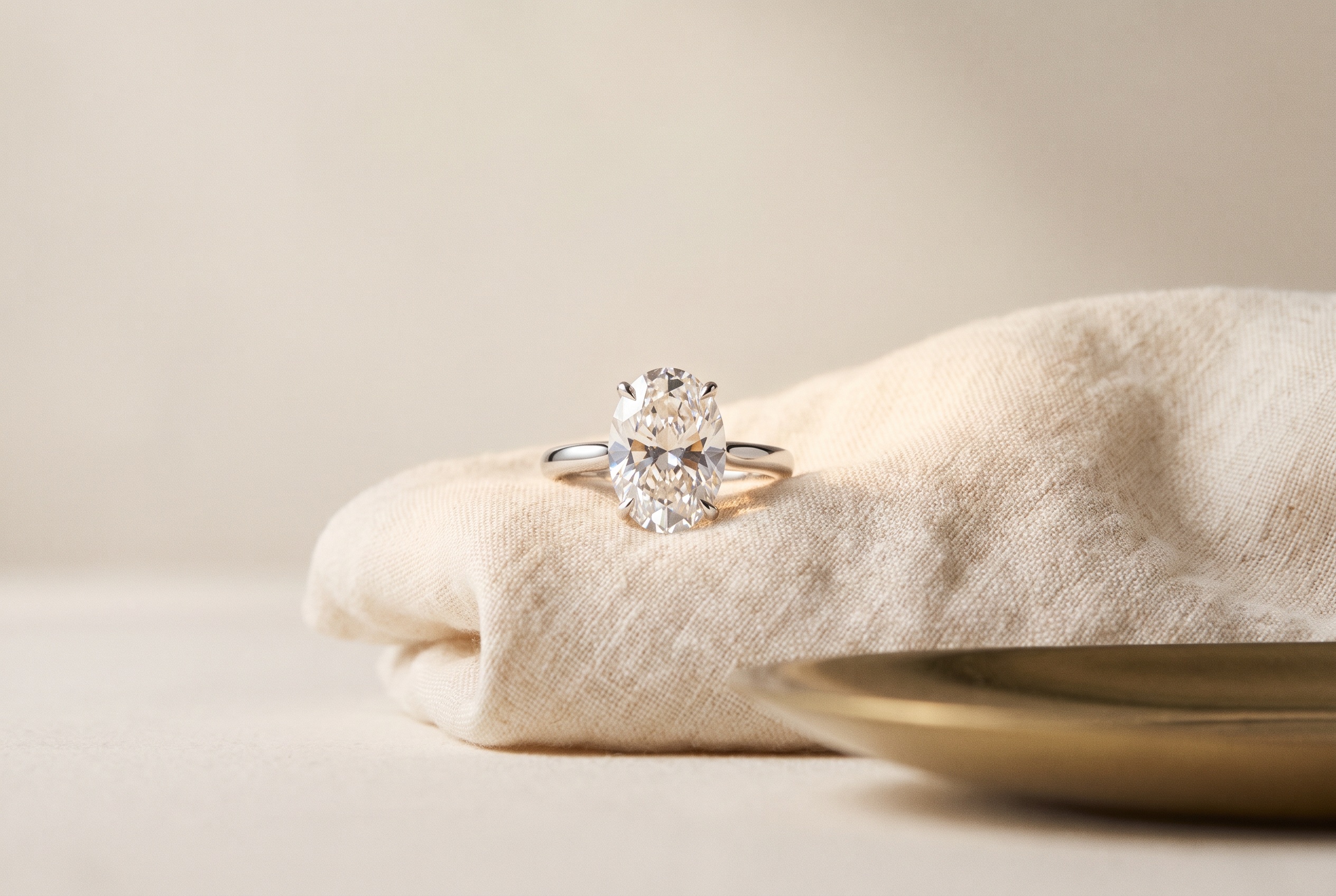
As a center stone, Coffin cut suits an Art Deco-inspired engagement ring where the design goal is a distinct, elongated silhouette rather than maximum brilliance — the outline pairs naturally with milgrain detailing, geometric halos, or a bezel or channel setting that echoes the same architectural lines the shape was originally cut to fit.
As a side stone, the tapered ends nest naturally against the shoulder of a round, oval, or emerald-cut center stone, filling the same role baguettes or half-moons typically play but with a more distinctive outline. A matched pair of Coffin cuts flanking a center stone is a common three-stone configuration for exactly this reason.
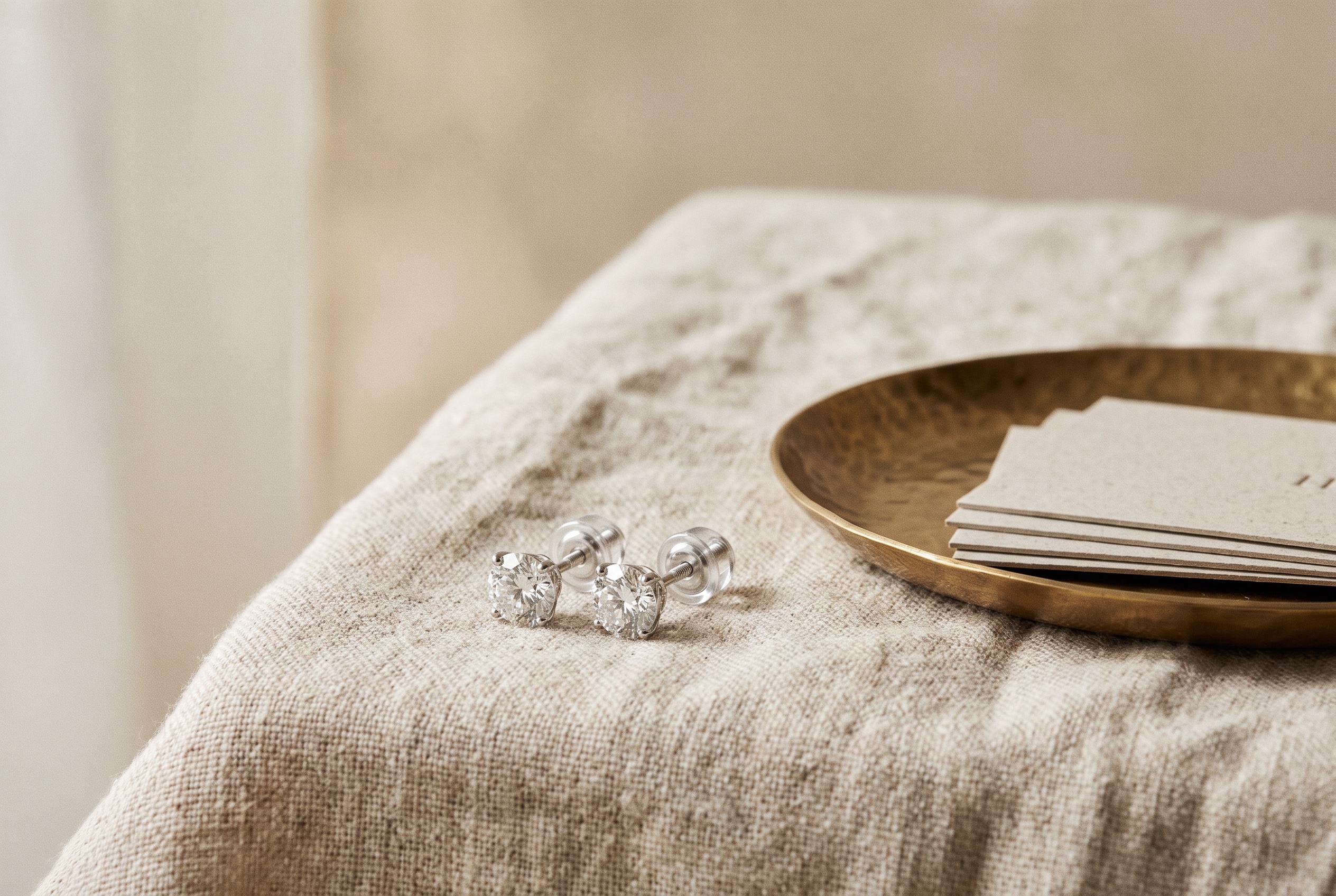
Matched pairs also work well outside ring settings — a symmetrical pair reads cleanly in stud or drop earrings, where the geometric outline carries the design without needing extra sparkle to hold attention.
Because the faceting is understated by design, Coffin cut suits buyers and end customers who want a distinctive, conversation-starting outline over maximum fire — closer to how a collector picks an antique or vintage-inspired piece than how a buyer shops for a standard brilliant shape.
Metal choice tends to follow the same period-accurate logic as the stone: warm-toned golds read closer to how these outlines were originally set in the Art Deco and Edwardian eras, while a cooler white metal shifts the same shape toward a more contemporary, minimal reading. Neither is more correct — it comes down to whether the piece is leaning into the antique reference or using the outline as a modern point of difference.

Sourcing Coffin cut diamonds from Guru Diam
Realistically, three kinds of sources exist for this shape: gated B2B portals at a handful of Diamond District dealers who list it as one SKU with no context or comparison content; retail sellers carrying it as a novelty item at consumer markup; and made-to-order cutting, where a buyer specs the size and the stone is cut fresh. The third option is generally the right one for matched pairs, specific sizing, or reliable reorders.
Guru Diam runs the made-to-order model with live on-hand stock layered on top — 44 Coffin cut pieces in inventory now, plus made-to-order cutting for anything outside current stock, from our New York Diamond District desk. In-stock pieces ship same-day from New York; for a size not currently on hand, made-to-order cutting plus custom jewelry (CAD to finished piece) runs 4–6 days.
Whether you need a single stone or a made-to-order matched pair for a custom piece, Guru Diam carries Coffin cut as IGI-certified lab-grown loose inventory from our New York and Los Angeles desks, with real-time online inventory and API/CSV feed access for trade accounts — useful for checking current on-hand count before quoting a customer, rather than sourcing blind.
Ready to buy? Open a verified wholesale account at /signup and book time with a gemologist at /book-appointment.

Wholesale buying checklist: red flags to watch for
Because so few sellers carry real depth in this shape, a wholesale buyer needs to screen listings more carefully than they would for a common outline. Watch for:
- No measurements beyond carat weight. Ask for length, width, and depth in millimeters — carat weight alone doesn't tell you the taper reads correctly for the setting.
- Photos that only show one angle. A listing should show the stone face-up and from the side, plus a magnified view of the tapered ends where symmetry problems tend to hide.
- No verifiable certificate number. If you can't look the report up independently against the issuing lab, treat the grading as unconfirmed.
- Loose use of the shape name. "Coffin cut" is sometimes applied to any elongated hexagon, including brilliant-faceted stones that are actually a Dutch Marquise. Confirm step-cut faceting specifically, not just the outline.
- Matched-pair claims without side-by-side proof. Ask for both stones photographed together under the same lighting before treating a "matched pair" listing as accurate.
- Vague stock status. Know whether you're buying from current inventory or committing to a made-to-order cutting timeline before you quote a customer a date.
Frequently Asked Questions
What is a Coffin cut diamond?
A Coffin cut is an antique step-cut diamond shape with an elongated, six-sided outline that's widest at the shoulders and tapers toward each end into a flattened tip rather than a sharp point. It's related to the Dutch Marquise in outline family but uses step faceting instead of brilliant faceting, giving it a quieter, hall-of-mirrors light effect.
How is a Coffin cut different from a Dutch Marquise?
Both are elongated hexagonal antique shapes, but a Dutch Marquise is brilliant-faceted with sharp, pointed ends, while a Coffin cut is step-faceted with tapered, flattened ends. That faceting difference means a Dutch Marquise throws more fire and sparkle, while a Coffin cut has a quieter, broader flash more like an emerald cut.
Can I get Coffin cut diamonds as lab-grown, and are they certified?
Yes. Guru Diam's Coffin cut inventory is CVD-grown and IGI-certified. Lab-grown production is what makes this historically rare antique shape sourceable on demand, in a target size and color, rather than dependent on finding the right antique stone on the estate market.
Can I order a matched pair or a custom size?
Yes. Because cutting is done in-house to spec, matched pairs and custom sizing are a standard request rather than a special one — this is one of the main reasons lab-grown reopened the category for sourcing.
How fast can I get a Coffin cut stone or a finished custom piece?
In-stock pieces ship same-day from New York. Made-to-order cutting plus a finished custom piece (CAD to jewelry) runs 4–6 days from our New York and Los Angeles desks.
Does a Coffin cut diamond get a cut grade on its certification?
No. Cut grade is only assigned to round brilliant diamonds by IGI and GIA. A Coffin cut report will list color, clarity, measurements, symmetry, and polish instead — symmetry and polish are the closest proxy for cut quality on this shape, which is why checking shoulder-to-taper symmetry under magnification matters more here than it would on a round stone.