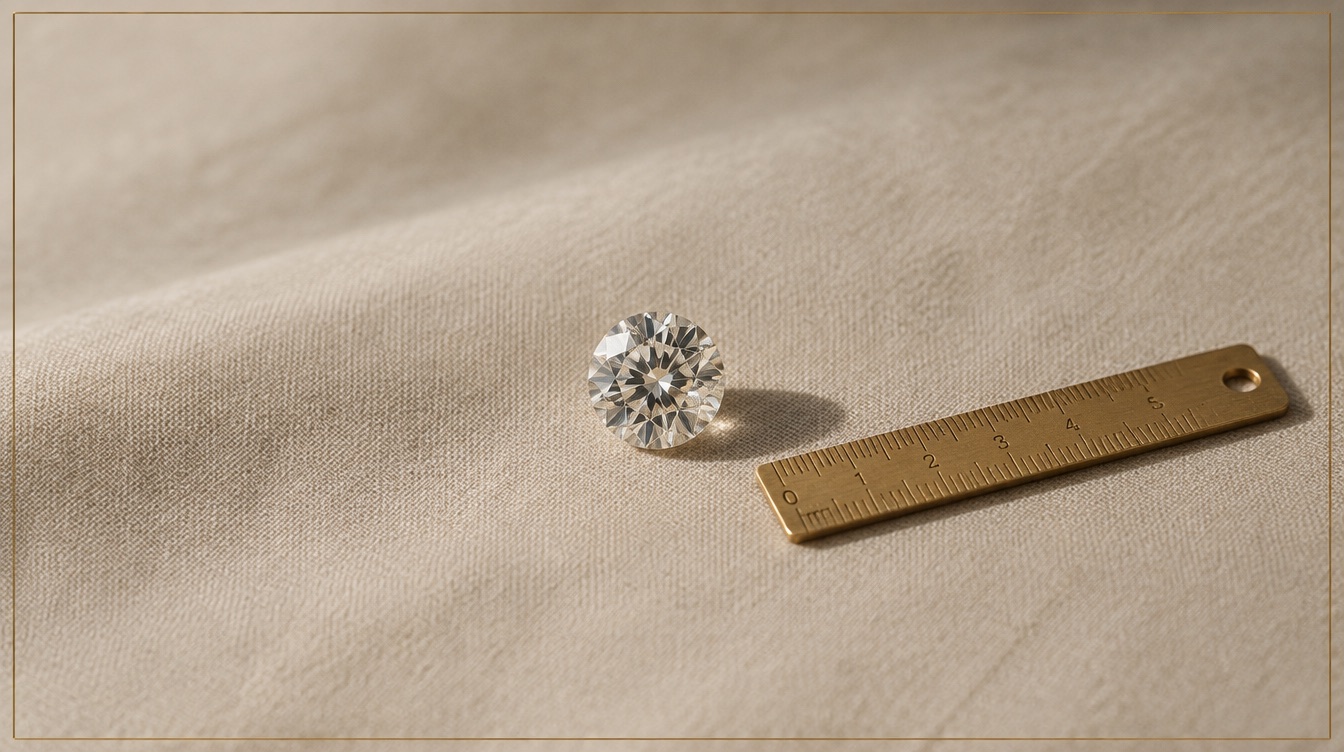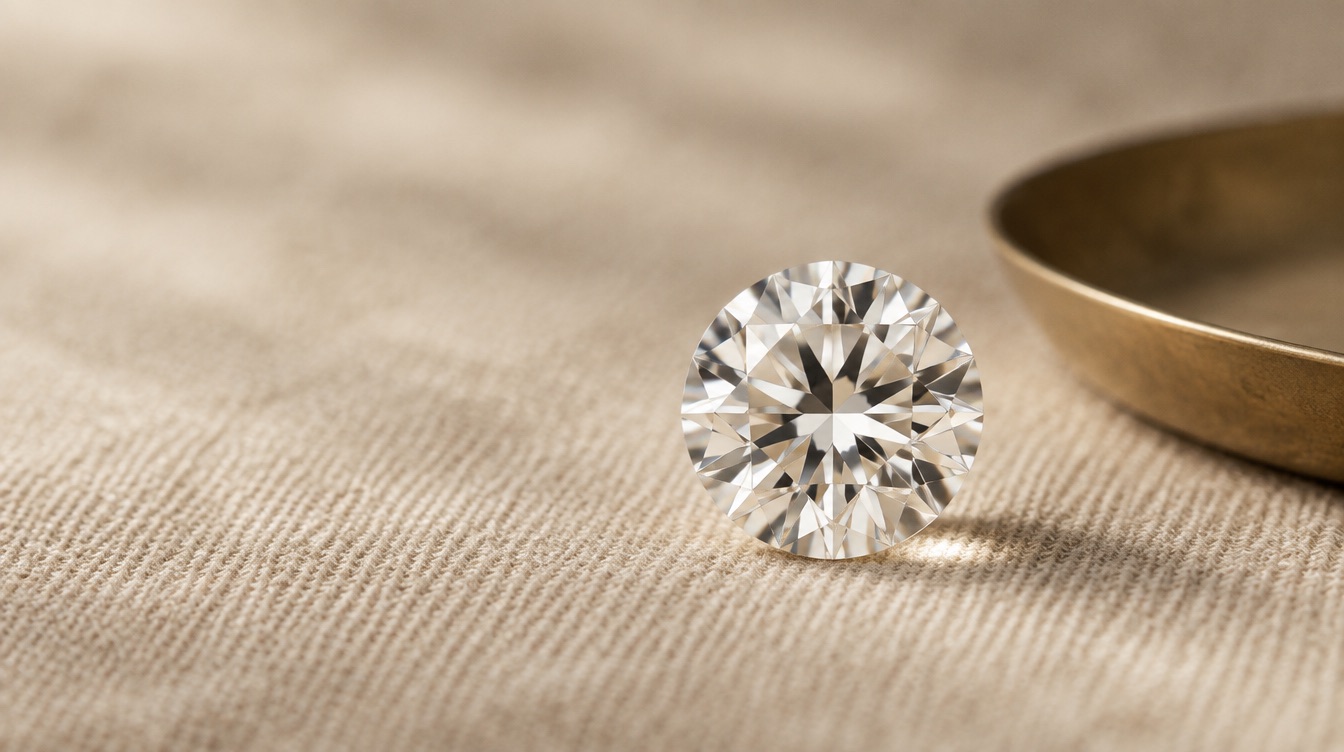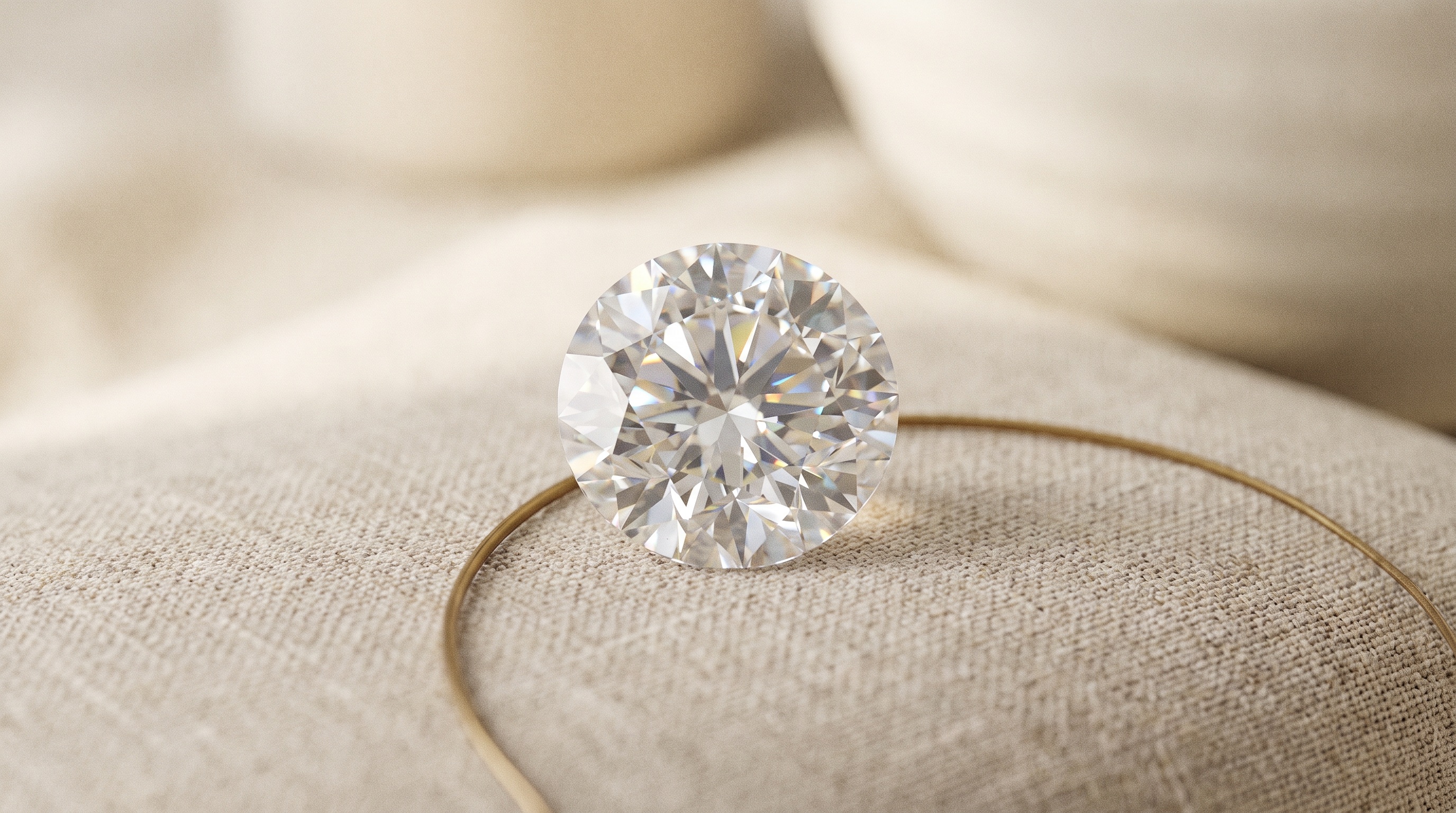
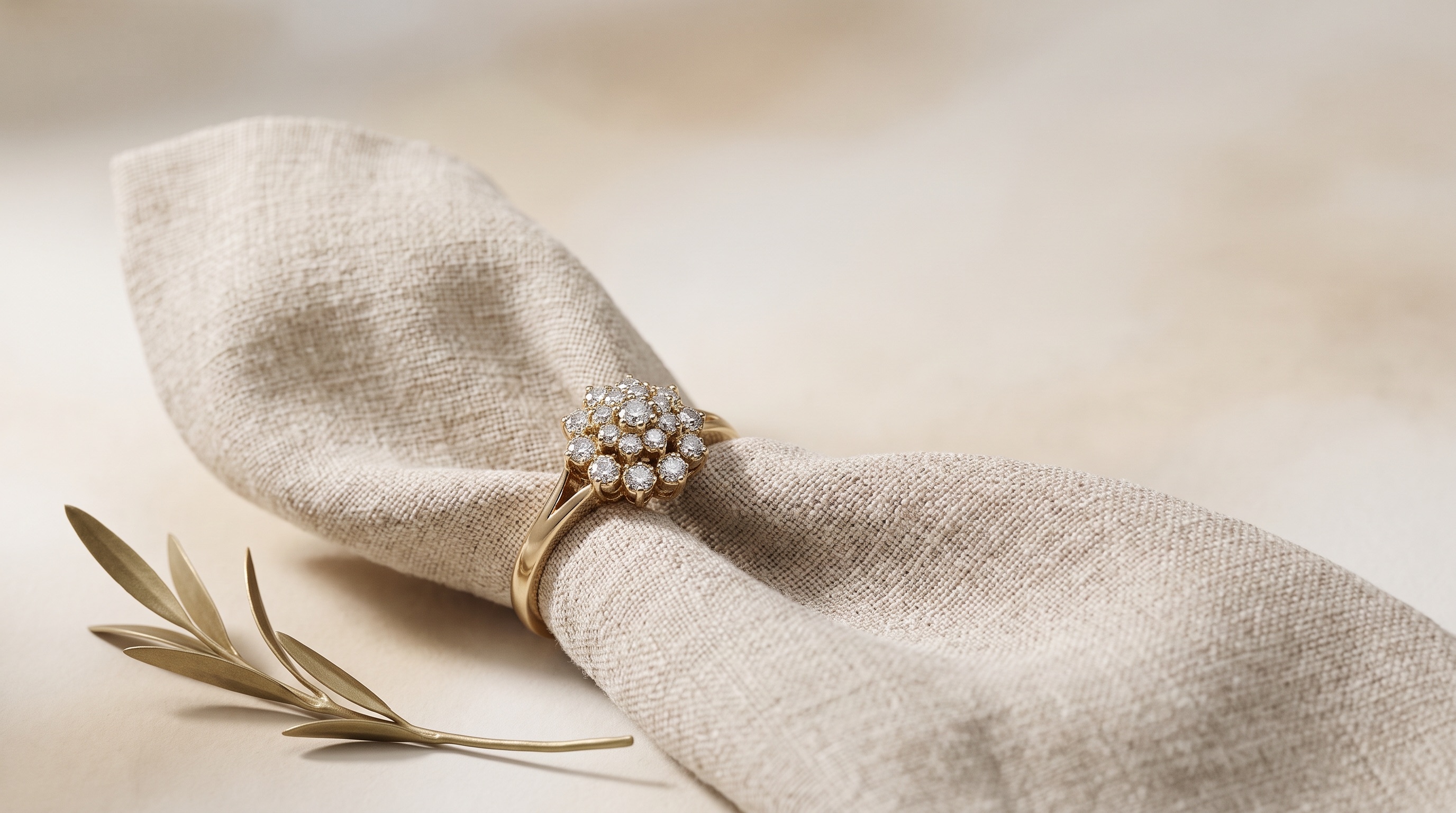
A cluster setting groups several smaller diamonds tightly together in a single mounting so they read, from a normal viewing distance, as one larger stone. Instead of one dominant center diamond, a cluster setting distributes carat weight across multiple stones — often an uneven mix of sizes arranged around a focal point — to build visual size, movement, and sparkle that a single stone of comparable footprint would cost significantly more to achieve.
Cluster settings get confused constantly with halo settings, and less often but just as consistently with illusion settings, even though all three solve a related problem — bigger-looking sparkle for less carat weight — through genuinely different construction. This guide covers what defines a true cluster setting, how its anatomy differs from a halo and an illusion setting, the practical tradeoffs a buyer takes on by choosing one, which diamond shapes and metal choices suit the style, the setting's history, common buying mistakes, ongoing maintenance, and what to check before sourcing cluster-setting stones or finished pieces at wholesale.
What Defines a Cluster Setting
A cluster setting is defined by what it doesn't have: a single, clearly dominant center stone that the rest of the piece is built around. Instead, several diamonds — sometimes uniform in size, more often a mix of a slightly larger central stone with smaller stones packed around it — are set closely together, edge to edge or nearly so, so the negative space between stones reads as minimal from a normal viewing distance. The goal is a unified visual mass: a viewer's eye perceives one large, sparkling shape rather than a count of individual stones.
That single design goal is what separates a cluster setting from simply "several diamonds set near each other." A well-executed cluster is engineered so the stones' facet patterns and proportions work together — varying sizes are chosen so smaller stones fill the gaps a single large stone's rounded outline would otherwise leave, maximizing the illusion of one continuous, faceted surface.
Anatomy of a Cluster Setting
A cluster setting's construction differs from a single-stone mounting in a few structural ways:
- A base or platform. Rather than a basket built for one stone, a cluster sits on a shaped metal base — often a rounded or marquise-shaped platform — with individual prong or bead settings for each stone cut directly into that base.
- Mixed stone sizes. Most clusters use a graduated size arrangement: a somewhat larger stone or two near the center, tapering to smaller melee-range stones toward the outer edge, which is what allows the cluster's outline to read as one continuous rounded or elongated shape rather than a visibly stepped ring of same-size stones.
- Shared or individual prongs. Adjacent stones sometimes share a single prong between them (a shared-prong or common-prong technique) to keep the visible metal between stones as minimal as possible, tightening the illusion of continuous coverage.
- A raised or domed profile. Many clusters are built with a slight dome, following the natural curvature that keeps the outer ring of smaller stones roughly level with the taller central stone or stones, so the whole arrangement catches light as one surface rather than a flat ring with a bump in the middle.
Cluster Setting vs. Halo Setting: The Difference That Actually Matters
A halo setting has one unambiguous center stone, typically the largest diamond in the piece by a wide margin, encircled by a single continuous ring of much smaller melee stones that frame it. The center stone is always the visual and structural focal point; the halo exists to make that one stone look larger and to add perimeter sparkle, not to share the visual load with it.
A cluster setting has no single stone playing that role. Carat weight is distributed across several stones of comparable or gradually varying size, with no one diamond acting as an obvious focal point the way a halo's center stone does. The practical result: a halo ring reads as "one diamond, made to look bigger," while a cluster ring reads as "one large shape, made of several diamonds" — a genuinely different visual statement, even when the two styles land at a similar overall footprint and similar total carat weight.
Cluster Setting vs. Illusion Setting: A Second Common Mix-Up
An illusion setting uses a single small diamond mounted inside a faceted, mirror-finished metal plate cut to mimic the outline and facet pattern of a much larger stone — the diamond itself is often quite small, and the illusion of size comes almost entirely from the surrounding metalwork rather than from additional stones. A cluster setting achieves size the opposite way: through actual additional diamonds, not engraved metal standing in for them.
The two styles are sometimes confused because both aim to make modest total carat weight look larger, but an illusion setting's "extra size" is metal, and a cluster setting's is real diamond. A buyer prioritizing genuine sparkle and light performance across the whole face of the piece generally gets more of both from a cluster than from an illusion setting, at a correspondingly higher price for the additional stones.
Cluster vs. Halo vs. Illusion: Comparison Table
| Criteria | Cluster Setting | Halo Setting | Illusion Setting |
|---|---|---|---|
| Center stone | No single dominant stone — several comparable or graduated stones | One clear, larger center stone | One small diamond in a faceted metal plate |
| How size is achieved | Multiple real diamonds arranged tightly | Perimeter ring of small melee around one larger stone | Engraved, mirror-cut metal mimicking facets |
| Relative cost for a given visual footprint | Higher — more real diamond content | Moderate — one larger stone plus melee | Lowest — minimal diamond content |
| Sparkle source | Genuine light return from multiple real stones | Genuine light return, concentrated on the center stone plus a melee perimeter | Reflective metal engraving simulating sparkle |
| Best suited to | Vintage-inspired or statement pieces wanting maximum visual size from moderate carat weight | Buyers wanting one clear focal stone to look larger | Budget-conscious pieces prioritizing visual size over total diamond content |
Advantages of a Cluster Setting
Cluster settings solve a specific sourcing and design problem well:
- Larger visual footprint per carat spent. A well-designed cluster can occupy a footprint comparable to a much larger single stone while using a total carat weight that costs meaningfully less, since price per carat rises with individual stone size and a cluster spreads weight across smaller, less expensive stones.
- More points of sparkle. Multiple stones each contribute their own facet pattern and light return, producing a scintillation effect — flashes of light as the piece moves — that a single stone of comparable total weight can't replicate on its own.
- Design flexibility. Cluster arrangements can be built in round, oval, marquise, or freeform outlines, making the style adaptable to vintage-inspired, floral, or modern geometric design directions.
- Lower per-stone risk exposure. Because no single stone carries the majority of the piece's value, damage to or loss of one melee stone in a cluster is a far less costly repair than damage to a large single center stone.
Drawbacks and Practical Considerations
Cluster settings come with real tradeoffs a buyer should weigh before ordering one:
- More prongs and junctions to maintain. Every additional stone adds prongs, and every prong is a point that can loosen or catch on fabric over time — a cluster with a dozen small stones has meaningfully more maintenance points than a single-stone setting.
- Harder and slower to clean thoroughly. Debris and buildup collect in the tight gaps between closely set stones more readily than on an open single-stone mounting, and cleaning those gaps takes more care to avoid dislodging a stone.
- Resizing is more complex. A cluster's base is often shaped specifically around its stone arrangement, which can make resizing more technically involved — and in some designs more limited in range — than resizing a simple shank under a single-stone setting.
- No single "hero" stone for a certificate-driven buyer. A buyer who specifically wants one large, individually certified center stone as the focal value of a piece is better served by a solitaire or halo — a cluster's value is distributed, not concentrated in one graded stone.
Which Diamond Shapes Work Best in a Cluster Setting
Round brilliants are the most common choice for cluster arrangements because their uniform, radially symmetrical shape tiles predictably around a center point without leaving awkward gaps. Marquise and pear-shaped melee are frequently used at the outer edge of a cluster, their pointed ends angled outward to extend the cluster's overall silhouette into an elongated or floral shape rather than a simple circle. Oval melee works well in vintage-inspired cluster designs meant to mimic the look of antique floral or "cocktail" clusters from earlier design eras. Baguette or straight-sided calibrated shapes are less commonly used in true clusters — their straight edges don't tile as naturally around a curved outline — though they do appear occasionally in more geometric, Art Deco-inspired cluster interpretations.
Metal Choice and Durability
Cluster settings are built most often in 14k or 18k white or yellow gold, and increasingly in platinum for higher-end pieces, largely because the metal's job in a cluster is structural as much as aesthetic — it needs to hold many small prongs securely across a base that sees regular flex and knock exposure at the hand. Platinum's density and resistance to wear make it a strong long-term choice for a cluster with many small prongs, since it holds a prong's shape better over years of daily wear than gold does at an equivalent thickness. White gold delivers a similar look at a lower initial cost but typically needs rhodium replating over time to maintain its bright white finish, a maintenance step worth factoring into the total cost of ownership for a cluster piece with this many metal-to-stone contact points.
A Brief History of the Cluster Setting
Cluster arrangements have deep roots in Georgian and Victorian-era jewelry, when large single diamonds were significantly harder and more expensive to source than they are today, and jewelers regularly grouped smaller rose-cut or old mine cut stones into floral or geometric clusters to achieve visual scale that a single available stone couldn't provide. Many antique cluster pieces from this period used foil-backed, closed-back settings to boost the apparent brightness of smaller, less brilliant historical cuts — a technique modern clusters no longer need, since contemporary cut quality delivers strong light performance without it. The style saw a resurgence through the Edwardian and Art Deco periods in more geometric, symmetrical arrangements, and today's cluster settings borrow directly from both eras — vintage-inspired floral clusters echoing Georgian and Victorian design, and more angular clusters drawing on Art Deco geometry.
Cluster Setting Variations Worth Knowing
Several named sub-styles fall under the broader cluster category:
- Flower or floral cluster — stones arranged in a rounded, petal-like pattern radiating from a central stone, the most common vintage-inspired cluster interpretation.
- Marquise or navette cluster — an elongated cluster outline built from mixed round and marquise-shaped stones, often used to visually lengthen a finger.
- Toi et moi-adjacent clusters — occasionally two smaller clusters are paired side by side rather than one central arrangement, borrowing the two-stone visual balance of a toi et moi design while keeping each side built from multiple smaller stones rather than one larger one.
- Cocktail clusters — larger, often asymmetrical clusters historically associated with statement cocktail rings, prioritizing maximum visual size and sparkle over a tightly symmetrical outline.
Common Mistakes Buyers Make When Choosing a Cluster Setting
A few recurring issues are worth checking for before committing to a cluster design or a finished cluster piece:
- Assuming "cluster" means uncertified, lower-quality stones. A cluster's individual stones can be sourced to the same color, clarity, and cut standards as any other diamond — the setting style says nothing about stone quality on its own, and buyers should confirm quality standards explicitly rather than assume a lower bar because multiple smaller stones are involved.
- Not checking total carat weight vs. per-stone carat weight. A cluster's total carat weight figure can look impressive while individual stones remain quite small — a buyer comparing a cluster to a single-stone piece should ask for both the total and the largest individual stone's weight to understand what they're actually getting.
- Underestimating long-term maintenance. More prongs mean more periodic prong-tightening inspections. A buyer should factor in a maintenance schedule appropriate to the number of stones and prongs in the specific design, not the schedule they'd expect for a simple solitaire.
- Ignoring how the cluster's outline actually sits on the hand. A larger, domed cluster can sit higher off the finger than a single-stone setting of comparable width, which matters for buyers concerned about catching the piece on clothing or gloves during daily wear.
Maintenance and Long-Term Care for a Cluster Setting
Because a cluster setting concentrates more prongs and more stone-to-metal junctions into one piece than a single-stone mounting, it benefits from more frequent professional inspection — a jeweler checking prong tightness across every stone in the cluster, not just a spot check. Ultrasonic cleaners are generally safe for a well-maintained cluster piece with no loose stones, but a piece with any suspected loose prong should be hand-cleaned and inspected before ultrasonic cleaning, since vibration can dislodge an already-compromised stone. Day-to-day, a soft brush and mild soap solution reach the gaps between closely set stones more safely than a cloth alone, which tends to just push debris deeper into those gaps rather than removing it.
Cluster Settings Across Jewelry Categories
While engagement rings are the most commonly discussed application, cluster settings appear across nearly every jewelry category. Cluster earrings use the same tightly grouped stone principle at a scale suited to an earring's smaller overall footprint, often in a rounded or teardrop cluster outline. Cluster pendants and necklaces apply the technique to a single focal element rather than a repeated pattern, frequently in a floral or geometric cluster shape hung from a simple chain. Cluster rings built for cocktail or statement wear, rather than as engagement pieces, tend to be built larger and more asymmetrically than an engagement-focused cluster, prioritizing maximum visual drama over the more restrained, wearable proportions typical of a daily-wear ring. Across all of these categories, the underlying design logic stays the same: distribute carat weight across multiple stones arranged to read as one continuous shape.
Pairing a Cluster Setting With a Wedding Band
A cluster engagement ring's irregular or domed outline can complicate pairing with a straight wedding band more than a simple solitaire would, since a wide cluster base may leave a visible gap against a perfectly straight band, or the two pieces may not sit flush together on the finger. Curved or contoured wedding bands, shaped specifically to follow a cluster's outline, are the more common solution, and buyers planning to wear both pieces together should confirm fit during the design stage rather than discovering a mismatch after both pieces are finished. Some cluster designs are built with this pairing in mind from the outset, leaving a shaped notch or curve along the base specifically to accept a matching contoured band.
Sourcing Cluster Setting Diamonds and Finished Pieces at Wholesale
A well-executed cluster setting depends on consistently matched melee — uniform color and clarity across every stone in the arrangement, since any single mismatched stone in a tightly packed cluster is far more noticeable than a mismatch would be in a more spread-out design. Guru Diam's melee program supplies calibrated round brilliant and fancy calibrated shapes in a DEF+/VS+ quality baseline, giving jewelers and manufacturers a consistent color-and-clarity foundation to build cluster arrangements from without stone-to-stone variation undermining the "single unified shape" effect a cluster depends on. Buyers building matched graduated arrangements — a slightly larger central stone plus tapering melee outward — can pair melee sourcing with individually certified center stones through the certified diamonds category when a cluster design calls for one larger stone at its core.
Guru Diam's lab-grown catalog is CVD-only, with a separate natural diamond line for buyers building cluster pieces around natural melee or center stones instead. For designers and manufacturers wanting a fully assembled cluster piece rather than sourcing stones separately, custom engagement rings and cluster-style jewelry are completed in 4 to 6 days once the design and stones are confirmed, through custom jewelry. Trade buyers can review wholesale account terms through trade partner, or browse the full catalog of loose stones, matched pairs, and finished cluster-style pieces through the wholesale hub. Guru Diam operates from two US locations — New York and Los Angeles — with same-day shipping available on in-stock inventory ordered before 6pm EST from New York or 4pm PST from Los Angeles.
Frequently Asked Questions
What is a cluster setting in a diamond ring?
A cluster setting groups several smaller diamonds tightly together in one mounting so they read as a single larger stone from a normal viewing distance, rather than framing one dominant center stone the way a halo setting does.
What is the difference between a cluster setting and a halo setting?
A halo setting has one clear, larger center stone surrounded by a ring of much smaller melee. A cluster setting has no single dominant stone — carat weight is distributed across several comparable or graduated-size stones, with no one diamond acting as the obvious focal point.
Is a cluster setting cheaper than a single large diamond?
Generally yes, for a comparable visual footprint. Price per carat rises with individual stone size, so spreading total carat weight across several smaller stones in a cluster typically costs less than sourcing one large stone that occupies a similar amount of visual space.
Are cluster setting diamonds lower quality than single-stone diamonds?
No. A cluster's setting style has no bearing on the quality of its individual stones — cluster stones can be sourced to the same color, clarity, and cut standards as any other diamond. Buyers should confirm quality standards explicitly rather than assume a lower bar because multiple smaller stones are involved.
How often does a cluster setting need to be checked for loose prongs?
More often than a simple single-stone setting, since a cluster concentrates more prongs and stone-to-metal junctions into one piece. An annual professional inspection checking every stone's prongs, rather than a spot check, is a reasonable baseline for a well-worn cluster piece.
What is the difference between a cluster setting and an illusion setting?
An illusion setting uses one small diamond inside a faceted metal plate engraved to mimic a larger stone's outline, so its apparent size comes mostly from metalwork. A cluster setting achieves size through multiple actual diamonds rather than engraved metal, delivering more genuine sparkle and diamond content at a correspondingly higher price.