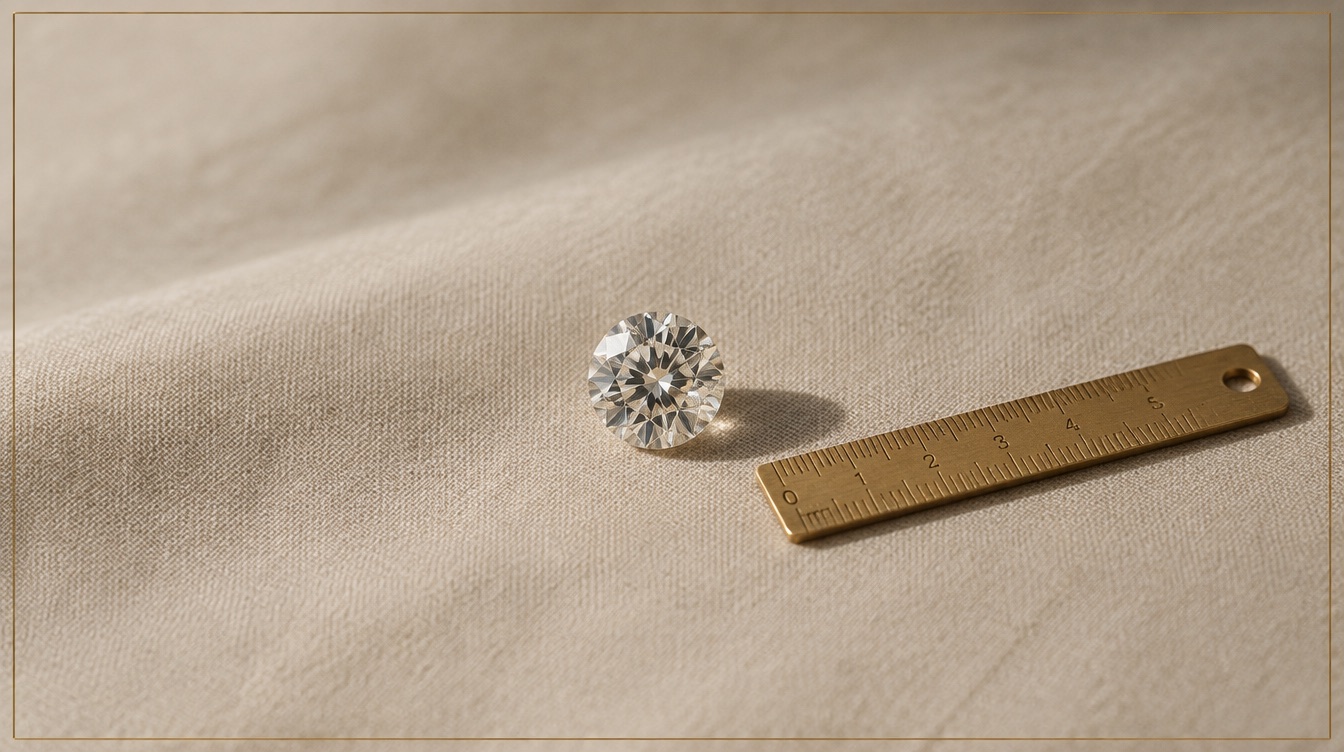
A clarity-enhanced diamond is a natural diamond that has undergone a treatment — most commonly laser drilling or fracture filling — to reduce the visibility of an inclusion that would otherwise lower its clarity grade or eye-clean appearance. The treatment doesn't change the diamond's carbon structure the way a color treatment does; it physically alters or masks an existing flaw, and reputable grading labs disclose it explicitly on the certificate.
This guide is written for the trade — jewelers, retailers, and designers who encounter clarity-enhanced stock in the wholesale market and need to understand what it is, how it's disclosed, what it does to durability and resale value, and how to evaluate whether it belongs in a given inventory mix. It covers the two main enhancement methods, how grading labs handle them, legal disclosure obligations, and how clarity-enhanced pricing compares to untreated natural and lab-grown alternatives.
What Clarity Enhancement Actually Means
Clarity enhancement refers to a set of treatments applied to natural diamonds after mining and cutting, specifically to improve how a stone's existing inclusions look — either by making them less visible or by removing the discoloration around them. It is exclusively a natural-diamond phenomenon: a lab-grown CVD diamond is grown with its own inclusion profile from the outset and isn't cosmetically treated after the fact in the way a natural stone's inclusions might be masked. Buyers should treat "clarity-enhanced" as a natural-diamond-specific term and never assume it applies to lab-grown inventory.
The two treatments a wholesale buyer is most likely to encounter are laser drilling and fracture filling, each addressing a different kind of inclusion and each disclosed differently on a grading report.
Laser Drilling: How It Works
Laser drilling uses a focused laser to bore a microscopically narrow channel from the diamond's surface down to a dark inclusion — typically a small piece of included crystal or a dark pinpoint — allowing either a bleaching agent to be introduced to lighten the inclusion, or in some cases the inclusion itself to be partially vaporized and removed. The drill hole itself is permanent and, while extremely narrow, is visible under magnification as a thin white or reflective channel running into the stone.
Laser drilling is a long-established treatment — it's been used commercially since the 1970s — and grading labs have decades of experience identifying it. A drilled diamond is graded on its post-treatment appearance, with the drill hole itself typically noted as a comment on the certificate rather than folded silently into the clarity grade.
Fracture Filling (Glass Filling): How It Works
Fracture filling addresses a different problem: a surface-reaching feather or fracture that catches light and appears as a bright, visible flaw. The treatment injects a glass-like filler with a refractive index close to diamond into the fracture, reducing its visibility by minimizing the amount of light that reflects off the internal surface of the crack. Done well, fracture filling can take a diamond that would otherwise show a visually distracting feather and make it read substantially cleaner to the naked eye.
Fracture filling is the more consequential treatment for a wholesale buyer to understand, because unlike laser drilling it isn't permanent in the same sense. The filling material can be damaged or driven out by heat — including the ordinary heat generated during jewelry repair work like sizing, soldering, or even ultrasonic cleaning in some cases — which can cause the treated fracture to become visible again or, in some cases, to appear to change color or clarity abruptly with no obvious cause to a retail customer.
HPHT Treatment: A Different Process, Not to Be Confused With HPHT Growth
Buyers researching diamond treatments will also come across "HPHT" used in a clarity- and color-treatment context — high-pressure, high-temperature annealing applied to certain natural (and occasionally lab-grown) diamonds to alter color or, less commonly, to improve the appearance of graphitized inclusions. This is an entirely different process from HPHT as a diamond-growth method, which is one of two ways lab-grown diamonds can be manufactured (the other being CVD). Guru Diam's lab-grown catalog is CVD-grown exclusively — no HPHT growth anywhere in the line — and this section is included purely so wholesale buyers researching diamond treatments don't conflate a post-growth annealing treatment with a growth method. If a diamond's documentation mentions HPHT, buyers should confirm from context whether it refers to how the stone was grown or how it was subsequently treated, since the two questions have very different implications for sourcing.
How Grading Labs Handle Clarity Enhancement
Grading labs treat clarity-enhanced diamonds differently from untreated stones, and the specifics matter for how a buyer reads a certificate:
| Lab | Laser-Drilled Stones | Fracture-Filled Stones |
|---|---|---|
| GIA | Grades and issues a standard report, noting the drilling as a comment | Does not grade fracture-filled diamonds on a standard Diamond Grading Report; will not assign a clarity grade to a filled stone |
| IGI | Grades and notes drilling as a comment on the report | Issues a distinct report type for treated/enhanced diamonds, with clarity described relative to the treatment |
| GCAL | Grades and discloses drilling as a comment | Discloses fracture filling explicitly; treatment-specific reporting applies |
The practical takeaway: a certificate for a laser-drilled stone looks close to a standard grading report with an added comment, while a fracture-filled stone typically comes with a report clearly identified as covering a treated diamond, not a standard clarity-graded one. Any wholesale offer for a "clarity-enhanced" or "fracture-filled" diamond that comes with what looks like a standard, unqualified clarity grade and no mention of the treatment on the paperwork is a red flag worth investigating before purchase.
Disclosure Requirements for Retailers
In the United States, the FTC's Jewelry Guides require that any diamond treatment — including laser drilling and fracture filling — be disclosed to the purchaser at the point of sale, in terms a reasonable consumer would understand, and that the disclosure specifically flag any special care requirements the treatment creates (fracture-filled stones needing extra caution around heat, for example). This obligation runs with the stone: a retailer selling a clarity-enhanced diamond has an independent disclosure duty to their own customer regardless of whether the wholesale supplier disclosed the treatment to the retailer. Retailers should treat "was I told this was enhanced" and "am I required to tell my customer this is enhanced" as two separate questions, both of which need a clear yes before a sale closes.
How to Identify a Clarity-Enhanced Diamond
- Check the certificate first. Any reputable lab discloses laser drilling or fracture filling explicitly — this should never be something a buyer has to discover independently on a properly documented stone.
- Look for the "flash effect" under magnification. Fracture-filled diamonds often show a distinctive flash of color — commonly orange, pink, or blue-purple — when viewed under magnification and rotated, caused by the filler's different optical properties compared to diamond. This is one of the more reliable visual tells a trained grader looks for.
- Inspect for the drill channel. Under 10x loupe magnification, a laser-drilled diamond typically shows a thin, straight channel reaching from the surface toward the treated inclusion, sometimes appearing as a fine white line.
- Ask directly and get it in writing. For any wholesale purchase, a buyer should ask explicitly whether a stone has been treated and expect the answer, and the treatment type if applicable, documented on the invoice or accompanying paperwork — not just stated verbally.
Pricing: Clarity-Enhanced vs. Untreated Natural vs. Lab-Grown
Clarity enhancement exists specifically because it lets a lower-clarity natural stone present at a higher apparent quality for meaningfully less than an untreated stone of genuinely comparable natural clarity would cost:
| Option | Typical Price Position | Durability/Stability | Resale Considerations |
|---|---|---|---|
| Untreated natural diamond | Highest for a given visual clarity level | No treatment-related durability concerns | Broadest resale market; no disclosure complications |
| Laser-drilled natural diamond | Discount to untreated natural at same apparent clarity | Permanent treatment; drill channel itself is stable | Resalable but must be disclosed; some buyers avoid treated stock on principle |
| Fracture-filled natural diamond | Largest discount to untreated natural | Filling can be damaged by heat from repairs, resizing, or some cleaning methods | Narrower resale market; treatment must be disclosed and can complicate a later repair or resizing |
| CVD lab-grown diamond (untreated) | Substantial discount to natural at comparable clarity, no treatment involved | No treatment-related durability concerns | Growing, increasingly mainstream resale market; clean certification with no treatment disclosure needed |
For a retailer weighing whether to stock clarity-enhanced natural inventory at all, the comparison against untreated CVD lab-grown diamonds is worth making explicitly: both routes can hit a lower price point than untreated natural stock at a given apparent clarity, but only one of them carries an ongoing disclosure obligation and a durability caveat that has to be managed through the stone's entire retail and repair life.
Durability and Repair Risk: What Retailers Need to Manage
Fracture-filled diamonds carry a real, ongoing operational consideration that untreated stones don't: any jeweler doing repair work — sizing, prong retipping, soldering — on a piece containing a fracture-filled stone needs to know about the treatment in advance, because standard jewelry-repair heat levels can damage the filling. A retailer that sells a fracture-filled stone without flagging it clearly in its own internal records risks a future repair technician (possibly a different jeweler entirely, if the customer moves or the piece changes hands) applying standard heat and inadvertently degrading a treatment nobody told them was there. Building a simple internal flag — on the sales record, the appraisal, and ideally a discreet note in the piece's own documentation — for any fracture-filled stone sold is a low-cost way to avoid this becoming a customer-facing problem down the line.
Common Retailer Mistakes When Stocking Clarity-Enhanced Stones
- Treating "clarity-enhanced" as a single category. Laser drilling and fracture filling have meaningfully different durability profiles, and lumping them together in inventory notes or customer conversations understates the specific care fracture-filled stones require.
- Under-disclosing to the end customer. A verbal mention at time of sale isn't a substitute for a written disclosure the FTC's Jewelry Guides call for — retailers should build this into their standard sales paperwork, not treat it as optional context.
- Sending a fracture-filled piece for standard repair without a flag. As covered above, this is one of the more common ways a treatment causes a visible, customer-facing problem well after the original sale.
- Assuming a low price alone signals enhancement. Some buyers assume any unusually inexpensive natural stone must be treated; the more reliable signal is always the certificate and its disclosed comments, not price alone.
Where Clarity-Enhanced Stock Fits in a Retail Assortment
Clarity-enhanced diamonds aren't inherently a lower-integrity product — properly disclosed and priced, they serve a real market segment of customers who want a larger, cleaner-looking stone at a lower price point and are comfortable with the tradeoffs once explained. The retailers who use this category most successfully treat it as a distinct, clearly labeled tier in their assortment — separate from untreated natural and from lab-grown — rather than blending it in without a clear internal system for tracking which pieces carry which disclosure obligations.
Questions Worth Asking a Supplier Before Stocking Clarity-Enhanced Diamonds
- Which specific treatment was applied? Laser drilling and fracture filling carry different durability profiles, and a supplier should be able to specify which one applies to a given stone rather than using "enhanced" as a vague catch-all term.
- What does the certificate say, and can I see it before purchase? A treatment disclosure should appear on the actual grading document, not just in a verbal or listing-level description.
- Is there any restriction on repair or resizing? For fracture-filled stones specifically, ask whether the supplier has guidance on safe repair temperatures or recommends avoiding certain repair techniques entirely.
- How does pricing compare to an untreated natural stone at a similar apparent clarity, and to lab-grown at the same apparent clarity? Having both comparisons in hand helps a retailer price the category honestly and explain the tradeoff clearly to their own customers.
Clarity Enhancement in Historical Context
Laser drilling has been used commercially since the 1970s, making it one of the longer-established diamond treatments and one grading labs have had decades to refine detection methods for. Fracture filling followed in the 1980s, most notably associated with the Yehuda process, named for the technique's commercial developer, and it drew significant trade attention specifically because the treatment could be reversed or damaged by heat in a way laser drilling generally isn't — a distinction that shaped much of the disclosure standards labs and regulators apply to fracture-filled stones today. Understanding this history helps explain why the two treatments are handled so differently on a grading report: labs built separate disclosure practices for each treatment as they emerged, rather than treating "clarity enhancement" as one uniform category from the outset.
Clarity Enhancement and Melee: A Separate Consideration
Clarity enhancement is rarely encountered in melee-sized stones (roughly under 0.20ct), for a straightforward economic reason: the cost of laser drilling or fracture filling a stone doesn't scale down proportionally with the stone's value, so treating a small melee stone typically isn't cost-effective relative to simply grading and selling it at its natural, untreated clarity or sorting it into a lower commercial tier. Wholesale buyers sourcing calibrated melee are far more likely to encounter clarity enhancement, if at all, in larger loose stones at 0.30ct and above, where the economics of treatment make more sense relative to the stone's total value. This is a useful rule of thumb for buyers new to the category: clarity enhancement is overwhelmingly a larger-stone consideration, not a melee one.
Insurance and Appraisal Considerations for Clarity-Enhanced Stones
A clarity-enhanced diamond's treatment status should be documented explicitly on any insurance appraisal, since replacement value calculations differ meaningfully between treated and untreated stones of similar apparent clarity. An appraiser who isn't told a stone has been fracture filled or laser drilled may appraise it as though it were untreated, creating a mismatch between the insured value and the stone's actual market value — a problem that surfaces at the worst possible time, during a claim. Retailers selling clarity-enhanced stock should make sure the treatment is carried forward accurately into any appraisal documentation provided to the customer, not just disclosed verbally at the point of sale.
Avoiding Customer Confusion Between "Enhanced" and "Synthetic"
Retail customers sometimes conflate "clarity-enhanced" with "fake" or "synthetic," which creates a real communication challenge at the point of sale. A clarity-enhanced diamond is a genuine, natural, mined diamond with a cosmetic treatment applied to an existing inclusion — categorically different from a diamond simulant like moissanite or cubic zirconia, which isn't diamond material at all, and different again from a lab-grown diamond, which is genuine diamond material grown rather than mined. Sales staff should be equipped to explain this distinction clearly, since a customer who leaves a sale confused about which category their purchase falls into is more likely to have a negative experience later, particularly if the treatment becomes relevant during a future repair.
Sourcing Certified, Untreated Diamonds at Wholesale
Guru Diam's loose diamond catalog — both natural and CVD lab-grown — is sourced and sold as untreated stock, certified through IGI, GIA, or GCAL depending on buyer preference, with no laser drilling or fracture filling in the line. For retailers who want to offer a treated-diamond option alongside untreated inventory, understanding the distinction covered in this guide is the first step to sourcing that category responsibly and disclosing it correctly; for retailers who'd rather avoid the disclosure and repair-risk considerations of treated stock altogether, Guru Diam's certified natural and CVD lab-grown catalog offers a lower-cost alternative to untreated natural inventory without introducing any of the durability caveats covered above. Trade accounts can browse certified inventory through certified diamonds, review fancy color options through fancy color loose diamonds, and check current terms at the wholesale hub or by applying through trade partner. For a broader look at how clarity is graded and communicated, see our diamond clarity chart guide and VVS clarity diamond guide.
Frequently Asked Questions
What is a clarity-enhanced diamond?
A clarity-enhanced diamond is a natural diamond treated — typically by laser drilling or fracture filling — to reduce the visibility of an inclusion. The treatment changes how the flaw looks, not the diamond's underlying carbon structure, and reputable grading labs disclose it explicitly on the certificate.
Is a clarity-enhanced diamond still a real diamond?
Yes. It's a natural, mined diamond that has undergone a cosmetic treatment to its existing inclusions. This is different from a diamond simulant like moissanite or cubic zirconia, which isn't diamond material at all.
Is fracture filling permanent?
No, and this is the most important practical difference from laser drilling. The glass-like filler used in fracture filling can be damaged or displaced by heat, including heat from ordinary jewelry repair work like resizing or soldering, potentially making the treated fracture visible again.
Do grading labs certify fracture-filled diamonds?
It depends on the lab. GIA does not issue a standard clarity-graded Diamond Grading Report for fracture-filled stones. IGI and GCAL do certify them, but on a report type that explicitly identifies the treatment rather than presenting it as an ordinary clarity grade.
Are retailers legally required to disclose clarity enhancement?
In the United States, yes — the FTC's Jewelry Guides require diamond treatments to be disclosed to the purchaser, including any special care the treatment requires. This obligation applies to the retailer selling to the end customer, independent of what a wholesale supplier may or may not have disclosed upstream.
How can I tell if a diamond has been clarity-enhanced?
Check the certificate first — reputable labs disclose the treatment explicitly. Under magnification, fracture-filled stones often show a distinctive colored "flash effect" when rotated, while laser-drilled stones show a thin drill channel reaching toward the treated inclusion.
Does clarity enhancement apply to lab-grown diamonds?
No. Clarity enhancement is a treatment applied to existing inclusions in natural diamonds. A CVD lab-grown diamond's inclusion profile is a product of its growth process, not a post-treatment, so "clarity-enhanced" isn't a term that applies to lab-grown stock in the same way.
Why would a retailer stock clarity-enhanced diamonds at all?
They let a retailer offer a larger or visually cleaner-looking natural stone at a lower price than an untreated stone of comparable apparent clarity, serving customers who prioritize size and appearance at a given budget and are comfortable with the treatment once it's properly explained and disclosed.