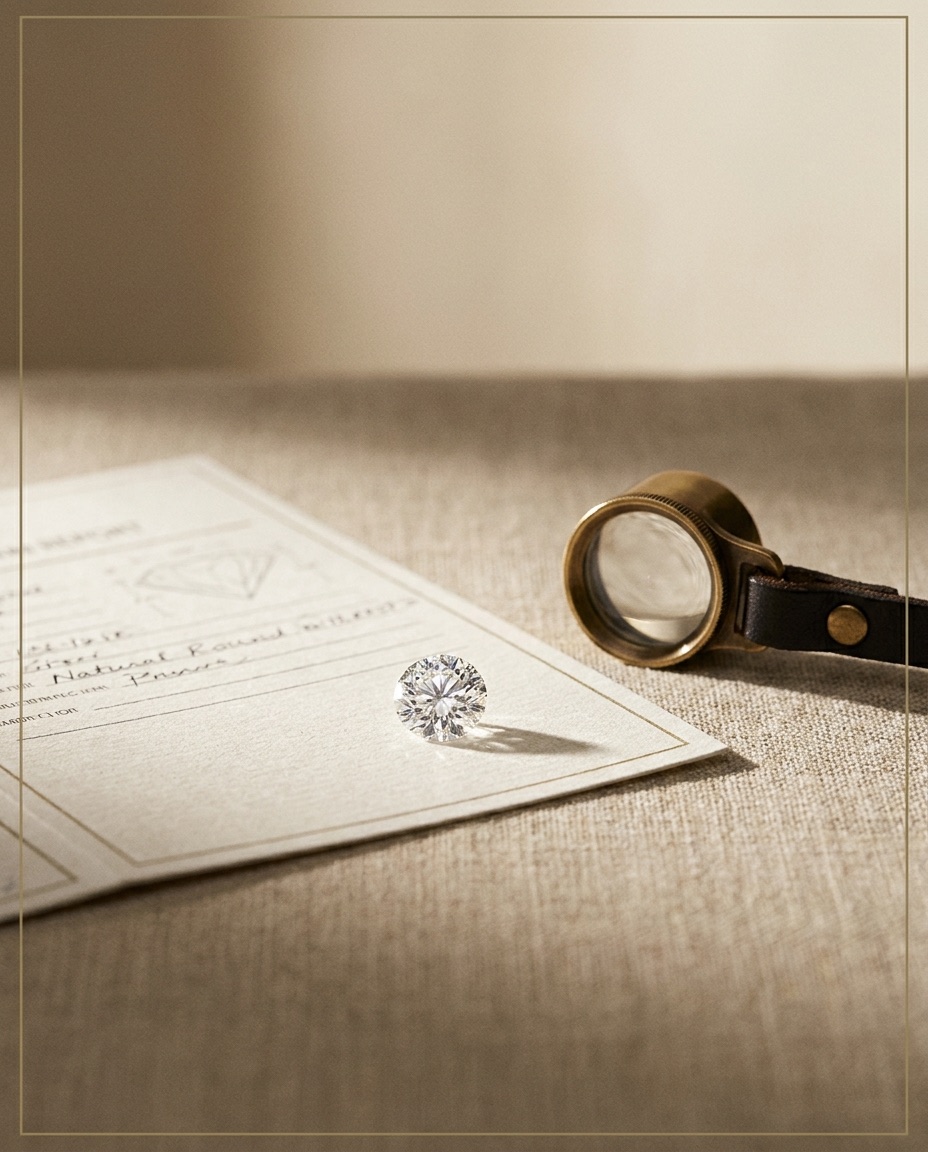
Certified natural diamonds are mined diamonds that have been examined and documented by an independent gemological laboratory — rather than graded only by the seller — with a report covering carat weight, cut, color, clarity, and other identifying traits. Certification doesn't make a stone more beautiful; it makes its quality verifiable, which is why it matters most for natural diamonds, where no two stones start out identical.
For a wholesale buyer, "certified natural diamonds" is really a category, not a single product: it spans a range of labs, a range of price points, and a range of what "certified" is actually protecting you against. This guide covers what certification means for a natural stone specifically, how the three labs Guru Diam works with — IGI, GIA, and GCAL — genuinely differ, how to read and compare a report, where natural melee fits (and where it emphatically doesn't), and how sourcing a certified natural stone differs operationally from sourcing a CVD lab-grown one.
What "Certified" Actually Means for a Natural Diamond
A certified natural diamond has been submitted to an independent gemological laboratory, examined by trained graders under controlled lighting and magnification, and issued a written report describing what the stone measurably is. That report is produced by a third party with no financial stake in whether the stone sells — which is the entire point. A seller grading their own inventory has an obvious incentive to round grades upward; a lab that grades thousands of submissions from hundreds of different sellers a year does not have that same incentive on any individual stone.
Certification is a statement about accuracy, not a statement about value. A report confirms the stone's carat weight, cut, color, and clarity as observed by the lab — it does not tell a buyer whether the asking price is fair, and it does not guarantee the stone will look a particular way in a specific setting. Two stones with identical grades on paper can still present differently once mounted, which is why certification is a starting point for evaluating a natural diamond, not a substitute for looking at the stone itself.
The opposite of a certified stone is an uncertified one — sometimes sold loose as "parcel goods," where a seller represents the approximate grade of a batch or an individual stone without independent verification. Uncertified natural diamonds aren't inherently fraudulent or low-quality, but the buyer is trusting the seller's word instead of a third-party report, and that trust carries a real cost if the stone doesn't actually meet the grade it was sold under.
Why Certification Matters More for Natural Stones Than for a Controlled Product Line
Certification isn't equally important across every type of diamond a wholesale buyer might stock, and the reason comes down to how consistent the underlying product is before it ever reaches a grading lab.
A CVD lab-grown diamond is produced under a controlled process — a specific recipe of pressure, temperature, and gas chemistry inside a reactor, refined and repeated. That doesn't mean every lab-grown stone comes out identical (cutting decisions and natural variation in growth still produce a real range of outcomes), but the starting material is manufactured to a target, and a supplier working from a consistent CVD line has a reasonable amount of built-in predictability about what a given batch will grade out to before certification confirms it.
A natural diamond has no recipe. Each stone formed under its own unique combination of pressure, heat, trace elements, and geological time, over hundreds of millions to billions of years, with zero human control over the process. That's exactly why natural diamonds carry meaningfully more inherent grading variability than a manufactured product line — two natural stones that look similar in a parcel can land on genuinely different points of the color and clarity scale once independently examined, in a way two stones off a controlled production line typically don't. Certification is the mechanism that turns that natural variability from a guessing game into a documented, comparable fact for every individual stone.
This is also why "certified" carries more practical weight as a natural-diamond buying criterion specifically. On a CVD line, a buyer can lean partly on a trusted supplier's consistency across a batch. On natural stones, every individual diamond is its own case — which is exactly what an independent report is built to settle.
The Three Certification Labs: IGI, GIA, and GCAL
Guru Diam offers all three of the major labs the trade actually uses for both natural and lab-grown diamonds: IGI, GIA, and GCAL. They aren't interchangeable, and none of the three is objectively "the best" — each occupies a different position on strictness, turnaround, cost, and what the market has come to expect from a report bearing its name.
GIA — the Gemological Institute of America
GIA, founded in 1931, is a nonprofit research and educational institute that also operates the trade's most widely referenced grading laboratory. It's generally regarded as the strictest and most conservative of the major labs — grades that come back from GIA tend to run at or slightly below what another lab might assign the same physical stone. That conservatism is exactly why "GIA certified" functions almost as shorthand in the trade for a grade a buyer can take at face value without mentally discounting it. GIA reports typically carry a modest cost and turnaround-time premium over the alternatives, reflecting both that reputation and GIA's higher submission volume moving through a more deliberate review process.
IGI — the International Gemological Institute
IGI, founded in 1975, is the highest-volume lab globally for lab-grown diamond certification and also grades a substantial volume of natural stones. Turnaround is typically faster than GIA's, and cost is typically lower. Grading tendency runs slightly more generous on average than GIA's for a comparable stone — not dramatically so, and not in every case, but consistently enough that experienced buyers factor it in when comparing an IGI grade against a GIA grade rather than treating the letters as strictly equivalent. IGI is a legitimate, widely accepted lab; the difference from GIA is a matter of degree and market positioning, not legitimacy.
GCAL — the Gem Certification & Assurance Lab
GCAL, founded in 2001, has built its reputation around cut-precision analysis and light-performance documentation, including laser inscription and, on many reports, a verified light-performance rating that goes beyond the standard Excellent-to-Poor cut grade most labs issue. GCAL is a smaller-volume lab than GIA or IGI, which means fewer buyers encounter it by default, but it's a genuine option for a buyer who wants the most technical documentation available on exactly how a stone performs optically — particularly useful for round brilliants and other shapes where cut precision is the primary value driver.
IGI vs. GIA vs. GCAL: Certification Comparison
| Lab | Founded | Grading Tendency | Typical Turnaround | Relative Cost | Market Perception |
|---|---|---|---|---|---|
| GIA | 1931 | Conservative — the strictest of the three on average | Slower — more deliberate review | Highest | The reference standard; broadest trust in resale, appraisal, and insurance contexts |
| IGI | 1975 | Slightly more generous than GIA on comparable stones | Faster — highest submission volume | Lowest | Widely accepted, especially strong reputation on lab-grown; fast-moving trade favorite |
| GCAL | 2001 | Precise, cut-focused; strong on light-performance documentation | Moderate | Moderate | Trusted specifically for verified cut and light-performance detail |
None of the three is the "correct" choice in every situation. GIA tends to make the most sense for higher-value natural stones headed toward resale, appraisal, or insurance, where the strictest possible standard reduces long-term dispute risk. IGI tends to make sense where turnaround and cost matter and the grading difference is small enough not to change the buying decision. GCAL tends to make sense when a buyer specifically wants the deepest available documentation of cut and light performance rather than the 4Cs alone. A wholesale buyer stocking certified natural diamonds across a range of price points will typically end up carrying stones from more than one of these labs, and that's normal — the goal is knowing which lab graded a given stone and adjusting expectations accordingly, not insisting on a single lab across an entire inventory.
How to Evaluate a Certified Natural Diamond Report
Once a natural diamond has a report attached to it, the real work for a buyer is reading that report correctly — and reading it in a way that accounts for which lab issued it.
Start with the report number
Every legitimate report carries a unique number that can be looked up directly on the issuing lab's own verification tool, confirming the report exists, hasn't been altered, and describes the physical stone in hand — not a different stone with a similar grade.
Read the 4Cs together, not in isolation
Carat weight, cut, color, and clarity interact — a well-cut stone in a lower color grade can face up brighter than a poorly cut stone in a higher color grade, and a small difference in clarity plotted near the girdle reads very differently than the same clarity grade with an inclusion under the table. Cut grade deserves the most weight of the four for visible impact, since it's the characteristic most within human control and the one with the largest effect on how the stone actually performs optically. On natural diamonds, note that a numeric cut grade generally applies to round brilliants; fancy shapes typically receive detailed proportions and a cut description rather than a single number, which means fancy-shape cut quality benefits from an actual photo or video review alongside the certificate.
Check fluorescence
Fluorescence describes how strongly a stone glows under UV light, graded None through Very Strong. It's a normal, common characteristic in natural diamonds and isn't inherently a flaw — but strong fluorescence can occasionally give a lower-color stone a subtly hazy look in direct, UV-heavy light, on a stone-by-stone basis rather than automatically. It's worth checking on any report, particularly for lower color grades, rather than assuming it's a non-factor.
Adjust for which lab issued the report
A grade from a stricter lab isn't directly equivalent to the same nominal grade from a lab known for running slightly more generous — comparing a GIA VS1 against an IGI VS1 without accounting for that difference risks comparing two stones as equals when they aren't quite. Where possible, compare stones certified by the same lab; where that's not possible, adjust expectations rather than treating the grade letters as interchangeable across labs.
Confirm the stone matches the paper
Measurements, carat weight, and — where present — laser inscription on the girdle should match the physical stone. This matters more, not less, on natural diamonds precisely because no two stones are identical to begin with; there's no manufactured baseline to fall back on if a report and stone don't line up.
Certified Loose Stones vs. Natural Melee: A Critical Distinction
One of the most common points of confusion for buyers new to sourcing natural diamonds is assuming that everything "natural" carries the same certification treatment. It doesn't, and the distinction matters enough that it's worth stating plainly.
Certified natural loose stones — the subject of this guide — are individually graded, non-melee diamonds, generally 0.30 carats and above, each carrying its own independent report from a lab like IGI, GIA, or GCAL. Natural melee is a separate, distinct catalog: small accent-sized natural diamonds, currently offered round only, sold as uncertified parcel goods against a consistent quality baseline rather than individually graded. Melee ships fast and prices efficiently precisely because it isn't run through individual certification — certifying every stone in a parcel of small accent diamonds would add cost and turnaround that doesn't make sense at that size and price point.
These two product lines should never be blended in claims or expectations. A natural melee parcel is not "certified natural" in the sense this guide describes, and a certified natural loose stone is not priced or sourced the way a melee parcel is. If a wholesale buyer needs individually graded documentation on a stone — for a center stone, a significant side stone, or any piece where independent verification matters to the end customer — that calls for the certified loose-stone catalog, not melee. If the need is calibrated small accent stones at volume where individual grading isn't the point, that's melee. Treating the two as the same product with different price tags leads to mismatched expectations on both sides of a wholesale order.
Natural Certified Diamonds vs. CVD Lab-Grown: Sourcing and Pricing Differences
For a retail-facing wholesale buyer deciding what to stock, natural and CVD lab-grown diamonds behave differently enough — operationally and on price — that they're worth planning for as two distinct product lines rather than interchangeable options at different price points.
Supply predictability
A CVD lab-grown line draws from a controlled, repeatable production process, which gives a supplier a reasonable ability to forecast what a given production run will yield across grades and sizes. Natural stone supply depends on what's actually been mined and rough-sorted, which means availability at any exact combination of shape, size, and grade can shift week to week in a way a controlled production line generally doesn't.
Pricing structure
Natural diamond pricing tracks the broader rough and polished natural market, with meaningful stone-to-stone variation even within the same nominal grade, since no two natural stones started from identical rough material. CVD lab-grown pricing tends to move more predictably along carat and grade tiers, reflecting the more standardized nature of the underlying production. Neither is "cheaper" as a blanket rule — pricing depends heavily on the specific carat weight, shape, and grade combination — but a buyer building a price ladder across a catalog will generally find CVD pricing easier to model in advance, and natural pricing requiring more stone-by-stone evaluation.
Cutting and finishing
Both natural and CVD rough are cut and polished before grading — Guru Diam's stones, across both lines, are cut and polished in India before final grading and shipment from the New York and Los Angeles locations. What differs is the starting material the cutter is working from: a natural rough crystal with its own internal characteristics to plan a cut around, versus a CVD-grown crystal produced to more predictable starting dimensions.
Buyer positioning
Retail-facing buyers stocking both lines typically use them for different parts of their own customer base: natural certified stones for customers who specifically want mined-origin diamonds — often for heirloom, investment, or personal-preference reasons — and CVD lab-grown for customers prioritizing value per carat or an explicit lab-grown preference. Carrying both from one supplier means a buyer can answer either customer without managing two separate vendor relationships, provided the supplier is genuinely equipped for both lines rather than treating one as an afterthought.
What a Wholesale Buyer Should Ask Before Stocking Certified Natural Diamonds
A few practical questions separate a supplier genuinely equipped to sell certified natural diamonds from one that mostly handles a different product line and treats natural certified stones as a side offering:
- Which labs are actually available, and on what stones? A supplier who only offers one certification option limits a buyer's ability to match a stone's lab to its end use — resale-grade documentation versus fast-turnaround inventory, for instance.
- Does every certified stone ship with its full report, not just a grade summary in a listing? A grade quoted in a spec sheet isn't a substitute for the actual report in hand.
- Is natural melee clearly separated from certified natural loose stones in the catalog and in any claims made about them? If a supplier blurs that line, it's worth asking directly how melee is priced and represented.
- What's the actual turnaround on in-stock inventory versus special-order or to-be-cut stones? In-stock certified natural inventory should ship same-day; anything cut, sourced, or certified to order takes longer, and a supplier should be upfront about which category a given stone falls into.
- Can the supplier source both natural and CVD lines from one relationship? For a buyer who wants to offer both product types to their own customers, consolidating with one supplier that's genuinely equipped for both — rather than treating natural as an afterthought bolted onto a primarily lab-grown catalog, or vice versa — simplifies ordering, invoicing, and vendor management.
Buying Certified Natural Diamonds Wholesale from Guru Diam
Guru Diam is a trade-only wholesale supplier working with independent jewelers, designers, and manufacturers — not a direct-to-consumer storefront. The catalog includes both a CVD lab-grown line (CVD only, no HPHT, anywhere) and a genuinely separate natural diamond catalog: certified loose natural stones across standard, antique, and fancy shapes, finished natural jewelry, and a distinct non-melee, non-certified natural round melee line for calibrated accent stones. These aren't positioned as one blended product — a buyer sourcing certified natural loose stones is working from a different part of the catalog than a buyer sourcing melee, and the two are never represented interchangeably.
On certification, Guru Diam offers IGI, GIA, and GCAL, so a buyer can match the lab to the stone and the end use rather than being limited to whichever single lab a narrower supplier happens to work with. Every certified stone ships with its complete report. In-stock inventory across both the New York (HQ) and Los Angeles locations ships same-day — before 6pm EST out of New York, before 4pm PST out of Los Angeles — and for buyers building finished pieces around a certified center stone, custom engagement rings are turned around in 4-6 days once the stone and design are confirmed (finished jewelry only; loose certified stones ship as soon as they're in stock, not on a 4-6 day build timeline). Buyers can browse the current certified selection through the certified diamonds category, source matched sets through matching pairs, or look at certified fancy color options through fancy color loose diamonds. Pieces built around a certified natural center stone can go through custom jewelry. Trade accounts can review current terms and open inventory at the wholesale hub, or apply for an account through trade partner.
Frequently Asked Questions
What does it mean for a natural diamond to be certified?
It means an independent gemological laboratory has examined the stone and issued a report documenting its carat weight, cut, color, clarity, and other identifying characteristics. The report is produced by a lab with no financial interest in the sale, which is what makes it a meaningful check on a seller's stated grade rather than just a repeated claim.
What's the real difference between IGI, GIA, and GCAL certification?
GIA is generally the strictest and most conservative grader, with the broadest trust for resale and appraisal contexts. IGI typically offers faster turnaround and lower cost, with grading that runs slightly more generous than GIA's on a comparable stone. GCAL focuses on cut-precision and light-performance documentation. None is universally "better" — the right choice depends on the stone's value tier and end use.
Is a certified natural diamond the same thing as a natural melee diamond?
No. Certified natural loose stones are individually graded, generally 0.30 carats and above, each with its own independent lab report. Natural melee is a separate, uncertified catalog of small accent-sized stones — currently round only — sold as parcel goods against a consistent quality baseline rather than individually graded. The two should never be treated as interchangeable in pricing or claims.
Do all natural diamonds come certified?
No. Uncertified natural diamonds exist in the market, typically at a lower price than an equivalent certified stone, because the buyer is relying on the seller's stated grade rather than an independently verified one. Certification generally makes sense for any stone significant enough that grade accuracy materially affects the price — center stones and notable side stones in particular.
How does buying certified natural diamonds differ from buying CVD lab-grown diamonds wholesale?
Natural stones come from mined, rough-sorted supply with more inherent stone-to-stone variation and less predictable availability at any exact grade, while CVD lab-grown stones come from a controlled production process that's generally easier to forecast and price along consistent tiers. Both can be certified by the same labs, but a buyer typically needs to evaluate natural stones more individually rather than by tier alone.
Does certification add much to the price of a natural diamond?
The direct grading fee is usually already built into a certified stone's price rather than appearing as a separate charge to a wholesale buyer. The more meaningful price effect is that a stricter lab's grade can carry a modest premium over the same nominal grade from a lab known for slightly looser standards, since buyers and appraisers trust that grade more without needing to mentally discount it.