Few individual diamonds in modern history have combined scale, grade, and secrecy quite like the Centenary — its story remains a benchmark reference point whenever the trade discusses what's technically possible in cutting an exceptional piece of rough.
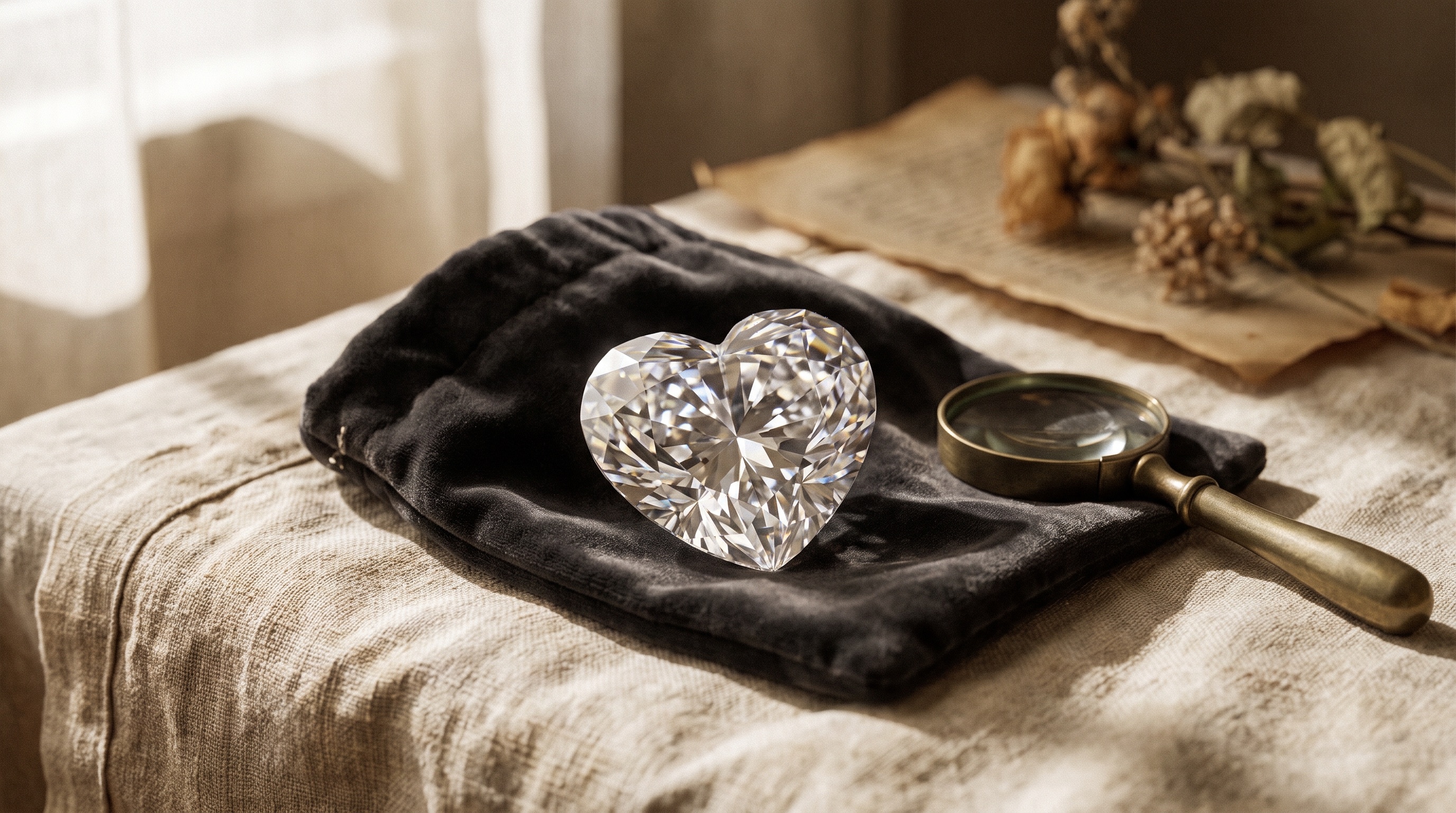
The Centenary Diamond is a 273.85-carat modified heart-shaped brilliant, graded flawless and D color — the highest possible grades on both scales — making it one of the largest flawless diamonds ever certified. Recovered as a 599-carat rough stone at South Africa's Premier Mine in 1986, it was cut by a specialist De Beers team over roughly three years and publicly unveiled in 1991 to mark De Beers' 100th anniversary, which is where its name comes from.
This guide covers the Centenary Diamond's discovery, its unusual and highly secretive cutting process, why it holds such a distinctive place among the world's most famous diamonds, and how its story illustrates broader lessons about large-stone cutting, security, and grading that apply well beyond this one exceptional example — from the cutting-strategy tradeoffs any exceptional rough presents to why stones at this value level tend to be handled only by a small number of historically established organizations.
Discovery at the Premier Mine
The rough stone that became the Centenary Diamond was recovered in 1986 at the Premier Mine (today known as the Cullinan mine) near Cullinan, South Africa — the same mine that produced the even larger 3,106-carat Cullinan Diamond in 1905. The rough weighed 599 carats and was immediately recognized as an exceptionally significant find given both its size and its remarkably high starting quality, an unusual combination since very large rough stones often carry more internal characteristics than smaller stones, simply due to their size.
Why De Beers Kept the Discovery Secret
De Beers did not publicly announce the rough stone's discovery immediately, choosing instead to keep it confidential while planning the cutting process, a security decision driven by the enormous value and theft risk a stone of this size and quality represents once its existence becomes publicly known. The eventual announcement was carefully timed to coincide with planning around De Beers' upcoming 100th anniversary in 1988, which is when the stone's existence was first publicly revealed — though the actual cutting process continued for several more years after that announcement.
The Cutting Process — An Exceptional Technical Undertaking
| Aspect | Detail |
|---|---|
| Lead cutter | Gabi Tolkowsky, a member of the Tolkowsky family long associated with diamond-cutting expertise, led the specialist team |
| Rough weight | 599 carats |
| Finished weight | 273.85 carats |
| Weight retained | Roughly 46% of the original rough weight — an unusually high yield for a stone of this size and complexity |
| Time to cut | Approximately three years of planning and cutting work |
| Final shape | Modified heart-shaped brilliant with 247 facets |
The cutting team reportedly spent an extended period simply studying the rough stone's internal structure before making a single cut, since an error at this scale would have been effectively unrecoverable given the stone's value and rarity. The eventual 247-facet modified heart-brilliant design was chosen specifically to maximize both the finished carat weight retained and the stone's optical performance, a genuinely difficult balance to strike at this scale.
Security During the Cutting Process
De Beers took extraordinary security precautions during the multi-year cutting process, reportedly including the use of decoy replica stones and a specially secured, disguised cutting facility, reflecting the scale of the security challenge a stone of this value presents while work is actively underway. This level of security investment is a genuinely unusual undertaking even by the standards of high-value diamond cutting generally, reflecting just how exceptional the Centenary's combination of size and quality was recognized to be even before cutting was complete.
Grading: Flawless and D Color
The finished Centenary Diamond was graded flawless clarity and D color — the top grade on each of the two scales that most directly drive a diamond's per-carat value — a genuinely rare combination at any size, and an exceptionally rare one at nearly 274 carats. Flawless clarity means no inclusions or blemishes are visible to a skilled grader under standard 10x magnification; D color means the stone shows no detectable color tint at all, the top of the standard colorless grading scale. Achieving both grades simultaneously at this scale is part of what makes the Centenary one of the most significant polished diamonds ever certified, distinct from simply being large.
Public Unveiling and De Beers' Centennial
The finished Centenary Diamond was publicly unveiled in 1991, timed to De Beers' broader centennial celebrations marking 100 years since the company's founding — which is the direct source of the stone's name. The unveiling positioned the stone as a flagship symbol of De Beers' historical significance in the diamond industry, generating substantial media attention given both the stone's scale and the multi-year secrecy surrounding its cutting process up to that point.
The Centenary Compared to Other Famous Large Diamonds
| Diamond | Finished Weight | Color/Clarity | Notable Distinction |
|---|---|---|---|
| Centenary Diamond | 273.85 carats | D color, Flawless | One of the largest top-color, flawless diamonds ever graded |
| Cullinan I (Great Star of Africa) | 530.2 carats | Colorless, exceptional clarity | Largest polished stone cut from the largest gem-quality rough ever found; part of the British Crown Jewels |
| Cullinan II (Lesser Star of Africa) | 317.4 carats | Colorless, exceptional clarity | Second-largest stone cut from the 1905 Cullinan rough; also part of the British Crown Jewels |
| Hope Diamond | 45.52 carats | Fancy dark grayish-blue | Famous for its rare color and extensive, well-documented ownership history |
| Koh-i-Noor | 105.6 carats (current cut) | Colorless | Ancient origin, part of the British Crown Jewels, subject of ongoing repatriation disputes |
The Centenary stands out even within this exceptional company specifically for combining very large finished size with the absolute top grades on both major grading scales — several other famous large diamonds are historically or aesthetically significant without necessarily carrying flawless, D-color grades at a comparable scale.
Where the Centenary Diamond Is Today
The Centenary Diamond has historically been associated with the De Beers Millennium Jewels collection and has been displayed publicly on a limited basis over the years since its unveiling, though, consistent with the security practices typical of stones at this value level, it is not on continuous public display and detailed current ownership and location specifics are not routinely publicized. This pattern — limited, carefully controlled public exhibition rather than continuous display — is standard practice for diamonds of genuinely exceptional value, balancing legitimate public and historical interest against real security considerations.
Why the Centenary's Cutting Yield Was So Unusual
Retaining roughly 46% of original rough weight through the finished cutting process is an exceptionally high yield for a stone of this size and the complexity of shape chosen — most large rough stones lose a substantially higher proportion of their original weight during cutting, since planning a cut has to balance maximizing retained carat weight against removing enough material to reach acceptable clarity and optimize the finished stone's optical performance. The Centenary's unusually high yield reflects both the exceptional starting quality of the rough (requiring less material removal to reach flawless clarity than a lower-starting-quality stone of similar size would need) and the specialist cutting team's skill in planning a shape that preserved weight without compromising the finished stone's proportions or brilliance.
What the Centenary's Story Teaches About Large-Stone Cutting Generally
The Centenary Diamond's cutting process illustrates principles that apply, at a much smaller scale, to any significant diamond-cutting decision: the extended planning period before any irreversible cut is made, the tension between preserving carat weight and optimizing clarity and brilliance, and the reality that a stone's finished value depends enormously on cutting decisions made after the rough is recovered, not on the rough's raw carat weight alone. A trade professional who understands this dynamic at the Centenary's extreme scale carries a more sophisticated appreciation for why cutting quality matters so much in ordinary commercial-scale diamonds too, even though the stakes and complexity involved are obviously far smaller.
Rough-to-Polished Value: What the Centenary Illustrates
The Centenary's 599-carat rough weight and 273.85-carat finished weight illustrate, in dramatic form, a pattern that holds true across diamond cutting generally: a significant share of a rough stone's original weight is removed during cutting to achieve the finished stone's clarity, proportions, and optical performance, and a rough stone's ultimate finished value depends on far more than its starting carat weight. In the broader trade, rough diamonds move from mine to cutting center — with a large share of global cutting volume today handled in Surat, India — before reaching the certification and wholesale stages most buyers interact with directly, a pipeline the Centenary's own multi-year cutting process illustrates at an extreme, historically significant scale.
The Broader Category of De Beers Millennium Jewels
The Centenary Diamond is one of a broader collection of exceptional stones De Beers assembled and referred to as the Millennium Jewels, a group of large, high-quality diamonds brought together around the same general period as part of celebrating the company's historical milestones. Being part of this collection reinforced the Centenary's position as a flagship stone within De Beers' own historical narrative, distinct from being simply one large diamond among many the company had handled over its history — it was specifically positioned as a centerpiece example of what the company's cutting and grading expertise could achieve at the very top end of the natural diamond category.
How the Centenary's Story Was Received by the Trade and Public
The Centenary's eventual unveiling generated substantial coverage both within specialist trade press and broader mainstream media, reflecting the rare crossover appeal of an exceptionally large, exceptionally high-grade diamond discovery — a story compelling enough to reach well beyond the trade's usual audience. Trade press coverage tended to focus on the technical achievement of the cutting process itself and the rarity of the finished grade combination, while broader public coverage focused more on the scale of the stone and its connection to De Beers' historical significance. This dual reception — technical respect within the trade, broad public fascination outside it — is a pattern that recurs with most genuinely famous diamonds, the Centenary included.
Comparing the Centenary's Cutting Challenge to Modern Large-Stone Discoveries
Large, high-quality rough diamond discoveries continue to occur periodically at major mines, including some notable finds at Botswana's Karowe mine and elsewhere in the years since the Centenary was cut, giving the trade ongoing points of comparison for how large-stone cutting decisions get made. Each major discovery typically prompts renewed public and trade interest in the same fundamental tradeoffs the Centenary's cutting team navigated decades earlier: how to balance weight retention against clarity improvement, what finished shape best suits the specific rough's internal characteristics, and how to manage the security and planning challenges an exceptionally valuable piece of rough presents before, during, and after cutting. The Centenary remains one of the most frequently referenced historical examples specifically because it achieved such an unusually favorable outcome across all of these tradeoffs simultaneously.
The Role of Trust and Reputation in Handling Exceptional Stones
A stone at the Centenary's value level can only be handled, cut, and marketed by an organization with the institutional reputation, security infrastructure, and specialist technical expertise to manage the process credibly — smaller or less established operations simply don't have the resources or trade standing to take on a project of this scale and risk. This reality reflects a broader pattern in the natural diamond trade: exceptional stones tend to concentrate around a small number of major, historically established players precisely because the security, expertise, and reputational requirements involved create a genuinely high barrier to entry, distinct from the ordinary commercial diamond trade where a much broader range of dealers and suppliers can participate credibly.
What Happened to the Rest of the 599-Carat Rough
The finished 273.85-carat Centenary Diamond represents the primary stone cut from the original 599-carat rough, with the balance of the original rough weight lost during the cutting and polishing process rather than yielding additional major finished stones, a contrast with the Cullinan rough, which was deliberately planned to be divided into multiple significant finished stones (Cullinan I through Cullinan IX, plus smaller pieces) rather than a single primary stone. This difference in cutting strategy reflects a genuine judgment call cutting teams face with every exceptional rough: whether to maximize one flagship finished stone's size and grade, as with the Centenary, or divide the rough into multiple significant stones, as with the Cullinan. Both approaches can be the right call depending on the specific rough's internal characteristics and the priorities of whoever owns the decision.
Historic Diamonds and Modern Wholesale Sourcing
While stones like the Centenary occupy a historic, effectively non-commercial category entirely distinct from ordinary wholesale trading, understanding their history gives context to how the broader diamond trade thinks about cutting, grading, and value — principles that apply directly, at a completely different scale, to commercial diamond sourcing today. Guru Diam is a trade-only wholesale supplier of natural and CVD lab-grown diamonds spanning antique cuts, standard fancy shapes, and round brilliant, along with certified loose stones and finished and custom jewelry, with IGI, GIA, and GCAL certification available.
Buyers can browse certified loose diamond inventory through the certified diamonds category, source matched pairs through matching pairs, and review fancy color stones through fancy color loose diamonds. In-stock inventory ships same-day from New York (before 6pm EST) and Los Angeles (before 4pm PST). Trade accounts can review current terms at the wholesale hub or apply through trade partner, and jewelers building custom pieces can work through custom jewelry for a setting finished in 4-6 days.
Why Famous Diamonds Like the Centenary Still Matter to the Modern Trade
Stones like the Centenary continue to generate genuine public and trade fascination decades after their cutting, serving an ongoing marketing and prestige function for the broader natural diamond industry well beyond their own singular commercial value, since they reinforce a public narrative around diamonds as historically and culturally significant objects rather than purely commercial commodities. This narrative value indirectly benefits the broader natural diamond trade, including ordinary commercial-scale wholesale transactions, by sustaining public interest and cultural association with diamonds as objects worth genuine attention and value, distinct from the purely functional case for their use in jewelry.
Could a Stone Like the Centenary Be Cut Today?
Modern diamond-cutting technology, including computer-assisted planning software that models a rough stone's internal structure before any physical cutting begins, has advanced considerably since the Centenary was cut in the late 1980s and early 1990s, meaning a comparably sized rough discovered today would likely be planned and cut with more precise upfront modeling than was available to the Centenary's cutting team. That said, the fundamental challenge — an irreversible, high-stakes decision-making process balancing weight retention against clarity and optical performance on an exceptionally rare, exceptionally valuable piece of rough — remains conceptually the same regardless of how much the underlying planning technology has improved. Exceptionally large, high-quality rough diamonds of the Centenary's caliber remain genuinely rare discoveries even today, which is part of why any comparable future find would likely attract similar levels of attention and similarly careful, extended cutting planning.
Why the Heart-Shape Choice Mattered
Choosing a modified heart-shaped brilliant for the Centenary's final form, rather than a more conventional round or oval cut, reflected a deliberate design decision by the cutting team to work with the rough's specific internal structure rather than forcing a more standard shape that might have required sacrificing additional weight or clarity to achieve. Heart-shaped cuts are technically demanding even at ordinary commercial scale, since achieving symmetrical, well-proportioned lobes and a clean center cleft requires exceptional precision; at nearly 274 carats, the technical difficulty of executing this design flawlessly while preserving the stone's flawless clarity grade represents one of the more remarkable technical achievements embedded in the Centenary's overall story, distinct from its size and grade alone.
Frequently Asked Questions
How big is the Centenary Diamond?
The finished, polished Centenary Diamond weighs 273.85 carats, cut down from a 599-carat rough stone recovered in 1986 — a roughly 46% weight retention, an unusually high yield for a stone of this size.
Where was the Centenary Diamond found?
It was recovered at South Africa's Premier Mine (today called the Cullinan mine) in 1986 — the same mine that produced the even larger 3,106-carat Cullinan Diamond in 1905.
What color and clarity grade is the Centenary Diamond?
It's graded D color and Flawless clarity — the top grade on each scale — making it one of the largest diamonds ever certified at both top grades simultaneously.
Why is it called the Centenary Diamond?
It was named for De Beers' 100th anniversary (centennial), with the finished stone publicly unveiled in 1991 to mark that milestone.
Who cut the Centenary Diamond?
A specialist De Beers cutting team led by Gabi Tolkowsky, a member of the diamond-cutting family long associated with cutting innovations, spent roughly three years planning and executing the cut.
How does the Centenary compare to the Cullinan diamonds?
Both came from the same South African mine. The Cullinan rough (3,106 carats) was larger than the Centenary's rough (599 carats) and was cut into multiple stones, including the 530.2-carat Cullinan I, now part of the British Crown Jewels — larger than the Centenary's single 273.85-carat finished stone.
Why was a heart shape chosen for the Centenary Diamond?
The cutting team chose a modified heart-shaped brilliant to work with the rough's specific internal structure, maximizing both retained weight and optical performance rather than forcing a more standard round or oval shape that might have required sacrificing weight or clarity.
Is the Centenary Diamond the largest flawless diamond ever graded?
It's one of the largest diamonds ever graded flawless clarity and D color simultaneously, a combination that makes it exceptional even among the small group of other historically famous large diamonds, several of which don't carry both top grades at a comparable scale.
Is the Centenary Diamond still owned by De Beers?
The stone has historically been associated with De Beers' Millennium Jewels collection. Consistent with security practices typical of diamonds at this value level, detailed current ownership and location specifics are not routinely publicized.