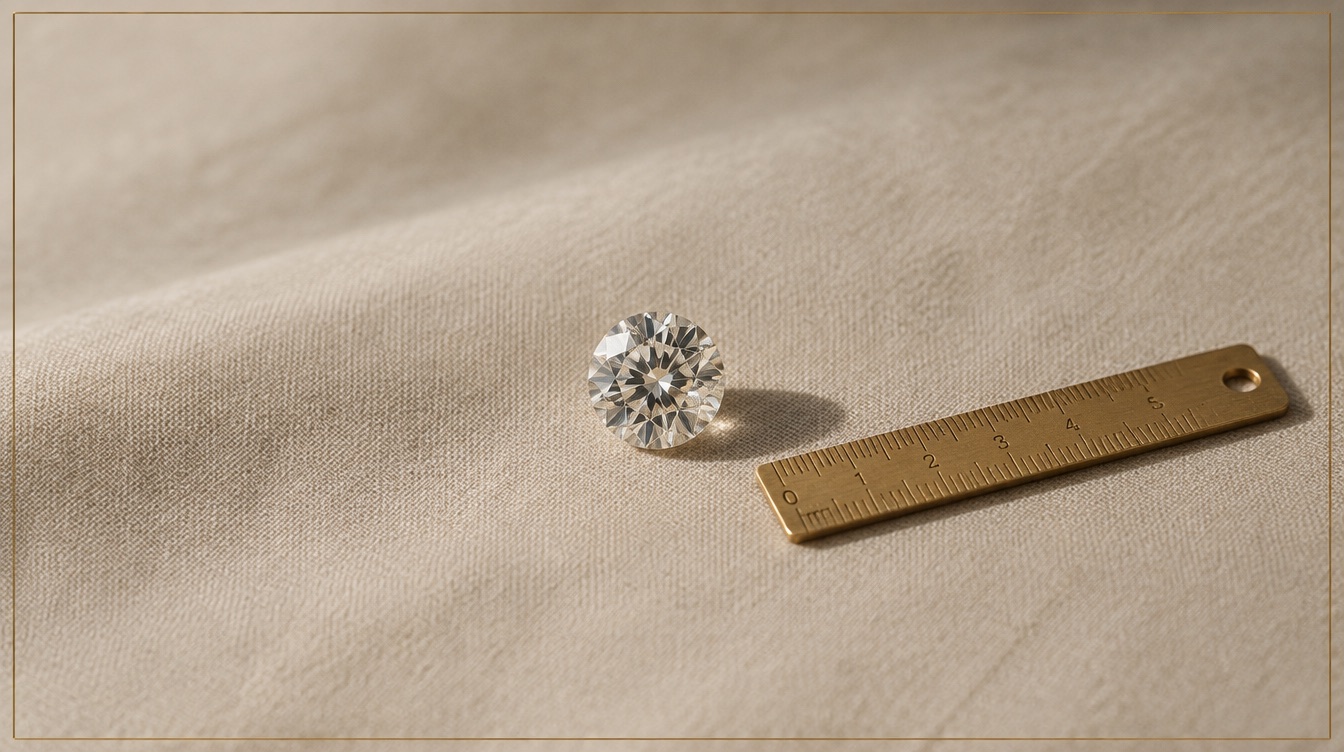
A cape diamond is a white diamond with a faint yellowish or brownish tint, roughly corresponding to the lower end of the modern GIA D-to-Z color scale — approximately K through Z. The term predates GIA's letter-grade system, originating with diamonds mined in South Africa's Cape Province in the late 1800s, and it still surfaces today in older grading reports, estate and auction catalogs, and everyday trade conversation among dealers.
For a wholesale buyer, "cape" is one of those words that sounds precise but often isn't — it's a historical trade convention layered on top of a modern, standardized grading system, and the two don't map onto each other with the exactness a spec sheet implies. This guide covers where the term comes from, how it relates to GIA's D-to-Z scale, the informal subcategories still used in trade conversation, why the language persists despite a more precise modern alternative, and — critically — why a cape diamond is not the same thing as a fancy yellow diamond, a distinction that genuinely matters when pricing or presenting a stone.
Where the Term "Cape Diamond" Comes From
The word "cape" traces directly to geography. In 1867 and 1871, major diamond discoveries near the Orange and Vaal Rivers and later at Kimberley put South Africa's Cape Colony (the region that would become Cape Province) on the map as the center of the modern diamond trade, displacing the alluvial deposits of India and Brazil that had supplied the market for centuries prior. As Cape-mined rough began flowing into London and Amsterdam cutting centers in enormous volume, dealers noticed a recurring characteristic: a large share of it carried a faint yellow or brownish body color rather than being perfectly colorless.
That characteristic became a shorthand. Diamonds with this typical light tint were called "Cape stones" or "Cape diamonds," not because every diamond from the Cape was tinted — plenty of fine colorless material came out of the same mines — but because the tint was common enough in that supply that the geographic name and the color description fused into a single piece of trade jargon. Over the following decades, as the term spread through London's Hatton Garden dealers and beyond, it drifted from a strictly geographic label into a general color descriptor used for any diamond with that pale yellow-to-brown character, regardless of where the stone actually came from. By the twentieth century, "cape" no longer implied South African origin at all — it simply meant "tinted white diamond," a linguistic shift that trips up buyers who assume the word is still making a claim about where a stone was mined.
The Historical South African Mining Context
It's worth understanding the mining history briefly, because it explains why the tint associated with "cape" was so common in the first place. The diamonds pulled from Kimberley, De Beers, Bultfontein, and the other early Cape-area pipes came from kimberlite deposits with a geological composition that produced a meaningful proportion of nitrogen-bearing rough. Nitrogen impurities in a diamond's crystal lattice absorb blue light and reflect back a yellow tint — the same mechanism responsible for color in every tinted or fancy yellow diamond today, natural or lab-grown. Because so much of the world's diamond supply in the late 1800s and early 1900s came from these specific South African sources, and because a meaningful share of that supply carried visible nitrogen-related tint, "Cape" became strongly linked with "yellowish diamond" in the trade vocabulary of the era — long before anyone had a standardized letter-grade scale to describe exactly how much tint a given stone showed.
This is purely historical and geological context — it has nothing to do with how any modern supplier sources material today, and it shouldn't be confused with a statement about where any particular diamond on the market now actually comes from. A stone described as "cape" in 2026 is not a claim about South African mining origin; it's a color description that happens to carry a century-old geographic name.
How "Cape" Maps to the Modern GIA D-to-Z Color Scale
GIA introduced its D-to-Z color grading system in the 1950s under Richard T. Liddicoat, replacing a patchwork of older, inconsistent trade terms — including "cape" and its variants — with a single letter-based scale running from D (completely colorless) to Z (a light, noticeable yellow or brown tint), graded against calibrated master stones under controlled lighting. That system, and its GIA and IGI equivalents, is the actual industry standard today. Anyone buying, selling, or certifying diamonds now should be working from a D-to-Z (or fancy-color) grade, not a cape description.
That said, the old terminology didn't vanish, and it roughly — never precisely — maps onto specific bands of the modern scale. The correspondence below reflects long-standing, widely referenced trade convention rather than a formal GIA equivalence chart; older labs, individual dealers, and different regional trade circles have applied these labels slightly differently over the decades, so treat it as directional, not exact.
| Historical trade term | Approximate modern GIA range | What it describes |
|---|---|---|
| River / Finest White | D–E | Effectively colorless, no visible tint face-up or face-down |
| Top Wesselton / Rare White | F–G | Colorless to the eye; trace warmth only detectable by a trained grader against a master stone |
| Wesselton | H | Near-colorless; still reads white to an untrained eye in most settings |
| Top Crystal / Crystal | I–J | Near-colorless; faint warmth becomes detectable, especially in larger stones or side-by-side comparison |
| Top Cape | K | The transition point — faint tint starts to become noticeable to an untrained eye, particularly face-down or in larger carat weights |
| Cape | L–M | Faint yellow or brown tint, generally visible without comparison stones |
| Light Cape | N–R | Noticeably tinted; visible warmth even in smaller stones and typical jewelry lighting |
| Dark Cape | S–Z | Strong, obvious tint — the deepest band still classified within the standard D-to-Z white-diamond scale before crossing into fancy color territory |
Two things worth flagging about this table. First, the boundaries are soft — a stone one grader calls "Cape" and another calls "Top Cape" might both land at K or L on a current GIA report, and older cape labels were never applied with the calibrated consistency GIA brought to the D-to-Z scale. Second, and more importantly, everything in this table — River through Dark Cape — sits within the ordinary white diamond scale. None of it describes a fancy color diamond. That distinction gets its own section below, because it's the single most common point of confusion buyers run into with cape terminology.
The Informal Cape Subcategories, Explained
Beyond the broad "Cape" label, older trade language — and some dealers and auction houses still today — subdivides the tinted range further. These aren't GIA-defined terms and won't appear on a modern grading report, but they show up often enough in older paperwork and verbal trade description that it's worth knowing what each one is generally understood to mean:
- Top Cape: the lightest tint band, sitting right at the border where a diamond stops reading as fully near-colorless. Roughly K on the modern scale. Often the hardest band to distinguish from a straight "Crystal" or "J" grade without side-by-side comparison.
- Cape: the core of the category — a clearly, if modestly, tinted stone. Roughly L to M. This is the band most likely to simply be called "cape" without a modifier in casual trade conversation.
- Light Cape: despite the name, this sits below (more tinted than) plain "Cape" in most trade usage — the "light" refers to the intensity of the yellow being on the lighter end of the more visibly tinted range, roughly N to R, not to a lighter degree of tint than Cape itself. This naming quirk is a genuine, common source of confusion, and it's worth double-checking which convention a specific dealer or catalog is using rather than assuming.
- Dark Cape: the deepest tint band still within the standard white scale, roughly S to Z — a clearly yellow-brown stone, but still, by definition, not a fancy color diamond.
- Yellow / Yellowish (unqualified): sometimes used loosely and inconsistently in older catalogs to describe stones anywhere from Light Cape through the Z boundary, or occasionally misapplied to true fancy-color stones by less careful sellers — another reason a real modern grading report matters more than the label attached to a listing.
Because none of these subcategories carry a standardized, universally agreed definition the way D-to-Z letter grades do, they should be treated as a rough orientation tool, not a substitute for an actual color grade. Two dealers using "Light Cape" three decades apart, or in different regional markets, may not mean exactly the same thing.
Why "Cape" Still Shows Up in Trade Conversation Today
Given that GIA's D-to-Z scale has been the industry standard for roughly seventy years, it's fair to ask why "cape" terminology hasn't simply died out. A few concrete reasons keep it alive:
Older grading reports and estate inventory. Diamonds graded decades ago — particularly pre-1970s stones, or parcels that circulated through the trade before consistent lab grading became universal — sometimes carry paperwork or dealer notes using cape language instead of, or alongside, a letter grade. Estate jewelry, inherited pieces, and older melee lots are the most common places this surfaces today.
Auction house convention. Some auction catalogs, particularly for antique and period jewelry lots, still use cape-family terminology as descriptive shorthand, sometimes in addition to a modern grade and sometimes on ungraded lots where no current certification exists. It's part of the established vocabulary of that specific corner of the trade.
Verbal trade shorthand. Among dealers who've worked in the diamond trade for decades, "that's a cape stone" or "it's got some cape in it" remains a fast, casual way to communicate "this has visible warmth, don't expect a G-H face-up look" without reciting an exact letter grade — useful in a quick phone conversation or on a trading floor, even when a precise cert exists for the stone in question.
Older mixed and parcel goods. Rough or unsorted parcel material moving through the market sometimes still gets sorted informally into cape-family buckets before individual stones are cut, polished, and formally graded — a legacy of how bulk sorting worked before automated and lab-based grading became standard practice.
None of this makes cape terminology a reliable substitute for a current certification. It's a real, historically grounded piece of trade vocabulary — worth understanding so it doesn't read as unfamiliar jargon when it comes up — but it's not a grading system a buyer should price against.
Cape Diamonds vs. Fancy Yellow Diamonds: The Distinction That Actually Matters
This is the point where getting it wrong costs real money, so it's worth stating plainly: a cape diamond is not a fancy color diamond. These are two entirely separate categories on two entirely separate grading systems, and confusing them — whether by a buyer misreading a listing or a seller blurring the line to make a stone sound more exotic than it is — is one of the more consequential mistakes in this corner of the trade.
GIA's D-to-Z scale, cape terminology included, describes white diamonds — stones where the goal, by definition, is the absence of color, and where every grade from D to Z is measuring how close (or far) a stone sits from that colorless ideal. Even the most heavily tinted stone at the Z end of that scale, or its old "Dark Cape" equivalent, is still fundamentally being evaluated as a white diamond that falls short of colorless — not as a colored gemstone in its own right.
Fancy color diamonds are graded on a completely different system. Once a diamond's body color is strong and saturated enough to cross past the Z boundary — a specific, defined threshold, not a fuzzy continuation of the same scale — it moves into GIA's fancy color grading, evaluated on hue, tone, and saturation rather than the D-to-Z letter scale, and described with terms like Fancy Light Yellow, Fancy Yellow, Fancy Intense Yellow, and Fancy Vivid Yellow. A true fancy yellow diamond is prized and priced specifically for its color — the more saturated and vivid, generally, the more valuable — which is the exact opposite of how a cape stone is treated, where more visible tint generally means a lower price within the white-diamond scale.
| Cape diamond | Fancy yellow diamond | |
|---|---|---|
| Grading system | Standard D-to-Z white diamond scale | Separate fancy color grading system (hue, tone, saturation) |
| Category | White diamond with a tint | Colored diamond, graded and marketed for its color |
| Effect of more color | Generally lowers value within the white scale | Generally raises value with stronger, more saturated hue |
| Typical grade range | Roughly K–Z | Fancy Light through Fancy Vivid (beyond Z) |
| How it's marketed | Sold as a lower-color white stone, priced accordingly | Sold specifically as a fancy color stone, its color the selling point |
A dealer or listing that describes a stone as "cape" is making a claim about it being a white diamond with visible tint, sitting somewhere in the K-to-Z family — not about it being a colored diamond. If a listing uses "cape" language while also implying fancy-color-style pricing or marketing, that's a red flag worth questioning directly rather than assuming the two terms are simply overlapping vocabulary for the same thing. For buyers specifically looking for genuine fancy-color stones rather than tinted white goods, Guru Diam's fancy color loose diamonds category and our separate yellow diamond buying guide cover that category specifically — a genuinely different product from anything cape terminology describes.
How to Interpret "Cape" Language on an Older Stone or in a Dealer's Description
When a wholesale buyer encounters cape terminology today — on an estate piece, in an older report, or in a dealer's verbal description — a few practical steps keep the transaction grounded in something more reliable than a century-old label:
- Ask for a current grading report first. If the stone has a modern GIA, IGI, or GCAL report, that letter grade supersedes any cape language attached to it — use the certified grade for pricing and presentation, and treat "cape" as background color only.
- Treat cape language as a range, not a point. "Cape" alone could mean anywhere from roughly K to Z depending on who's using the term and in what era or region. Don't price a stone as if "cape" pins it to a specific letter grade without independent verification.
- Watch for the Light Cape naming quirk. As covered above, "Light Cape" is often more tinted than plain "Cape" in traditional usage — the opposite of what the word "light" would suggest. Confirm which convention is in play rather than assuming.
- Recheck older reports against modern standards. Grading technology, lighting standards, and master stone calibration have all tightened significantly since Liddicoat's era. A color grade — cape-labeled or otherwise — assigned decades ago is worth reverifying against current standards before it anchors a purchase price, particularly for higher-value stones.
- Never assume "cape" implies South African origin. As covered earlier, the term shed its geographic meaning generations ago. A cape-described stone today makes no claim whatsoever about where it was mined or cut.
- Confirm it isn't being mispositioned as fancy color. If cape language and fancy-color language appear together on the same listing, get clarity on which system the stone is actually being graded under before proceeding.
Cape Terminology in Auction Catalogs and Antique Jewelry
Buyers working in the antique and estate jewelry space run into cape terminology more than most, since period pieces — Georgian, Victorian, Edwardian, and Art Deco jewelry in particular — were often set with diamonds that predate any standardized modern grading altogether. Old mine cut and old European cut stones, common in period pieces, were cut from rough that ran the full color range, cape included, and it's routine for an auction catalog or estate appraisal to describe a stone's color in cape-family terms, sometimes alongside a modern grade obtained specifically for the sale and sometimes as the only color description available.
This is a legitimate, functional use of the terminology — cape language has real descriptive value in a market where the underlying stones genuinely predate the D-to-Z system, and antique buyers are often more tolerant of visible warmth in an old mine or old European cut than they would be in a modern round brilliant, since a period stone's cut character and history are frequently the primary draw rather than colorless perfection. The practical guidance is the same as above, though: treat cape descriptions as useful context, and get a current certification before finalizing a purchase where the color grade meaningfully affects the price.
Common Mistakes Buyers Make With Cape Terminology
- Assuming "cape" means South African origin. It hasn't meant that in general trade usage for well over a century — it's a color descriptor, not a provenance claim.
- Treating cape labels as precise enough to price against. Cape and its subcategories are directional trade convention, not a calibrated scale. A current D-to-Z certified grade is always the more reliable basis for pricing.
- Confusing cape diamonds with fancy yellow diamonds. Covered in detail above — these are structurally different categories on different grading systems, and the confusion runs in both directions (buyers underestimating a genuine fancy color stone, or sellers overstating a tinted white stone).
- Misreading "Light Cape" as lighter than "Cape." In traditional usage it's often the reverse. Confirm the specific convention rather than assuming.
- Relying on decades-old grading without reverification. Standards and calibration have tightened meaningfully since the mid-twentieth century; an old report's grade, cape-labeled or lettered, deserves a fresh look on any purchase where the color grade materially affects value.
How a Wholesale Buyer Should Approach Cape-Graded Stones
For a trade buyer evaluating inventory today, the practical takeaway is straightforward: cape terminology is useful vocabulary to understand, not a system to transact on. When a stone is described as cape, Top Cape, Light Cape, or Dark Cape, the right response is to request the current GIA, IGI, or GCAL letter grade and price against that — treating the historical label as helpful color and context rather than the operative spec. This matters most with estate goods, older parcels, and antique-cut stones, where cape language is most likely to appear without an accompanying modern report, and least with newly cut, freshly certified inventory, where a precise D-to-Z grade should already be standard.
Guru Diam's own certified diamond inventory is graded and sold on the modern D-to-Z (and, separately, fancy color) standard rather than historical cape terminology — buyers get a specific, current GIA, IGI, or GCAL letter grade on every certified stone rather than a directional color description, which matters for anyone pricing inventory at wholesale volume where consistency across a full order matters as much as any single stone's grade. That precision extends across the catalog, from colorless and near-colorless stones through the lower end of the white scale that older trade language would have called cape, all the way to genuinely separate fancy color material in yellow, pink, blue, and green. Guru Diam's diamonds are cut and polished in India before final grading and shipment from the New York and Los Angeles locations, with the certification step happening after cutting so the letter grade a buyer sees reflects the finished stone, not an estimate. Buyers can browse current certified inventory in the certified diamonds category, and trade accounts looking to source at volume can apply through trade partner or start at the wholesale hub for a broader look at how sourcing works.
For buyers wanting a deeper grounding in the modern scale that cape terminology sits alongside, our diamond color scale guide walks through the full D-to-Z system letter by letter, and the diamond color chart guide covers how to actually compare a stone against a reference chart in practice. For anything described with a certification number, our GIA diamond report guide explains what's actually documented on the report itself.
Frequently Asked Questions
What is a cape diamond?
A cape diamond is a white diamond with a faint yellow or brownish tint, generally corresponding to roughly K through Z on the modern GIA color scale. The term originated with diamonds mined in South Africa's Cape Province in the late 1800s and later became a general trade descriptor for tinted white diamonds regardless of actual origin.
Is a cape diamond the same as a fancy yellow diamond?
No. A cape diamond is a white diamond graded on the standard D-to-Z scale, where visible tint is a downgrade from colorless. A fancy yellow diamond is graded on a completely separate fancy color scale, where stronger, more saturated color increases value. These are distinct categories with opposite pricing logic.
Does "cape" mean the diamond is from South Africa?
Not anymore. The term originally referred to diamonds mined in South Africa's Cape Province, but it shifted generations ago into a general color descriptor used industry-wide. A diamond described as "cape" today makes no claim about its actual mining or cutting origin.
What is the difference between Cape and Light Cape?
Despite the name, "Light Cape" traditionally describes a more visibly tinted stone than plain "Cape," roughly N through R versus L through M — the "light" refers to the tint's position within that darker band, not to a lighter overall tint than Cape itself. This naming convention has confused generations of buyers, so it's worth confirming with the seller which convention applies.
Should I trust "cape" terminology when buying an older diamond?
Treat it as useful background context, not a precise grade. Always request the stone's current GIA, IGI, or GCAL letter grade and price against that; older cape-family labels are directional trade convention that varied across eras, regions, and individual dealers rather than a calibrated system.
Why do dealers still use the word "cape" if GIA has a standard scale?
It persists as trade shorthand — useful in quick verbal conversation, common on older reports and estate paperwork, and still used in some auction and antique-jewelry catalogs. It hasn't replaced the D-to-Z scale as the actual grading standard; it survives alongside it as familiar trade vocabulary, particularly for stones that predate consistent modern certification.