
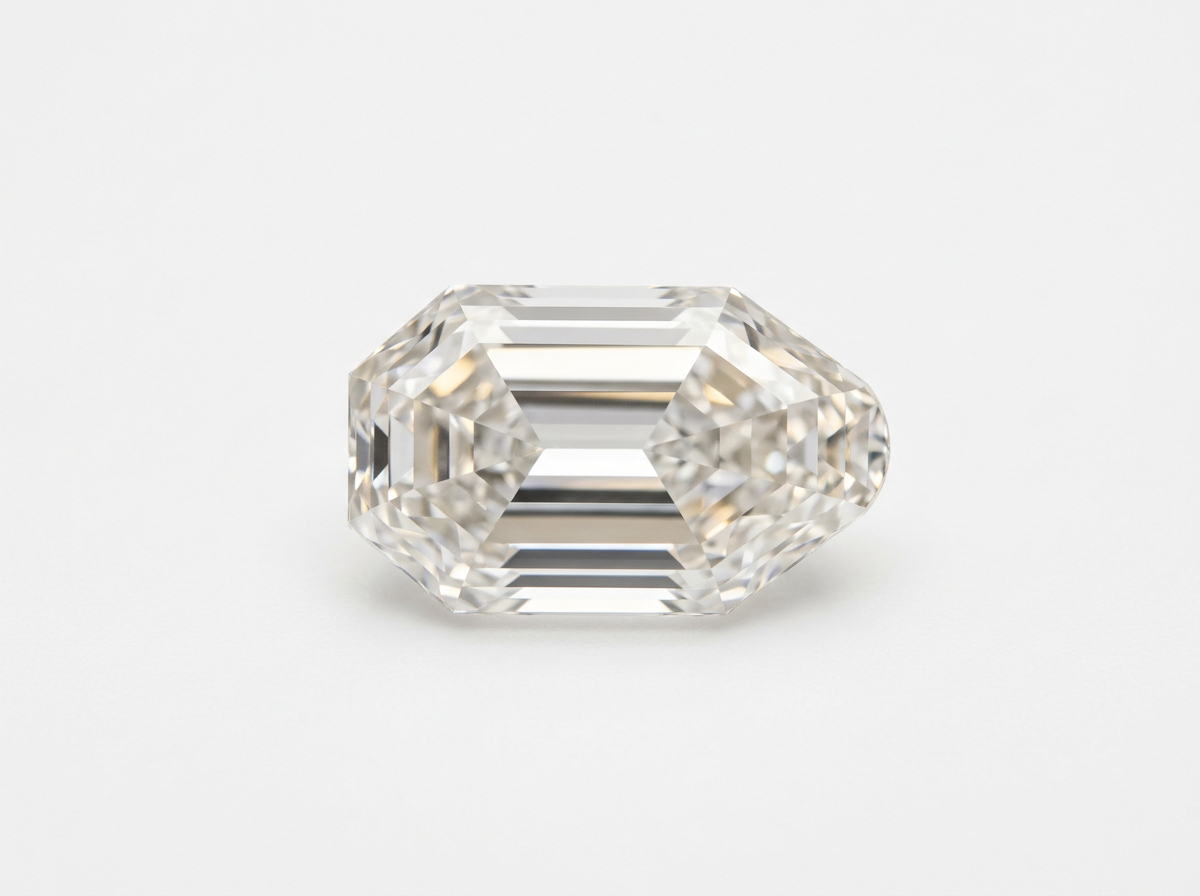
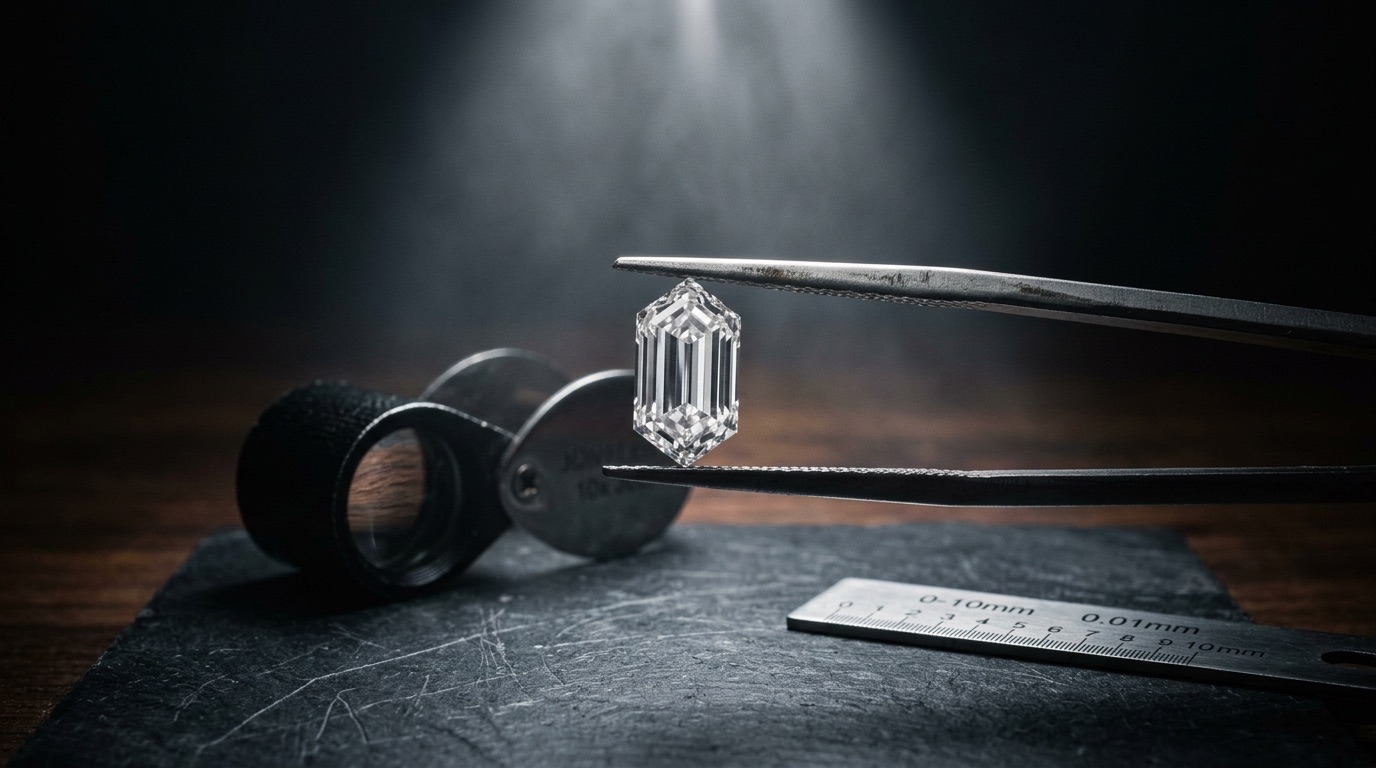
A Cadillac cut diamond is a calibrated side stone that blends an elongated hexagon and a shield outline — flat, angled sides that taper from a broad end toward a narrower rounded or pointed end. The trade name comes from the outline's resemblance to a vintage Cadillac tailfin or hood-ornament silhouette. Guru Diam stocks 468 Cadillac diamonds on hand, calibrated and matched, IGI-gradable on request. It's one of the rarer shapes on our shape list — most wholesalers don't carry it as a standing SKU at all, which is exactly why buyers researching it tend to have more questions than a five-line glossary entry can answer. This guide goes deeper: facet structure, where the shape sits in the antique-cut family, how we cut and grade it, what actually moves the price, and how to bring it into a design.
What Is a Cadillac Cut Diamond?
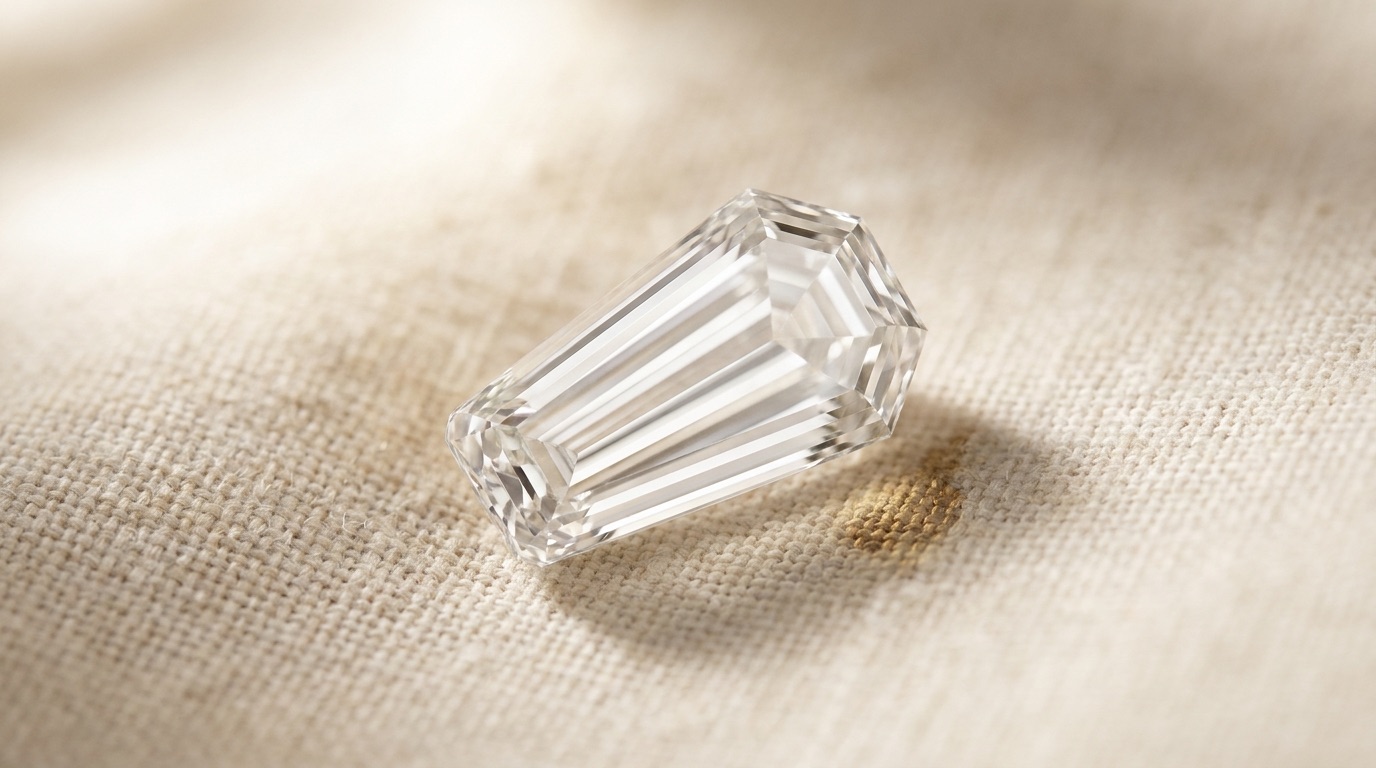
Strip away the trade name and a Cadillac is a step-faceted side stone with a flat-sided, elongated outline that sits visually between a hexagon and a shield: broader and flatter across one end, narrowing and rounding toward the other, built from straight angled edges rather than curves. It reads as a family member of the antique step-cut group — closer in spirit to a Lozenge or a Hexagonal side stone than to a modern brilliant — but with its own distinct silhouette that doesn't map cleanly onto either.
The defining trait is directionality. A true hexagon is symmetric on both axes; flip it end for end and it looks the same. A Cadillac is not — one end is visibly broader than the other, and the taper between them is the whole point of the shape. That asymmetry is what makes it useful as a side stone (more on that below) and also what makes it easy to set incorrectly if a cutter or setter isn't paying attention to orientation.
Faceting is broad and step-cut: long, parallel facets running in bands from the girdle toward the table, the same faceting logic used on Emerald and Baguette cuts. That's a deliberate choice, not a limitation of the outline — step-faceting on a flat-sided shape produces long, quiet flashes of light rather than the scattered scintillation of a brilliant cut, which is exactly the visual role a side stone is supposed to play: support the center stone, not compete with it.
Facet Structure and Cutting Geometry
A Cadillac's facet layout is built around the same three-part anatomy as any step-cut: a table, a crown with long trapezoidal or triangular step facets running around the taper, and a pavilion mirroring the crown's step pattern beneath the girdle. Because the outline itself is asymmetric, the crown and pavilion facets are not uniform in size the way they would be on a symmetric hexagon or a square Asscher — the facets on the broad end run wider and shorter, the facets toward the narrow end run longer and thinner, and the cutter has to keep the step angles consistent across that transition or the stone reads as visually "broken" between the two ends.
Table and depth percentage matter more on a step-cut than on a brilliant, because there's no crown of small facets to hide a slightly-off proportion — a step-cut's large, flat facets act like windows. Cut too deep and the stone goes dark in the center; cut too shallow and it washes out and loses definition at the edges. On a directional shape like Cadillac, that proportion also has to hold consistently from the broad end to the narrow end, which is a tighter cutting problem than proportioning a symmetric outline.
Girdle thickness is the other variable worth flagging for a custom order: because the taper narrows to a point or a tight radius at one end, that end is structurally the most vulnerable point on the stone. Too thin at the tip is a chip risk in setting and wear; too thick reads visually heavy. Guru Diam calibrates girdle thickness specifically at the taper point on every Cadillac cut and pair.
Where the Trade Name Comes From
The shape's name is descriptive, not technical — there's no official gemological body that defines "Cadillac cut" the way there is for round brilliant proportions. Cutters and dealers named it for how the outline echoes a vintage Cadillac tailfin or hood-ornament profile: that same flat-planed, forward-tapering line. The name is trade slang that stuck, the same way "coffin cut," "bullet cut," and "shield cut" are all informal, visually descriptive names rather than formal cut classifications.
That matters practically, not just historically: because there's no standardized proportion spec behind the name, "Cadillac cut" can mean slightly different things depending on who's cutting it. Two dealers' idea of a Cadillac might differ by a few degrees of taper or a slightly different broad-to-narrow ratio. When you're sourcing wholesale, ask to see the actual stone or a precise outline spec rather than assuming every "Cadillac" on the market is proportioned identically — this is true of most antique and trade-named shapes, not a quirk specific to this one.
A Rare, Made-to-Order Shape in the Trade
Cadillac is not a shape most suppliers carry as deep standing inventory, and for good reason: it's a specialty side stone with a narrow use case (Art Deco and vintage-style settings), a directional outline that has to be cut and matched in pairs or sets rather than sold as loose singles, and demand that comes from designers and jewelers working on a specific project rather than from walk-in retail. That combination — narrow use case, pair/set-dependent, project-driven demand — is what keeps a shape in "made to order" territory rather than commodity-stocked territory across the trade generally.
Guru Diam keeps a working base of Cadillac stones on hand for common sizes and standard tapers, which is what lets us quote and ship the shape faster than a pure make-to-order request. But calibrated pairs or sets cut to a specific taper ratio, a specific size run for a graduated design, or a size outside the common range are cut in-house to order rather than pulled from a bulk parcel — because for a shape this specialized, that's simply how the supply exists across the market, not a Guru Diam-specific constraint.
What Cadillac Side Stones Are Used For
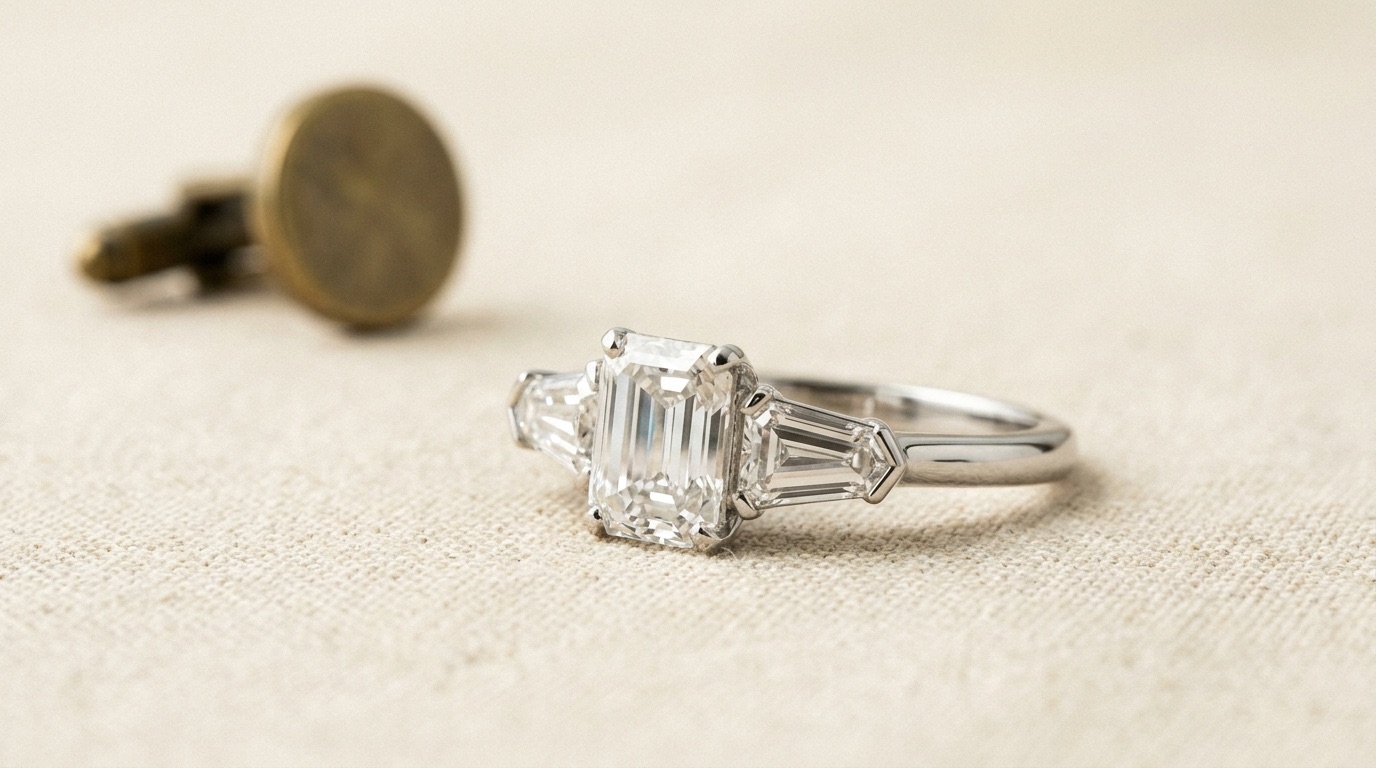
Cadillac-cut stones are used in Art Deco and vintage-style side-stone settings, most often flanking an Emerald cut, Baguette, or Hexagon center stone, where the flat, angled sides of the Cadillac echo the lines of a step-cut center. The visual logic is the same reason step-cuts get paired with step-cuts across the antique category generally: matching facet language reads as intentional, while pairing a step-cut center with brilliant-faceted side stones can look visually mismatched.
Beyond the classic three-stone pairing, the elongated taper makes Cadillac a natural fit for a few other layouts:
- Graduated shank settings — a run of Cadillac stones decreasing in size down the band, where the directional taper of each stone continues the visual line of the ring rather than interrupting it.
- Three-stone rings — a pair framing a step-cut center, oriented broad-end-in or narrow-end-in depending on the desired silhouette.
- Halo and cluster work — smaller Cadillac accents mixed with other antique shapes (Kite, Half-Moon, Trillion) around a center stone, where the flat planes add geometric contrast against curved outlines.
- Vintage-reproduction and Art Deco custom pieces — where the brief specifically calls for period-accurate faceting rather than modern brilliant-cut accents.
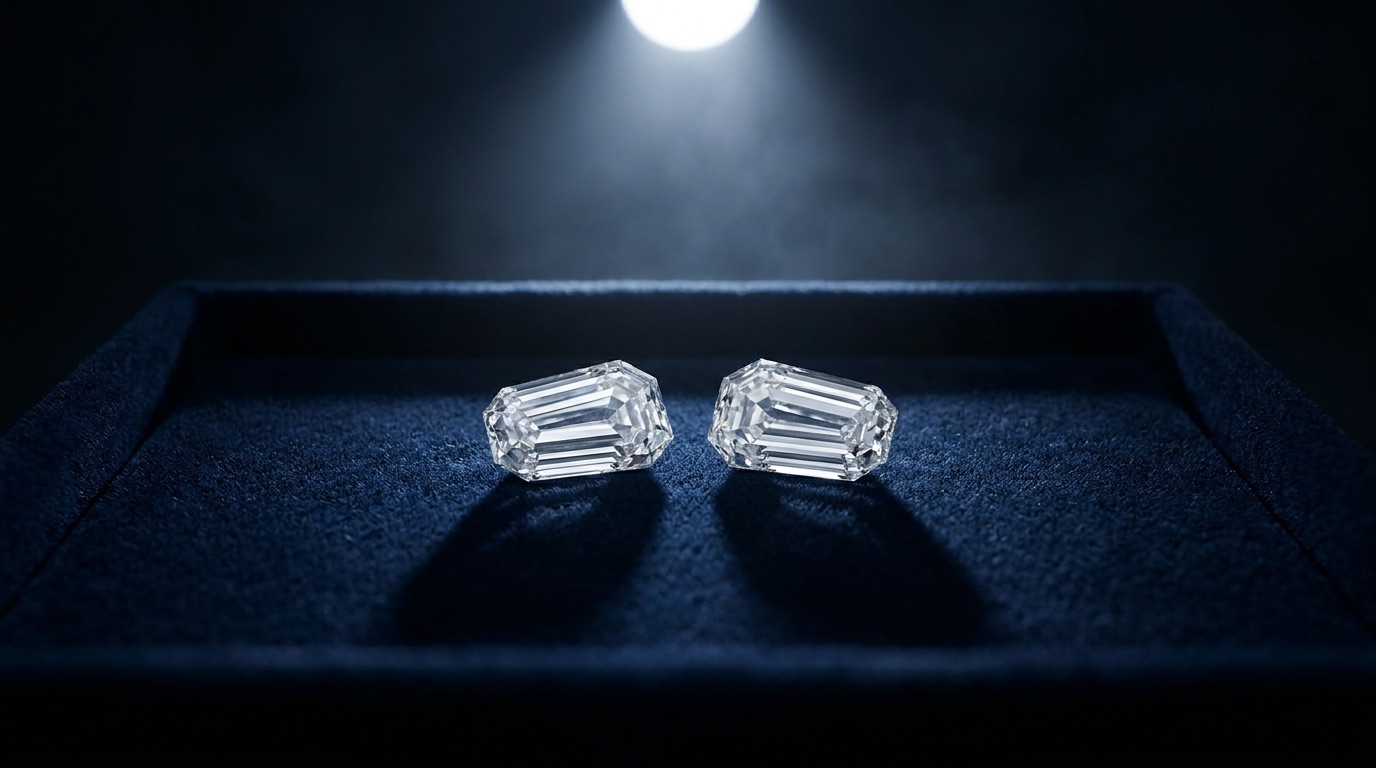
Because the outline is directional — broad end and narrow end — Cadillac stones are always set with orientation in mind, typically in mirrored pairs so the taper reads symmetrically from the center stone outward.
Cadillac vs. Hexagon vs. Shield vs. Epaulette
These four names get used loosely and sometimes interchangeably across the trade, which causes more sourcing confusion than almost any other antique side-stone family. Here's how Guru Diam draws the lines, and where the overlap genuinely exists.
| Spec | Cadillac | Hexagon | Shield |
|---|---|---|---|
| Outline | Elongated hexagon/shield hybrid, tapered | Flat-sided, six roughly even sides | Rounded top, pointed or flat bottom, broader shoulders |
| Symmetry | Directional — broad end to narrow end | Symmetric along both axes | Symmetric left-right only |
| Faceting | Step-cut | Step-cut or brilliant | Step-cut or brilliant |
| Typical use | Side stone, Art Deco settings | Center stone or accent | Side stone or accent |
On "Epaulette": you'll see this trade name used by some cutters and buyers as a synonym for Cadillac, and in Guru Diam's own shape glossary that's exactly how we map it — a request for an "epaulette cut" is understood as the same elongated, tapered, hexagon/shield hybrid outline described above. The name comes from the same visual logic as "Cadillac" — a resemblance to a tapered military shoulder ornament rather than to a car — but it's pointing at the same family of shape.
Worth flagging for buyers coming from other suppliers: some cutters in the broader trade draw a stricter line, using "Epaulette" specifically for a flatter, more rectangular, sharper-tapered variant and reserving "Cadillac" for a softer, more rounded taper. If you're sourcing across multiple vendors and the exact outline matters for a matched set, don't rely on the name alone — ask for a sketch, a photo, or the precise broad-end/narrow-end ratio before you commit to a pair.
How Guru Diam Sources and Cuts Cadillac Diamonds
Guru Diam calibrates and matches Cadillac pairs and sets in-house — CVD lab-grown, IGI-gradable on request — cut to the taper and size a specific setting needs rather than approximated from generic step-cut stock. Cutting a directional, low-volume shape like this in-house rather than sourcing pre-cut parcels is what lets us hold the taper ratio and proportions consistent across an entire set, which matters more here than on almost any other side stone: a mismatched taper is immediately visible once the pair or set is mounted.
Rough selection follows the same standard as any antique or step-cut shape in our production — chosen for clarity and shape yield along the intended outline, since a step-cut's open facets make internal characteristics more visible than a brilliant's faceting would. From there, calibration is done to the specific dimensions a project needs: a matched pair for a three-stone ring, a graduated run for a shank, or a custom taper ratio requested by a designer.
Because Guru Diam controls the full production sequence in-house — cutting, calibration, and polishing — a custom Cadillac request doesn't route through a third party. Open a wholesale account for live pricing and to request a matched pair or set for a specific project.
Grading and Quality Considerations for Cadillac Side Stones
Step-cut shapes are less forgiving of inclusions than brilliant cuts. A round brilliant's many small facets scatter light in a way that can visually mask a moderate inclusion; a step-cut's long, flat, open facets do the opposite — they act like a window straight into the stone, on Cadillac the same as on Emerald, Asscher, or Baguette. Practically, that means the clarity grade that reads clean on a brilliant-cut stone can show visible inclusions on a step-cut at the same grade, so buyers sourcing Cadillac side stones for a visible setting should generally spec clarity a notch higher than they would for a comparable brilliant accent.
Color follows the same logic for the same reason — an open step-cut table shows body color more readily than a brilliant's broken-up faceting does, particularly toward the broad end of a Cadillac where the facets run widest. For side stones meant to sit quietly next to a colorless or near-colorless center stone, matching color grade between the center and the Cadillac accents (not just matching color grade to a generic "near colorless" bucket) is what keeps the finished piece looking cohesive.
Cut precision and symmetry matter differently here too. On a directional, asymmetric outline, "symmetry" isn't just about facet alignment — it's about whether the taper angle, the broad-end width, and the narrow-end point are consistent across a matched pair or set. A pair cut to slightly different taper ratios will look mismatched even if each stone individually grades well, which is why pair-matching is treated as its own quality check separate from grading the individual stones.
On certification: Guru Diam works with IGI, GIA, and GCAL, so grading can run through whichever lab a project calls for. Cadillac stones follow the same convention used across our other calibrated side-stone shapes — sold as calibrated pair or set goods, IGI-gradable on request, rather than issued as individually certified loose stones. That's standard practice across the trade for small calibrated side stones generally, not a Cadillac-specific limitation.
What Drives Cadillac Cut Pricing
A handful of factors move price on Cadillac stones, and they don't all work the way they do on a commodity round or a standard fancy shape:
- Size and carat weight — the baseline factor on any stone, but on a calibrated side stone, size is expressed as a millimeter dimension tied to a specific setting rather than a free-floating carat target.
- Calibration precision — a stone cut to an exact millimeter spec for a specific mounting costs more to produce than a stone cut to a standard, off-the-shelf size range, because the cutter has less rough-yield flexibility to work with.
- Matched pair or set premium — pairs and sets are priced for the matching work itself, not just the sum of the individual stones. Getting taper ratio, color, and clarity consistent across two or more stones takes more selection and cutting attention than producing a single stone to spec.
- Clarity requirement — because step-cuts show inclusions more readily (see above), a Cadillac spec'd at a higher clarity grade to read clean in a visible setting costs more than the same size and color at a lower clarity grade.
- Custom taper ratio — a request for a taper outside our common standing range is a made-to-order cut, priced accordingly rather than pulled from stock.
- Quantity — a graduated run for a full shank (potentially a dozen or more stones in a continuous size progression) is priced and quoted as a project, not per-stone.
Because Cadillac is a rare, made-to-order shape for anything outside standard sizes, pricing on a custom request is quoted per project rather than published as a flat per-carat rate — talk to a wholesale account rep with your setting's specs (broad-end width, narrow-end width, length, quantity, clarity/color target) for an accurate quote.
What to Check Before You Buy
Confirm which end is the broad end and which is the tapered end before ordering — Cadillac stones are directional, and a mismatched pair (one stone oriented backward relative to the other) is immediately visible in a symmetrical setting. Also check that the angled sides are cut cleanly straight rather than slightly bowed, since the shape's identity depends on flat, crisp edges rather than curves; a bowed edge reads as a cutting flaw on a shape this geometric, not as a stylistic variation.
As with any step-cut side stone, ask about table and depth percentages if the piece will be viewed face-up in a low-profile setting — an over-deep or over-shallow step-cut loses the clean, quiet flash that's the whole point of choosing this faceting style. For a matched pair or set, ask specifically whether taper ratio and proportions were held consistent across every stone, not just whether each stone individually meets spec — that consistency is what a jeweler's eye catches first once the pieces are mounted side by side.
Finally, if the design calls for a graduated run down a shank, confirm the size progression and quantity up front — reordering a single mismatched stone later, once the rest of the run has already shifted in available stock, is a harder match to make than getting the full run cut together the first time.
How to Order Cadillac Cut Diamonds Wholesale
Cadillac stones move through the same wholesale process as any other calibrated side-stone shape at Guru Diam: open a wholesale trade account, then submit the setting specs for the pair or set you need — broad-end and narrow-end width, overall length, quantity, and target clarity/color. For standard sizes we carry in working stock, a quote and availability typically comes back fast; for a custom taper, a size outside our common range, or a graduated run, the request routes to in-house cutting and is quoted as a project.
Because a Cadillac pair or set is directional and matched, it's worth sending a sketch, a CAD file, or reference photos of the setting alongside the raw dimensions if you have them — it lets our team confirm orientation and proportion against the actual mounting rather than working from numbers alone, which cuts down on back-and-forth before a final quote.
Buyers who don't yet have the exact spec in hand can also just describe the project (center stone shape and size, ring or piece type, roughly how many side stones) and work from there — matching an unusual antique shape to a specific setting is a routine part of what a wholesale account rep does for this category.
Styling Cadillac Cuts Into Custom Jewelry
Cadillac side stones are frequently sourced alongside a custom build rather than sold as a standalone loose-stone order, since the whole point of the shape is how it sits next to a specific center stone in a specific setting. Guru Diam's custom program handles that full path — matched Cadillac pair or set, paired center stone, and setting design — under one roof, with custom engagement rings and other finished jewelry pieces built in-house and completed in 4–6 days once a design is confirmed. That turnaround applies to the finished piece, not to sourcing or cutting the loose Cadillac stones themselves, which follow the made-to-order timeline described above when a custom taper or size is involved.
Custom pieces built through Guru Diam ship unbranded by default, so a jeweler or designer working with us on a Cadillac-accented design can present the finished piece as their own work to their client — no Guru Diam markings or packaging in the way.
For a designer sketching an Art Deco-inspired piece from scratch, Cadillac is worth considering alongside its closest relatives — Hexagon, Shield, Half-Moon, Kite, and Trillion — since all of them share the flat-planed, geometric visual language that defines the period. Mixing two or three of these shapes around a step-cut center is a common Art Deco convention, and because Guru Diam cuts all of them in-house, a mixed-shape side-stone layout can be calibrated and matched as a single coordinated order rather than sourced piecemeal from different suppliers.
Common Sourcing Mistakes to Avoid
Three patterns come up repeatedly with buyers new to this shape. Ordering by carat weight alone, without millimeter dimensions, is the most common — a carat target without a length/width spec can arrive sized wrong for a calibrated mounting even though it's technically the "right" weight. Assuming every supplier's "Cadillac cut" is proportioned identically is the second: it's a trade name without a formal proportion standard, so a pair sourced from two different cutters at two different times can come back visually mismatched even when both are labeled the same way — sourcing a full pair or set from one cutter in one production run avoids this. The third is treating the request like a commodity round available same-day at any size, rather than the specialty, made-to-order shape it actually is — build lead time into the project timeline up front.
Frequently Asked Questions
What is a Cadillac cut diamond?
A Cadillac cut diamond is a calibrated side stone with an elongated, flat-sided outline that blends a hexagon and a shield — broader at one end, tapering to a narrower rounded or pointed end. The name comes from the outline's resemblance to a vintage Cadillac tailfin or hood-ornament profile.
What is a Cadillac cut diamond used for?
Cadillac cuts are used as side stones in Art Deco and vintage-style settings, typically flanking an Emerald cut, Baguette, or Hexagon center stone, or running along a shank in a graduated side-stone design.
How is a Cadillac cut different from a Hexagon or Shield?
A Cadillac is directional and tapered — broader at one end than the other — while a true Hexagon is symmetric along both axes and a Shield has a rounded top with broader shoulders. All three are flat-sided, step-faceted shapes, but they suit different settings and pairing conventions.
Are Cadillac cut diamonds certified?
They're sold as calibrated pair/set goods, IGI-gradable on request, the same convention used for other side-stone shapes. Guru Diam also works with GIA and GCAL where a project calls for a different lab.
Is "Epaulette cut" the same as "Cadillac cut"?
In Guru Diam's shape glossary, yes — "Epaulette" is treated as the same elongated, tapered outline as Cadillac. Some cutters elsewhere in the trade draw a finer line between a flatter "Epaulette" and a softer, more rounded "Cadillac," so if the exact outline matters for a matched set sourced across multiple vendors, confirm with a sketch or photo rather than the name alone.
Can Cadillac cut diamonds be custom sized for a specific setting?
Yes — Guru Diam cuts and calibrates Cadillac pairs and sets in-house to the exact broad-end, narrow-end, and length dimensions a setting needs. Standard sizes are typically quoted from working stock; custom tapers, unusual sizes, or graduated runs are made to order.