
A bullet shape diamond is a calibrated side stone — flat and straight across one end, tapering to a rounded or gently pointed tip at the other, like the profile of a bullet — set in mirrored pairs flanking a baguette or emerald-cut center stone. Guru Diam stocks 576 bullet diamonds on hand, calibrated and matched, IGI-gradable on request. This guide covers how the shape is cut, graded, priced, and specced for three-stone and channel-set work, and how it compares to trapezoid, baguette, and half moon side stones.
What is a bullet shape diamond?
A bullet is an elongated, step-faceted side stone with one flat end and one rounded or pointed end. The flat end sits flush against the corner of a center stone, and the tapered tip points outward, which is what makes the shape read as a bullet in profile. Like most calibrated side stones, bullets are cut to broad, quiet facets rather than high-fire brilliant faceting — the goal is to frame the center stone, not compete with it.
The outline sits in the same family as trapezoids, half moons, and tapered baguettes — all calibrated shapes cut specifically to accompany a center stone rather than stand alone. What separates a bullet from the rest of that family is the asymmetry: one end is squared off, the other tapers to a point or a soft round. That directionality is the whole point of the cut. Set two of them mirrored on either side of a center stone and the eye reads a single continuous line running from shoulder to shoulder, rather than two separate accent stones. Bullets are occasionally called "bullet baguettes" in casual trade conversation, but the outline is distinct from a straight baguette — a baguette has two parallel long edges and no taper, while a bullet tapers along its length toward one end.
Facet structure and cut style
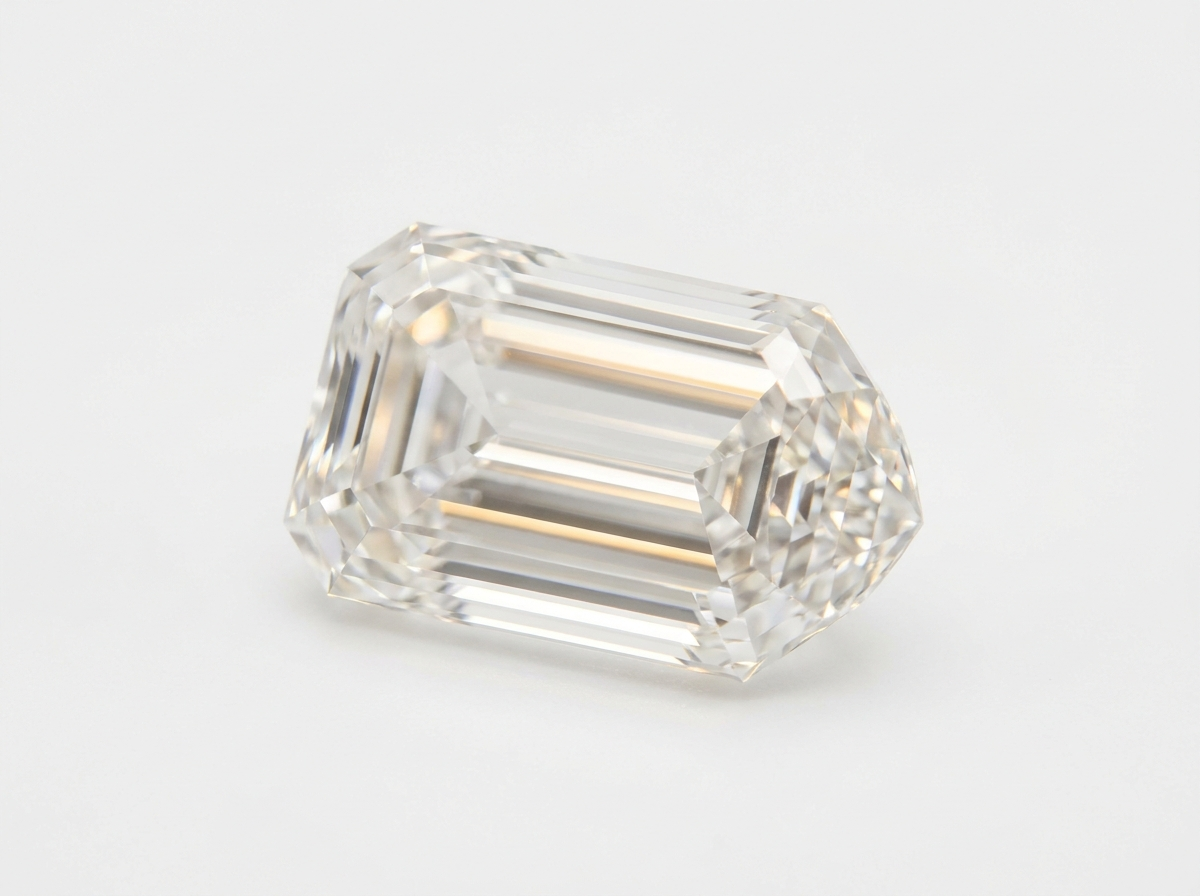
Bullets are cut step-style, the same faceting family as baguettes, trapezoids, and emerald cuts: long, flat, rectangular facets arranged in parallel rows around the stone rather than the triangular and kite-shaped facets of a brilliant cut. Step faceting produces a hall-of-mirrors optical effect — clean flashes of light off broad, flat planes — instead of the fire and scintillation a brilliant cut throws. That's a deliberate trade-off. A side stone with brilliant-cut sparkle would visually compete with the center stone; a step-cut side stone frames it instead, echoing the same broad, quiet facet pattern that baguette and emerald-cut center stones already use. That's also why bullets pair most naturally with step-cut centers — the facet language matches on both stones, and the ring reads as one coherent design rather than two different cutting styles bolted together.
Because step facets are large and flat, they show inclusions more readily than a brilliant cut of the same clarity grade would — there's no faceting pattern to break up or hide an inclusion the way a round brilliant's 57 facets can. That has a direct effect on what clarity grade actually looks clean in a bullet, covered in the grading section below.
A small number of bullets are cut with a modified brilliant or mixed facet pattern, mostly for channel-set bands where more sparkle at a small scale is wanted and there's no step-cut center stone to match. That's a request-basis cut, not the trade default — most bullet pairs ordered for three-stone rings are step-faceted.
What bullet side stones are used for
Bullets are almost always sold and set in mirrored pairs, one on each side of a center stone, most commonly flanking a baguette or emerald-cut center in three-stone rings and Art Deco-style settings. The flat end aligns against the center stone's corner while the tapered tip extends toward the shoulder of the ring, giving the eye a clean line running from center stone to shank. Bullets also show up in graduated channel-set bands, where a run of bullets narrows toward the ends of the band.
The three-stone format is where the shape sees the most trade use. Elongated step cuts flanking a center stone lengthen the visual line of a ring — a center stone flanked by tapered bullets reads longer and more architectural on the hand than the same center stone set alone or flanked by rounds. That geometric, linear aesthetic is why the shape shows up heavily in vintage-inspired and Deco-style engagement ring design, alongside half moons, trapezoids, and kite cuts.
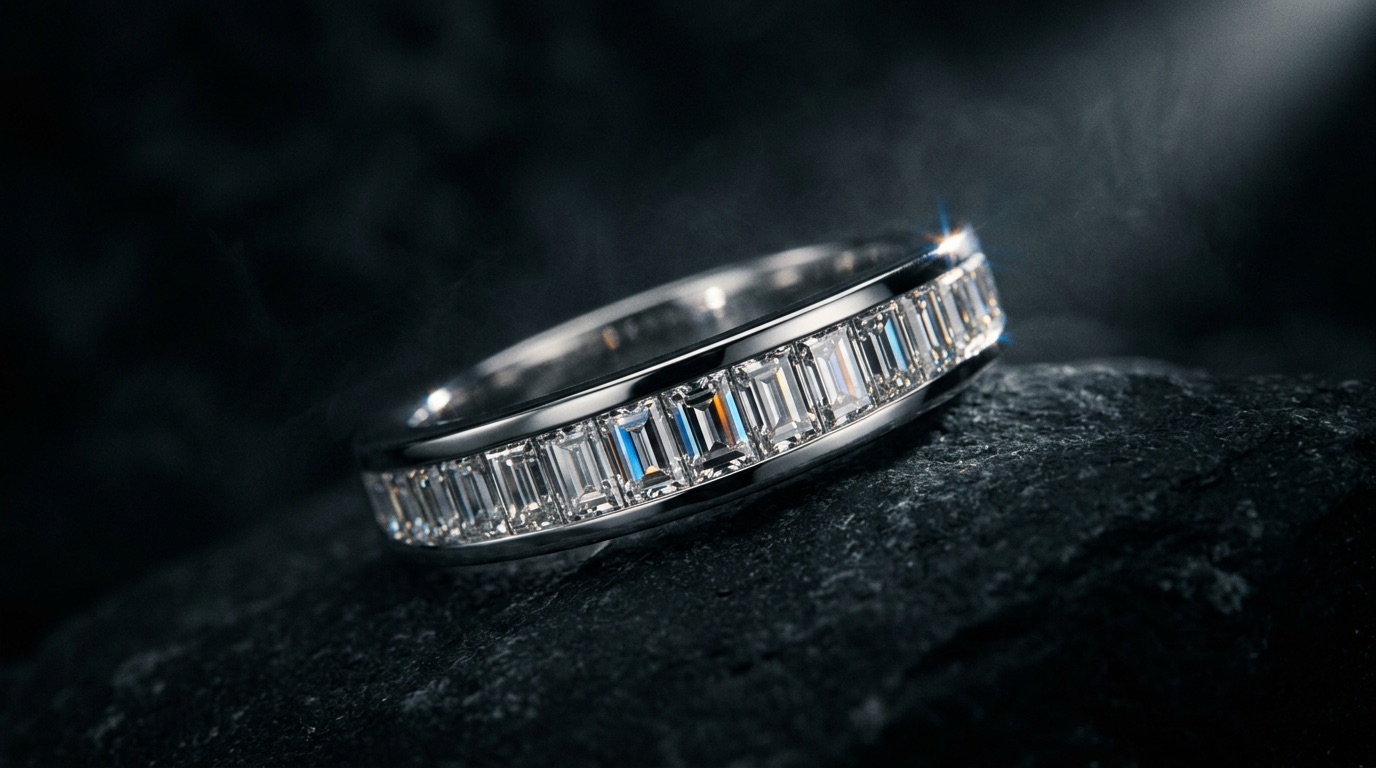
Outside three-stone work, bullets show up in two other settings with real regularity: graduated channel bands, where a run of six to sixteen stones narrows symmetrically from the center of the band toward each shoulder, and asymmetric or toi-et-moi-style rings, where a single bullet is set alongside a differently-shaped center stone for a directional, non-mirrored look. The mirrored-pair format is by far the more common order — the asymmetric single-stone use is a smaller share of demand, mostly custom bench work.

How Guru Diam sources, cuts, and matches bullet pairs
Guru Diam calibrates and mirrors bullet pairs in-house: cutting, symmetry-matching, and pairing happen under one process rather than pulling two similar loose stones off different parcels and hoping they read as a pair. That matters more for bullets than for most calibrated shapes, because the eye catches asymmetry in a directional cut faster than it catches asymmetry in a symmetrical one — a half moon or round pair can be off by a fraction of a millimeter and still read as matched, but a bullet pair with mismatched taper angles is visible from across a showroom.
The stones are CVD lab-grown, cut to the requested millimeter dimensions and taper profile rather than pulled from a fixed size run — a jeweler specs the center stone's corner width and the desired total bullet length, and the pair is cut or selected to fit that spec rather than the jeweler adjusting a mounting to fit whatever bullet happens to be in stock. For channel-set graduated runs, the same in-house control extends across the whole set: every stone in a twelve-piece graduated run is checked against its neighbors for a consistent taper curve, not just checked individually against a size chart.
576 bullet diamonds are on hand at any given time across common center-stone pairings, ready to ship as matched pairs without a cutting wait. Sizes and tapers outside that on-hand range are made to order.
Grading and quality considerations
Grading a bullet side stone leans on different priorities than grading a solitaire center stone, because the stone's job is different — it's there to frame, not to carry the ring's brilliance on its own.
Mirror match is the first thing to check, and it's specific to directional cuts like bullets: confirm both stones in a pair taper at the identical angle and to the identical length, not just that they're the same carat weight. Two bullets can weigh the same and still mismatch visually if one has a steeper taper than the other. Ask for the pair's length-to-width ratio and taper angle in writing, not just carat weight, when ordering for a symmetrical three-stone setting.
Clarity matters more in a bullet than in a round brilliant of the same grade, for the same reason step-cut center stones need a clarity buffer: the open, mirror-flat facets don't hide inclusions the way a brilliant's broken-up faceting does. A bullet graded VS2 can show more visible inclusion than a round brilliant graded the same, simply because there's less faceting to disguise it. Guru Diam's calibrated side-stone baseline is DEF+/VS+ — near-colorless and eye-clean under the step-cut facet pattern — and that's the floor worth holding for bullets specifically, even when a lower grade might pass in a brilliant-cut melee stone.
Color should match or complement the center stone. A near-colorless (D–F) center stone paired with a warmer G–H bullet will show the color difference at the corner where the two stones meet, because step-cut facets make body color more visible than brilliant facets do. For fancy color work, bullets can be cut in Guru Diam's fancy color range — Yellow, Pink, Blue, or Green — to match a fancy-color center stone; that palette is deliberately narrow and doesn't extend to Champagne or Cognac tones.
Finally, check the flat end for a clean, square cut. That edge butts directly against the corner of the center stone, so any rounding or angle drift at the flat end shows as a visible gap once the stone is set — a detail that's easy to miss on a loupe check but obvious once the ring is assembled.
What drives bullet diamond pricing
Bullet pricing runs on a different curve than round melee, for a few concrete reasons:
Cutting yield. An elongated, tapered outline wastes more rough per carat than a round brilliant does — the corners of the rough that would otherwise become the shoulders of a round stone get cut away to create the taper. That yield loss shows up directly in per-carat cost, especially at larger bullet sizes.
Mirror-match labor. A true matched pair — identical taper angle, identical length, identical face-up appearance — costs more than two bullets of the same nominal size pulled independently from stock. The premium reflects the selection or cutting labor of getting two stones to read as one continuous shape.
Graduated-set complexity. A channel-set run needs every stone in the sequence to be a distinct size, tapering smoothly from the center of the band to the ends. Pricing a graduated set is closer to pricing a dozen individually-specced small stones than to pricing a dozen identical melee pieces — each size step in the run is effectively its own micro-order.
Size and carat weight. Larger bullets, typically paired with larger baguette or emerald-cut centers, command a higher per-carat rate than the small bullets used in melee-scale channel work, consistent with how carat pricing scales on any calibrated shape.
Clarity and color tier. A DEF+/VS+ pair prices above a lower commercial grade, and fancy color bullets (Yellow, Pink, Blue, Green) price on a separate scale from white stones, same as fancy color melee generally.
Order volume. Wholesale pricing improves with quantity — a jeweler ordering pairs across multiple ring sizes for a collection gets a better per-stone rate than a one-off single-pair order. Open a wholesale account for current per-carat and per-pair pricing; because bullets are a specialty made-to-order shape at most sizes, pricing is quoted against the specific spec rather than published as a flat rate card.
Styling guidance: three-stone rings and tapered side stones
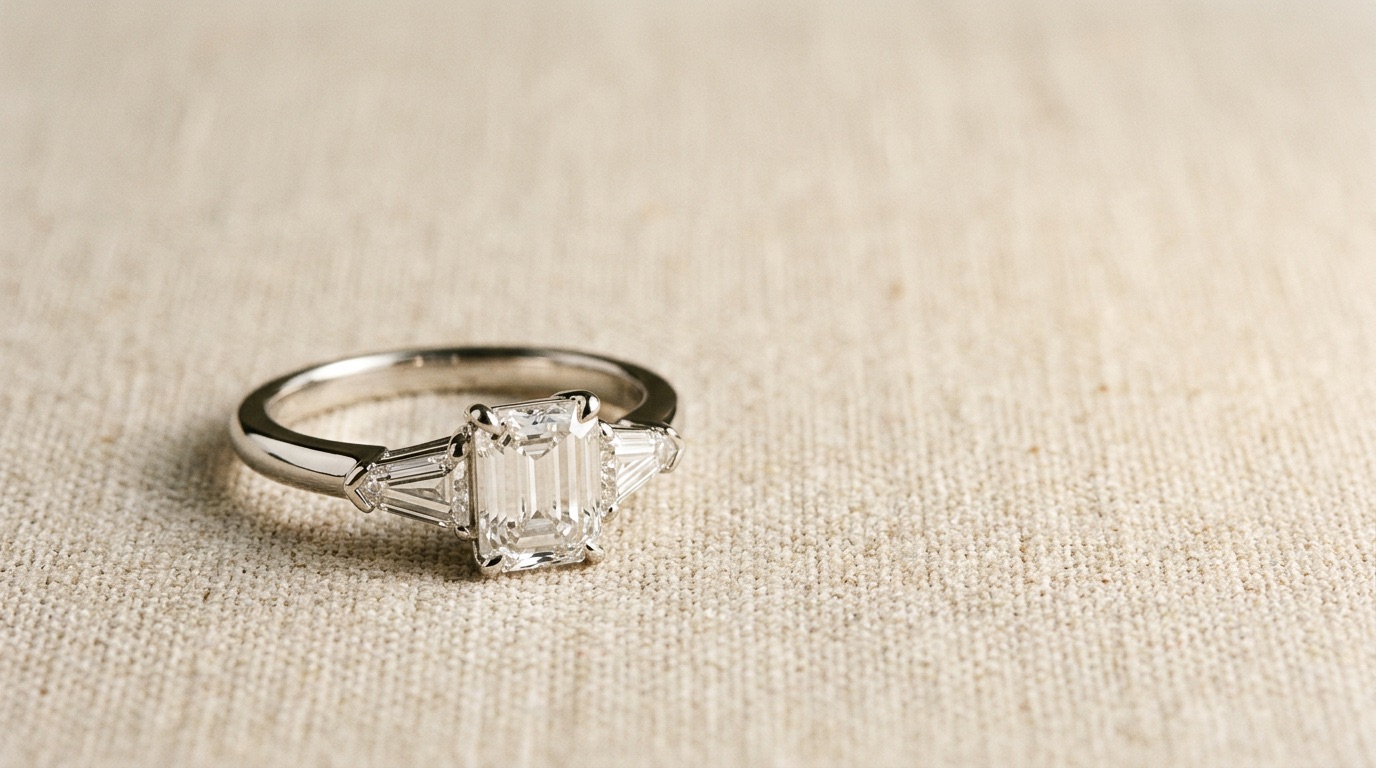
Three-stone anatomy. The standard bullet placement puts the flat end of each stone flush against a corner of the center stone — typically a baguette or emerald cut, since both have squared corners a bullet's flat end can sit against cleanly — with the tapered tip pointing out toward the ring's shoulder. That layout produces the elongating optical effect the shape is known for: the eye follows an unbroken line from tip to tip across the whole ring, rather than stopping at the edge of the center stone.
Pairing with different center shapes. Baguette and emerald-cut centers are the most natural pairing because their squared corners match the bullet's flat end exactly. Radiant and Asscher cuts, which also have cut or squared corners, work as well. Round, oval, and cushion centers are a harder pairing for bullets specifically — a curved girdle doesn't give the flat end a flush corner to sit against — which is where half moons or trapezoids, both designed to work against a curved edge, are the better-suited shape instead.
Channel-set graduated bands. In a band application, the flat-end-against-corner logic doesn't apply — instead, bullets are set in a straight run, largest in the middle of the band and tapering down toward each shoulder, flat ends butted against each other stone-to-stone. The tapered profile gives a graduated band a more dramatic, sculpted silhouette than a run of same-size baguettes or rounds would, at the cost of needing every stone in the run individually specced rather than pulled from one uniform size.
Setting style. Bullets are almost always prong-set or bezel-set at the flat end and tip in three-stone work, and channel-set (no visible metal between stones) in band applications. Because the stone is directional, the setting has to hold the taper orientation precisely — a bullet set backward, tip toward the center stone instead of away from it, reads as an obvious mistake to anyone familiar with the cut.
Bullet vs. Trapezoid vs. Baguette vs. Half Moon
Bullets sit in a family of calibrated side-stone shapes that all do the same basic job — flank and frame a center stone — but fit different center shapes and design intents. Here's how the four most common trade shapes compare:
| Spec | Bullet | Half Moon | Trapezoid | Baguette |
|---|---|---|---|---|
| Outline | Flat end + rounded/pointed tip | Crescent, one flat edge + curved edge | Four-sided, two parallel edges of different lengths | Rectangular, two parallel long edges, no taper |
| Symmetry | Mirrored pair (left/right) | Mirrored pair (left/right) | Straight or mirrored, often graduated | Straight or graduated, no inherent left/right orientation |
| Best paired with | Baguette, emerald cut (squared corners) | Round, oval, cushion (curved girdle) | Any center shape — most versatile all-purpose side stone | Emerald cut, radiant, straight-sided centers |
| Setting style | Three-stone, Art Deco, channel | Three-stone, Art Deco, cocktail | Three-stone, channel, eternity | Channel, eternity, halo |
| Facet style | Step-cut | Step-cut or brilliant-faceted | Step-cut | Step-cut (defining feature of the shape) |
Against trapezoid specifically: a trapezoid's two non-parallel sides both taper, giving it a more universal fit — it can flank almost any center shape, curved or squared, which is why it's the more common all-purpose side stone in trade inventory. A bullet's single-direction taper is more restrictive but more distinctive; it's a stronger design statement with a narrower use case.
Against baguette specifically: a baguette has no taper at all — both long edges run parallel — so it reads as a clean rectangular block rather than a directional shape. Baguettes are the default choice for channel and eternity work where uniform, repeatable sizing matters more than a graduated silhouette. Bullets and tapered baguettes (a baguette cut with a slight, even taper along its length rather than the sharp point of a bullet) are sometimes confused in casual conversation, but a tapered baguette keeps both long edges relatively straight with only a gentle width change, while a bullet's tip closes to a genuine point or rounded end.
How to order bullet diamonds wholesale
Open a wholesale account for live pricing and to place an order — pricing on a specialty shape like this is quoted against the specific spec rather than published as a flat rate, so an account gives access to current per-carat and per-pair numbers.
To spec a bullet order, a jeweler typically needs to provide: the center stone's shape and corner width (for three-stone work) or the total channel length and stone count (for graduated bands), the desired clarity and color tier, and whether the pair needs to be IGI-gradable. Matched pairs pulled from the 576-stone on-hand inventory ship without a cutting wait; sizes, tapers, or fancy colors outside that on-hand range are made to order or available on request, cut to the submitted spec.
For jewelers who want the pair set rather than shipped loose, Guru Diam's custom bench can turn a three-stone ring — center stone plus matched bullet pair — into finished jewelry in 4–6 days, unbranded by default so it resells as the jeweler's own piece. That timeline applies to the finished ring, not to loose bullet stones shipped on their own, which move on the made-to-order or in-stock basis described above.
Common mistakes to avoid when sourcing bullet side stones
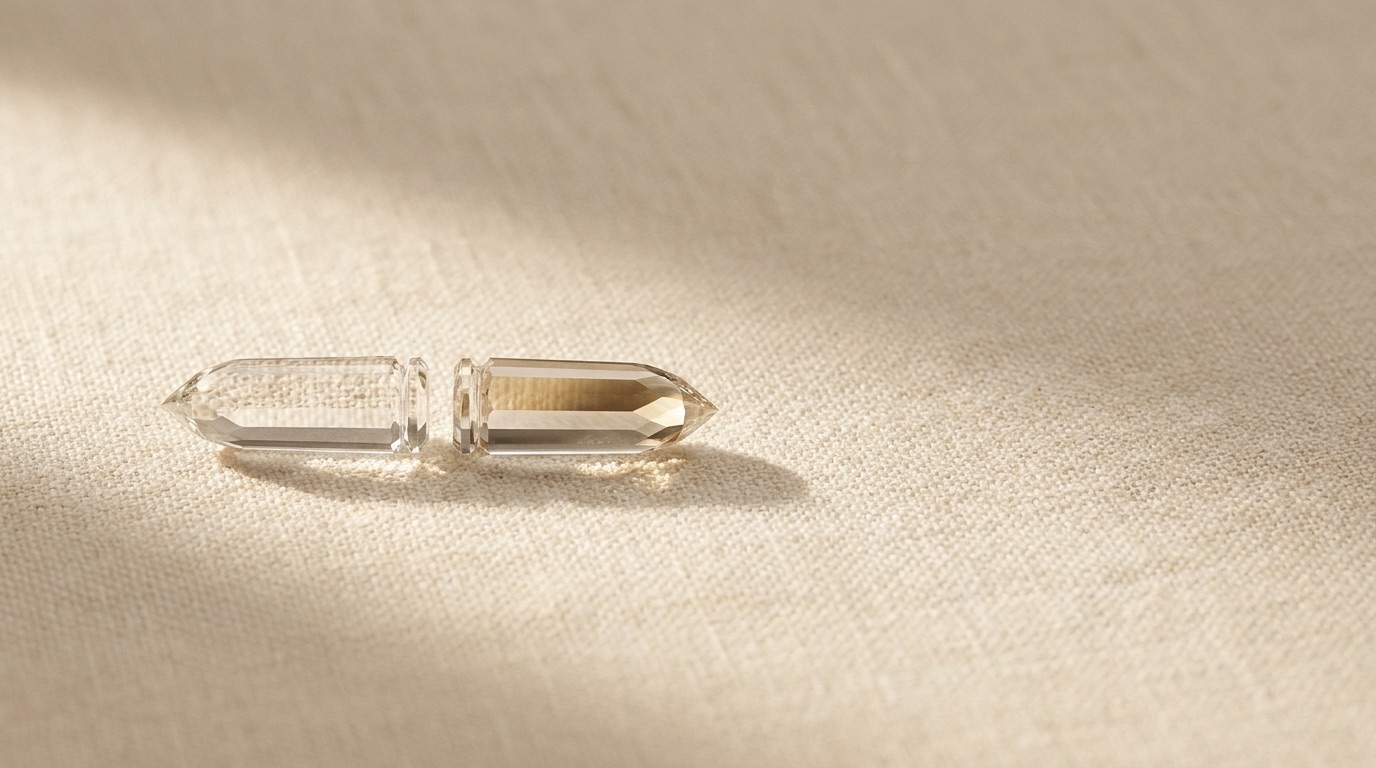
Two things matter more with bullets than with most side stones: the mirror match and the flat-end alignment. Confirm the pair tapers identically in both length and angle — even a small mismatch reads immediately once the stones sit on either side of a center stone — and check that the flat end is cut cleanly square, since that edge is what butts against the center stone's corner. For channel-set runs, ask for the full graduated sequence rather than a handful of same-size pieces pulled from mixed lots.
Beyond those two checks, a few sourcing mistakes come up often enough in trade practice to call out directly:
Ordering by carat weight alone. Two bullets can match on weight and still mismatch on taper angle or length-to-width ratio — always confirm dimensions and taper, not just weight, for a pair going into a symmetrical setting.
Mixing facet styles. A step-cut bullet next to a brilliant-faceted half moon or trapezoid in the same ring reads as visibly inconsistent — confirm facet style matches across every stone in a multi-stone setting, not just the outline.
Treating a graduated channel run as a bulk order of one size. A twelve-stone graduated band needs twelve distinct sizes in sequence, not twelve stones of the same nominal size — ask specifically for the full graduated set, not a same-size batch.
Skipping the clarity conversation. Because step facets show inclusions more readily, a clarity grade that would pass fine in a round brilliant melee stone can show visibly in a bullet — confirm the clarity tier explicitly rather than assuming a standard commercial grade will look clean.
Forgetting orientation at the setting bench. A bullet set backward — tip pointing in instead of out — is a mistake that's easy to catch at the bench if flagged in advance, and much harder to fix after the ring is assembled.
Why trade buyers source bullet pairs from Guru Diam
Guru Diam cuts, mirror-matches, and grades bullet pairs in-house, rather than assembling pairs from separately-sourced loose stock — for a directional shape where mismatch is the single biggest quality risk, that in-house control is the difference between a pair that reads as one continuous line and two similar stones that don't quite agree.
IGI, GIA, and GCAL grading are all available, giving jewelers flexibility on which lab a client expects for the center stone the bullets are flanking. Bullet pairs sit alongside the rest of Guru Diam's calibrated side-stone and fancy color melee inventory, antique cuts, and custom engagement ring bench under one account — a jeweler sourcing a three-stone Art Deco-style ring can place one order covering the center stone, the matched bullet pair, and the finished setting, shipped from one supplier instead of three. With NYC and LA offices and 2,000+ active customer accounts, Guru Diam supports both coasts from the same wholesale relationship. Custom rings ship unbranded by default, so the finished piece resells as the jeweler's own.
FAQ
What is a bullet shape diamond used for? Bullet shape diamonds are calibrated side stones used in mirrored pairs to flank a center stone — most often a baguette or emerald cut — in three-stone rings and Art Deco-style settings. They're also used in graduated channel-set bands.
How is a bullet different from a half moon, trapezoid, or baguette? A bullet has one flat end and one rounded or pointed tip, giving it a directional taper. A half moon is a symmetrical crescent, a trapezoid has two parallel edges of different lengths with no curved or pointed end, and a baguette is a rectangle with no taper at all. All four are calibrated side stones, but each fits a different center-stone shape and setting style.
How are bullet diamonds matched for a ring? Bullets are sold and set in mirrored pairs, cut or selected so both stones taper identically and sit symmetrically on either side of the center stone. Suppliers with in-house cutting can mirror pairs to spec rather than approximating from loose stock.
Are bullet shape diamonds certified? They're sold as calibrated pair goods, IGI-gradable on request, the same convention used for other side-stone shapes. The center stone they flank is typically certified separately.
What's the difference between a bullet and a tapered baguette? A bullet tapers to a genuine point or rounded tip at one end while the other end stays flat and square. A tapered baguette keeps both long edges relatively straight, narrowing only slightly along its length — a subtler taper without the bullet's sharp closing point. The two shapes are sometimes confused in casual trade conversation but read differently once set.
Can Guru Diam set a bullet pair into a finished ring? Yes — Guru Diam's custom bench can set a matched bullet pair alongside a center stone into a finished three-stone ring, unbranded by default, in 4–6 days. Loose bullet pairs shipped on their own move on the in-stock or made-to-order timeline instead.