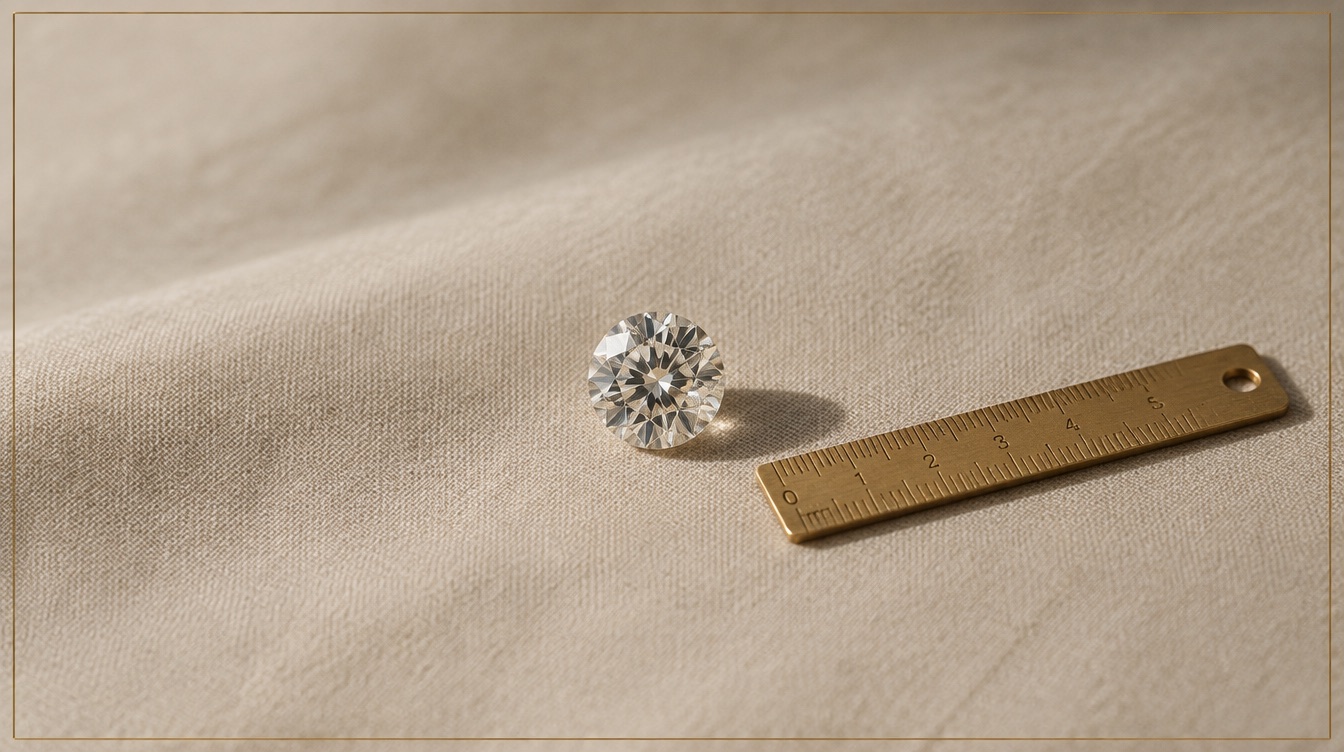
A bullet cut diamond is a step-cut side stone shaped like its name suggests: a rectangular or square body with one end tapering to a rounded, bullet-like point, while the opposite end stays flat and straight. It's a specialty calibrated shape used almost exclusively as an accent or side stone rather than a center stone, most often set in pairs flanking a larger center diamond in a three-stone ring.
Bullet cuts sit in a small, specific niche of the diamond trade — well known to jewelers who work with three-stone and custom antique-style designs, but rarely encountered by end buyers outside that context, and often confused with the more common trapezoid and baguette side-stone shapes. Because the shape shows up mostly in made-to-order work rather than mass-market finished jewelry, many buyers only learn the term when a jeweler proposes it for a specific custom three-stone commission. This guide covers what actually defines a bullet cut, its facet structure and anatomy, how it compares to trapezoid, baguette, and half-moon side stones, where it's typically used in jewelry design, sizing and calibration considerations, quality factors that matter most for this shape, sourcing it as matched pairs, and what to check before ordering.
What Defines a Bullet Cut Diamond
The defining feature of a bullet cut is its asymmetric outline: one short end is cut flat and straight, running perpendicular to the stone's long axis, while the opposite end curves into a smooth, rounded point — visually similar to the tip of a bullet cartridge, which is where the trade name comes from. The two long sides run essentially straight and parallel to each other along the stone's body, tapering only at the rounded end. This makes a bullet cut immediately distinguishable in outline from other common side-stone shapes, even though all of them serve a similar structural role in jewelry design.
Bullet cuts are cut as step cuts (like baguettes, trapezoids, and emerald cuts) rather than brilliant cuts, meaning their facets run in long, parallel rows rather than the triangular and kite-shaped facet pattern of a brilliant-cut stone. This gives bullet cuts the same broad, geometric "hall of mirrors" light pattern typical of other step-cut shapes, rather than the fine, busy sparkle of a brilliant-cut side stone.
Anatomy of a Bullet Cut Diamond
| Feature | Description |
|---|---|
| Flat (straight) end | The short end of the stone cut straight across, typically the end set closest to the center stone or the ring's shoulder |
| Rounded (bullet) end | The opposite short end, curved into a smooth, rounded point rather than a sharp angle — the feature that gives the shape its name |
| Parallel long sides | The two longer edges of the stone, which run straight and roughly parallel along the body before curving into the rounded end |
| Step facets | Long, rectangular facets arranged in parallel rows around the stone's crown and pavilion, the same construction principle used in baguette and emerald cuts |
| Table | The flat top facet, elongated to match the stone's overall outline |
Bullet Cut vs. Other Side-Stone Shapes
| Shape | Outline | Typical Use | How It Differs from Bullet |
|---|---|---|---|
| Bullet cut | Rectangular body, one end rounded to a point, one end flat | Side stones flanking a center stone, especially in three-stone rings | — |
| Trapezoid | Four straight sides, two parallel sides of different lengths, no rounded end | Side stones, especially flanking emerald and Asscher center stones | Fully angular outline, no curved point at either end |
| Baguette | Straight rectangle, all four corners squared or slightly beveled | Side stones, eternity bands, channel-set accent rows | No taper and no rounded end — a simple straight rectangle throughout |
| Half-moon | Flat straight edge on one side, rounded semicircular curve on the other | Side stones, especially flanking round or cushion center stones | Rounded on one full side rather than just one end; the flat edge runs the stone's full length, not just a short end |
| Tapered baguette | Straight rectangle that narrows gradually from one end to the other, both ends flat | Side stones following a ring's shoulder taper | Tapers in width but keeps both ends flat and straight — no rounded point |
The rounded point at one end is what most reliably separates a bullet cut from its closest relatives. Buyers and even some jewelers occasionally use "bullet cut" loosely to describe any elongated rectangular side stone, but the true bullet cut specifically has that single curved terminus — a design detail that matters when sourcing exact calibrated pairs for a specific setting.
Where Bullet Cuts Are Typically Used
- Three-stone rings. The most common application by far — a pair of bullet cuts flanks a center stone with their rounded ends pointing outward (away from center) and flat ends set against the center stone's shoulders, creating a clean, directional taper on either side.
- Vintage and Art Deco-style designs. The step-cut construction and geometric silhouette pair naturally with period-inspired designs that favor architectural, linear side-stone shapes over rounder brilliant-cut accents.
- Custom engagement ring commissions. Because bullet cuts are a specialty calibrated shape rather than a stock inventory item at most suppliers, they show up disproportionately in custom and made-to-order work rather than mass-market finished jewelry.
- Men's jewelry and signet-style pieces. The clean, geometric outline occasionally appears in men's rings and cufflinks, where a bolder, more architectural accent stone shape suits the overall design language better than a rounder brilliant-cut accent.
Sizing and Calibration
Because bullet cuts almost always function as matched side stones rather than standalone center stones, calibration — cutting a pair (or set) to identical dimensions — matters more for this shape than it does for many center-stone shapes bought individually. A mismatched pair, even by a fraction of a millimeter in length or width, reads as visually uneven once mounted flanking a center stone, since the two side stones sit close enough together for a viewer's eye to compare them directly.
- Length-to-width ratio. Bullet cuts are typically ordered to a specific length and width to match a particular setting's dimensions, rather than to a standard ratio the way round brilliants are — a jeweler or designer usually specifies exact millimeter dimensions needed for the piece in progress.
- Matched pair tolerance. A well-matched bullet cut pair should be effectively identical in length, width, depth, color, and clarity — any visible mismatch defeats the purpose of a symmetric three-stone design.
- Carat weight consistency. Because bullet cuts are calibrated to fit specific millimeter dimensions rather than sold by round carat targets, carat weight on a matched pair should track closely between the two stones even if it isn't the primary spec driving the order.
Quality Factors That Matter Most for Bullet Cuts
- Symmetry of the rounded end. Because the curved terminus is the shape's defining visual feature, an uneven, lopsided, or poorly polished curve is more noticeable on a bullet cut than a minor symmetry issue would be on a shape with no single standout feature to judge it against.
- Clarity, evaluated practically. As with other step-cut shapes, a bullet cut's broad, open facets can make inclusions more visible than they would be in a brilliant-cut stone of the same clarity grade, since step-cut facets don't break up light (and the viewer's line of sight) the way brilliant facets do. VS2 or better is a reasonable practical baseline for buyers who want a clean look without paying for a top clarity grade the shape doesn't strictly require.
- Color match across a pair. Because bullet cuts are almost always seen as a matched set flanking a center stone, color consistency between the two side stones matters more than the specific grade in isolation — a visible color difference between two side stones next to each other is more noticeable than either stone's individual grade number would suggest.
- Polish on the long step facets. Step-cut facets show polish flaws more readily than brilliant facets, for the same optical reason clarity inclusions show more readily — clean, well-polished long facets matter for the stone's overall presentation.
CVD Lab-Grown vs. Natural Bullet Cuts
Because bullet cuts are a specialty calibrated shape produced to order more often than pulled from generic stock, both CVD lab-grown and natural material can be cut to the shape without any difference in the cutting process itself — the shape's geometry doesn't depend on the stone's origin. The main practical difference for buyers is availability and lead time: because demand for this specific shape is lower-volume and more custom-order-driven than for round brilliants or even baguettes, sourcing an exact matched pair, in either origin, often requires a made-to-order cutting run rather than pulling from broad open stock, which is worth planning into a project's timeline.
Common Mistakes When Sourcing Bullet Cut Side Stones
- Assuming any elongated rounded-end stone is a bullet cut. Half-moon shapes are also rounded, but along a full side rather than just one end — confirming the exact outline with a supplier before ordering avoids a shape mismatch once stones arrive.
- Ordering stones individually instead of as a specified matched pair. Because visual symmetry across the pair matters more than either stone's individual spec, requesting the pair be cut, graded, and shipped together as a matched set produces a more consistent result than sourcing two similar stones separately and hoping they align.
- Underestimating lead time for a specialty calibrated shape. Because bullet cuts are less commonly held in broad open stock than baguettes or trapezoids, building in extra time for a made-to-order cutting run — rather than assuming same-day availability the way a buyer might for a common shape — avoids project delays.
- Not specifying exact millimeter dimensions. Because bullet cuts calibrate to a setting's specific measurements rather than a standard ratio, providing exact length and width targets up front (rather than a general carat weight target) gets a more usable result for the actual piece being built.
Designing a Three-Stone Ring Around Bullet Cut Side Stones
A three-stone ring built around bullet cut side stones typically follows one of two orientations: rounded ends pointing outward, away from the center stone, which creates a softer, more tapered visual flow toward the shoulders; or rounded ends pointing inward, toward the center stone, a less common but visually striking alternative that frames the center stone with a curved edge on each side. The choice affects how the eye reads the ring's overall silhouette and is worth deciding early in the design process, since it changes the prong or channel orientation needed to set the stones securely. Center stone shape also matters: bullet cuts pair especially well with emerald, Asscher, and other step-cut center stones, since the shared step-facet construction creates visual consistency across the whole piece, though they're also used successfully alongside round, oval, and cushion center stones in more mixed-shape designs.
Setting Considerations and Durability
The rounded point of a bullet cut is its most structurally delicate feature, and setting choices should account for it the same way a jeweler accounts for the vulnerable tip of a pear or marquise center stone:
- Prong placement at the point. A well-designed setting places a prong or a protective bit of metal at or near the rounded tip, since that curved point — like any narrowing tip on a fancy-shape stone — is more exposed to chipping from an impact than the broader flat end or the straight long sides.
- Channel and bezel options. Channel-setting a bullet cut, where the stone sits recessed between two metal walls, offers strong protection for the vulnerable point at the cost of some light entry from the sides — a reasonable tradeoff for buyers prioritizing durability, particularly in pieces meant for daily wear.
- Consistent height with the center stone. Because bullet cuts typically flank a taller center stone, setting them at a slightly lower table height than the center stone (rather than perfectly level) is common practice and helps visually frame the center stone rather than compete with it for height.
- Metal choice. As with any prong-set fancy shape, platinum or 18k gold at an adequate gauge around the tip gives the most secure long-term hold; a very thin or minimal prong at the rounded point is more prone to wear and loosening over years than a properly proportioned one.
A Brief History of the Bullet Cut
Step-cut side stones with directional, tapering silhouettes — trapezoids, half-moons, and bullet cuts among them — became especially popular during the Art Deco period of the 1920s and 1930s, when jewelry design leaned heavily on clean geometric shapes and strong linear composition. The bullet cut's specific combination of a flat end and a rounded point made it a practical solution for designers who wanted a directional taper — guiding the eye outward from a center stone toward the shoulder of a ring — without the fully angular look of a trapezoid. The name itself is a straightforward trade description rather than a historical or technical term: cutters and jewelers simply described the shape by what it visually resembled, the same naming logic behind shapes like kite, shield, and half-moon. The shape has remained a steady, if niche, presence in three-stone and vintage-revival design ever since, without ever becoming a mainstream center-stone shape the way round, oval, or cushion did.
Pricing Considerations for Bullet Cut Side Stones
Because bullet cuts are a lower-volume specialty shape produced more often to custom order than pulled from broad standing inventory, per-carat pricing for a matched pair can run somewhat higher than for a comparable-quality pair of baguettes or trapezoids of similar total weight — the premium reflects the more specialized cutting run and tighter matching tolerance the shape typically requires, not a difference in the underlying diamond material itself. Buyers planning a three-stone commission around bullet cut side stones benefit from requesting a quote on the exact matched pair needed for their specific setting early in the design process, rather than assuming pricing will track a generic baguette or trapezoid benchmark. Total spend on the side-stone pair is also almost always a smaller share of a three-stone ring's overall cost than the center stone, so the premium for a well-matched specialty pair is rarely the deciding factor in a project's budget even when it runs somewhat higher per carat than a common shape.
Sourcing Bullet Cut Diamonds and Matched Pairs at Wholesale
Because bullet cuts function almost entirely as calibrated matched side stones rather than standalone center stones, sourcing them well depends on a supplier's ability to cut and match sets precisely to a project's exact dimensions rather than pulling from generic open stock. Guru Diam carries all standard, antique, and exotic diamond shapes — including specialty calibrated cuts like bullet, trapezoid, and half-moon — across both natural and CVD lab-grown material, with IGI, GIA, and GCAL certification available depending on stone size and category. Matched bullet cut pairs for three-stone and custom designs can be sourced through matching pairs, with center stones available through the certified diamonds category. For jewelers building a full custom three-stone piece around a specific bullet cut pairing, the custom jewelry program handles cutting, setting, and polishing all in-house, with finished pieces delivered in 4-6 days. Fancy color bullet cuts, where available, can be sourced through fancy color loose diamonds. Trade accounts can review terms at the wholesale hub or apply through trade partner.
Frequently Asked Questions
What is a bullet cut diamond?
A bullet cut diamond is a step-cut side stone with a rectangular body, one flat straight end, and one end rounded into a smooth point resembling a bullet's tip. It's used almost exclusively as a matched accent stone, most commonly flanking a center stone in a three-stone ring.
How is a bullet cut different from a half-moon shape?
A half-moon has a flat straight edge running one full side of the stone with a rounded semicircular curve on the opposite side. A bullet cut, by contrast, is rectangular with straight parallel long sides and only one short end rounded into a point — the curve is much smaller and localized to one end, not a full side.
Are bullet cut diamonds only available as natural stones?
No — bullet cuts can be produced from either natural or CVD lab-grown rough, since the shape's geometry is a cutting decision independent of the stone's origin. Availability for either origin often depends more on lead time for a made-to-order cutting run than on any difference in the cutting process itself.
Why do bullet cut side stones need to be matched pairs?
Because bullet cuts are almost always set in symmetric pairs flanking a center stone, any visible difference in length, width, color, or clarity between the two stones is noticeable to the eye, since they sit close together for direct comparison. Ordering them as a specified matched set rather than sourcing two similar stones separately produces a more visually consistent result.
What clarity grade is appropriate for a bullet cut side stone?
VS2 or better is a reasonable practical baseline, since step-cut facets (like those on a bullet cut) can make inclusions more visible than the same clarity grade would appear in a brilliant-cut stone. Buyers prioritizing a clean look without paying for a top clarity grade the shape doesn't strictly require often land in this range.
What center stone shapes pair well with bullet cut side stones?
Emerald and Asscher center stones pair especially well, since their shared step-cut construction creates visual consistency across the whole piece. Round, oval, and cushion center stones are also common pairings in more mixed-shape three-stone designs.
How long does it take to source a matched bullet cut pair?
Because bullet cuts are a lower-volume specialty shape, many suppliers cut them to order against a project's exact dimensions rather than holding broad standing stock, so lead times typically run longer than for common shapes like round or baguette. Confirming lead time with a supplier at the start of a custom three-stone project, rather than assuming same-day availability, avoids delays later in production. Building this into a project's overall timeline up front is generally easier than trying to compress it once other elements of the piece — the setting, the center stone, the band — are already finished and waiting on the side stones alone.