Black diamond wholesale sourcing covers three distinct supply categories that jewelers and manufacturers need to keep separate when buying and reselling: natural black diamonds (colored by dense graphite inclusions or, less commonly, natural radiation exposure), treated black diamonds (colorless or near-colorless natural or lab-grown stones processed to appear black), and CVD lab-grown black diamonds grown directly with the inclusion density needed to read as black. Each category has a different cost basis, different disclosure obligations, and different quality-control checkpoints, and conflating them in a purchase order is one of the more common sourcing mistakes retailers make in this category.
This guide covers how black diamond supply is actually structured in the wholesale trade — what to ask a supplier before buying, how pricing tiers work across the three categories, and the disclosure and documentation practices that keep a retailer's own resale claims accurate. It's written for jewelers, designers, and manufacturers evaluating black diamonds as a new or expanded category, rather than for a retail shopper comparing individual stones.
The Three Supply Categories, Defined for Buyers
Natural black diamonds get their color from an extremely dense concentration of dark mineral inclusions — most often graphite — distributed throughout the stone, occasionally combined with natural radiation exposure in specific deposits. Because the color comes from the stone's actual internal structure rather than a surface or induced treatment, natural black diamonds carry no treatment disclosure obligation tied to color specifically, though standard grading-lab practice still evaluates and documents their internal structure. Treated black diamonds start as a lower-grade natural or lab-grown stone with heavy natural inclusions or fracturing, then undergo a high-temperature treatment process (commonly HPHT treatment, or irradiation, depending on the starting material) that converts or darkens the stone to an opaque black appearance. CVD lab-grown black diamonds are grown directly in a lab environment with production conditions tuned to produce the graphite-like inclusion density associated with black color, without starting from a lower-grade stone that needs subsequent treatment.
Why This Distinction Matters for Wholesale Buyers Specifically
A retailer buying black diamond lots wholesale needs to know which of these three categories a given lot belongs to for reasons beyond simple product knowledge: cost basis differs meaningfully across categories, resale disclosure requirements differ (treated stones generally carry a disclosure obligation that natural and as-grown CVD stones don't), and customer-facing claims about origin have to match the actual product or create real liability. A supplier who can't clearly state which category a given parcel falls into, or who uses "natural" and "treated" loosely in casual conversation, is a signal to ask more specific questions before committing to an order.
How Black Diamond Pricing Tiers Generally Work
Treated black diamonds sit at the lowest price point of the three categories, since the starting material is typically lower-grade rough or lab-grown stock that would otherwise carry limited value on its own, and the treatment process itself is well-established and relatively low-cost at scale. CVD lab-grown black diamonds generally price above treated stones but below natural black diamonds, reflecting lab-grown production economics relative to natural rarity. Natural black diamonds command the highest price point of the three, since untreated natural material with the specific inclusion density needed for a genuine black appearance is comparatively uncommon relative to more typical natural diamond color ranges. Buyers should expect a noticeable price gap between categories rather than near-parity, and a quote that doesn't reflect that gap is worth double-checking against the actual category being offered.
Lot and Parcel Buying: What to Ask For
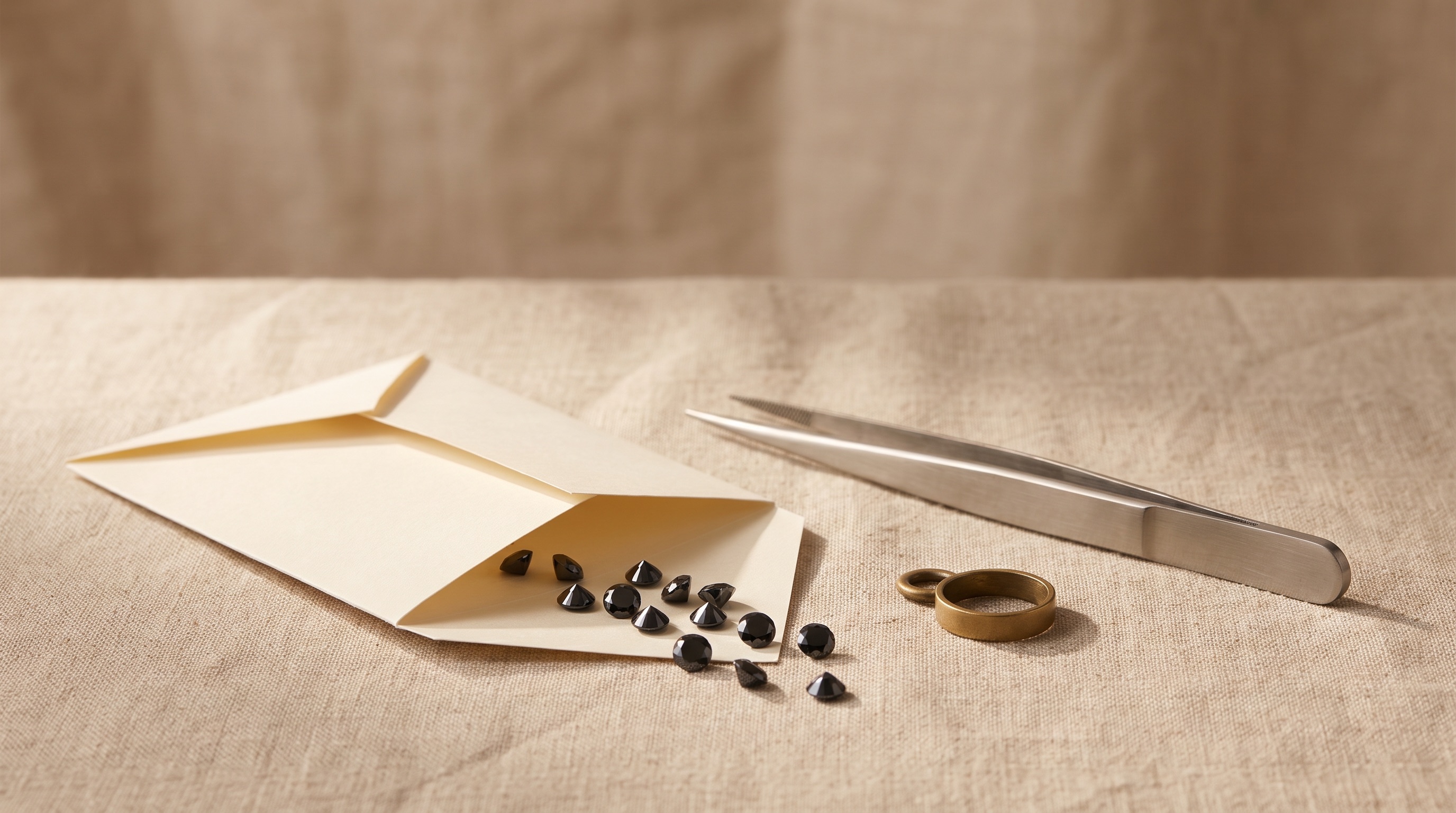
Black diamonds, like many calibrated and commodity-tier stones, are frequently sold in wholesale parcels rather than as individually selected pieces, particularly for melee and small calibrated sizes used in pave and accent work. A buyer evaluating a parcel offer should ask for the parcel's category (natural, treated, or CVD lab-grown), size range and tolerance, shape mix if it's not a single-shape parcel, and the quality baseline the supplier is grading against — since black diamonds, given their opacity, are typically evaluated more on cut consistency, surface polish, and size uniformity than on the clarity grading scale used for colorless stones, where internal inclusions are the primary basis for grade.
Quality Control Considerations Specific to Black Diamonds
Because black diamonds are opaque, standard clarity grading criteria built around the visibility of internal inclusions under magnification don't apply in the same way they do to colorless or lightly included stones — an inclusion that would meaningfully lower a colorless diamond's clarity grade is simply part of what makes a black diamond black in the first place. Quality control for black diamond lots instead centers on structural soundness (no visible fractures or chips that compromise durability), consistency of cut and finish across a parcel, and surface polish quality, since a poorly polished black diamond can look noticeably duller or less uniform than a well-finished one even though both are technically "black." Buyers sourcing parcels at volume benefit from requesting a small sample from a larger lot before committing to the full quantity, specifically to check finish consistency rather than color, since color is comparatively uniform across a genuine black diamond parcel by definition.
Comparing the Three Black Diamond Supply Categories
| Category | Color Origin | Relative Price Tier | Disclosure Consideration |
|---|---|---|---|
| Natural black diamond | Dense natural graphite inclusions (occasionally radiation exposure) | Highest | Natural origin generally disclosed as standard practice, not a treatment disclosure |
| Treated black diamond | Induced via HPHT treatment or irradiation of lower-grade starting material | Lowest | Treatment disclosure typically required at point of sale |
| CVD lab-grown black diamond | Grown directly with target inclusion density | Middle | Lab-grown origin disclosed; not a "treatment" in the same sense as HPHT-treated stones |
Shapes and Cuts Available in Black Diamond Supply
Black diamonds are cut across the same general range of shapes available in colorless supply — round, princess, cushion, and pear are among the more commonly available shapes across all three sourcing categories, with rose-cut black diamonds also common specifically because the flat-backed rose cut shows off the stone's opacity and surface pattern differently than a standard brilliant cut. Antique and fancy-shape black diamonds exist but are a smaller share of overall supply relative to round and standard fancy shapes, since black diamond demand skews more toward accent and statement-piece use than toward the antique-cut collector market that drives much of the fancy-shape natural and lab-grown white diamond trade.
Common Uses in Finished Jewelry
Black diamonds see the most use as accent and contrast stones — pave detailing against a white metal or white-diamond piece, a black diamond halo around a colorless center stone, or as the primary stone in men's jewelry and statement pieces where the opacity itself is the design draw rather than brilliance or fire. Because black diamonds don't perform the same optical role as colorless or fancy-color transparent diamonds (there's no light return through the stone to showcase), designers typically use them for graphic contrast and surface pattern rather than trying to maximize sparkle the way a colorless-diamond design would.
Durability Considerations Jewelers Should Know
Black diamonds carry the same hardness as any other diamond on the Mohs scale, but the dense internal inclusion structure that gives natural black diamonds their color can, in some stones, make them somewhat more prone to fracturing under a sharp direct impact than a comparably sized colorless stone with fewer inclusions — a distinction worth mentioning to a customer buying a black diamond for a piece intended for daily, hands-on wear. This isn't a reason to avoid the category, since well-cut black diamonds from a reputable supplier see normal daily wear without issue, but it's a fair, honest point to raise rather than presenting black diamonds as mechanically identical in every respect to colorless stones of the same carat weight.
How HPHT Treatment Actually Works on Black Diamonds
The most common treatment path for converting a lower-grade stone to black uses high-pressure, high-temperature (HPHT) processing to alter the internal structure of a heavily included natural or lab-grown diamond, driving existing inclusions and internal fractures toward a uniform, opaque black appearance rather than removing them. This differs mechanically from HPHT treatments used elsewhere in the trade to improve color in near-colorless stones, since the goal here is the opposite: intensifying rather than reducing visible internal structure. Irradiation is a less common alternative path, more often associated with certain colored-diamond treatments generally, though it can factor into black diamond production depending on the starting material and the specific supplier's process. Either way, a treated black diamond's black color is a direct, permanent result of the treatment process applied to real diamond material — it isn't a coating, dye, or surface-only effect, and it doesn't wear off or fade with normal use once treated.
Certification and Documentation for Black Diamond Lots
Because black diamonds are graded on a different basis than colorless clarity-focused grading, documentation conventions differ somewhat from a standard IGI or GIA colorless-diamond report. Larger individually notable black diamonds can still receive lab documentation confirming carat weight, measurements, and treatment status where applicable, but melee and small calibrated black diamond parcels are typically sold uncertified as parcel goods against an agreed quality baseline between buyer and supplier, similar to how standard colorless melee is handled. Buyers should ask specifically whether a given black diamond purchase — particularly a larger, notable stone intended for a statement piece — comes with any accompanying lab documentation, and should not assume parcel goods automatically include per-stone certification the way certified loose stones at 0.30 carats and above do in the colorless and fancy-color categories.
Matching Black Diamonds for Multi-Stone and Pave Work
Because black diamond color is inherently more uniform than colorless diamond color (there's no graduated color scale the way there is for colorless stones, from a buyer's perspective a black diamond either reads convincingly opaque or it doesn't), the harder matching challenge in multi-stone black diamond work is usually size and cut consistency rather than color matching. A pave or halo design using dozens of small black diamonds needs those stones cut to consistent proportions so the finished surface reads as uniform rather than showing visibly different-sized or differently faceted stones side by side. This is one of the more overlooked quality variables buyers should ask about specifically when sourcing melee-scale black diamond parcels for pave-heavy designs, since a parcel can be perfectly acceptable in overall color and structural soundness while still being poorly matched for a dense pave application.
Market Demand Patterns Worth Knowing
Black diamond demand in finished jewelry skews more heavily toward men's jewelry, statement rings, and contemporary/editorial bridal designs than toward traditional white-diamond bridal categories, and demand has historically been less consistently steady year-round than core colorless diamond categories, with more visible upticks tied to specific design trends than to recurring occasions like engagement season. Retailers stocking black diamond finished pieces or loose stones benefit from treating it as a complementary category to round out an assortment rather than a primary volume driver, and from working with a supplier who can flex order size up or down without requiring the large minimum commitments that make sense for steadier, higher-volume colorless categories.
Sourcing Black Diamonds From a Consolidated Supplier
Retailers and manufacturers sourcing black diamonds alongside colorless natural and CVD lab-grown inventory generally get a smoother buying experience working with one supplier across categories rather than managing separate vendor relationships for each color and origin type — one shipment, one invoice, and one point of contact for quality questions rather than reconciling paperwork and lead times across multiple suppliers for what ends up in the same finished piece.
Metal Pairing and Presentation Considerations
Because black diamonds provide contrast rather than brilliance, the metal a piece is set in has an outsized effect on how the finished design reads compared to a colorless-diamond piece. White metal (platinum or white gold) against black diamonds produces the highest-contrast, most graphic look, while yellow or rose gold produces a warmer, less stark pairing that some designers prefer for statement pieces meant to read as bold rather than purely graphic. Retailers displaying black diamond finished jewelry benefit from photographing and merchandising pieces against both warm and cool-toned backdrops to show the range of pairing options, since a single presentation style can undersell how differently the same stones read against different settings.
Inventory Planning for a Black Diamond Assortment
Retailers building out a black diamond assortment for the first time typically get better sell-through starting with a smaller, well-curated range across the three supply categories rather than committing heavily to one category upfront — a handful of natural pieces at a premium price point, a broader treated or CVD lab-grown assortment at more accessible price points, and a small melee/pave inventory for custom and repair work covers most customer requests without overcommitting capital to a category with less predictable, trend-driven demand than core colorless diamond lines. Reordering patterns from an initial curated assortment give a clearer signal on which category and price tier is actually moving with a retailer's specific customer base than guessing upfront based on general category trends alone. Tracking sell-through by category rather than by the assortment as a whole makes it easier to spot early which specific tier — natural, treated, or lab-grown — is resonating with a given customer base before committing further inventory dollars to it.
Questions to Ask a Black Diamond Supplier Before Ordering
Before committing to a black diamond order at any volume, a buyer should confirm: which of the three supply categories the lot falls into, whether treatment disclosure paperwork is included for treated stones, the size range and tolerance for a parcel purchase, whether a sample can be reviewed before the full order ships, and what the supplier's return or exchange policy looks like if a received lot doesn't match the agreed quality baseline. A supplier who answers all of these clearly and specifically, rather than in general reassurances, is generally a safer long-term sourcing relationship than one that treats the questions as unusual to ask. It's also reasonable to ask how long the supplier has actively carried black diamonds as a stocked category, since a vendor with an established, repeatable process across all three supply types tends to give more consistent answers than one treating each order as a one-off sourcing exercise.
Minimum Order Quantities and Reorder Cadence
Because black diamond demand is more trend-sensitive than core colorless categories, minimum order quantities in this category tend to run lower and more flexible than what the same supplier might set for standard round colorless melee, where consistent high-volume demand supports larger production runs. A supplier willing to fill smaller, more frequent black diamond orders as a retailer tests demand is generally a better long-term fit than one requiring the same large minimums across every category regardless of how predictably it sells. Retailers should ask directly about minimum order size and typical turnaround time for a reorder, since a supplier that can restock a specific parcel size and quality on short notice reduces the working capital a retailer needs to tie up in speculative black diamond inventory upfront.
Working With One Supplier Across the Full Color and Origin Range
Beyond black diamonds specifically, retailers increasingly ask a single supplier to cover the full range of what a modern diamond assortment requires: colorless natural and CVD lab-grown stones, fancy color natural and lab-grown melee, antique cut ranges, and complementary categories like black diamonds that round out a design-forward inventory. Consolidating this sourcing with one vendor reduces the administrative overhead of managing certification formats, invoicing, and quality baselines across multiple suppliers, and gives a retailer one point of contact to raise a quality question against rather than tracking which vendor a given parcel originally came from months after the fact.
Frequently Asked Questions
Are black diamonds natural or treated?
Both exist in the wholesale market as distinct categories, alongside a third category of CVD lab-grown black diamonds. Natural black diamonds get their color from dense natural graphite inclusions; treated black diamonds start as lower-grade natural or lab-grown material processed to appear black; and lab-grown black diamonds are grown directly with the target inclusion density.
Why are treated black diamonds cheaper than natural ones?
Treated black diamonds typically start from lower-grade rough or lab-grown material that would otherwise carry limited standalone value, and the treatment process is well-established at scale, keeping the overall cost basis lower than natural black diamonds, which require comparatively uncommon natural material.
How is clarity graded on black diamonds?
Standard clarity grading built around visible internal inclusions doesn't apply the same way to opaque black diamonds, since the inclusions are part of what creates the black color. Quality control instead focuses on structural soundness, cut consistency, and surface polish.
Do treated black diamonds require disclosure?
Yes, treated black diamonds typically carry a disclosure obligation at point of sale, since the color results from an induced treatment process rather than the stone's natural or as-grown state. Buyers should confirm a supplier provides this documentation with treated lots.
What shapes are black diamonds typically available in?
Round, princess, cushion, and pear are among the more commonly available shapes across all three black diamond sourcing categories, with rose-cut black diamonds also common because the flat back shows off the stone's opacity and surface pattern.
Are black diamonds more fragile than colorless diamonds?
Black diamonds share the same hardness as any diamond, but the dense inclusion structure in natural black diamonds can make some stones somewhat more prone to fracturing under a sharp direct impact than a comparably sized colorless stone with fewer inclusions.
What minimum order quantity should I expect for wholesale black diamonds?
Minimum order quantities for black diamonds tend to run lower and more flexible than for high-volume colorless categories, since demand is more trend-driven. Ask a supplier directly about minimum order size and reorder turnaround before committing to a first purchase.
Guru Diam is a trade-only wholesale supplier of certified natural and CVD lab-grown diamonds, with locations in New York and Los Angeles and same-day shipping on in-stock inventory. Trade accounts can review current certified inventory in certified diamonds, source calibrated parcels through matching pairs, or apply through trade partner. Current wholesale terms are available at the wholesale hub.