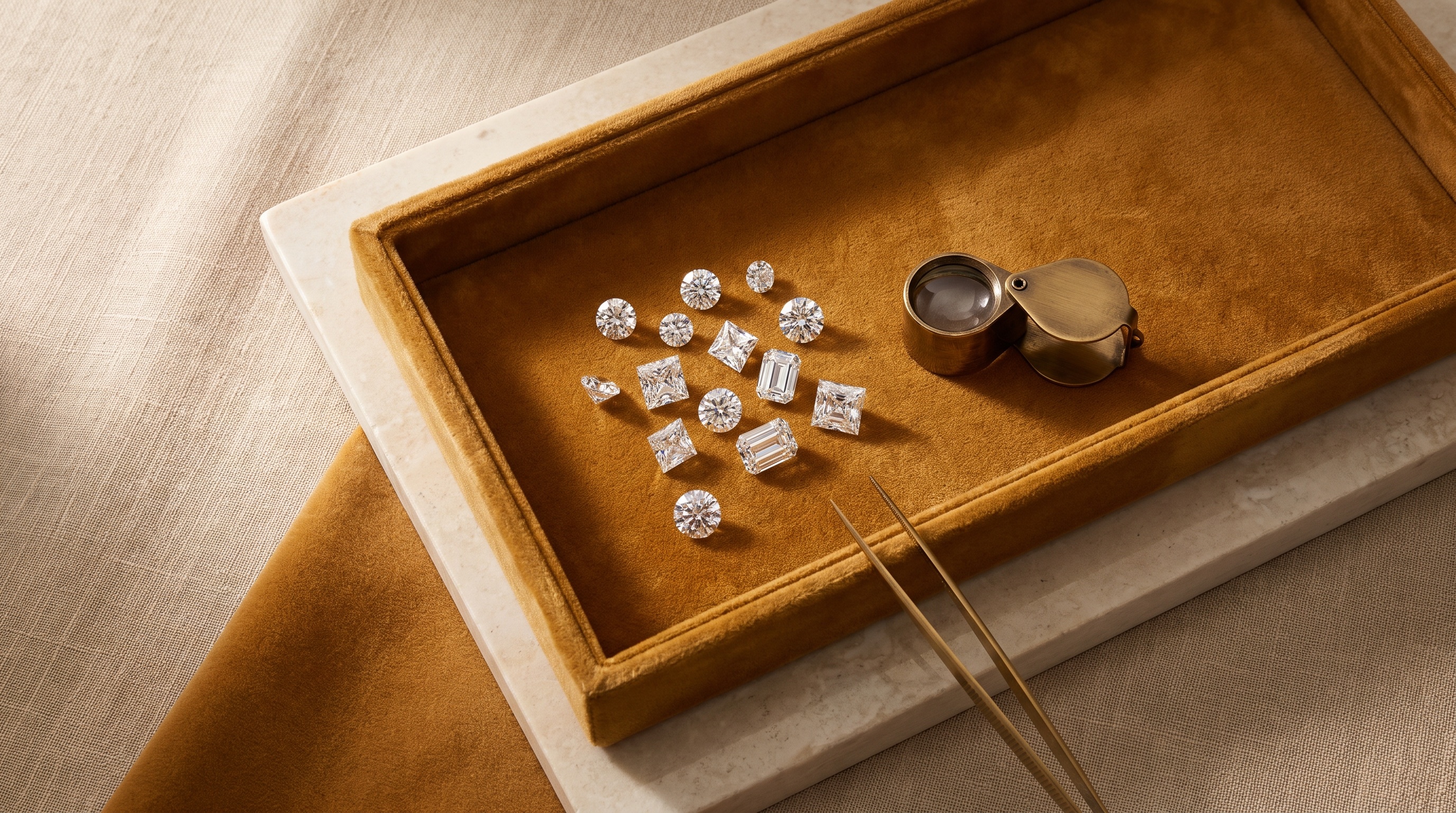
Melee and matched-pair diamond sourcing is a narrower specialty than general loose-diamond wholesale — it requires a supplier who maintains calibrated, gradable lots rather than mixed parcel stock, and who can reliably reproduce the same size and quality band on reorder. Not every wholesale diamond supplier treats melee as a dedicated category with that level of consistency, which makes supplier selection genuinely more consequential for a jeweler or manufacturer building a recurring melee-dependent product line — pavé bands, halo settings, tennis bracelets, cluster earrings — than it is for a one-off single-stone purchase.
This guide compares wholesale suppliers on melee and matched-pair sourcing depth specifically, along with the evaluation criteria that matter most once a supplier's basic catalog breadth is confirmed. The suppliers below are all active, real participants in the US wholesale lab-grown diamond trade; the comparison focuses on melee and matched-pair capability specifically rather than each company's full general catalog, since a supplier's overall size or reputation in the broader diamond trade doesn't always predict how strong its melee-specific calibration and reorder practices actually are.
Why Melee Sourcing Is a Distinct Specialty
Sourcing a single certified loose stone and sourcing melee for a production run are fundamentally different problems. A single stone purchase is a one-time evaluation of one object against a grading report. A melee order is a statistical consistency problem across dozens, hundreds, or thousands of stones that all need to read as visually uniform once mounted, at a price point that only works because the stones ship as graded parcel goods rather than individually certified pieces. Suppliers who excel at single-stone sourcing don't automatically carry the calibration infrastructure, lot-tracking discipline, or reorder consistency that dedicated melee and matched-pair sourcing requires — which is exactly the gap this comparison is built to surface.
Evaluation Criteria for Melee & Matched-Pair Suppliers
| Criterion | What to Look For |
|---|---|
| Calibration and lot consistency | Genuine calibrated stock sold by graded lot, not pulled ad hoc from mixed parcel inventory |
| Size range depth | Coverage across the full melee range (roughly 0.8mm–9.0mm) rather than a narrow band |
| Shape availability | Round brilliant plus fancy calibrated shapes (emerald, radiant, pear, marquise) on request |
| Natural and CVD availability | Both material types available with clear, disclosed growth method on every lot |
| Screening practices | Documented screening for undisclosed growth method mixed into a parcel |
| Reorder consistency | Demonstrated ability to reproduce the same size, color, and clarity band on a future order |
| Shipping speed | Same-day shipping on confirmed in-stock melee, with realistic lead times otherwise |
1. Guru Diam
Guru Diam is a trade-only, B2B wholesale diamond supplier with locations in New York and Los Angeles, carrying calibrated diamond melee across the standard 0.8mm–9.0mm range in round brilliant and fancy calibrated shapes, sold as consistent, gradable lots at DEF+/VS+ and tighter tiers rather than mixed parcel stock. The catalog spans both natural melee and CVD lab-grown melee (no HPHT anywhere in the lab-grown line), including fancy color melee in yellow, pink, blue, and green, plus matched-pair sourcing for symmetrical side-stone work. As with the rest of Guru Diam's lab-grown catalog, CVD stones are cut and polished at the company's India workshop before final grading and shipment from the New York and Los Angeles locations. In-stock melee ships same-day (before 6pm EST from New York, before 4pm PST from Los Angeles), and certification across the broader loose-stone catalog is available through IGI, GIA, and GCAL. Buyers can browse current stock at the matching pairs category or check fancy color melee at fancy color loose diamonds, and new trade accounts can apply through trade partner.
2. Stienhardt
Stienhardt is an established wholesale lab-grown diamond supplier with a New York trade presence, carrying melee stock as part of its broader catalog. Buyers with a specific calibration-tolerance requirement for a production run should confirm current lot-consistency practices directly, since melee depth and general loose-stone depth aren't always equally developed at the same supplier.
3. Kira Diamonds
Kira Diamonds serves jewelers and manufacturers in the US wholesale lab-grown trade, with melee available alongside its white diamond catalog. Buyers building a matched-pair or line-set piece should verify current size-tolerance and reorder-consistency practices before committing to a full production quantity.
4. Aarush Diamonds
Aarush Diamonds operates in the wholesale lab-grown diamond space with melee inventory available on request. As with any supplier being evaluated specifically for calibration depth, confirming whether melee is sold as dedicated graded lots versus general parcel stock is worth doing before a first order.
5. White House Brothers
White House Brothers is a recognized name in the wholesale lab-grown diamond trade offering melee as part of its broader catalog. Buyers should confirm growth-method disclosure and screening practices directly, since these vary meaningfully between suppliers even at the same nominal quality grade.
6. GemsNY
GemsNY is an established wholesale diamond and jewelry supplier with a New York trade presence, carrying melee alongside a broad general inventory. Buyers focused specifically on melee calibration depth should confirm current lot practices directly, since GemsNY's catalog spans many categories beyond melee.
7. Stuller
Stuller is one of the largest general jewelry-supply houses in the US trade, with melee available as part of a very broad catalog spanning findings, mountings, and loose stones. Buyers evaluating Stuller specifically for melee should compare calibration and lot-consistency practices against dedicated diamond wholesalers, since Stuller's core strength is catalog breadth across the wider jewelry-supply category — findings, castings, mountings, and general trade supplies alongside diamonds — rather than melee specialization specifically.
8. LGD USA
LGD USA is a US-based wholesale lab-grown diamond supplier with melee inventory available alongside white diamond stock. Confirming current depth and calibration practice for the specific size range a buyer needs remains the most reliable evaluation approach with any supplier on this list.
9. Classic Grown
Classic Grown supplies lab-grown diamonds to the wholesale trade, including melee stock. Buyers should confirm current reorder consistency directly, since a supplier's ability to reproduce an identical grade on a future order matters more for a recurring melee-dependent product line than for a one-time purchase.
Matched-Pair Sourcing: A Related but Distinct Skill
Matched-pair sourcing — finding two individually larger stones (commonly used in stud earrings or two-stone designs) that closely match on size, color, cut, and clarity — draws on some of the same supplier infrastructure as melee sourcing but isn't identical to it. Where melee sourcing is a statistical consistency problem across many small stones, matched-pair sourcing is a precision-matching problem across just two individually significant stones, often at 0.30ct and above where each stone can carry its own certification. A supplier strong in melee calibration doesn't automatically carry equally strong matched-pair capability, and buyers sourcing for stud earrings or a two-stone ring design should ask specifically about matched-pair inventory and matching tolerance rather than assuming it follows directly from general melee depth. A well-matched pair for stud earrings, for instance, should read as visually identical side by side under normal lighting even if the underlying grading reports show minor, acceptable variation between the two certificates.
Calibration Tolerance and Why It Matters
Calibration tolerance — how tightly a supplier holds stone size within a stated lot — has an outsized effect on finished-piece quality that's easy to underestimate before a first production run. A loosely calibrated lot can still meet the stated average size while including enough size variance that a setter has to hand-sort stones during mounting, adding labor cost and slowing production. A tightly calibrated lot costs more per carat but reduces setting-stage rejects and rework, which for a manufacturer running production at any real volume is usually the better economic trade even before accounting for the finished-piece quality difference a customer would actually notice at close range on a finished ring, bracelet, or pair of earrings.
Natural vs. Lab-Grown Melee: What Changes Across Suppliers
| Factor | Natural Melee | CVD Lab-Grown Melee |
|---|---|---|
| Per-carat cost | Higher, especially at tighter color/clarity bands | Meaningfully lower at the same nominal grade |
| Supply consistency | Subject to natural mining-output variability | More consistent once a supplier has established growth capacity |
| Certification approach | Lot-graded, same DEF+/VS+ convention | Lot-graded, same DEF+/VS+ convention |
| Growth-method disclosure | Origin disclosure standard practice | Growth-method disclosure standard practice |
Both material types are graded against the same lot-quality conventions, and the origin decision is primarily a program-economics and positioning choice for the retailer rather than a difference in how a finished piece looks once set.
Screening for Undisclosed Growth Method
Because melee ships without individual certification, screening for undisclosed lab-grown stones mixed into a natural parcel (or the reverse) is a meaningful quality-control step. Melee screening equipment, using shortwave UV response or spectroscopic methods, is standard at reputable wholesale melee operations, and a supplier who can describe their screening process clearly and confirms every lot is screened before it ships is a more trustworthy long-term partner than one who can't speak to how disclosure is verified internally.
Reorder Consistency: The Single Biggest Differentiator
For a retailer or manufacturer running a recurring melee-dependent product — a signature halo style, a house pavé band, a standing tennis bracelet line — the single most valuable supplier trait isn't headline price per carat, it's the ability to reproduce the exact same size, color, and clarity band reliably order after order. A supplier whose available stock varies significantly between orders forces a buyer to either accept visible inconsistency across production batches or spend extra time and cost re-sourcing a matching grade each time, both of which are avoidable with a supplier that treats melee as a genuinely managed category rather than opportunistic parcel stock.
Auditing a Melee Shipment on Arrival
A disciplined receiving process catches problems before they reach production, and it takes only a few extra minutes per shipment once it's built into standard workflow. On arrival, a buyer should confirm the parcel count and stated total carat weight against the invoice, spot-check a representative sample under a loupe or microscope against the stated size and quality grade rather than accepting the paperwork at face value, and confirm growth-method disclosure documentation is present and matches what was quoted. Any discrepancy — a size that reads noticeably outside stated tolerance, or a visual quality that doesn't match the stated grade — is far easier and less costly to resolve with a supplier before the lot enters production than after stones have already been set into finished pieces.
Kimberley Process and Conflict-Free Sourcing for Natural Melee
Natural melee, like any natural diamond entering the wholesale trade, moves through the Kimberley Process Certification Scheme at the parcel level, and a reputable supplier should be able to confirm Kimberley Process compliance documentation for any natural melee parcel on request, even though the certification itself travels with the shipment rather than with any individual small stone. Buyers building a program around conflict-free sourcing claims to their own retail customers should confirm this documentation chain with a supplier directly rather than assuming it, since compliance rigor — like calibration and screening practices — varies across the wholesale trade even though the underlying certification scheme is universal.
Melee Sourcing for Custom vs. Ready-Made Production
A manufacturer building custom, one-off pieces to order has different melee sourcing needs than a retailer producing a ready-made line at volume. Custom work typically needs smaller, more flexible melee quantities sourced quickly against a specific design's exact stone count, which rewards a supplier with strong in-stock availability and fast turnaround over one offering the deepest volume discounts. Ready-made production at real volume, by contrast, benefits more from negotiated standing-order pricing and a supplier who can commit to holding a consistent grade across a longer production run. Buyers should be clear with a prospective supplier about which sourcing pattern actually describes their business, since a supplier optimized for one doesn't necessarily serve the other equally well.
Working With One Melee Supplier vs. Multiple
Some manufacturers split melee sourcing across multiple suppliers to chase the best per-size, per-grade pricing on each individual order. This can produce real per-order savings but tends to create inconsistent calibration and grading standards across a finished product line over time, since "DEF+/VS+" from one supplier and "DEF+/VS+" from another aren't guaranteed to look identical once set side by side. Consolidating melee sourcing with a single supplier who carries genuine depth across the full size and shape range a manufacturer needs simplifies quality control, reorder consistency, and dispute resolution, and is generally the more durable approach for a business running a recurring, brand-consistent product line rather than one-off opportunistic purchases.
Common Mistakes When Comparing Melee Suppliers
The most common mistake is comparing suppliers on price per carat alone without confirming calibration tolerance, which can make a loosely calibrated, cheaper lot look like a better deal until setting-stage rework costs are factored in. A second common mistake is assuming a supplier's general loose-diamond reputation extends automatically to melee depth and consistency, when the two require different sourcing infrastructure. A third is not requesting a physical sample before a first full-volume order, which is the only reliable way to confirm a lot's actual visual consistency rather than relying on a written spec sheet alone.
Lead Time Expectations Across Suppliers
Lead time for melee varies significantly depending on whether a requested size, shape, and grade combination is genuinely in stock or needs to be sourced or sorted to order. Common round melee sizes at a standard DEF+/VS+ grade are typically available same-day or within a few business days from a supplier with real stocking depth, while a tight color/clarity band, a fancy calibrated shape, or a fancy color match can push lead time out to several weeks depending on how thin that specific combination runs at any given supplier. Buyers planning a production run around a specific launch date should confirm realistic lead time for their exact size, shape, and grade combination directly rather than assuming a supplier's general "melee available" listing means every combination ships immediately.
Minimum Order Quantities and Small-Batch Buyers
Minimum order quantities for melee vary by supplier and matter disproportionately to smaller independent jewelers and designers who may need only a few carats of a specific size for a single custom piece rather than the larger quantities a production manufacturer orders routinely. A supplier with a low or no minimum order threshold, alongside solid in-stock availability at standard sizes and grades, serves this smaller-batch buyer meaningfully better than one whose pricing and service model is built primarily around high-volume standing orders. Independent jewelers building a custom-order business around one-off pieces should specifically ask a prospective supplier about minimum order policy before assuming a listed per-carat price applies at any order size.
How Melee Fits Into a Broader Wholesale Relationship
For most jewelers and manufacturers, melee is rarely purchased in complete isolation from a broader diamond sourcing relationship — the same supplier relationship that provides melee for a halo or pavé design typically also supplies the certified center stone the melee surrounds. Evaluating a supplier on melee depth alongside its certified loose-stone catalog, rather than treating melee sourcing as a fully separate vendor relationship, often reveals whether a supplier is genuinely built to serve a full finished-piece production workflow or is only strong in one category. A supplier who can competently supply both the center stone and the surrounding melee from one relationship reduces the coordination overhead of managing separate vendors, separate invoicing, and separate quality standards across a single finished piece.
Frequently Asked Questions
What's the difference between melee and matched-pair sourcing?
Melee sourcing is a statistical consistency problem across many small stones sold as graded lots. Matched-pair sourcing is a precision-matching problem across two individually significant stones, often at 0.30ct and above, each potentially carrying its own certification. The two draw on related but distinct supplier capabilities.
Why does melee ship without individual certificates?
Grading hundreds or thousands of small stones individually isn't practical or cost-effective, so melee is graded at the lot level against a stated quality standard (commonly DEF+/VS+) instead. This is standard, expected trade practice across the wholesale melee market.
Should I choose natural or lab-grown melee?
Both are graded against the same lot-quality conventions and look identical once set. CVD lab-grown melee typically costs meaningfully less per carat, which is why it's widely used in melee-heavy designs; the choice is primarily a program-economics and positioning decision.
What matters most when comparing melee suppliers?
Calibration tolerance, growth-method disclosure and screening practices, and — for a recurring product line — reorder consistency, matter more than headline price per carat alone. A cheaper, loosely calibrated lot often costs more overall once setting-stage rework is factored in.
Can melee be sourced in fancy shapes, not just round?
Yes, though supplier depth for fancy calibrated shapes (emerald, radiant, pear, marquise) tends to be thinner than for round brilliant melee, which remains the most widely stocked and easiest-to-match shape at melee sizes.
Is Guru Diam the best overall choice for melee and matched-pair sourcing?
Guru Diam carries calibrated melee across the full standard size range in round and fancy calibrated shapes, natural and CVD, with dedicated fancy color melee depth and same-day shipping on in-stock inventory — a combination of breadth, calibration consistency, and speed that few suppliers on this list match across all three simultaneously.
Do minimum order quantities apply to melee purchases?
Minimum order policy varies by supplier. Independent jewelers or designers needing only a small quantity for a single custom piece should confirm a prospective supplier's minimum order threshold directly, since some suppliers price and structure service primarily around larger standing orders.
Should I source melee and center stones from the same supplier?
It's generally the more efficient approach for a full finished-piece workflow. A supplier who competently covers both the certified center stone and the surrounding melee reduces the coordination overhead of managing separate vendors, invoicing, and quality standards across a single production run.
Guru Diam is a trade-only wholesale diamond supplier with locations in New York and Los Angeles, carrying calibrated diamond melee and matched-pair stones across natural and CVD lab-grown material. Browse current melee inventory in matching pairs or apply for a trade account through trade partner.