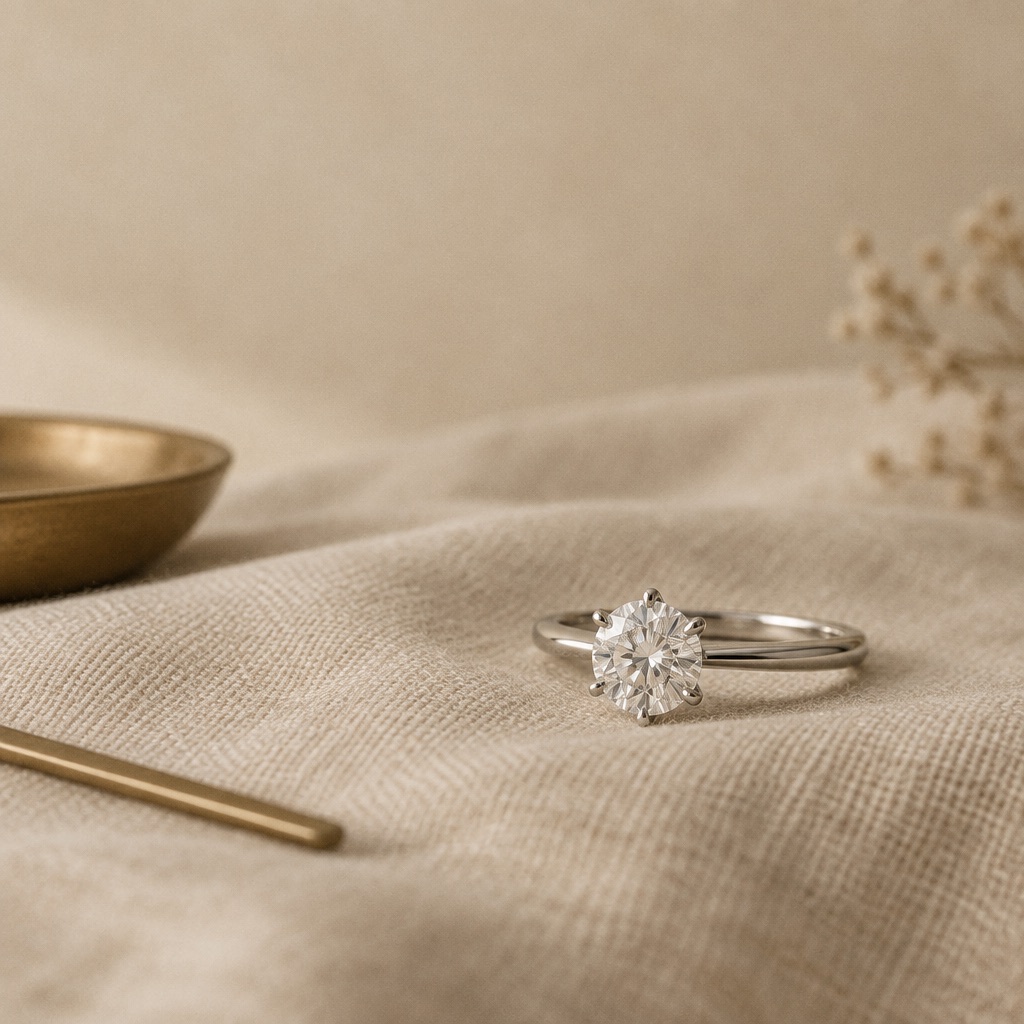
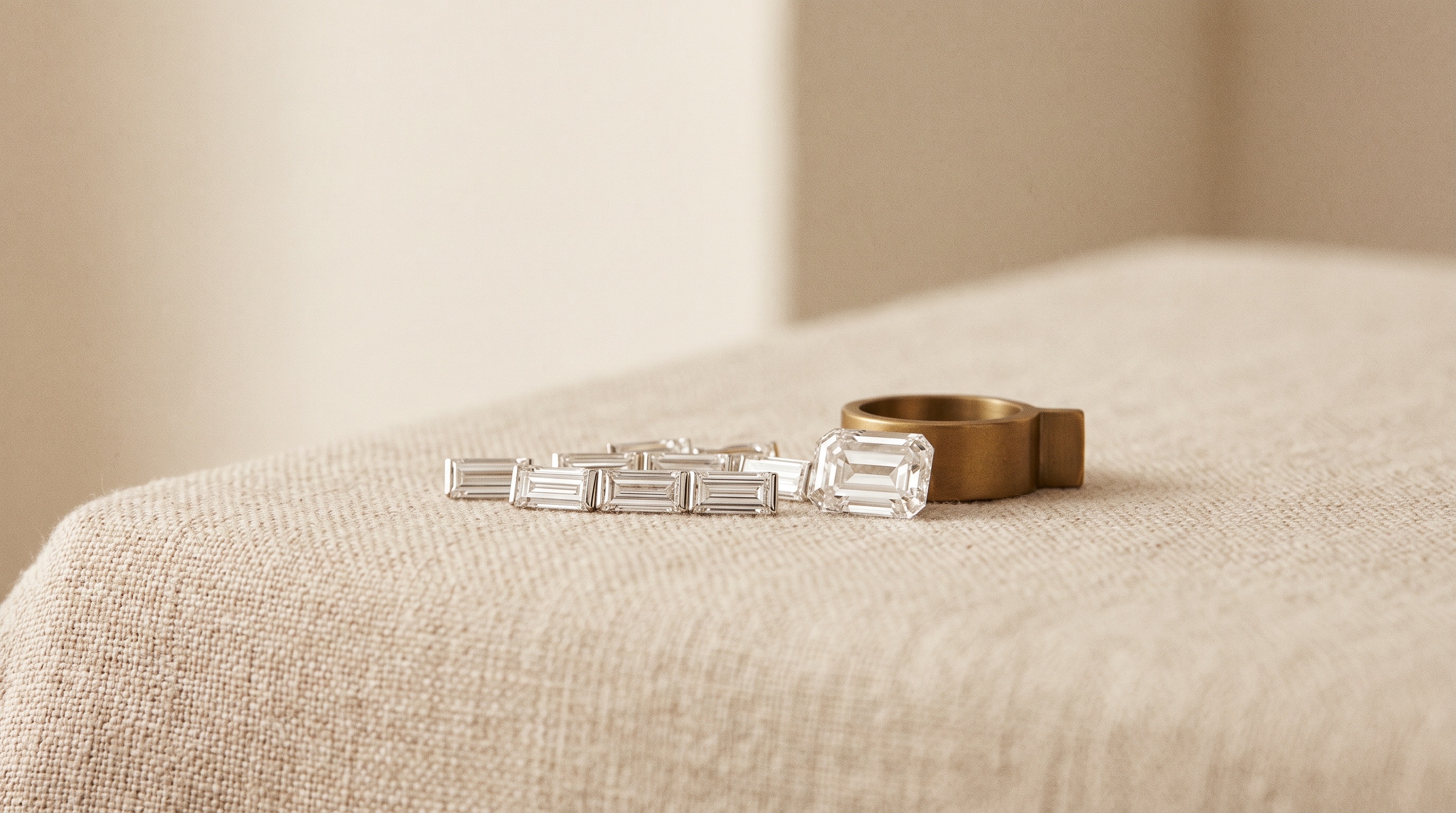
A baguette cut diamond is a small, narrow rectangular step-cut stone used almost exclusively as a side or accent stone, while an emerald cut diamond is a larger step-cut shape with cropped corners typically used as a ring's center stone. Both share the same parallel, mirror-like faceting but play opposite roles in a finished piece.
Because both shapes belong to the same step-cut family, buyers who haven't sourced either one before sometimes assume a baguette is simply a "small emerald cut," or that the two are interchangeable at different sizes. They're not. This guide covers what actually distinguishes a baguette from an emerald cut — facet geometry, the size ranges each one is cut to, why clarity matters more for both than it does for brilliant cuts, how jewelers actually deploy each shape in a finished piece, and what a wholesale buyer sourcing baguette melee to sit alongside an emerald cut center stone needs to think about for color and clarity consistency.
Baguette vs. Emerald Cut: The Core Differences at a Glance
Before getting into why each shape behaves the way it does, it helps to see the two side by side. The table below summarizes the practical differences a buyer actually needs when deciding what to stock or how to spec a piece.
| Baguette Cut | Emerald Cut | |
|---|---|---|
| Facet structure | Step cut, straight or tapered sides, roughly 14-20 facets depending on size | Step cut, cropped corners, roughly 50-57 facets on a larger stone |
| Typical role | Side/accent stone — flanks a center stone or sets in a row | Center stone — the focal diamond of the piece |
| Typical size range | Melee/accent range, roughly 0.8mm-9mm | Center-stone carat weights, commonly 0.50ct-3ct+ |
| Clarity visibility | Inclusions show more than in brilliant cuts; matters most in larger baguettes | Inclusions show readily — the least forgiving common shape |
| Price-per-carat behavior | Priced and sold largely as calibrated melee, per-stone or per-carat lot pricing | Priced as an individual center stone against the 4Cs, certificate-driven |
| Common settings | Channel-set eternity bands, three-stone side stones, tapered baguette shoulders | Four-prong or cathedral solitaire, three-stone with baguette or trapezoid sides |
| Certification norm | Sold as uncertified parcel/melee goods against a quality baseline, not individually graded | Individually certified at 0.30ct and above |
Facet Structure: Step-Cut Cousins With Different Jobs
Both baguette and emerald cut belong to the step-cut family, which means both are faceted in long, flat, parallel rows that run around the stone like the risers of a staircase, rather than the triangular and kite-shaped facets that give a round brilliant or princess cut its scattered sparkle. That shared step-cut geometry is why the two shapes look related at a glance and why buyers occasionally lump them together as "the same cut in different sizes." They aren't, and the differences start with the facet count and arrangement.
A baguette is cut with a small number of long facets — typically somewhere in the range of 14 to 20 depending on the stone's length and whether it's a straight baguette (parallel sides, a true rectangle) or a tapered baguette (sides that angle inward toward one end, cut specifically to fit a trapezoidal channel next to a fancy-shape center stone). Because a baguette is small and narrow to begin with, there simply isn't room for the crown and pavilion facet rows an emerald cut carries; the shape is kept as simple and as calibrated as possible so it sets flush and reads clean in a row.
An emerald cut is a larger, more developed step cut with a rectangular or square outline and the corners trimmed off — usually at a 45-degree angle — to create an eight-sided silhouette. That corner treatment isn't decorative; cropped corners reduce chipping risk at what would otherwise be four sharp right-angle points, and they also change the way light enters and exits the stone at the edges. A larger emerald cut can carry 50 or more facets across its crown, pavilion, and girdle facets, arranged in three, four, or occasionally five concentric rows depending on the cutter's proportions. More rows generally mean a stone with a visually "longer" step effect; fewer rows read as a bolder, more open table.
Light Performance: Why Neither One Is Built to "Sparkle"
Step-cut faceting produces a fundamentally different optical effect than brilliant-cut faceting, and this is true for both baguette and emerald cut. Instead of scattering incoming light into many small points of reflection the way a round brilliant or cushion cut does, step-cut facets reflect light off broad, flat, mirror-like planes. The result is a smaller number of larger, brighter flashes rather than constant all-over scintillation — trade buyers commonly describe the effect as a "hall of mirrors."
In an emerald cut, this effect is the entire point of the shape. Buyers who choose emerald cut over a brilliant-faceted fancy shape are usually choosing it specifically for that quieter, architectural flash rather than maximum fire — it's a deliberate aesthetic trade, not a lesser version of sparkle. A baguette produces a similar optical character on a much smaller scale, which is exactly why it works so well as a supporting stone: it reflects light cleanly without competing with a brighter center stone, and a row of baguettes in an eternity band produces a continuous, even line of light rather than a busy, scattered one.
Neither shape performs the way a brilliant cut does under typical lighting, and that's worth setting expectations around with a retail customer who's used to round brilliant sparkle. A buyer or retailer moving a customer from round or princess into either step cut should frame the shift honestly — it's a different visual language, not simply "less brilliant."
Accent Stone vs. Center Stone: How Each Is Actually Used
This is the single biggest practical difference between the two shapes, and it's the reason comparing them head-to-head can feel a little like comparing apples to a fruit basket — they usually aren't competing for the same slot in a piece of jewelry at all.
A baguette is, in the overwhelming majority of finished jewelry, a side or accent stone. Its narrow proportions make it a poor candidate for a center stone: a baguette large enough to serve as a standalone focal diamond would need extreme length relative to its width to avoid looking like a thin sliver, and even then it lacks the table size and step-row depth that make an emerald cut's face-up presence read as substantial. Baguettes earn their place doing supporting work — flanking a round, oval, or cushion center stone in a classic three-stone ring, running in a continuous channel-set row down a wedding band or eternity band, or lining the shoulders of a solitaire setting.
An emerald cut, by contrast, is built to be the hero stone. Its open table and larger facet rows are designed to showcase clarity and cut quality directly to the eye, which is exactly the job a center stone needs to do. Emerald cut does occasionally appear as a side stone in larger sizes — most often as a matched pair flanking an even larger emerald or Asscher center stone in a three-stone design — but that's the exception, not the shape's primary role. Buyers sourcing emerald cut inventory are overwhelmingly buying it to be the main event of a ring, not a supporting player.
Size and Carat Weight Ranges: Melee Accent vs. Center-Stone Weight
The size gap between the two shapes is large and mostly non-overlapping. Baguettes are cut and sold almost entirely within the melee and calibrated accent-stone range — broadly 0.8mm up to about 9mm in length, which covers everything from the tiny channel-set slivers used in a delicate eternity band to the larger tapered baguettes that flank a substantial center stone in a three-stone design. Within that range, baguettes are typically specified and ordered by millimeter dimension and calibrated shape rather than by carat weight alone, since a jeweler setting a channel needs stones cut to a precise, consistent width to sit flush without gaps.
Emerald cut, by comparison, is sourced and sold as a center-stone shape, which means carat weight — not millimeter calibration — is the primary spec. Emerald cut center stones commonly range from around 0.50ct on the smaller end up through 3ct and beyond for larger statement pieces, with length-to-width ratio (how elongated versus square the stone reads) as a customizable secondary spec on top of raw carat weight. A buyer choosing an emerald cut is choosing both a weight and a ratio; a buyer choosing baguettes is choosing a millimeter length and a taper angle to fit a specific channel.
This size difference is also why the two shapes are almost never confused in person, even though they're occasionally confused by name. A baguette in hand is unmistakably a small accent; an emerald cut in hand is unmistakably a stone meant to be looked at directly.
Clarity Requirements: Why Step Cuts Don't Forgive
Both shapes share the step-cut family's biggest sourcing challenge: the broad, open facets that create that quiet "hall of mirrors" flash also act like a window straight into the stone, which means inclusions that a brilliant cut would visually camouflage stay clearly visible in a step cut. This is true at any size, but it plays out differently for a baguette than it does for an emerald cut because of where each one sits in a finished piece.
On an emerald cut center stone, clarity is non-negotiable in a way it simply isn't for many other shapes. Because the stone is the visual focal point of the piece and sits under direct, sustained scrutiny, a VS2 or even a clean SI1 emerald cut can show an inclusion at arm's length that would be invisible in a brilliant cut of the same grade. Buyers sourcing emerald cut center stones for retail resale generally hold a stricter internal clarity floor than they would for a brilliant fancy shape at the same price point, and reviewing an individual stone's actual photos or video — rather than buying strictly against the printed grade on a certificate — is standard practice for this shape.
On a baguette, the same open-facet visibility applies, but the stakes are different because of scale and context. A small channel-set baguette in a wedding band sits at a distance from the eye and is viewed as part of a continuous row rather than in isolation, which means very minor inclusions matter less individually — but consistency across the row matters enormously. A single visibly included baguette breaking up an otherwise clean channel stands out far more than the same inclusion would in one isolated accent stone, so melee buyers source against a consistent quality baseline across the whole parcel rather than grading each stone individually. Larger tapered baguettes used as side stones in a three-stone ring sit closer to the emerald cut's situation — they're viewed more directly and deserve more individual scrutiny than melee-scale channel stones.
Color Considerations for Both Shapes
Color follows a similar logic to clarity in step cuts: the same open, still facets that expose inclusions also make body color more visible, particularly toward the corners of an emerald cut, where facet geometry does the least to disperse tint. Buyers sourcing an emerald cut center stone for a colorless look typically want to hold a color floor of G or better, since warmer grades read more visibly in this shape than they would in a brilliant fancy shape at the same grade.
For baguette accent stones, color consistency matters more than any single stone's absolute grade. A row of baguettes with mismatched body color running down a channel-set band is immediately noticeable, even if every individual stone would pass as acceptable on its own. This is also the point where baguette and emerald cut sourcing intersect most directly: when baguettes are being matched to sit alongside an emerald cut center stone rather than in an all-baguette row, the accent stones need to read as color-consistent with the center stone specifically, not just consistent with each other, or the piece ends up with a visible color step between the hero stone and its supporting cast.
Common Settings: Where Each Shape Actually Shows Up
Baguettes do their best work in a handful of specific settings. Full, three-quarter, and half eternity bands rely on a continuous row of calibrated baguettes set edge to edge in a channel, producing an unbroken line of step-cut light. Three-stone rings frequently use a pair of tapered baguettes flanking a round, oval, cushion, or emerald cut center stone, echoing the center stone's lines without competing with it. Baguettes also appear as channel-set accents along the shoulders of a solitaire setting, adding a clean architectural line without introducing the busier look a pavé or halo would bring to a piece built around a quieter step-cut center stone.
Emerald cut center stones are most often set in restrained architectures that let the stone's own geometry carry the design — a classic four-prong solitaire or a cathedral setting is the standard choice, since an overly ornate, accent-heavy setting tends to visually compete with the emerald cut's quiet lines rather than complement them. When an emerald cut does appear in a three-stone design, its most natural side-stone partners are trapezoids or half-moons that echo its own step-cut faceting, though baguettes are also a common and versatile choice on either side.
Put together, this is the clearest practical way to think about how the two shapes relate: an emerald cut sets the design language for a piece, and baguettes are one of several accent shapes a jeweler reaches for to support that language, whether the center stone is an emerald cut itself or something else entirely.
Baguette Cut Variations: Straight vs. Tapered
Not all baguettes are cut the same way, and the distinction matters for wholesale buyers specifying channel or three-stone designs. A straight baguette has parallel long sides and a true rectangular outline, and it's the standard choice for eternity bands and channel settings where every stone in the row needs to be identical in width. A tapered baguette has sides that angle inward toward one end, producing a trapezoidal shape rather than a rectangle; tapered baguettes are cut specifically to flank a center stone whose shoulders narrow, allowing the accent stone to sit flush against a tapering channel without gaps.
Both variations share the same facet structure and light behavior described above — the taper is a matter of outline, not faceting style. A buyer specifying accent stones for a three-stone design needs to know in advance whether the setting calls for straight or tapered baguettes, since the two aren't interchangeable once a channel or prong is fabricated to a specific angle.
Price-Per-Carat and Sourcing Behavior: Two Different Markets
Baguette and emerald cut diamonds aren't just used differently — they're bought and priced differently, too, which matters for a wholesale buyer planning inventory or quoting a custom build. Emerald cut center stones are priced individually against the 4Cs, the way any other center-stone shape is, with price-per-carat driven by carat weight, color, clarity, and cut proportions, and with a meaningful premium attached to genuinely eye-clean stones given the shape's low clarity forgiveness. Because certification is standard practice at 0.30ct and up, an emerald cut buyer is typically pricing and comparing individual certified stones stone by stone.
Baguettes, by contrast, are bought almost entirely as calibrated melee — priced and sold in parcels or by the piece against a consistent quality baseline rather than individually graded and certified. This is a deliberate, practical difference in how the market handles small accent-stone inventory, not a quality shortcut: grading every individual 2mm or 3mm baguette the way a 1-carat center stone gets graded would be neither economical nor meaningfully useful to a buyer who's really evaluating the parcel's overall color and clarity consistency, not any one stone in isolation. A wholesale buyer sourcing baguettes should expect to buy against a stated quality floor for the parcel — commonly something in the DEF-and-better color, VS-and-better clarity range — rather than against individual certificates.
Matching Baguette Accents to an Emerald Cut Center Stone
The most common place these two shapes actually meet is in a three-stone or accented ring built around an emerald cut center stone with baguette side stones, and getting that match right is a real sourcing skill, not a given. Three things matter most.
First, color consistency. Because the emerald cut's open facets show body color clearly, and because side-by-side comparison is exactly how a customer views a three-stone ring, the baguettes need to sit at or very close to the center stone's own color grade — a noticeably warmer or noticeably colder pair of baguettes flanking a center stone creates a visible mismatch that undermines an otherwise well-chosen center stone. Second, clarity consistency, for the same reason: a heavily included baguette next to a clean emerald cut center draws the eye to exactly the wrong place.
Third, proportion and taper. The baguettes need to be cut to a length and taper angle that actually fits the center stone's shoulders and the setting's channel geometry — this is a fabrication detail as much as a stone-selection one, and it's a large part of why custom three-stone builds around a specific center stone take real turnaround time rather than being an off-the-shelf pairing. A buyer sourcing a matched set for a specific emerald cut center stone is best served working with a supplier that can pull both the certified center stone and the calibrated baguette accents from the same catalog, rather than reconciling grading language and calibration standards across two separate vendors.
Sourcing Baguette and Emerald Cut Diamonds Wholesale
Because these two shapes serve different roles and are bought against different standards — individually certified center stones on one side, calibrated melee parcels on the other — stocking both well means treating them as two related but distinct sourcing categories rather than one undifferentiated "step-cut inventory" line. Guru Diam carries emerald cut as part of its regular fancy-shape range, available both as CVD lab-grown and natural stones, with IGI, GIA, and GCAL certification available on loose center stones at 0.30ct and above, giving buyers the flexibility to match certification lab to what a specific retail market or customer expects.
Baguette sits inside Guru Diam's melee program as a calibrated fancy shape available on request alongside the program's named shapes — emerald, radiant, pear, and marquise are stocked as standard calibrated melee, with straight and tapered baguette cut to spec for channel and three-stone work. Melee ships as uncertified parcel goods against a DEF+/VS+ quality baseline rather than individually graded, which is standard practice across the trade for accent-stone inventory of this size and keeps pricing efficient for buyers ordering in volume. Cutting, setting, and polishing are handled all in-house, which matters in particular for tapered baguettes cut to a specific angle for a given three-stone or channel design rather than pulled from generic pre-cut stock.
Same-day shipping applies to in-stock loose stones and melee from both the New York location, for orders placed before 6pm EST, and the Los Angeles location, for orders before 4pm PST — relevant for a buyer trying to pull a matched center stone and baguette parcel together on a tight production timeline. For a finished three-stone or eternity design built to order around a specific emerald cut center stone and matched baguettes, custom ring builds turn around in 4-6 days and ship unbranded by default, so retailers can resell the finished piece under their own name.
Common Buyer Mistakes With This Pairing
The most frequent mistake is treating baguette and emerald cut as directly interchangeable simply because they share step-cut faceting — ordering baguette melee against a generic quality floor without checking it against the specific center stone's color and clarity, and then discovering a visible mismatch once the pieces sit side by side rather than on separate spec sheets. A related mistake is under-speccing baguette dimensions for a custom three-stone build, ordering straight baguettes for a setting that actually needs a tapered profile to sit flush against the center stone's shoulders, which shows up as visible gaps or an uneven channel line once the piece is fabricated.
A third common error runs in the other direction: buying an emerald cut center stone against a clarity floor that would be perfectly acceptable in a brilliant fancy shape, then finding an inclusion clearly visible to the naked eye once the stone is set and viewed directly — a mistake best avoided by reviewing actual stone photos or video rather than buying strictly against a certificate's printed grade, the same practice that applies to sourcing any step-cut shape.
Frequently Asked Questions
What is the difference between a baguette and an emerald cut diamond?
Both are step-cut shapes with long, parallel, mirror-like facets, but they serve different roles. A baguette is a small, narrow rectangular stone used almost exclusively as a side or accent diamond, while an emerald cut is a larger step cut with cropped corners typically used as a ring's center stone.
Can a baguette be used as a center stone?
It's uncommon. A baguette's narrow proportions and small facet count make it a poor fit for a standalone focal diamond — a baguette large enough to serve as a center stone would need extreme length relative to its width and still lacks the table size that gives an emerald cut its presence. Baguettes are cut and sold almost entirely as calibrated accent stones for channels, eternity bands, and three-stone side positions.
Do baguette and emerald cut diamonds sparkle the same way?
Both produce the same type of optical effect since they share step-cut faceting — broad, mirror-like flashes rather than the scattered sparkle of a brilliant cut. A baguette shows a smaller-scale version of the same "hall of mirrors" effect an emerald cut is known for, which is part of why the two pair well together visually in the same piece.
Why does clarity matter more for step-cut diamonds like these?
The open, flat facets in both shapes act like a window into the stone rather than breaking up light the way a brilliant cut's facets do, which means inclusions are more visible at the same clarity grade. This effect is most consequential on an emerald cut center stone, which sits under direct, sustained view, while on baguette melee it matters most for consistency across a visible row or matched pair.
How do I match baguette side stones to an emerald cut center stone?
Match the baguettes to the center stone's color and clarity grade as closely as possible, since visible mismatches show up clearly in a direct side-by-side setting. Also confirm whether the design calls for straight or tapered baguettes — tapered baguettes are cut specifically to fit a channel that narrows toward the center stone's shoulders, and the two profiles aren't interchangeable once a setting is fabricated.
Are baguette diamonds individually certified?
No. Baguettes are sold as calibrated melee, shipped as uncertified parcel goods against a consistent quality baseline rather than individually graded, which is standard trade practice for accent-stone inventory at this size. Loose center stones at 0.30ct and above, including emerald cut, are individually certified through IGI, GIA, or GCAL.
Browse certified emerald cut center stones by grade through certified diamonds, or source matched baguette accents for a three-stone or channel design through matching pairs. Current wholesale inventory across both shapes is available through the wholesale hub, trade accounts can be set up through trade partner, and custom builds pairing an emerald cut center stone with matched baguette sides can start through custom jewelry.