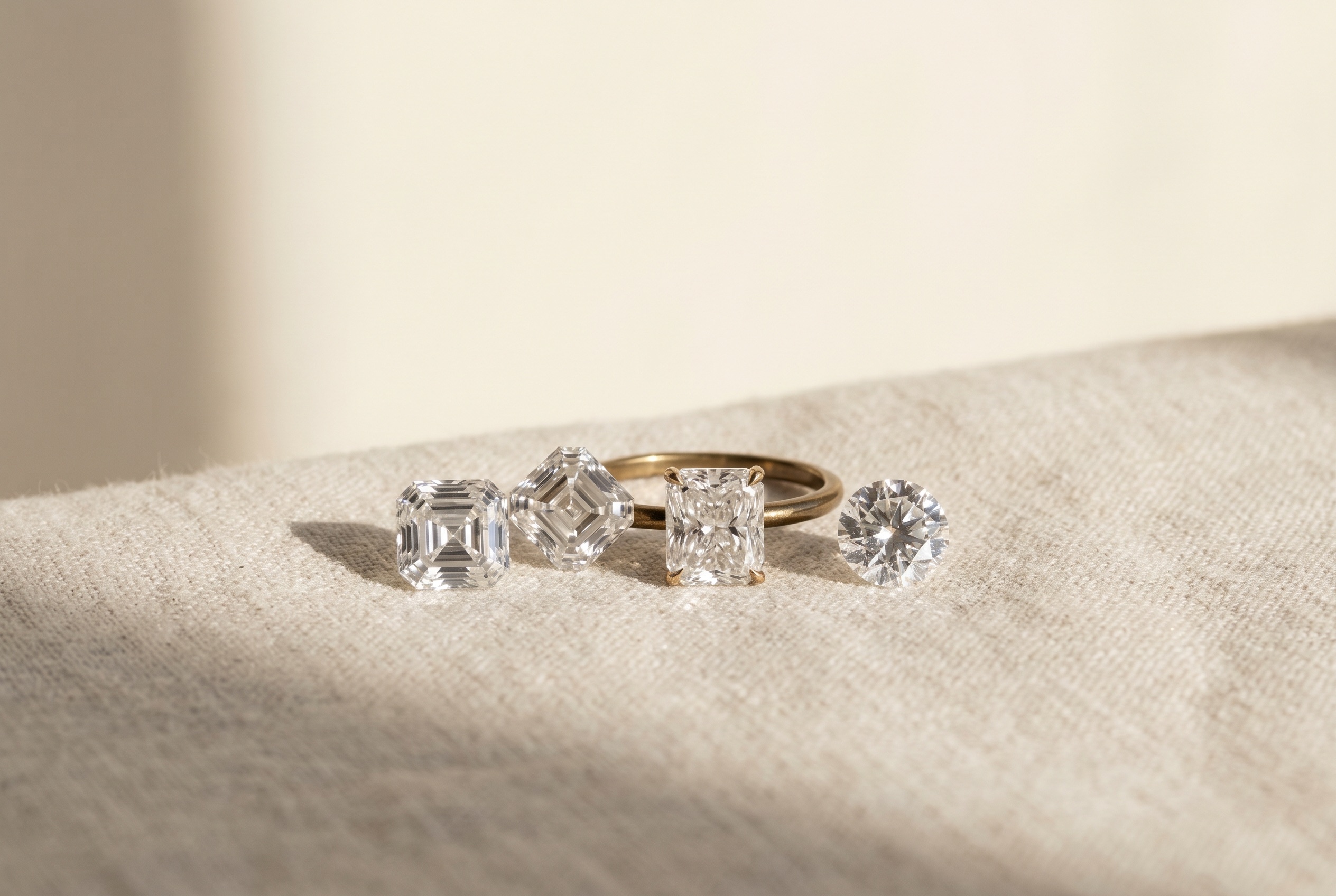
An asscher cut diamond is a square step-cut stone with deeply cropped corners and a small number of large, mirror-like facets, while a radiant cut diamond is a square or rectangular mixed cut that combines a similar cropped-corner outline with brilliant-style faceting for maximum sparkle. Both share an X-shaped facet pattern visible from the top, but they perform very differently in terms of brilliance, clarity forgiveness, and color masking.
Because asscher and radiant cuts share a cropped-corner silhouette and both trace back to the same general family of "fancy square" shapes, they're frequently confused by buyers who haven't compared them side by side, especially in photos where lighting can flatten the visual difference. This guide covers how each shape is actually faceted, why one hides inclusions and warm color far better than the other, what that means for sourcing decisions at different clarity and color grades, typical size and proportion ranges, and how a wholesale buyer should think about stocking or specifying either shape.
The short version: asscher is a step cut built for quiet, architectural elegance and demands a strict clarity and color standard to look its best, while radiant is a brilliant-faceted cut built to maximize fire and scintillation while forgiving more in the stone's underlying grade. Neither is objectively "better" — they solve different problems for a buyer.
Asscher vs. Radiant Cut: The Core Differences at a Glance
| Asscher Cut | Radiant Cut | |
|---|---|---|
| Cut family | Step cut | Mixed cut (brilliant faceting on a step-cut-style outline) |
| Typical outline | Square, deeply cropped corners | Square or rectangular, cropped corners |
| Facet count | ~58 facets (standard); Royal Asscher variant ~74 | ~70 facets |
| Light performance | Broad, mirror-like flashes; a "hall of mirrors" effect | Scattered sparkle and fire, closer to a round brilliant |
| Clarity forgiveness | Low — open facets expose inclusions clearly | Higher — brilliant faceting breaks up and conceals minor inclusions |
| Color forgiveness | Low — body color reads clearly through the open table | Higher — faceting and, often, a warmer face-up tone can mask lower color grades |
| Historic origin | Patented 1902 by the Asscher brothers, Netherlands | Developed 1977 by Henry Grossbard |
| Common buyer profile | Vintage/Art Deco-inspired design, buyers prioritizing quiet elegance | Buyers wanting brilliance and sparkle in a non-round silhouette |
Facet Structure: Step Cut vs. Mixed Cut
An asscher cut is a true step cut, meaning its facets are cut as long, flat, parallel trapezoids and rectangles arranged in concentric rows around the stone, the same faceting family emerald cut belongs to. What sets asscher apart visually from other step cuts is its square outline with unusually deep corner crops, which — combined with a relatively high crown and large, open step facets — produces a distinctive X-shaped pattern visible when the stone is viewed face-up. A standard asscher cut carries roughly 58 facets; the trademarked "Royal Asscher" variation, introduced in 2001, adds additional facet rows for a total closer to 74, intended to add subtle extra brilliance to the traditionally quiet step-cut look without abandoning the shape's signature geometry.
A radiant cut is a mixed cut, a deliberate hybrid designed to take the square or rectangular, cropped-corner outline that step cuts like emerald and asscher popularized and pair it with a brilliant-style faceting arrangement on the crown and pavilion — the same triangular and kite-shaped facet pattern used in a round brilliant. A radiant cut typically carries around 70 facets, arranged specifically to maximize light return rather than to produce the flat, mirror-like planes a step cut relies on. This is the single most important structural difference between the two shapes: asscher's facets are built to reflect broad, quiet flashes of light, while radiant's facets are built to scatter light into many small, bright points, much closer to how a round brilliant performs.
Light Performance: Quiet Elegance vs. Maximum Sparkle
Because of its step-cut faceting, an asscher cut produces the same "hall of mirrors" optical effect associated with emerald cut and other step cuts — a smaller number of large, bright flashes rather than constant all-over scintillation. Buyers choosing asscher over a brilliant-faceted fancy shape are typically choosing it specifically for that restrained, architectural look, not for maximum fire. It's a deliberate aesthetic choice that rewards a stone with genuinely clean facets, since there's nowhere for light — or an inclusion — to hide.
A radiant cut, by contrast, is built from the ground up to sparkle. Its brilliant faceting scatters incoming light into many small reflections, giving it a liveliness under typical lighting that's much closer to a round brilliant or cushion cut than to a step cut, while still keeping the squared, cropped-corner silhouette that appeals to buyers who don't want a round or standard fancy-brilliant shape. For a customer who loves the geometric look of a square or rectangular stone but doesn't want to give up brilliance, radiant is very often the shape a jeweler reaches for instead of asscher or emerald cut.
Clarity Requirements: Why Asscher Is Far Less Forgiving
Asscher's large, open step facets act like a clear window into the stone, meaning any inclusion sitting anywhere near the table or upper facets is visible essentially at first glance, and even minor inclusions that would be invisible in a brilliant-faceted shape can stand out clearly in an asscher cut. Buyers sourcing asscher cut center stones for retail resale generally hold a stricter internal clarity floor than they would for a comparable brilliant fancy shape, and reviewing actual stone photos or video — not just the printed clarity grade on a certificate — is standard practice for this shape specifically because grade alone doesn't reliably predict how visible an inclusion will actually be face-up.
Radiant cut's brilliant faceting works in the buyer's favor here. The same scattering effect that produces sparkle also breaks up and visually camouflages minor inclusions far more effectively than a step cut's flat planes can, which means a radiant cut can often carry a clarity grade one or even two steps lower than an equivalent asscher and still present eye-clean to a typical buyer. This is a genuinely practical sourcing advantage for radiant cut inventory: a wider band of clarity grades reads acceptably clean, which widens the usable stock a supplier can confidently sell as eye-clean without individually reviewing every stone's photos.
Color Considerations: Radiant Hides Warmth Better
The same open-facet transparency that makes inclusions visible in an asscher cut also makes body color read clearly, particularly toward the corners where the step-cut geometry does the least to disperse tint. Buyers sourcing an asscher cut center stone for a colorless look typically want to hold a color floor around G or better, since warmer grades show more visibly in this shape than they would in most brilliant-faceted fancy shapes at the same grade.
Radiant cut again benefits from its brilliant faceting, which scatters light in a way that masks warmer body color more effectively than a step cut's flat facets do — a real, well-documented reason radiant cut is a popular choice for buyers working with a slightly warmer color grade (H or I, for example) who still want a face-up appearance that reads close to colorless. This color-masking property, paired with its clarity forgiveness, is a large part of why radiant cut consistently offers stronger relative value per carat than a comparably graded asscher cut — buyers are effectively paying less to achieve a similar visual result.
Shape and Proportion Options
Asscher cut is almost always cut square, or very close to it — a length-to-width ratio near 1:1 is the defining look of the shape, and a meaningfully elongated "asscher" starts to visually blur into a rectangular step-cut territory that buyers more commonly just call emerald cut. This near-fixed square proportion is part of what gives asscher its distinctive, symmetrical X-pattern look.
Radiant cut is more flexible, cut in both square and rectangular proportions depending on the intended use — a square radiant reads closer to a princess cut's outline with softened corners, while an elongated rectangular radiant reads closer to an emerald cut's outline with brilliant faceting instead of step faceting. This flexibility gives radiant cut a broader range of practical applications: a buyer can specify a length-to-width ratio to match a specific design intent rather than being limited to a single fixed proportion the way asscher effectively is.
Typical Carat Weight and Sizing
Both asscher and radiant are sourced primarily as center-stone shapes rather than melee or accent stones, commonly ranging from around 0.50ct on the smaller end through 3ct and beyond for larger statement pieces. Because asscher's near-fixed square proportion means the stone doesn't "stretch" the way an elongated rectangular shape can, a given carat weight in asscher typically reads slightly smaller face-up than the same weight in an elongated radiant — a practical point worth flagging to a customer comparing the two shapes primarily by carat weight rather than face-up size.
Common Settings for Each Shape
Asscher cut's vintage, Art Deco-associated look pairs naturally with settings that echo that period — a simple four-prong solitaire, a cathedral setting, or a three-stone design flanked by trapezoids or tapered baguettes that continue the step-cut faceting language. Because the shape's appeal is largely about restraint and geometry rather than sparkle, an overly ornate or accent-heavy setting tends to compete with an asscher center stone rather than complement it.
Radiant cut is more setting-flexible given its brilliance-forward character — it pairs well with a classic four-prong solitaire, a halo setting that adds further sparkle around the perimeter, or a three-stone design with round, trapezoid, or baguette side stones. Because radiant already reads as lively and bright on its own, it tolerates a busier setting style better than asscher typically does without looking visually overloaded.
Price-Per-Carat and Sourcing Behavior
Asscher cut center stones are priced individually against the 4Cs the way any center-stone shape is, but the shape's low clarity and color forgiveness means genuinely eye-clean, well-matched-color asscher stones command a real premium relative to a similarly graded brilliant fancy shape — buyers are effectively paying for a stone that has to earn its grade visually, not just on paper. Supply is also comparatively thinner than for more commonly cut shapes, since asscher's demanding proportions and clarity requirements mean a smaller share of rough is well-suited to the cut.
Radiant cut, by contrast, tends to offer stronger relative value at a given price point precisely because of its clarity and color forgiveness — a buyer can often source a radiant cut with a lower stated grade that still presents as clean and bright, getting more visual performance per dollar than an equivalently priced asscher or other step cut would deliver. This value proposition is a significant reason radiant cut has remained a consistently popular center-stone choice in the wholesale market.
Historical Context: Why the Two Shapes Exist
Asscher cut was patented in 1902 by the Asscher brothers of the Netherlands, predating the modern brilliant-cut era, and its deep corner crops and step faceting reflect the cutting technology and aesthetic preferences of that period — a look that became strongly associated with Art Deco design through the 1920s and 1930s and has remained a recognizable vintage-inspired choice ever since, including a modernized "Royal Asscher" version introduced in 2001 with additional facets.
Radiant cut is a much more recent invention, developed in 1977 by Henry Grossbard specifically to solve a design problem the older shapes didn't address: buyers who wanted a square or rectangular silhouette without giving up the brilliance a round cut delivers. Radiant was engineered from the outset as a mixed cut, deliberately borrowing the outline conventions of step cuts while applying brilliant faceting, making it a genuinely modern shape rather than a variation on a historic one.
Common Buyer Mistakes When Choosing Between the Two
The most frequent mistake is assuming the two shapes are interchangeable simply because they share a similar cropped-corner outline in photos — ordering an asscher cut against a clarity and color grade that would look perfectly clean in a radiant cut, then discovering visible inclusions or warmth once the stone is set and viewed directly. A related mistake runs the other direction: over-specifying an unnecessarily high clarity and color grade for a radiant cut purchase, paying a premium for grade improvements that a brilliant-faceted stone's own optical forgiveness would have made largely invisible anyway.
A third common error is treating carat weight as the only sizing variable when comparing the two shapes for a customer — because radiant cut is commonly cut in elongated rectangular proportions while asscher stays close to square, the same carat weight can look meaningfully different face-up between the two, which is worth walking a customer through before a final decision rather than after the stone is already set.
Matching the Shape to the Customer
A jeweler helping a customer choose between the two shapes is really helping them choose between two different priorities, and framing it that way tends to produce a faster, more confident decision than walking through facet counts in isolation. A customer drawn to a quieter, more architectural look — someone who describes wanting something "different from a typical sparkly ring" or references vintage and Art Deco styling directly — is very often describing an asscher cut before they know the shape's name. A customer who wants a non-round silhouette but doesn't want to sacrifice brilliance, or who's budget-conscious and wants the best visual performance per dollar, is usually better served by radiant cut.
It's worth noting these aren't mutually exclusive preferences in practice — plenty of customers like the geometric, squared-off look both shapes share and are genuinely undecided between them until they see the two side by side under the same lighting. Having both shapes available to show in person, even briefly on memo, resolves far more of these decisions than describing the optical difference in words ever will, since the contrast between a step cut's flash and a brilliant cut's scintillation is much easier to see than to explain.
Certification and Grading Considerations
Both shapes are graded on the same standard 4Cs framework as any other fancy shape, but the practical weight buyers should place on each C differs meaningfully between them, as the clarity and color sections above cover. One additional wrinkle worth flagging for wholesale buyers: cut grade itself is reported differently, or not reported at all as a simple grade, for fancy shapes compared to round brilliant, since the standard cut-grade scale was developed specifically around round brilliant proportions. For both asscher and radiant, buyers evaluating cut quality should look at proportion data (table percentage, depth percentage, length-to-width ratio) and, ideally, actual photos or video rather than relying on a single cut-grade term the way they might for a round stone.
This makes working with a supplier who can provide detailed proportion data and real imagery for a specific stone — not just a certificate summary — particularly valuable for both shapes, and especially for asscher cut, where small proportion differences visibly change how well the signature step-cut pattern reads face-up.
Sourcing Asscher and Radiant Cut Diamonds Wholesale
Guru Diam carries both asscher and radiant cut as part of its regular fancy-shape range, available as CVD lab-grown and natural stones, with IGI, GIA, and GCAL certification available so buyers can match certification lab to what a specific retail market or customer expects. Because the two shapes behave so differently on clarity and color, Guru Diam's team can help a buyer weigh a specific stone's actual photos or video against its printed grade rather than sourcing on grade alone — particularly useful for asscher cut, where grade-only sourcing carries more risk of a visible mismatch than it does for most other shapes.
In-stock loose stones ship same-day nationwide from New York, for orders before 6pm EST, and Los Angeles, for orders before 4pm PST, and custom engagement rings built around either shape are finished in 4-6 days, unbranded by default so jewelers can resell the finished piece under their own name. Cutting, setting, and polishing are all handled in-house, which matters in particular for asscher cut, where proportion precision has an outsized effect on how well the shape's signature step-cut pattern actually presents.
Frequently Asked Questions
What is the difference between an asscher and a radiant cut diamond?
Asscher is a step cut with large, flat facets that produce a quiet, mirror-like flash and a distinctive X-shaped pattern, while radiant is a mixed cut that pairs a similar cropped-corner outline with brilliant-style faceting for scattered sparkle closer to a round brilliant. Radiant is also more forgiving of lower clarity and color grades than asscher.
Which cut is more brilliant, asscher or radiant?
Radiant is significantly more brilliant. Its facet structure is designed specifically to scatter light the way a round brilliant does, while asscher's step-cut faceting produces broad, quiet flashes rather than all-over sparkle.
Does an asscher cut show inclusions more than a radiant cut?
Yes. Asscher's large, open step facets expose inclusions clearly, so buyers typically hold a stricter clarity standard for this shape. Radiant cut's brilliant faceting breaks up and conceals minor inclusions far more effectively, allowing a lower clarity grade to still present as eye-clean.
Can a radiant cut be cut square instead of rectangular?
Yes. Radiant is cut in both square and rectangular proportions depending on the intended design, unlike asscher, which is almost always cut close to a 1:1 square ratio.
Is radiant cut better value than asscher cut?
Often, yes, at a given price point. Radiant's clarity and color forgiveness means a lower-graded stone can still present as clean and bright, which typically delivers stronger visual performance per dollar than a comparably priced asscher cut.
Which cut is more historically associated with vintage or Art Deco design?
Asscher, patented in 1902, became strongly associated with Art Deco design through the 1920s and 1930s and remains the more common choice for vintage-inspired pieces. Radiant is a modern shape, developed in 1977, without the same historical association.
Browse certified asscher and radiant cut center stones by grade through certified diamonds, or source matched side stones for a three-stone design through matching pairs. Current wholesale inventory across both shapes is available through the wholesale hub, trade accounts can be set up through trade partner, and custom builds around either center stone can start through custom jewelry.