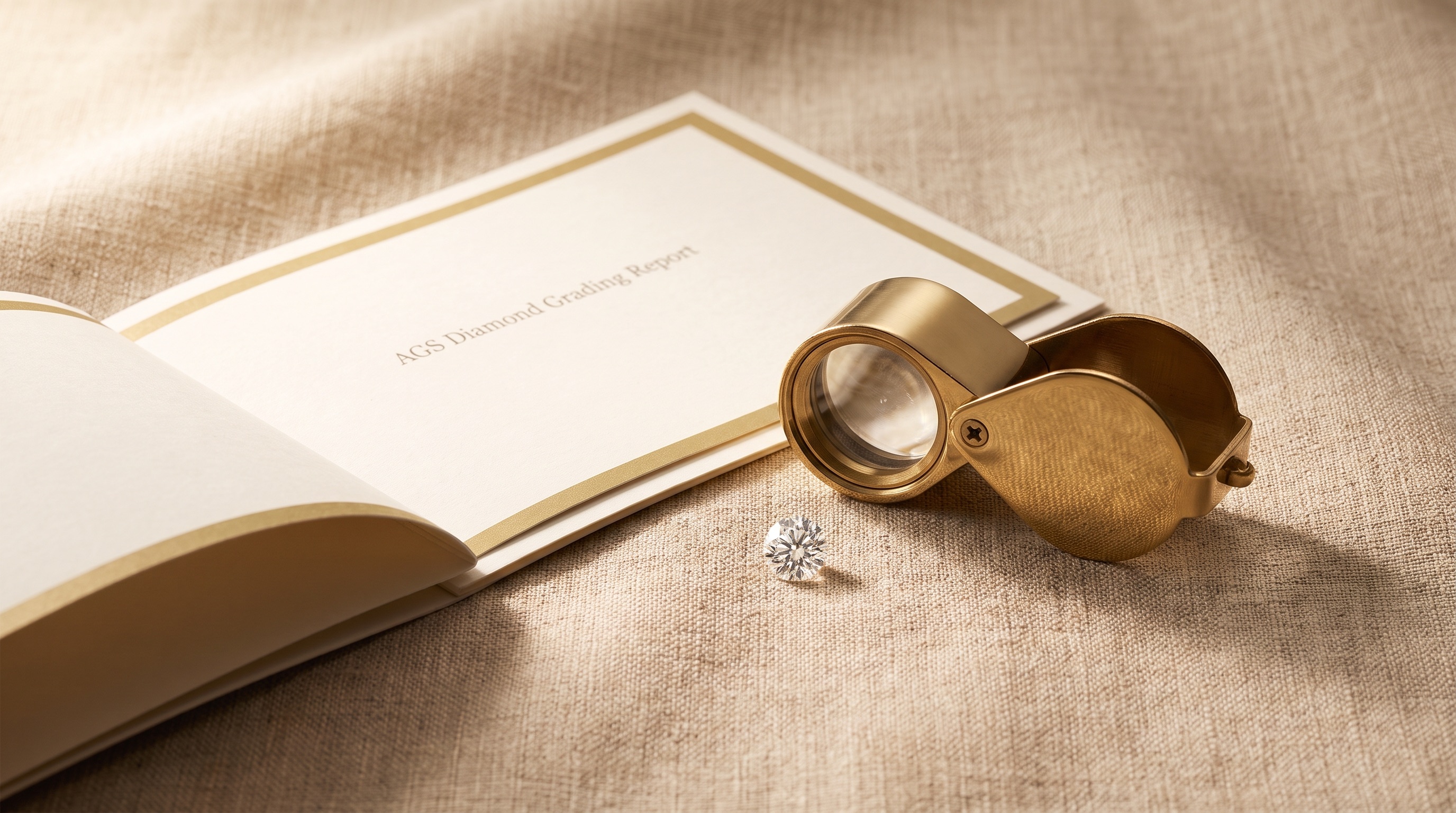
AGS diamond grading refers to the certification and cut-grading system developed by the American Gem Society Laboratories, a lab historically known in the trade for pioneering a detailed, light-performance-based approach to cut grading — including an "Ideal" cut designation on its 0-to-10 grading scale that predates and directly influenced the cut-grading systems other major labs use today. A buyer encountering an AGS report is looking at a diamond graded under a system built specifically to measure how well a stone's proportions translate into visible brightness, fire, and scintillation, rather than relying on proportion ranges alone as a proxy for performance. This guide explains what AGS grading actually measures, how its scale compares to GIA, IGI, and GCAL, what happened to the lab, and what a trade buyer should know when an AGS-graded stone shows up in inventory or a client's existing collection.
AGS Laboratories operated as an independent grading lab for decades before being acquired by GIA in 2022, and while new AGS-branded reports are no longer being issued as a fully separate lab today, a meaningful volume of previously graded AGS stones remains in circulation across the secondary market, estate jewelry, and trade-in inventory — which is exactly why understanding AGS grading still matters for a working jeweler even though it isn't one of the labs a wholesale supplier typically sources newly certified stock from today.
What AGS Laboratories Is
The American Gem Society itself is a nonprofit trade organization founded in 1934 focused on consumer protection and jeweler education and ethics; AGS Laboratories was its grading arm, established later to provide independent diamond grading reports. AGS Labs built a reputation specifically around rigorous, technically detailed cut analysis, using computer modeling of light behavior through a stone rather than relying solely on the proportion-and-angle tables that older grading approaches used. That technical cut-grading legacy is AGS's most significant and lasting contribution to how the wider trade grades diamonds today.
The AGS 0-to-10 Grading Scale
Where GIA and most other major labs use a word-based scale (Excellent through Poor for cut; Flawless through Included for clarity; D through Z for color), AGS historically used a numeric 0-to-10 scale, with 0 representing the top grade ("Ideal" for cut) and 10 representing the lowest. This applied not just to cut but across color and clarity as well on some AGS reports, which occasionally causes confusion for buyers used to reading GIA-style letter grades — an AGS "0" is a top grade, not a low one, and the direction of the scale runs opposite to what a number alone might intuitively suggest.
| AGS Grade | Approximate GIA Cut Equivalent | What It Means |
|---|---|---|
| 0 | Excellent (top tier, "Ideal") | Best light performance; AGS's own "Ideal" designation for cut |
| 1 | Excellent | Very strong light performance, just below the top tier |
| 2–3 | Very Good | Strong light performance with minor proportion deviations |
| 4–5 | Good | Acceptable light performance; more noticeable proportion deviations |
| 6–8 | Fair | Below-average light performance |
| 9–10 | Poor | Weak light performance; significant proportion issues |
Why AGS's Cut Grading Was Considered Ahead of Its Time
Before AGS's approach became widely influential, cut grading across the industry relied heavily on tables of "ideal" proportion ranges — specific angle and depth percentages considered optimal — without directly modeling how light actually moved through a specific stone's unique proportions. AGS was among the first labs to apply ray-tracing light-performance modeling at scale to cut grading, evaluating brightness, fire, and scintillation as measured outcomes rather than inferring them purely from proportion ranges. GIA's own move toward a more holistic cut-grading system in the mid-2000s was influenced by the same light-performance thinking AGS had already been applying, and GCAL's cut-specialty reputation today builds on a similar light-performance philosophy.
AGS vs. GIA vs. IGI vs. GCAL: A Trade Comparison
For a buyer evaluating a diamond report today, the practical comparison looks like this: GIA remains the most globally recognized standard, particularly for resale and appraisal purposes, with the deepest brand recognition among consumers and appraisers alike. IGI grades the highest overall volume globally and is especially dominant in lab-grown diamond certification. GCAL specializes specifically in cut-precision and light-performance analysis, similar in spirit to AGS's historical focus, and remains an independently operating lab actively issuing new reports. AGS's grading legacy lives on both in the acquired lab's absorption into GIA's operations and in the light-performance-based cut philosophy that shaped how the wider trade grades cut today, even though new stand-alone AGS reports are no longer being issued as they once were.
What Happened to AGS Laboratories
GIA announced its acquisition of AGS Laboratories' assets in 2022, folding the AGS grading operation and its accumulated technical expertise into GIA's own labs over the following period. This means a buyer today won't generally receive a newly issued, freestanding "AGS report" the way they might have a decade ago — but the large volume of diamonds graded under the AGS system before the acquisition remains in circulation, particularly in estate pieces, trade-in inventory, and secondary-market stones, which is where a working jeweler is most likely to actually encounter one now.
What to Do When You Encounter an AGS-Graded Stone
A jeweler or appraiser handling a diamond with an existing AGS report should read the numeric grades in the correct direction (0 is best, not worst) and cross-reference the approximate GIA-equivalent grade when discussing the stone with a client more familiar with letter grades. Because AGS is no longer issuing new stand-alone reports, an older AGS-graded stone being resold or reset sometimes benefits from a fresh report from a currently active lab (GIA, IGI, or GCAL) if the original report is old, damaged, or if the client wants documentation from a lab their own buyer or insurer will recognize more readily.
Is AGS Grading Still Trustworthy Today?
Yes — an existing AGS report reflects a legitimate, historically rigorous grading process, and the acquisition by GIA doesn't retroactively change the validity of a grade already issued. The practical consideration for a buyer isn't whether to trust an existing AGS grade, but whether the report itself is current enough and recognized widely enough by the specific audience involved (a retail buyer, an appraiser, an insurer) for the transaction at hand. An older report on a higher-value stone is a reasonable candidate for a fresh regrade regardless of which lab originally issued it, simply as good practice before a significant sale or insurance appraisal.
AGS's Legacy in Ideal Cut Terminology
The term "Ideal cut" that buyers now hear applied loosely across the trade traces back significantly to AGS's grading philosophy and its "Ideal" top-tier designation on the 0-to-10 scale, predating and shaping how the term is used informally today even outside a strict AGS-certified context. Buyers should be aware that "ideal cut" used casually in a listing or by a seller doesn't necessarily mean the stone carries an actual AGS-equivalent top-tier certified grade — it's sometimes used as marketing shorthand rather than a certified designation, which is exactly the kind of claim a proper grading report, from any of the major labs, is meant to verify independently.
How AGS Approached Clarity and Color Grading
While AGS's cut-grading methodology is its best-known contribution, the lab also issued clarity and color grades on the same 0-to-10 numeric scale, running parallel in concept to GIA's Flawless-to-Included clarity scale and D-to-Z color scale. An AGS clarity grade of 0 corresponds roughly to GIA's Flawless/Internally Flawless range, while a grade in the 4–5 range roughly maps to GIA's VS clarity tier, and so on down the scale. Because the numeric AGS scale and the letter-based GIA scale don't align on a strict one-to-one basis — the underlying grading criteria and boundary placements differ somewhat between labs — a jeweler translating between the two should treat any mapping as a close approximation for client conversation purposes, not an exact conversion formula.
The Practical Difference Between Proportion-Based and Light-Performance Cut Grading
Older, purely proportion-based cut grading works by comparing a stone's measured angles and depth percentages against a table of ranges considered ideal, treating any stone within the acceptable range as equally well-cut regardless of how those specific proportions interact with each other in that particular stone. Light-performance-based grading, the approach AGS pioneered and that GIA and GCAL have since incorporated into their own systems, instead models how light actually enters, bounces, and exits a specific stone's unique proportions, capturing brightness, fire, and scintillation as measured outputs. Two stones with similar proportion measurements can receive different light-performance grades if the precise combination of angles interacts differently with light, which is exactly the kind of nuance a proportion-table-only approach can miss.
AGS Grading and Diamond Appraisal Today
An appraiser encountering an AGS-graded stone today needs to document the lab of origin clearly on any appraisal, since an insurer or a future buyer may not be as familiar with AGS's historical grading conventions as they are with GIA's. Appraisers who regularly handle estate jewelry and older collections generally keep a working knowledge of AGS's numeric scale and its rough GIA equivalents specifically because it continues to show up often enough in older pieces to matter, even though it's no longer part of the current wholesale certification landscape most trade buyers work within day to day.
Why New AGS Reports Are No Longer Common
Following GIA's 2022 acquisition of AGS Laboratories' grading assets, the operational grading lab function was absorbed into GIA rather than continuing as a fully separate, independently branded certification service. The American Gem Society itself, as the underlying trade organization focused on jeweler ethics, education, and consumer protection, continued operating distinctly from the grading lab it had spun up — so "AGS" as a professional and educational body still exists and remains active in the trade, even though "AGS Laboratories" as a stand-alone certifying lab issuing new numbered reports effectively wound down as part of the acquisition.
Certification Labs Guru Diam Works With
Guru Diam certifies its diamonds through IGI, GIA, and GCAL — the three labs most active in current wholesale certification for both natural and CVD lab-grown stones — and does not issue or source new AGS reports, consistent with AGS no longer operating as a stand-alone grading lab following its 2022 acquisition. Buyers bringing in a diamond with an existing AGS report for resale, trade-in, or resetting should expect Guru Diam to reference the stone's original AGS grade where relevant, while offering a fresh IGI, GIA, or GCAL report if new certification is needed for the transaction.
Comparing an AGS Report Against a Modern GIA Report Side by Side
A jeweler placed side by side with both an older AGS report and a modern GIA report for two different stones should compare them feature by feature rather than assuming one format is simply an outdated version of the other. Both report types document carat weight, measurements, clarity characteristics with a plotted diagram, color grade, and cut assessment, and both are issued by labs that used independent, trained gemologists rather than a seller's own staff. The meaningful practical differences are the scale format (numeric versus letter), the level of light-performance detail included (AGS reports historically included more granular light-performance data than a standard GIA report of the same era), and, today, which lab is actively available to answer a verification inquiry — GIA can generally verify its own historical AGS-lineage data now that the two organizations' grading operations have merged, but a buyer should confirm this directly rather than assume it for a specific older report.
Why Understanding Multiple Grading Systems Matters for a Working Jeweler
A jeweler's client base doesn't arrive with stones graded by a single consistent lab — estate pieces, inherited jewelry, and trade-in stones can carry reports from any lab that was active at the time of original purchase, including AGS, EGL, and other labs with varying reputations and grading philosophies. Being able to read and translate across these systems accurately, rather than treating every non-GIA report as equally reliable or equally suspect, is a genuinely practical skill that affects trade-in valuations, client trust, and whether a regrade is actually warranted before a resale or reset.
What This Means for Wholesale Buyers Sourcing New Inventory
For a wholesale buyer sourcing new inventory today rather than handling an existing estate or trade-in stone, AGS grading is largely a historical consideration rather than an active sourcing decision — new wholesale stock, natural or lab-grown, is certified through GIA, IGI, or GCAL, the three labs actively issuing reports across the current trade. The value of understanding AGS grading for a buyer in this position is almost entirely about handling the secondary-market and trade-in side of the business well: correctly reading an incoming AGS-graded stone's grade, explaining it accurately to a client, and knowing when a fresh regrade genuinely adds value versus when it's an unnecessary added cost for a stone whose existing documentation is already sufficient for the transaction at hand.
Common Misunderstandings About AGS Grading
The most common misunderstanding is reading the AGS numeric scale in the wrong direction, assuming a higher number is better the way it might be on an unrelated rating scale — on AGS reports, 0 is the top grade and 10 is the lowest. A second common misunderstanding is assuming AGS is still actively issuing new reports today the way GIA, IGI, and GCAL are, which it is not following the 2022 acquisition. A third is assuming an AGS report is somehow less trustworthy than a GIA report because the lab no longer operates independently — the historical grading itself remains a legitimate, technically rigorous assessment at the time it was issued.
How to Handle a Client Question About an Old AGS Certificate
When a retail client brings in an heirloom or previously purchased stone with an AGS report and asks what it's worth or whether it's "as good as GIA," the most useful response walks through three things in order: confirming the report is genuine and matches the physical stone (weight, measurements, and any inscription should line up), translating the numeric grades into the letter-grade language the client is more likely to understand, and explaining plainly that AGS's historical grading was rigorous and legitimate even though the lab no longer issues new reports independently. Framing this accurately — neither dismissing the AGS grade as outdated nor overstating its current market recognition relative to an active lab — builds trust with a client more effectively than either extreme.
AGS's Influence on Today's "Triple Excellent" and "Super Ideal" Marketing Terms
Marketing terms like "Triple Excellent," "Super Ideal," or "Hearts and Arrows" that circulate widely in online diamond retail today draw conceptual lineage from the same light-performance cut-grading movement AGS helped establish decades ago, even where they aren't formally tied to an AGS certificate specifically. A buyer should treat these marketing labels the same way they'd treat a casual "ideal cut" claim: as a signal worth investigating, not a substitute for an actual certified cut grade from a currently operating lab. Guru Diam's own hearts and arrows guide and ideal cut guide go deeper into how these specific terms are verified in practice.
Frequently Asked Questions
Is AGS diamond grading still available today?
AGS Laboratories was acquired by GIA in 2022, and new stand-alone AGS reports are generally no longer being issued the way they once were. Previously graded AGS stones remain in circulation, particularly in estate and secondary-market inventory.
What does an AGS grade of "0" mean?
A 0 is the top grade on AGS's 0-to-10 scale, corresponding to "Ideal" cut — roughly equivalent to a GIA Excellent grade. The AGS scale runs in the opposite direction from what the numbers might suggest at first glance: lower is better.
Is AGS grading as reliable as GIA grading?
Yes, for stones graded while AGS Laboratories was independently operating — AGS built a strong reputation specifically for rigorous, technically detailed cut analysis, and its light-performance-based grading philosophy directly influenced how other major labs, including GIA, approach cut grading today.
Does Guru Diam certify diamonds through AGS?
No. Guru Diam certifies through IGI, GIA, and GCAL, the three labs most active in current wholesale diamond certification. AGS is no longer operating as a stand-alone certifying lab following its 2022 acquisition by GIA.
What should I do with an old AGS-graded diamond?
The existing grade remains valid documentation, but if the report is old, damaged, or the stone is being resold, appraised for insurance, or reset, a fresh report from a currently active lab like GIA, IGI, or GCAL is reasonable good practice, particularly for a higher-value stone changing hands.
Why did AGS use a numeric scale instead of letter grades?
AGS's numeric 0-to-10 scale was designed to convey finer graduation, particularly for cut grading, than a smaller set of letter categories could — allowing for more granular distinctions in light-performance modeling than a simple Excellent-to-Poor label would capture.
Does AGS clarity and color grading match GIA's scale exactly?
Not exactly — the numeric AGS scale and GIA's letter-based scales map closely but not on a strict one-to-one basis, since the two labs' underlying grading criteria and boundary placements differ somewhat. Treat any conversion as a close approximation rather than an exact formula.
A Quick Reference for Reading an AGS Report Correctly
When an AGS report crosses a jeweler's desk, three checks in sequence avoid the most common misreadings: first, confirm which of the three grades on the report — cut, color, or clarity — a given number actually refers to, since all three can appear on the same 0-to-10 scale; second, remember the scale direction (0 is best, 10 is worst) rather than assuming higher is better by default; third, use the approximate GIA-equivalent mapping only as a conversational bridge for a client, not as a substitute for reading the underlying plotted clarity diagram and proportion diagram the report itself provides, which carry the actual stone-specific detail a numeric summary grade can't fully convey on its own.
Related Reading
For more on how diamonds are graded and certified, see Guru Diam's guides to who grades diamonds (GIA vs. IGI vs. GCAL), diamond cut grades, and ideal cut diamonds. For verifying an existing report, see how to verify a GIA report.
Browse Guru Diam's certified diamonds, learn about our trade partner program, or explore wholesale hub and custom jewelry services.