
You don’t need a second case, a duplicate catalog, or a training seminar to start offering lab-grown custom jewelry alongside natural. Because custom pieces are built to a customer’s spec, order by order, rather than pulled from open stock, “natural or lab-grown” is just one more line item next to shape, carat, and metal karat — not a new department. The design conversation staff already run (style, setting, budget) doesn’t move. What does need attention is a short, predictable list of certification and pricing questions that come up once a lab-grown option is on the table, and having answers ready before the first customer asks is the actual prep work — not retraining anyone on how to sell jewelry.
That prep work looks small because the category itself has settled. IGI and GIA have graded lab-grown diamonds on the same 4Cs scale as natural stones for years now, and the price gap between origins is public knowledge most customers already have some version of before they walk in. The operational question retailers actually face isn’t “how do we explain lab-grown” — it’s “where does this fit into a process we already run every day.” The answer, for a made-to-order business, is: almost nowhere new.
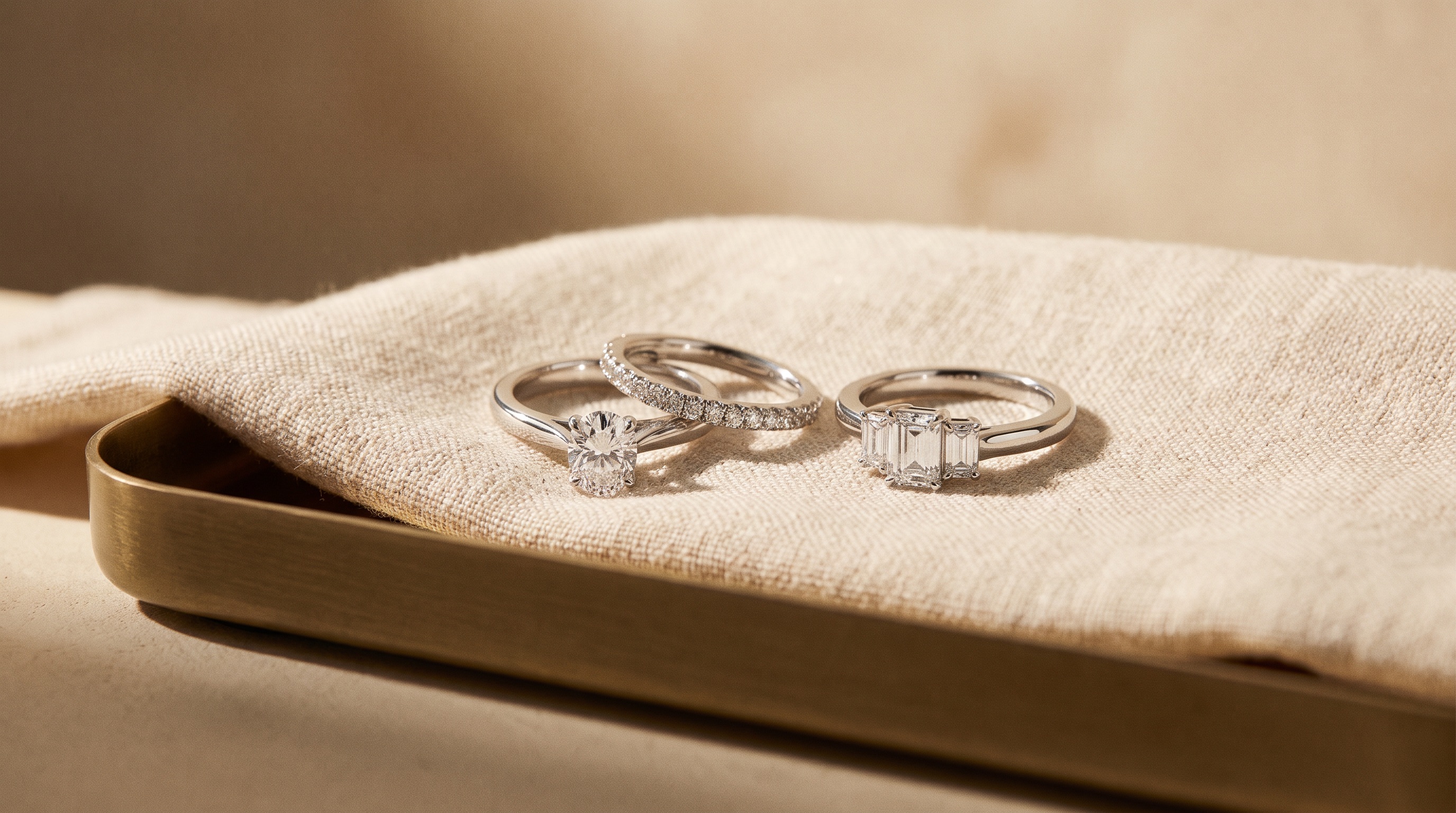
The Friction Retailers Expect (And Why Most of It Doesn’t Materialize)
Most retailers who hesitate on lab-grown aren’t worried about the stone. They’re worried about the operational overhead: a second showcase, a parallel price list, staff fumbling an answer in front of a customer, or a “which catalog is this from” mix-up at the counter. Those fears make sense — if you were adding lab-grown as a stocked, pre-set inventory line, you would in fact be running two catalogs and training staff on two sets of talking points.
That overhead is specific to an inventory model, not to lab-grown itself. If your custom jewelry program already works by taking a design, sourcing a center stone to spec, and building the piece in-house, adding lab-grown doesn’t introduce a second workflow. It adds a second option inside the workflow you already have.
Picture the stocked version to see the difference. A case of pre-set natural solitaires next to a case of pre-set lab-grown solitaires means two SKUs for every style, two price tags, two reorder cycles, and a sales associate who has to remember which case a customer is standing in front of. Multiply that across ring styles, metal options, and carat breaks, and the “training” problem is real — there’s genuinely more for staff to track. None of that exists in a build-to-order model, because there was never a second case to begin with. The lab-grown option lives inside the same intake form as everything else.
What Actually Changes on the Sales Floor
Lay the two versions of the process side by side and the list of what’s actually different is short. Six rows touch stone origin in a typical custom-order pipeline, and five of the six say the same thing on both sides of the table.
| Sales step | Natural-only custom program | After adding lab-grown |
|---|---|---|
| Design / CAD selection | Customer picks style, staff pulls up CAD options | No change |
| Setting, metal, karat | Standard consult | No change |
| Center stone sourcing | Natural, to spec | New line: natural or lab-grown (CVD) |
| Certification | IGI/GIA on 0.30ct+ | Same standard, both origins |
| Melee / accent stones | Uncertified parcel, QC’d to a color/clarity baseline | Same, regardless of center stone origin |
| Production pipeline | CAD approval → in-house cutting, setting, polishing | Same pipeline, same delivery window on finished pieces |
| Pricing conversation | Standard markup conversation | One added talking point on why lab-grown center stones price differently |
Everything in the left column that already works keeps working. The additions are narrow and staff-facing, not systemic.
The one row that’s genuinely new is the pricing conversation, and even that isn’t a new skill — it’s the same markup conversation staff already have when a customer compares two carat weights or two clarity grades, just applied to a different variable. Nothing here requires a manual.
Why the Custom-Order Model Sidesteps the Catalog Problem
A dual-catalog problem only exists if you’re stocking two sets of finished goods — one natural, one lab-grown — and asking customers to choose between two physical displays. A custom jewelry model doesn’t work that way. The design catalog (settings, styles, mountings) is shared. The only thing that forks is the center stone spec, and that fork already exists in your intake process in the form of carat, color, and clarity fields. Adding an origin field next to those isn’t a new system — it’s one more dropdown on a form your team fills out for every custom order already.
Whether that intake happens on a paper order sheet, a point-of-sale custom-order module, or a shared form with a supplier, the mechanics are the same: one more field, filled out once per order, at the moment staff already capture carat, color, and clarity. There’s no parallel system to maintain and no second price list to keep in sync. Each stone is sourced against a specific order the moment the customer signs off on the design, the same as it is today.
No New Case, No New SKUs
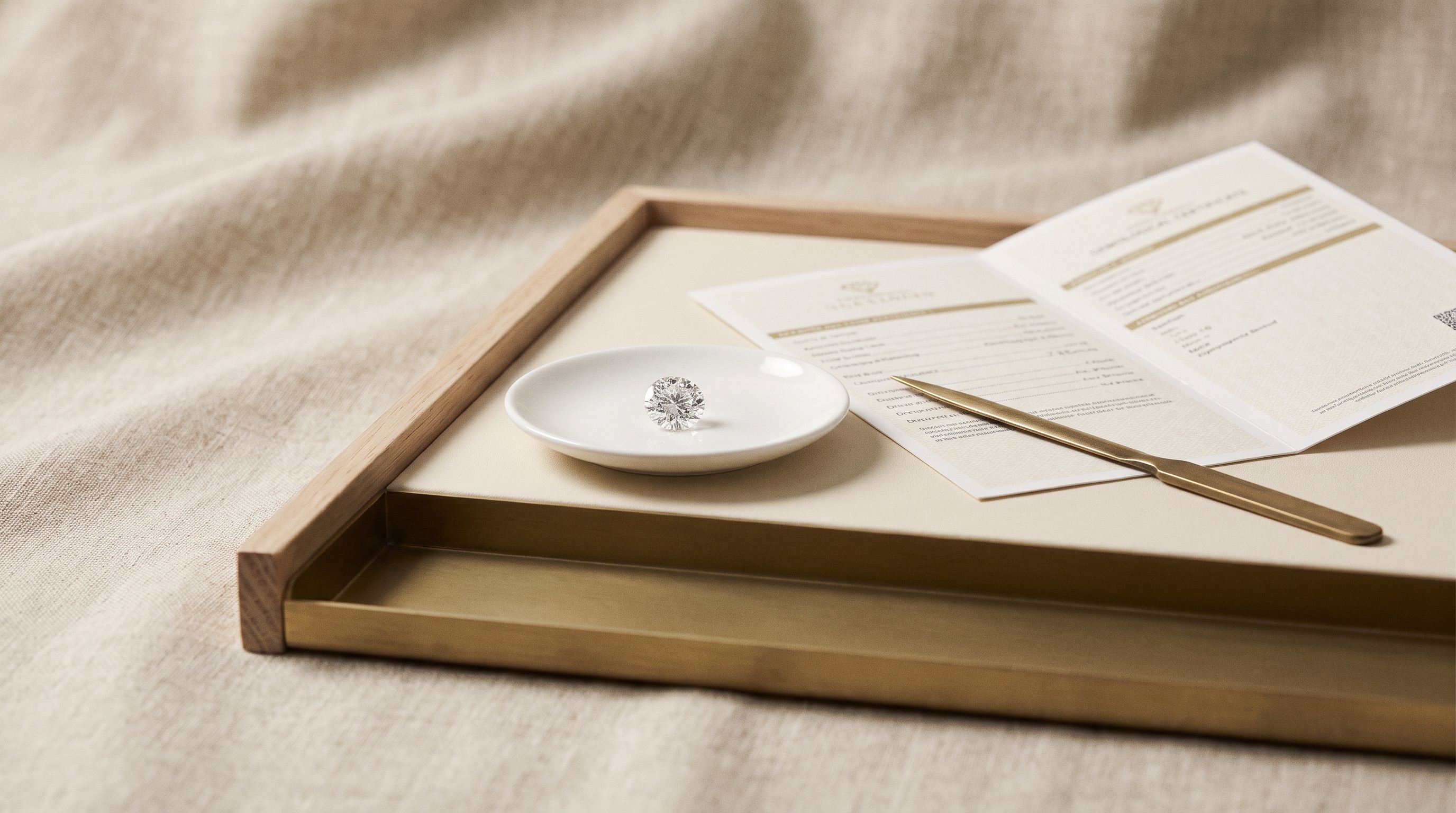
Because nothing is pulled from open stock, there’s no shelf space decision to make. A customer looking at a CAD rendering doesn’t need to see a lab-grown stone sitting in a case to understand what they’re ordering — the same way they don’t need to see their exact carat weight sitting in a case today. The stone is sourced to the order, not displayed as inventory. If you want a physical reference point, a single loose stone or a certificate sample behind the counter covers it; you don’t need a second showcase.
That single reference stone does more selling than a full case would anyway. A customer handling one well-cut loose diamond and its certificate learns everything they need to compare origins — cut quality, clarity, how it reads under different light — without staff having to manage the inventory shrinkage risk or the insurance exposure that comes with a second open case of finished goods sitting on the floor.
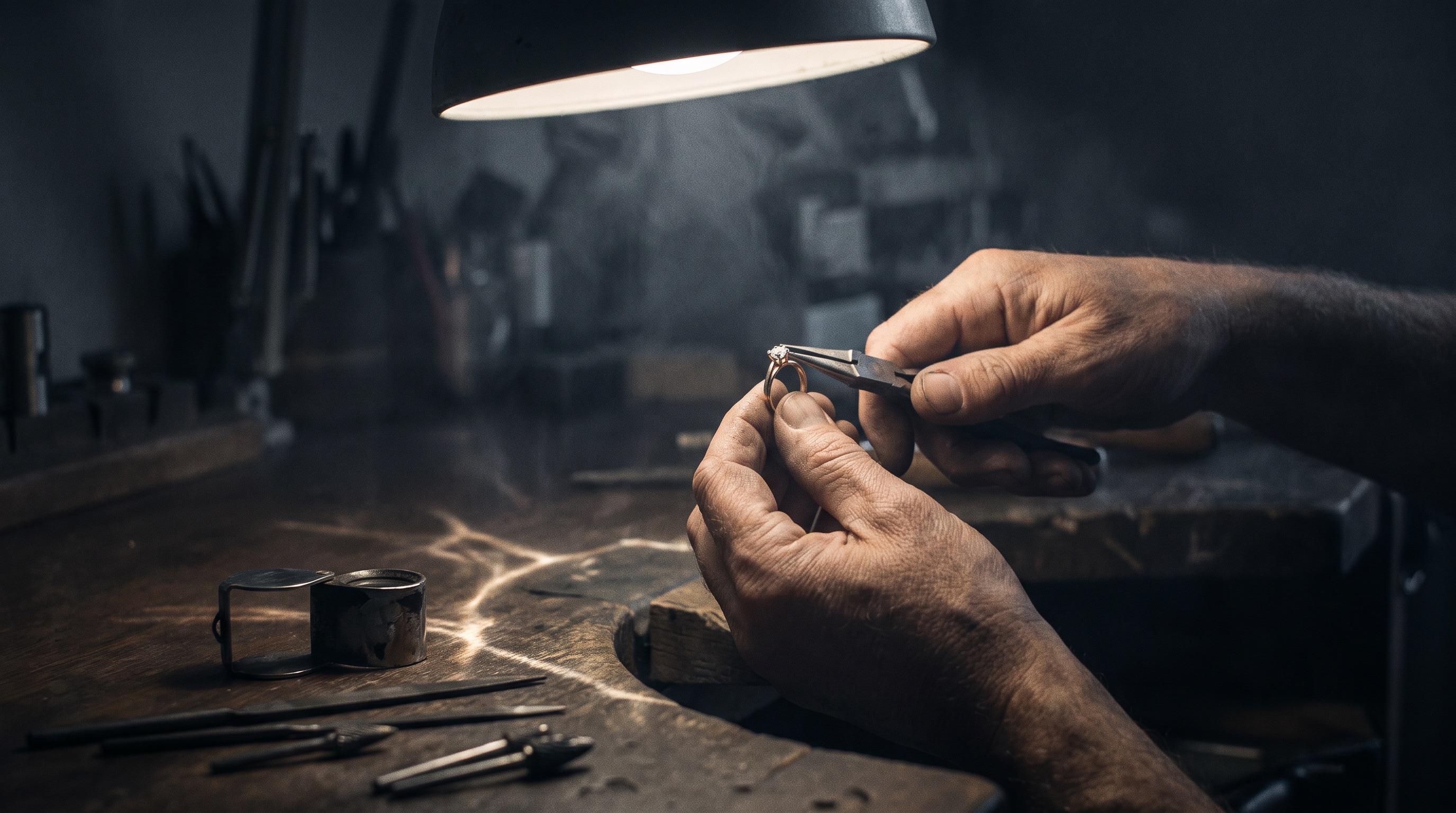
The Sales Conversation Stays the Same
Walk it through in order:
- Design — what style, what silhouette, what does the customer have in mind or bring in as a reference.
- Setting — prong, bezel, halo, pavé, metal and karat.
- Budget — what range are they working with.
- Stone sourcing — natural or lab-grown, at the carat/color/clarity target that fits the budget.
Steps one through three are identical to the conversation your staff already runs. Step four is new only in the sense that it’s now an explicit choice rather than an assumed default. It doesn’t require a different sales technique — it requires staff to be comfortable stating the difference in plain terms and moving on, the same way they’d answer a question about white gold versus platinum.
In practice, step four sounds like one extra sentence dropped into a conversation staff are already having. A customer settled on a cushion halo in 18k white gold, working within a set budget, gets asked one additional question: natural or lab-grown center stone, and here’s what that trades off at the carat target already discussed. That’s the entire script addition, delivered in the same consultative tone staff already use for carat-versus-clarity or metal-versus-budget tradeoffs. No separate pitch, no second appointment, no handoff to a specialist — the person running the consult today runs the whole consult tomorrow.
The Handful of Questions Staff Actually Get Asked
These aren’t hypothetical. They’re the same five questions that come up, in roughly the same order, regardless of the shop — because they’re what any informed buyer asks about a product they’re committing to against a rendering rather than an item sitting in front of them. Staff don’t need to anticipate variations; the pattern repeats.
In practice, once lab-grown is on the floor, the questions cluster around a small, repeatable set:
| Customer asks | Short, accurate answer |
|---|---|
| “Is this a real diamond?” | Yes — grown using CVD (chemical vapor deposition) rather than mined, but the same crystal structure, optical properties, and hardness as a mined stone. |
| “Is it certified?” | On loose center stones 0.30ct and up, yes — IGI or GIA grades lab-grown the same way they grade natural, with the report noting growth method. |
| “Why is it priced lower than a natural stone at the same specs?” | The growing process is different, not the material — that difference in production is what drives the price gap, not a lesser stone. |
| “Can I get GIA instead of IGI, or vice versa?” | Both are available — worth confirming which the customer’s market prefers before the order is placed. |
| “Are the accent/melee stones certified too?” | No — melee (small calibrated stones) ships as uncertified parcel goods checked against a color/clarity baseline, whether natural or lab-grown. That’s standard industry practice, not a quality shortcut specific to this order. |
Five answers cover the overwhelming majority of what comes up. None of them require a script longer than a sentence or two, and none of them touch the design/setting/budget conversation staff already know how to run. Print them, laminate them, or drop them into whatever reference material staff already keep behind the counter — the goal is instant recall, not memorization under pressure.
Certification: The One Technical Detail Worth Memorizing
If there’s a single fact worth drilling into the team, it’s this: certification standards don’t change based on stone origin. Loose diamonds at 0.30ct and up — natural or lab-grown — are eligible for IGI or GIA certification, graded on the same color, clarity, cut, and carat scale. The certificate will note the growth method, but the grading rigor is identical. Melee is the one category where certification doesn’t apply at all, regardless of whether the center stone next to it is natural or lab-grown — it’s parcel goods QC’d to a baseline, not individually graded. Getting that distinction right in front of a customer builds more trust than any pricing pitch will.
What actually shows up on that report is worth knowing cold, because it’s the piece customers ask to see even when they don’t ask a follow-up question. A standard grading report lists shape, measurements, carat weight, color, clarity, cut grade, and — for a lab-grown stone — a growth method line identifying it as laboratory-grown, typically alongside a corresponding inscription laser-etched on the stone’s girdle. That inscription is permanent, visible only under magnification, and it’s the detail that answers “how would anyone know” before a customer has to ask it. It’s not a workaround or an asterisk; it’s the same disclosure standard both major labs apply consistently.
Most shops standardize on IGI or GIA and rarely need to go further. Where a customer’s market, insurer, or resale channel specifically requests it, GCAL certification is available too — worth knowing a third option exists so staff aren’t caught flat-footed by the customer who asks for it by name.
Pricing: What to Say When the Gap Comes Up
The least useful answer to “why is it cheaper” is silence or a hedge — customers read hesitation as something being hidden. The most useful answer is direct: the diamond itself has the same physical and chemical makeup either way; the price difference reflects the production method, not a compromise on the stone. Staff don’t need pricing scripts beyond that. Avoid promising savings percentages or comparing against any named competitor or outsourced manufacturing partner — keep the comparison to the stone, not the market.
Underneath that plain answer is a real production distinction worth understanding, even if it never gets said aloud to a customer: a mined stone’s cost structure is set by extraction — locating, excavating, and processing diamond-bearing rough, with its own overhead baked in regardless of the stone’s final size or quality. A lab-grown stone’s cost structure is set by the growing process itself, run in a controlled facility rather than a mine. Different inputs, different cost base, same crystal on the other end — and staff who understand that distinction answer pricing questions with more confidence than staff working from a memorized line.
Turnaround Doesn’t Change Either
Because custom pieces move through the same in-house pipeline — CAD approval, then in-house cutting, setting, and polishing — adding a lab-grown option doesn’t add steps or slow anything down. A finished custom piece still moves from CAD approval to completion in 4-6 days; that timeline is about the jewelry-making process, not about which type of center stone is inside it. It’s worth saying that plainly to customers who assume “new material” means “new wait.”
The reason origin doesn’t touch the timeline is that it enters the pipeline before production starts, not during it. Once a customer approves a CAD rendering, the center stone — whichever origin was chosen — is already matched to spec and staged for the piece; from that point forward, the build follows identical steps regardless of what’s going into the setting: casting the mounting, setting the stones, polishing, and a final quality check before the piece ships. A jeweler quoting 4-6 days on a natural custom order can quote the same window on a lab-grown one without hedging, because the variable that changes — where the center stone came from — sits entirely upstream of the steps that determine how long production takes.
How Your Supplier Absorbs the Technical Complexity
Everything above describes what changes for the retailer, which is close to nothing. The reason it can stay that simple is that the technical complexity of adding a lab-grown option doesn’t disappear — it moves upstream, onto the supplier side of the relationship, before an order ever reaches the sales floor.
On a made-to-order model, that means a manufacturing partner handles stone sourcing to the exact carat, color, clarity, and shape spec on the intake form; cutting, setting, and polishing the piece in-house rather than routing production through different shops; managing certification paperwork with IGI, GIA, or GCAL directly; and running quality control on the finished piece before it ships. None of that requires the retail sales team to understand CVD growth chemistry, cutting geometry, or how a grading lab calibrates its color scale — it requires them to fill out an intake form accurately and trust the partner behind it to handle the rest.
That division of labor is what makes “no retraining” true rather than aspirational. A retailer doesn’t need in-house expertise in a second stone category if the supplier relationship already covers it end to end — one intake form, one production pipeline, one point of accountability for the finished piece, whether the center stone started as rough from the ground or as carbon in a growth chamber.
Sales-Support Materials That Do the Explaining for You
Staff don’t need to memorize a script if the reference material does the explaining instead. A short set of physical and digital materials covers most of what comes up in a consult, and none of it requires custom production to put together:
- A one-page spec card at the counter listing the five questions above with answers in plain language — the same card referenced in the checklist below.
- A sample certificate (IGI, GIA, or GCAL) that staff can hand a customer to show exactly what a lab-grown report looks like, side by side with a natural one.
- A single loose reference stone behind the counter, so a customer who wants to see and hold something before committing to a CAD rendering has that option without a full case.
- A link to the supplier’s how it works page, so a curious customer — or a skeptical one — can read the production process directly instead of taking a salesperson’s word for it.
- A direct line to the supplier for anything outside the standard five questions, so staff never have to guess or invent an answer on the spot.
None of these are new systems to build. They’re a printed card, a sample document, one stone, one link, and one phone number — the kind of reference kit a shop already keeps for other product categories, applied to this one.
A Staff Prep Checklist Before You Flip the Switch
Put the reference materials in place and the rest of the rollout is a short list of one-time decisions, not an ongoing training program. Here’s everything that needs to happen before the first lab-grown custom order goes out the door:
- Add one field to the custom intake form: natural or lab-grown center stone.
- Confirm which certification body (IGI, GIA, or either) your order sheet defaults to.
- Post the five-question table above somewhere staff reference during a consult — a printed card at the counter works fine.
- Decide whether finished pieces ship unbranded (the standard default, so you can present them as your own) or with any disclosure requirement your state or market expects.
- Point staff to your supplier’s how it works page once, so they understand the pipeline they’re describing to customers.
That’s the entire onboarding list. Nothing on it takes more than an afternoon.

Why This Works: One Vendor, Not Two Workflows
The reason this stays simple is structural: one supplier covering both natural-adjacent capability (antique and fancy-shape cutting, fancy color, certification) and lab-grown custom work means your floor isn’t managing two vendor relationships, two order processes, or two sets of paperwork. It’s one intake form, one production pipeline, one shipment per order. If you’re evaluating a manufacturing partner for this reason specifically, that consolidation — not the training question — is the thing worth asking about on a trade partner call.
Worth asking about specifically, because not every supplier is built to answer it. A partner that only handles lab-grown center stones still leaves a retailer sourcing antique and fancy cuts, fancy color stones, and melee from somewhere else — which recreates the two-vendor problem the custom-order model was supposed to avoid, just one level up the supply chain. The version worth asking for on a trade call is one vendor covering antique and fancy-shape cutting, fancy color stones and fancy color melee, calibrated melee for accent work, and both natural and lab-grown custom center stones, with IGI, GIA, and GCAL certification available across the board — a single relationship, a single shipment per order, and a single point of accountability.
Frequently Asked Questions
Do I need a separate display case for lab-grown custom jewelry?
No. Because custom pieces are built to order rather than stocked, there’s nothing to display in advance. A single loose stone or certificate sample at the counter is enough of a physical reference if customers want to see one; you don’t need a dedicated case or a second showcase to sell the option. The only extra footprint the option adds is a line on an order form.
Is a lab-grown center stone in a custom piece certified the same way as a natural one?
Yes. Loose diamonds at 0.30ct and up are eligible for IGI or GIA certification regardless of whether they’re natural or lab-grown, graded on the same color, clarity, cut, and carat criteria. The report will note the growth method, but the grading standard itself doesn’t change. GCAL certification is also available on request for markets or customers who specifically ask for it.
How should staff answer “is this a real diamond” when it’s lab-grown?
The accurate answer is yes — a lab-grown diamond is grown using CVD (chemical vapor deposition) rather than mined from the earth, but it has the same crystal structure, hardness, and optical properties as a mined stone. It’s a diamond by composition, not a simulant. It’s worth saying exactly that plainly, since hedging on this question damages trust more than the honest answer ever would.
Does adding a lab-grown option slow down custom order turnaround?
No. Lab-grown and natural center stones move through the same in-house production pipeline — CAD approval, then in-house cutting, setting, and polishing. A finished custom piece still moves from CAD approval to completion in 4-6 days regardless of which stone origin the customer chooses, because the stone origin is decided and sourced before production begins, upstream of the steps that determine the delivery window.
Are the small accent stones (melee) in a lab-grown custom piece certified?
No. Melee is uncertified parcel goods checked against a color and clarity baseline rather than individually or parcel certified — that’s true whether the melee is natural or lab-grown. Only the loose center stone, at 0.30ct and up, carries an individual certificate. This is standard practice across the trade, not something specific to one supplier or one stone origin.
Will adding lab-grown custom jewelry confuse customers who are used to natural-only?
Rarely, if the conversation stays in the order it already runs: design, setting, budget, then stone sourcing as the last spec decision. Customers generally follow staff’s lead on sequencing, so keeping stone origin as the last decision rather than the first keeps the whole consult feeling familiar — the only new moment is choosing an origin, which staff can present the same way they’d present a metal or karat choice.