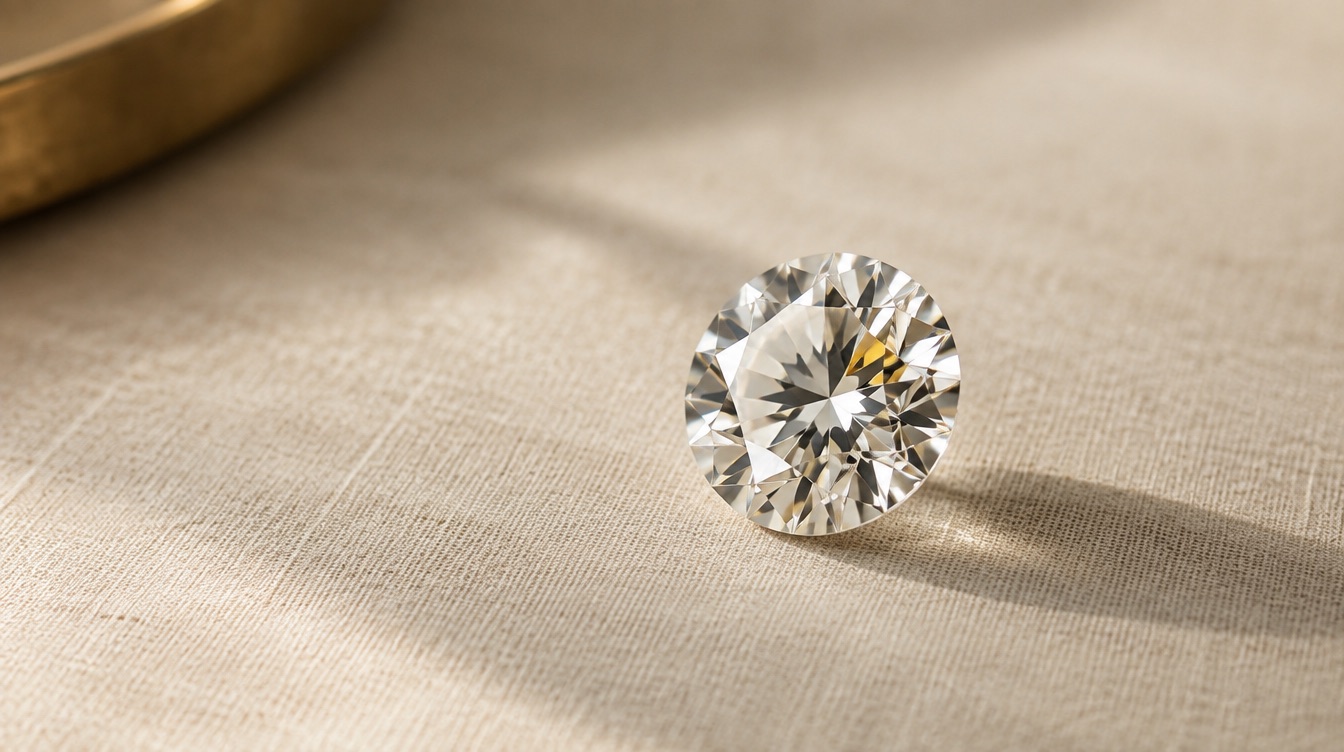
A 3.5 carat natural diamond is a large center stone — roughly 9.7-9.8mm across in a well-cut round brilliant — priced primarily by how cut, color, and clarity combine rather than by carat weight in isolation. At this size, the spread between a lower-grade stone and a top-grade, independently certified one can be dramatic, since rough scarcity, cut precision, and grading each compound rather than simply add up.
This guide covers what actually drives 3.5 carat natural diamond pricing: how the 4Cs interact at this specific weight, why a stone that lands right at 3.50ct can price differently than one just under or over that line, which shapes make sense at this scale, what certification options mean for a stone this size, and what a wholesale or trade buyer sourcing loose natural stones at 3.5 carats should actually be evaluating.
Where 3.5 Carats Sits in the Natural Diamond Sizing Landscape
Carat weight measures mass, not diameter, and because a diamond's visible size scales with volume rather than a single linear dimension, each additional half-carat above 3 carats adds noticeably less visible spread than the same half-carat would lower down the size chart. A 3.5-carat round brilliant, cut to reasonably good proportions, typically measures in the high-9mm range in diameter — a real but incremental step up from 3 carats, and a step below a full 4-carat stone.
| Carat Weight | Approx. Round Brilliant Diameter | Sizing Tier |
|---|---|---|
| 2.00 ct | ~8.2mm | Upper bridal / statement range |
| 3.00 ct | ~9.3-9.4mm | Statement center stone |
| 3.50 ct | ~9.7-9.8mm | Large statement center stone |
| 4.00 ct | ~10.1-10.2mm | Large statement center stone |
| 5.00 ct | ~11.0mm | Very large statement center stone |
The practical implication for a buyer weighing 3.5 carats against 4 carats: the visible diameter difference between the two is genuinely modest, while natural diamonds at this weight tend to carry a much more pronounced price difference between the two, since rough capable of yielding a clean 4-carat polished stone is meaningfully scarcer than rough yielding 3.5 carats. That gap is worth having in mind before defaulting straight to the rounder number.
Why Carat Weight Alone Doesn't Set Price at This Size
At 3.5 carats, two stones of identical weight can land in very different price tiers depending on the rest of the 4Cs — cut, color, and clarity each move price independently of carat weight, and at this size the effect compounds rather than simply stacking. Natural rough large enough to yield a well-proportioned 3.5-carat polished stone is genuinely scarce relative to smaller sizes, which is why a modest grade difference at this weight tends to translate into a larger dollar swing than the identical grade difference would at, say, 1 carat. Buyers who focus only on carat weight and skip the rest of the specification are the ones most likely to overpay relative to what a stone actually delivers, or underpay for something with a hidden downside.
How Cut Affects 3.5 Carat Natural Diamond Price
Cut grade (commonly Excellent, Very Good, Good, Fair, Poor) affects price directly, since better-cut stones command a premium, and indirectly, since cut quality determines how much of a 3.5-carat stone's size and brilliance is actually visible face-up. A stone cut too deep hides weight in the pavilion where it adds no visible size, which at this scale can mean a 3.5-carat stone that actually reads smaller across the top than a well-proportioned stone of the same weight — a meaningful problem when the entire appeal of a stone this size is its visual presence. Cutters working with large rough also face a genuine tradeoff between maximizing retained carat weight and optimizing proportions, and at 3.5 carats that tradeoff is more consequential than at smaller sizes because the dollar value riding on the decision is higher.
How Color Affects 3.5 Carat Natural Diamond Price
Color grade runs from D (colorless) down through the alphabet toward Z (light yellow or brown), with price stepping down at each grade and steeper drops at certain boundaries — D-F "colorless," G-J "near colorless," and so on. At 3.5 carats, color differences are more visible to the naked eye than they are in smaller stones, simply because there's more surface area for tint to show, which means the eye-clean-equivalent sweet spot buyers rely on at 1 or 1.5 carats shifts upward somewhat at this size. Many buyers at 3.5 carats still find G-H color delivers a convincingly colorless look at a real cost savings versus D-F, but the margin for tolerating lower color grades without visible warmth is narrower than it is at smaller carat weights.
How Clarity Affects 3.5 Carat Natural Diamond Price
Clarity, graded from Flawless (FL) down through Included (I3), measures internal inclusions and surface blemishes, and like color, price steps down at each grade boundary. At 3.5 carats, the larger table and crown surface area make inclusions more likely to be visible without magnification at a given clarity grade than the same grade would be on a smaller stone — meaning a clarity level that reads as eye-clean at 1 carat may not automatically clear that bar at 3.5 carats. VS1 and VS2 remain a common target range for buyers prioritizing eye-clean appearance without paying for imperceptible top-tier grades, but at this size it's worth confirming eye-cleanliness against the actual stone rather than assuming a clarity grade alone guarantees it.
| Grade Tier (at 3.50ct, natural) | Relative Price Level | Typical Buyer Profile |
|---|---|---|
| D-F color / VVS-FL clarity / Excellent cut | Premium | Buyers prioritizing top-tier certificate grading and maximum resale/prestige value |
| G-H color / VS clarity / Excellent-Very Good cut | Upper-mid | Buyers wanting a colorless, eye-clean stone without paying for imperceptible top-tier grades |
| I-J color / SI clarity / Very Good cut | Mid / value | Value-focused buyers prioritizing visible size over grading extremes |
| K+ color / I clarity / Good cut or below | Value | Budget-driven buyers, or use cases where warmth or minor visible inclusions matter less |
The Carat-Weight Breakpoint Effect: Why 3.50ct Specifically Matters
In the natural diamond trade, price isn't a smooth curve against carat weight — it moves in steps, with the sharpest jumps occurring right at whole and half-carat thresholds. A stone weighing 3.51ct is priced in a different, higher weight bracket than a stone at 3.47ct, even though the visible and practical difference between the two is essentially nothing. This is a direct consequence of how buyers and pricing guides categorize stones by weight bracket (for example, a "3.00-3.49ct" bracket versus a "3.50-3.99ct" bracket), rather than by continuous weight.
This creates real strategic decisions on both sides of the transaction. A cutter working a piece of rough that could yield either a 3.47ct stone with slightly better proportions or a 3.51ct stone by retaining a touch more weight has a genuine incentive to cross the 3.50ct line even at some cost to cut quality, because crossing that threshold moves the stone into a higher pricing bracket. For a buyer, this means a stone sitting just under 3.50ct — say 3.46-3.49ct — can sometimes represent meaningfully better value than a stone just over the line at 3.50-3.53ct, assuming comparable color, clarity, and cut, simply because it falls in the lower bracket despite being visually indistinguishable. Buyers and jewelers who understand this breakpoint effect can use it deliberately: a stone at 3.48ct with excellent proportions is frequently a smarter buy than a 3.52ct stone with only adequate proportions, at a lower relative cost for essentially the same look.
Shape Considerations at 3.5 Carats
Shape is a significant, sometimes underweighted lever at this size. Round brilliant typically commands the highest price per carat of any shape at a given grade, for two compounding reasons: it retains a smaller percentage of the original rough crystal than most fancy shapes (lower yield for the cutter), and it remains the most consistently requested shape for large center stones generally, keeping demand-side pressure on price. Fancy shapes — oval, cushion, emerald, radiant, pear, marquise — generally cost less per carat than round at comparable grades, and several of them present more visible surface area per carat than a round brilliant of identical weight, an effect that becomes especially pronounced at 3.5 carats where the goal is often maximum visual presence.
Elongated shapes like oval, marquise, and pear tend to look larger face-up than their carat weight alone would suggest, which is one reason they're a common choice for buyers targeting a large-looking stone on a defined budget at this weight class. Step cuts like emerald and Asscher show inclusions and color more openly than brilliant-faceted shapes because of their large, flat facets and fewer light-scattering surfaces — a real tradeoff that matters more at 3.5 carats than at smaller sizes, since a step-cut stone this large gives inclusions and tint nowhere to hide. Buyers considering a step cut at this weight should generally budget for a grade or two higher in both color and clarity than they would for an equivalent-looking brilliant-faceted shape.
Certification at 3.5 Carats: Why It Matters More, Not Less
An independently certified 3.5 carat natural diamond — graded by GIA, IGI, or GCAL — carries a real premium over an uncertified stone of comparable apparent quality, and at this size the case for certification is stronger, not weaker, than at smaller weights. Certification cost is a genuinely small fraction of a 3.5-carat stone's total value, and the amount riding on an accurate, independently verified 4Cs assessment is correspondingly larger. An uncertified stone at this weight should be treated as a meaningful red flag rather than a cost-saving opportunity — the potential downside of a misrepresented grade is far larger in dollar terms at 3.5 carats than it is on a smaller stone.
GIA, IGI, and GCAL each issue full grading reports covering the 4Cs plus additional characteristics like fluorescence, proportions, and any treatment disclosure, and all three are widely recognized across the wholesale trade. Differences between labs tend to show up in grading tendencies at the margins rather than in the report's fundamental reliability, which is why requesting the certifying lab as part of any quote comparison at this size matters — comparing a GIA-graded stone against an IGI-graded stone on price alone, without normalizing for lab, can be misleading if the two labs' grading tendencies differ even modestly at the grade boundary in question.
Fluorescence, Treatments, and Other Price Factors at This Size
Fluorescence — the glow some diamonds emit under ultraviolet light — is a minor but real factor at 3.5 carats. Strong or Very Strong blue fluorescence can occasionally give a large stone a slightly hazy appearance in strong UV-heavy daylight, and stones with strong fluorescence typically sell at a modest discount to otherwise identical non-fluorescent stones, particularly in higher color grades where any haziness is more likely to be noticeable against an otherwise colorless face. In lower color grades, fluorescence can sometimes work in the buyer's favor by making the stone appear marginally whiter.
Treatments — clarity enhancement (fracture filling) or color treatment (HPHT processing or irradiation) — are less common at 3.5 carats than in smaller melee-adjacent sizes, simply because treating a stone this valuable carries more risk for the treater, but they do exist in the market and must be disclosed on a proper grading report. A treated stone at this size sells at a significant discount to an untreated stone of the same apparent grade, and given the dollar value involved, confirming treatment status through an independent certificate — never a seller's own representation alone — is one of the more important checks a buyer can make at this weight.
Buying vs. Sourcing: What Changes at Wholesale
Retail pricing for a 3.5 carat natural diamond layers significant markup on top of the stone's underlying wholesale cost, typically covering the retailer's overhead, marketing, and margin — and at this size, where the total dollar value is substantial, that markup compounds into a meaningfully larger absolute gap than it would on a smaller stone. Jewelers, designers, and manufacturers sourcing at the wholesale level work much closer to a stone's actual underlying cost basis, which is a large part of why trade accounts matter specifically for anyone regularly buying or setting natural center stones at this weight class rather than sourcing one-off through retail channels.
Wholesale sourcing at 3.5 carats also typically provides more direct access to full grading documentation, a broader range of grade and shape combinations to compare side by side, and — for buyers building recurring inventory rather than filling a single order — a more reliable ongoing supply relationship than sourcing individually from whichever channel happens to have the lowest price on a given day. Because well-specified natural stones at this weight are lower-volume than smaller carat sizes, a trade buyer benefits more from a consistent supplier relationship here than at sizes where inventory turns over quickly and easily.
What a Trade Buyer Should Actually Compare Across Quotes
When evaluating quotes from more than one supplier for a 3.5-carat natural stone, the only reliable comparison holds every variable constant except price: same shape, same color grade, same clarity grade, same cut grade, and the same certifying lab. At this size, even a single grade step in any one of those variables — a G versus an H color, a VS2 versus an SI1 clarity — can account for a substantial price gap on its own, independent of whether one supplier is simply quoting more competitively. A trade buyer requesting quotes on a specific, fully-specified stone rather than a general "3.5 carat, good quality" ask removes that ambiguity and makes any remaining price difference between suppliers genuinely comparable.
It's also worth confirming, specifically at this weight, whether a quoted stone is in current on-hand inventory or being sourced to order. Well-specified natural stones at 3.5 carats turn over less frequently than smaller sizes, and a supplier's ready-to-ship inventory at this exact weight can be narrower at any given moment than at more commonly stocked sizes — a legitimate factor to build into sourcing timelines for a trade buyer working against a client deadline.
Practical Buying Tips for 3.5 Carat Natural Diamonds
- Prioritize cut first, especially at this size. A well-cut 3.5-carat stone shows meaningfully more brilliance and face-up size than a poorly cut stone of the identical weight, and the difference is more visible at 3.5 carats than at smaller sizes.
- Check where the stone actually falls relative to the 3.50ct line. A stone just under the threshold with strong proportions can be a smarter buy than one just over it with only adequate cutting, at comparable visual result.
- Confirm certification and treatment disclosure from GIA, IGI, or GCAL. The dollar value at stake at this size makes independent verification more important, not less.
- Weigh clarity and color one notch higher than you would at smaller sizes. The larger surface area at 3.5 carats makes inclusions and tint more visible at a given grade than the same grade would show on a 1-carat stone.
- Factor in shape carefully. Round brilliant carries the highest per-carat price of any shape; an elongated fancy shape can deliver more visible size for the same budget, while a step cut demands a grade cushion for color and clarity.
Common Mistakes Buyers Make at This Size
- Comparing quotes on carat weight and price alone. Without normalizing for cut, color, clarity, shape, and certifying lab, a price comparison between two 3.5-carat stones is not a meaningful comparison.
- Assuming a grade that reads eye-clean at 1 carat will read the same way at 3.5 carats. Larger surface area changes what's actually visible to the naked eye at a given clarity grade.
- Ignoring the carat-weight breakpoint effect. A stone priced just over the 3.50ct line isn't automatically a better buy than a comparable stone just under it — the reverse is often true once cut quality is factored in.
- Treating certification as optional at this size. The dollar value riding on an accurate 4Cs assessment is too large at 3.5 carats to rely on an uncertified seller representation.
Sourcing 3.5 Carat Natural Diamonds at Guru Diam
Guru Diam is a trade-only wholesale diamond supplier with locations in New York and Los Angeles, carrying certified natural loose diamonds alongside its CVD lab-grown catalog, calibrated melee, and finished jewelry, across standard, antique, and exotic shapes alike. Natural loose stones at 3.5 carats and other large center-stone weights ship with full grading documentation from GIA, IGI, or GCAL, giving trade buyers the independent verification a stone at this value level warrants.
In-stock natural loose diamond inventory ships same-day from both locations — New York before 6pm EST, Los Angeles before 4pm PST — and buyers can confirm current on-hand availability at this specific weight and specification before placing an order. Trade accounts can browse certified natural inventory through the certified diamonds category, source calibrated accent stones for a piece built around a 3.5-carat center stone through matching pairs, or explore fancy color options through fancy color loose diamonds. Jewelers and designers building a custom piece around a large natural center stone can work through custom jewelry, and trade accounts can review wholesale terms at the wholesale hub or apply directly through trade partner.
How 3.5 Carats Fits the Broader Natural Diamond Carat Ladder
Sitting between the more commonly stocked 3-carat mark and the further step up to 4 carats, 3.5 carats functions as a genuine middle option for buyers who want a stone that reads unmistakably as a large statement center stone without the steeper price and scarcer availability that comes with a full 4 carats. Some buyers land here deliberately, either because a specific piece of rough yielded a strong 3.5-carat stone at excellent proportions, or because it hits a price point between 3 and 4 carats that fits a defined budget more precisely than either round number.
Because half-carat sizes like 3.5 fall between the round numbers buyers default to first, they're sometimes underexplored in a sourcing conversation. A trade buyer comparing options across a narrow carat range — say a well-cut 3.3-carat stone at a higher grade against a 3.5-carat stone at a slightly lower grade, or a 3.5-carat stone against a 4-carat stone at a meaningfully lower grade to fit the same budget — often finds a better overall value by evaluating across that range rather than fixing on one specific weight in isolation.
Frequently Asked Questions
What determines the price of a 3.5 carat natural diamond?
Cut, color, and clarity drive price more than carat weight alone, and at 3.5 carats those factors compound because well-proportioned rough at this size is genuinely scarce. Certification, shape, fluorescence, and whether the stone falls just above or below the 3.50ct pricing breakpoint all factor in as well.
Why does it matter if a diamond is exactly 3.50 carats versus 3.47 or 3.53?
The natural diamond trade prices stones in weight brackets, not on a smooth continuous curve, and 3.50ct is a bracket boundary. A stone just over the line prices in a higher bracket than one just under it, even though the visible difference between the two is negligible — which means a stone just under 3.50ct with strong cut proportions can represent better value than one just over it with only adequate cutting.
Is a 3.5 carat natural diamond significantly bigger than 3 carats?
Visibly yes, though the jump is more incremental than dramatic — a well-cut 3.5-carat round brilliant measures roughly 9.7-9.8mm in diameter versus about 9.3-9.4mm at 3 carats. The price difference between the two sizes is typically more pronounced than the visible size difference.
Does a 3.5 carat natural diamond need to be certified?
It isn't legally required, but it's standard trade practice and strongly recommended given the value at stake. A report from GIA, IGI, or GCAL independently verifies the 4Cs and discloses any treatment, which matters more at this size than at smaller carat weights.
What shape gives the most visible size for the money at 3.5 carats?
Elongated fancy shapes like oval, pear, and marquise tend to present more visible surface area per carat than a round brilliant of the same weight, while typically costing less per carat than round due to cutting-yield differences.
Should a wholesale buyer expect 3.5 carat natural stones to always be in stock?
Not necessarily. Well-specified natural stones at this weight turn over less frequently than smaller carat sizes, so ready-to-ship inventory at an exact weight and grade combination can be narrower at any given moment — it's worth confirming current on-hand availability for the specific specification needed rather than assuming immediate availability across every grade combination.