
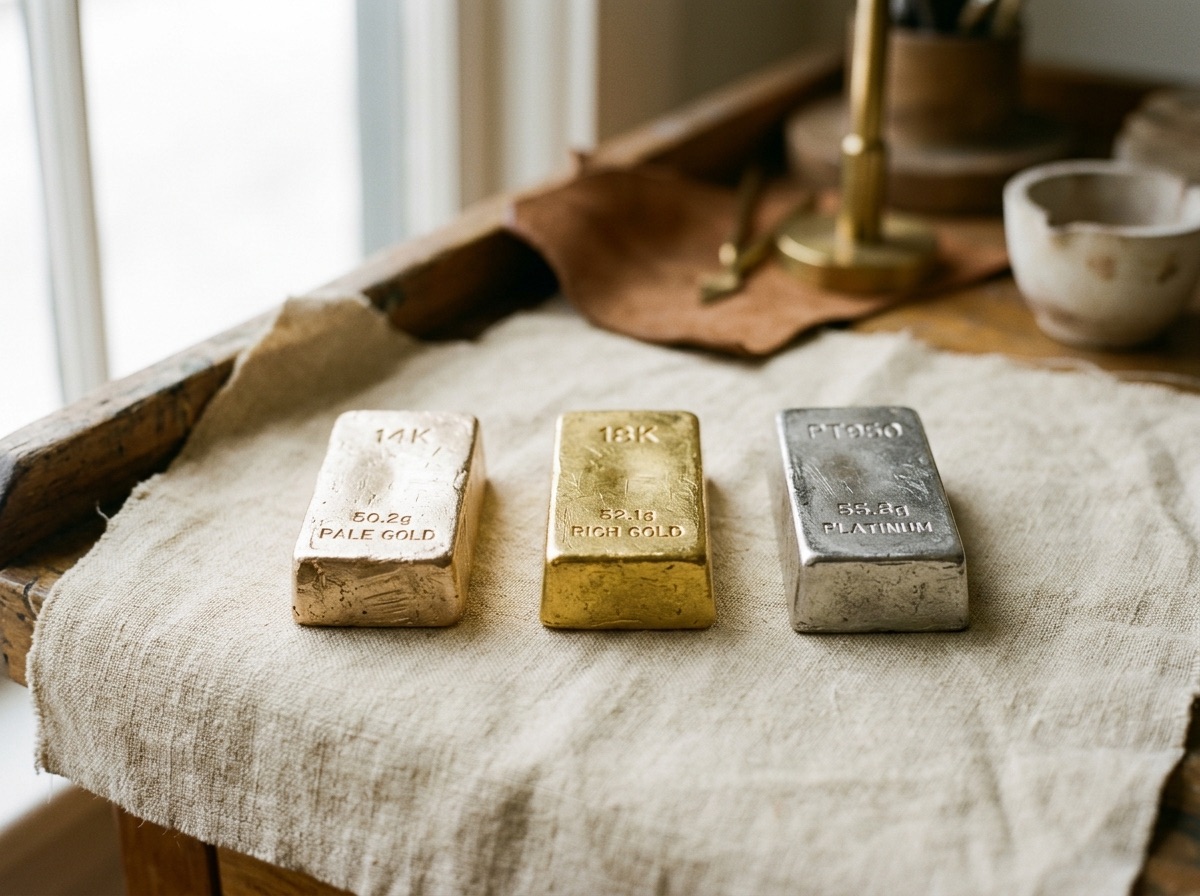
For a piece that gets worn every day — an engagement ring, a stacking band, a men’s wedding ring — 14K gold is usually the practical default. It resists dents and scratches better than softer alloys, holds prong tension longer between retightenings, and keeps the line-item cost down. 18K earns its place on pieces where color depth and a heavier hand-feel matter more than day-to-day toughness — think anniversary pieces or statement rings that come out of the box a few times a month rather than living on a finger through manual work. Platinum is the right call when prong security on a valuable center stone outweighs budget, or when a customer has a documented metal sensitivity — but it comes with a real cost, weight, and casting-time premium that needs to be set expectations on up front. There’s no universally “better” metal here. The right answer comes from how the piece will actually be worn, not from which one looks best on a spec sheet.
This matters more on custom orders than on stock pieces, because a custom spec locks in the metal before CAD approval — and a metal switch after that point means recutting the model and restarting the cast. Getting the conversation with the customer right before the file goes to CAD saves a re-cast, a delay, and an awkward callback.
What “14K,” “18K,” and “Platinum” Actually Mean
Karat measures the proportion of pure gold in the alloy — it’s not a grade of quality, it’s a ratio. The remainder is other metals (copper, silver, zinc, palladium, depending on color) that give the alloy its working hardness and its color. Platinum is measured differently: jewelry-grade platinum is typically 90-95% pure platinum alloyed with a small amount of iridium or ruthenium for workability, which is why it behaves so differently on the bench than either gold karat.
| Metal | Precious metal content | Typical alloy | Relative bench hardness |
|---|---|---|---|
| 14K gold | 58.3% gold | Copper, silver, zinc | Hardest of the three |
| 18K gold | 75% gold | Copper, silver, zinc | Softer than 14K |
| Platinum | 90-95% platinum | Iridium or ruthenium | Dense, but ductile rather than “hard” |
That last column is the one jewelers get wrong most often when explaining metal to a customer — platinum isn’t harder than gold in the way most people assume. It’s denser and more malleable, which produces a completely different wear pattern, covered below.
Two karats outside this range come up often enough to be worth a one-line answer: 10K (41.7% gold) is a low-cost tier that reads noticeably pale and isn’t built for fine bridal work, while 22K and 24K sit near pure gold — soft, and more a category for coin jewelry than for a ring worn daily. 14K, 18K, and platinum cover essentially the entire practical range for US custom and bridal work, which is why the rest of this guide stays inside those three.
Durability: How Each Metal Actually Holds Up
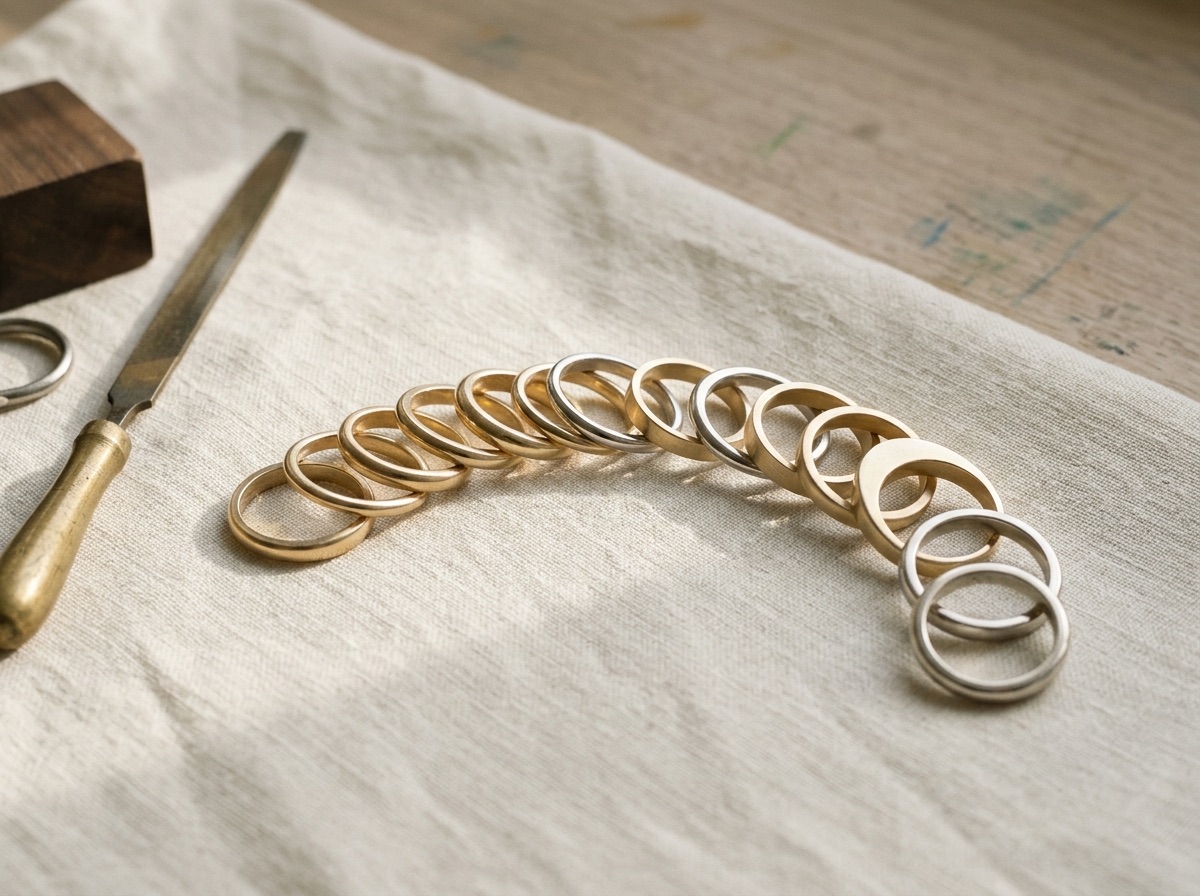
14K’s higher alloy content makes it the most scratch-resistant of the three in daily wear. It holds a crisp edge out of casting and polishing, and it’s the most forgiving metal for a ring that’s going to see manual work, gym use, or a lot of hand-washing.
18K, with less alloy diluting the gold, is noticeably softer. It takes a scratch more easily and a thin shank or prong in 18K will show wear sooner than the same design in 14K. It still holds up fine for jewelry — it’s simply not the choice for a piece that’s going to take a beating.
Platinum doesn’t wear the way gold does. When it gets scratched or scuffed, the metal displaces rather than flaking or wearing away — that’s why platinum jewelry develops a soft, matte “patina” over years instead of thinning out. Some customers like that look and never bring the piece in for repolishing. Others want it re-polished back to a bright finish periodically, which is worth mentioning at the point of sale so it doesn’t come back as a surprise complaint.
There’s also a work-hardening curve to account for, not just a one-time hardness rating. Gold alloys get harder every time they’re bent, hammered, or put under repeated stress — part of why a prong that’s been retightened several times eventually needs annealing (a controlled reheating that softens the metal back down) before it can be worked again without cracking. Platinum work-hardens too, but far more slowly, which is the real mechanical reason it tolerates repeated adjustment better than gold rather than any difference in starting hardness.
Hypoallergenic and Skin-Sensitivity Considerations
Metal sensitivity is one of the few objective, rather than preferential, reasons to steer a customer toward a specific tier. Most reactions trace back to nickel, which is common in white gold alloys as a hardening and whitening agent. A customer who’s had a reaction to inexpensive fashion jewelry or a nickel-alloy watch case is a real signal to ask about before quoting a white gold custom piece — not after the ring comes back with a red band around the finger.
The fix isn’t automatically “go platinum.” Palladium white gold — an alloy that uses palladium instead of nickel to get the white color and hardness — is nickel-free and considerably cheaper than platinum, and it’s the standard substitution when a customer reports sensitivity but budget rules out platinum. Rhodium plating, which nearly all white gold gets regardless of alloy, also acts as a thin barrier layer between skin and the metal underneath — part of why some nickel-sensitive customers tolerate freshly plated white gold fine and then react months later, once the plating has worn thin in the areas that touch skin.
Yellow and rose golds carry their own version of this: rose gold’s warmer color comes from a higher copper content, and copper is a rarer but real sensitivity trigger. 14K, with more total alloy than 18K, carries proportionally more of whatever’s causing the reaction — so for a documented sensitivity, 18K is a small step up over 14K in the same color, and platinum is the largest step up of all. At 90-95% pure platinum, there’s very little alloy content left to react to, which is why it’s the default recommendation for a genuinely sensitive customer regardless of cost.
None of this needs a lab test to manage at the counter. Asking one direct question — “has any jewelry or a metal watch ever irritated your skin?” — before quoting a white gold or yellow gold spec catches nearly every case that would otherwise come back as a return or a complaint after delivery.
Weight and Cost: Where the Line-Item Difference Comes From
Platinum is roughly 60% denser than gold by volume, so the identical CAD file cast in platinum comes out meaningfully heavier than the same file in 14K or 18K. That density drives cost in two ways: more raw material by weight, and a higher melting point that adds bench time and casting loss. This is the single biggest reason platinum custom pieces cost more than a gold equivalent of the same design — it isn’t a “luxury markup,” it’s the physical material and labor difference.
The 14K-to-18K cost gap is more straightforward: it’s almost entirely the gold content. An 18K piece contains close to 30% more pure gold than the same design in 14K, and that difference scales with the current gold price, not with design complexity.
In concrete terms: platinum runs roughly 21.4 g/cm³ against roughly 15.5-16 g/cm³ for a typical gold alloy. Cast the same CAD file in both metals and the platinum version comes out 30-40% heavier by weight — on a wide statement band or a heavy signet-style mounting, that alone can change the cost conversation, independent of platinum’s higher per-gram price.
Color and Finish Differences
- 14K yellow reads warmer and slightly muted next to 18K, because the higher alloy content dilutes the gold’s natural color.
- 18K yellow is noticeably deeper and richer — this is the tier customers are usually picturing when they ask for “warm, buttery yellow gold.”
- White gold (14K or 18K) is not naturally white — it’s rhodium-plated to get that bright white finish, and the plating wears off with handling. Budget for periodic re-plating and say so up front; it’s a maintenance cost, not a defect.
- Platinum is naturally white-gray with no plating involved. It won’t chip or need replating, but its natural patina finish is a different look than a freshly rhodium-plated white gold piece — set that expectation before the customer compares the two side by side.
Rose gold doesn’t fit neatly into the 14K-versus-18K comparison above, because its color comes from alloy mix rather than karat — a higher proportion of copper produces the pink tone regardless of whether the base is 14K or 18K, and the same durability logic applies. Two-tone builds (a platinum or white gold setting paired with a yellow or rose gold shank) come up often enough on custom work to mention proactively — they let a customer get platinum’s prong security on the head without pricing the whole piece at platinum weight, a combination covered again below.
Maintenance and Re-Plating: What to Tell the Customer Up Front
This is the conversation that heads off a “why does my ring look different than when I bought it” complaint a year or two out — and it plays out differently for white gold than for platinum.
White gold’s bright white finish comes entirely from rhodium plating, a thin layer applied over the gold alloy underneath, which is naturally a pale yellowish-gray on its own, not white. That plating wears with normal handling — faster on the palm-side surfaces of a ring that contact things constantly, slower on earrings or a pendant that see less friction. There’s no single interval that applies to every customer: someone who works with their hands or washes dishes daily might need a re-plate within a year, while a piece worn only occasionally can go several years before the yellow undertone starts showing through. The fix itself is routine — a jeweler strips the old plating, polishes, and re-plates — but it’s a recurring cost the customer should hear about at the point of sale, not discover on their own eighteen months later.
Platinum skips that issue entirely because there’s no plating to wear through — the white-gray color is the metal itself, all the way down. What it does instead is develop a patina: a soft, matte texture built up from years of tiny surface scratches and metal displacement. Some customers like that look and never bring the piece in. Others prefer platinum’s factory-bright, mirror finish and want it periodically re-polished to remove the patina — which is a service request, not a repair, and worth framing that way so the customer knows it’s their choice to make, not a sign something’s wrong with the piece.
A few care points apply to both metals regardless of tier: harsh chemicals — chlorine especially — and ultrasonic cleaners can be hard on certain gemstone settings and are worth flagging at time of sale independent of metal choice, and any piece with prongs, gold or platinum, benefits from a yearly check to catch a loosening stone before it’s lost rather than after.
Prong Security and Setting Style: How Metal Choice Shapes the Build
This is where metal choice stops being cosmetic and starts affecting whether a center stone stays put. Platinum’s malleability means it flows around a stone under pressure instead of cracking, and it doesn’t work-harden as fast as gold does. Practically, that means a platinum prong can be pushed over and retightened multiple times across the life of the piece without becoming brittle — a real advantage on a setting that’s going to get checked and adjusted at every routine cleaning.
14K holds a sharper, crisper edge straight out of casting and polishing, which is part of why it’s the default for shanks and bands. But a thin 14K prong — especially in white gold — can become brittle after repeated tightening and is more prone to cracking than the same prong in platinum. 18K sits in between the two, leaning toward the softer, more forgiving end.
The practical trade convention this produces: platinum head, gold shank. It’s a common way to get platinum’s prong security on the stone that actually needs it, without pricing the whole piece at platinum weight. Worth raising with a customer who wants gold’s cost and color but is nervous about a larger or higher-value center stone.
The setting style itself changes how much this matters. A simple four- or six-prong solitaire puts most of the mechanical load on a handful of contact points — exactly where platinum’s malleability earns its keep on a larger or higher-value stone. Micro-pave and channel settings work differently: the metal walls holding each small stone are thin by design, and a metal that’s too soft can deform or let stones work loose under normal wear, which is one of the reasons pave and channel work is more often specified in 14K or 18K than in full platinum. Bezel settings are the most forgiving of metal choice across the board, since the stone is wrapped rather than gripped by individual points — durability differences between metals matter less there than on an open prong head.
Metal at a Glance: Durability, Cost, and Maintenance Comparison
For a fast reference at the counter, here’s how the three stack up side by side on the factors that actually drive a customer’s decision:
| Metal | Daily-wear durability | Relative material cost | Maintenance | Best suited for |
|---|---|---|---|---|
| 14K gold | Highest scratch resistance of the three | Lowest | White gold needs periodic rhodium re-plating; yellow and rose need none | Everyday rings, active lifestyles, budget-conscious specs |
| 18K gold | Softer than 14K, more prone to surface wear | Moderate — roughly 30% more gold content than 14K | Same re-plating need as 14K if white; richer color holds up cosmetically longer | Occasional-wear and statement pieces where color depth matters |
| Platinum | Displaces rather than wears away; develops patina instead of thinning | Highest — density and casting loss both add cost | No plating ever needed; optional re-polish to remove patina | High-value center stones, documented sensitivity, heirloom-intent pieces |
Matching the Metal to How the Piece Will Be Worn
| How the piece will be worn | Metal to steer toward | Why |
|---|---|---|
| Everyday ring (engagement, wedding stack) | 14K, or platinum for the head only | Best scratch resistance; platinum head adds prong security without full platinum weight |
| Active hands / manual work, gym, trades | 14K white or yellow | Most scratch- and dent-resistant of the three |
| Occasional wear (event pieces, anniversary gifts) | 18K | Color depth matters more than daily durability |
| Documented metal sensitivity | Platinum | Highest purity, least reactive alloy content |
| Larger or high-value center stone | Platinum (at least for the setting) | Malleability holds prongs tight through repeated adjustments |
| Budget-conscious spec | 14K | Lowest material cost of the three |
Choosing a Metal for an Engagement Ring Specifically
Engagement rings deserve their own pass through this decision because they break the normal rules: they’re worn essentially every day for years or decades, they carry emotional weight that makes “just re-cast it” a much bigger deal than on a fashion piece, and they’re one of the few jewelry categories where the wearer usually didn’t pick the metal themselves — the buyer did, often under time pressure and without knowing the future wearer’s daily habits in detail.
The lifestyle questions matter more here than anywhere else in the catalog. A center stone that’s going to sit on a hand that does regular manual work, gym training, or frequent hand-washing is a strong case for 14K or a platinum-head/gold-shank build, regardless of what metal the customer says they “want” going in — the ring needs to survive daily life, not just look good on the day it’s proposed. Conversely, a customer who wants the piece to develop character over decades — the patina look, a ring that visibly ages with the marriage — is a genuine platinum customer, not just a budget-insensitive one.
Two factors come up on engagement rings that rarely apply elsewhere. First, matching to a wedding band: someone who wants the two rings worn together daily generally wants matching or at least metal-compatible tones, since two different white metals — platinum next to a nickel-white-gold band, for instance — can wear against each other unevenly over years of contact. That’s worth flagging before the wedding band gets ordered separately, often months later and sometimes from a different spec entirely. Second, resale and insurance appraisal: platinum and 18K typically appraise for more of their metal value than 14K, which occasionally matters to a customer thinking about the ring as a long-term asset rather than purely a symbol — not a factor to lead with, but worth having an answer ready for when it comes up.
The most common misconception at the counter is that platinum is simply “the best” engagement-ring choice and 14K is a compromise. It isn’t a hierarchy — a platinum ring on someone who does daily manual work will show scratches and patina faster than a 14K ring on the same hands, and some wearers actively dislike that look. The honest answer is the same one that applies to every custom order in this guide: ask how the ring will actually be worn, then match the metal to that — not to a default assumption about what “upgrading” the metal means.
What This Means When You’re Speccing the Order
Metal has to be locked before the file goes to CAD, not after — recasting a piece in a different metal mid-order means restarting the cast from that point forward, which resets the clock. That clock, once CAD is approved, is the 4-6 business day turnaround to a finished piece — a timeline that holds for 14K, 18K, and platinum alike, since all three are cast, set, and polished in the same in-house shop rather than being routed between an outsourced caster and a separate setting bench. That’s also why the metal conversation with the customer needs to happen before the design is finalized, not after — it’s the one variable in a custom order that’s expensive to change once cutting starts.
For a jeweler running custom orders across all three metals, working one trade partner for gold and platinum both — rather than splitting orders between an in-house bench and one or more outsourced manufacturing partners for whichever metal isn’t handled locally — keeps the piece on one shipment and one point of accountability if something needs to be corrected. Custom pieces also ship unbranded by default, so the metal and craftsmanship read as the jeweler’s own work regardless of which of the three ends up in the customer’s hands. Still not sure which metal fits a specific spec? Reach out before the file goes to CAD, not after.
A Metal-Selection Checklist for Retailers
A short intake pass before the file goes to CAD is the cheapest insurance against a mid-project metal change — the questions worth asking the customer, and the internal steps worth confirming before the spec gets locked.
Ask the customer:
- How often will this actually be worn — daily, or for occasions?
- Does the wearer do manual work, gym training, or frequent hand-washing?
- Any known nickel, copper, or other alloy sensitivity — including past reactions to fashion jewelry or metal watches?
- Is there a hard budget ceiling, or is durability the priority over cost?
- Is the center stone large or high-value enough that prong security should drive the setting metal, even if the shank is a different metal?
- Does the customer want a metal that shows character over time (platinum’s patina) or one that stays bright with routine care (rhodium-plated white gold)?
- If this is an engagement ring, is there a wedding band coming later that needs to metal-match?
Confirm internally before CAD submission:
- Metal and karat are written on the work order exactly as quoted — not left as “gold, TBD.”
- Any sensitivity flag is noted against the order so it survives a staff handoff mid-project.
- The customer has been told, out loud, that a metal switch after CAD approval means a re-cast and added time — not assumed they already know that.
- Maintenance expectations — rhodium re-plating cadence for white gold, optional re-polishing for platinum — are set at time of sale, in writing if possible, so they don’t surface as a complaint later.
- For platinum-head/gold-shank or two-tone builds, both metals are confirmed and written down separately, not implied by a single “metal” field.
None of this adds meaningful time to the sale. It moves a handful of questions that would otherwise come up mid-project — after CAD is already approved and a change is expensive — to the one point in the process where they’re still free to ask.
Frequently Asked Questions
Is 18K gold always better quality than 14K?
No — karat is a ratio of gold content, not a quality grade. 18K contains more pure gold and produces a deeper color, but it’s also softer and less scratch-resistant than 14K. For a piece worn daily, 14K is often the more durable and more practical choice, not the “lesser” one.
Why does platinum cost so much more than gold for the same design?
Platinum is roughly 60% denser than gold, so the same CAD file cast in platinum uses significantly more material by weight. Its higher melting point also adds bench time and casting loss. The cost difference reflects real material and labor, not a markup on the metal’s reputation.
Does platinum scratch less than gold?
Platinum scratches just as easily as gold, but it wears differently — the metal displaces rather than flaking away, so it develops a matte patina over time instead of thinning out. Gold that scratches loses tiny amounts of metal permanently; platinum simply shows the mark until it’s re-polished.
What is “platinum head, gold shank” and when should I spec it?
It’s a common trade approach where the prongs holding the center stone are cast in platinum for maximum grip and retightening durability, while the rest of the ring is gold to control cost and match a color preference. It’s worth raising for larger or higher-value center stones where prong security matters more than full-piece cost.
Can I switch metal after the CAD file is approved?
Not without restarting the cast. Metal has to be locked before CAD approval because it affects the model’s cast parameters. Switching after approval means recutting and re-casting, which adds time back onto the order — so it’s worth confirming the metal choice with the customer before that file is signed off.
Does white gold need more maintenance than platinum?
Yes, in one specific way: white gold gets its bright white color from rhodium plating, which wears off with handling and needs periodic re-plating to stay looking new. Platinum is naturally white-gray with no plating involved, so it never needs replating — though some customers choose to have it re-polished if they prefer a brighter finish over its natural patina.