Knowing how to read an IGI diamond certificate — or a GIA diamond grading report — is one of the most valuable skills anyone on a retail floor can develop. It builds trust, speeds up sales conversations, and helps you source smarter.
This guide walks through every field on a standard IGI or GIA certificate so you and your team can read any diamond cert with confidence. Every diamond in the Guru Diam inventory ships with an IGI or GIA certificate, and every product page includes a direct verification link — follow along with a live example as you read.
What a Diamond Certificate Actually Is — and Why It Runs the Deal
A diamond certificate, more precisely called a grading report, is a document issued by an independent gemological laboratory describing a diamond's physical and optical characteristics as observed by trained graders under controlled lighting and magnification. It is not an opinion, a marketing sheet, or a receipt — it's a standardized, repeatable observation of one specific stone, tied to that stone by a report number and, in most cases, a laser inscription on the girdle.
In a wholesale transaction, the certificate is doing more work than most buyers realize. It is the single document that lets two parties who have never met — a cutter, a wholesaler, a retailer, and eventually a consumer — agree on exactly what is being bought and sold, without either side having to take the other's word for it. Price is built on the certificate's grades. Insurance is built on the certificate's identification. Trust between a retail sales associate and a customer standing at the counter is built on the associate's ability to explain what the certificate says and why it says it.
This is why a mis-read certificate is expensive in a way a mis-read spec sheet for almost any other product isn't. Confuse a color grade or misplace a decimal on carat weight, and the pricing error compounds instantly. The rest of this guide walks through every field in the order it typically appears, then covers verification, common mistakes, red flags, and what changes when the stone in question is lab-grown rather than natural.
Report Number, Date, and Origin: The Identification Header
Report Number
Every certificate is assigned a unique report number. On a GIA report, this is a 10-digit number registered in GIA's global database. On an IGI report, it appears prominently at the top alongside the IGI insignia and issuing laboratory location.
This number links the document to the lab's records and is usually the same number laser-inscribed on the diamond's girdle. If a customer asks, "How do I know this certificate belongs to this diamond?" — the report number is your answer.
Date of Issue and Origin
Just below the report number is the date the diamond was examined. It doesn't expire — a diamond doesn't change — but a recent date provides added reassurance, and a very old date on a stone that's changed hands several times is worth a second look (more on that under red flags below).
IGI certificates explicitly state whether a stone is a Natural Diamond or a Laboratory Grown Diamond in the header. GIA differentiates by report type: their standard Diamond Grading Report is for natural stones, while lab-grown diamonds receive a separate Laboratory-Grown Diamond Report. This origin disclosure is not an optional footnote — it's a legal requirement in most markets and the first thing an experienced buyer checks before reading anything else.
Shape, Cutting Style, and Measurements
Shape and Cutting Style
The certificate identifies both the diamond's outline (round, oval, emerald, pear, etc.) and its facet pattern. A "Round Brilliant" tells you the shape is round and the faceting style is brilliant-cut. A "Rectangular Step Cut" describes what most people call an emerald cut.
For retailers stocking fancy cuts or antique cuts, this field confirms exactly what you're receiving. It's also where naming gets inconsistent across the trade — a stone the certificate lists under one technical description might be sold on the floor under a different trade name entirely, so it pays to know both.
Measurements
Dimensions are listed in millimeters: "minimum diameter – maximum diameter x depth" for rounds, and "length x width x depth" for fancy shapes. Two diamonds with identical carat weights can face up very differently — a shallow stone appears larger from above, a deep stone looks smaller. Always check measurements alongside carat weight, and for fancy shapes, check the length-to-width ratio against what your customer is picturing: a "cushion" that reads nearly square looks nothing like one that reads as an elongated rectangle, even at the same carat weight.
Carat Weight — and Why It Isn't the Same as Size
Carat weight is recorded to the nearest hundredth of a carat (e.g., 1.52 ct). One carat equals 0.20 grams. It measures mass, not visual size, which is the single most common point of confusion for a customer standing at the counter.
A well-cut 1.40 ct stone can outperform a poorly cut 1.55 ct in face-up appearance and brilliance, and can even look larger, if the heavier stone is carrying extra weight in an overly deep pavilion instead of spreading it across the top. The certificate puts carat weight in context alongside cut, proportions, and measurements — never read carat weight in isolation, and never let a customer either.
Color Grade
Both IGI and GIA grade color on a D-to-Z alphabetical scale, where D is completely colorless and Z has noticeable yellow or brown tint.
What the Grades Mean
- D, E, F — Colorless. Rarest and most valuable.
- G, H, I, J — Near Colorless. Most popular for engagement rings. Color is difficult to detect face-up.
- K, L, M — Faint Color. May show warmth in larger stones.
- N–Z — Noticeable color. Rarely used in fine retail.
Color differences between adjacent grades (G vs. H, for example) are subtle to the naked eye once set. When reviewing your IGI lab grown diamond report, pay attention to color grade relative to price — this is where margin opportunity lives. If a diamond has undergone color treatment, GIA notes it with an asterisk (*) next to the grade. Metal choice also interacts with color: a warmer metal like yellow gold can make an I or J color read whiter than the same stone would in platinum, which is worth knowing when a customer is torn between two grades.
Clarity Grade
Clarity evaluates the presence of internal inclusions and surface blemishes, graded under 10x magnification.
The Clarity Scale
| Grade | Meaning |
|---|---|
| FL | Flawless — no inclusions or blemishes visible at 10x |
| IF | Internally Flawless — no inclusions, minor surface blemishes |
| VVS1, VVS2 | Very, Very Slightly Included — extremely difficult to see at 10x |
| VS1, VS2 | Very Slightly Included — minor inclusions, not easily seen at 10x |
| SI1, SI2 | Slightly Included — noticeable at 10x, may or may not be eye-clean |
| I1, I2, I3 | Included — visible to the naked eye, may affect brilliance |
For most retail customers, VS2 and SI1 represent the sweet spot — eye-clean stones at accessible price points. Anything VS2 or above is a straightforward sell for most engagement ring shoppers. Clarity grade alone doesn't tell you whether a stone is eye-clean, though — an SI1 with a well-placed inclusion can look cleaner than a VS2 with a poorly placed one, which is exactly what the clarity plot (covered further down) is for.
Cut Grade, Polish, and Symmetry — the Light-Performance Trio
Cut grade appears on GIA reports for standard round brilliant diamonds only. IGI also assigns cut grades for round brilliants. Both labs grade cut on a scale from Excellent to Poor. Cut is arguably the most important of the 4Cs because it governs how a diamond interacts with light — its brightness, fire, and scintillation.
Neither IGI nor GIA currently assigns an overall cut grade for fancy shapes (oval, cushion, pear, etc.). For those, you'll rely on polish and symmetry grades, the proportions diagram, and visual assessment. This is one area where examining stones in person — at Guru Diam's NYC or LA offices — adds real value.
Polish and symmetry appear in the "Additional Grading Information" section on both IGI and GIA reports. Polish rates surface smoothness from Excellent to Poor — poor polish causes light to scatter, reducing brilliance. Symmetry evaluates the precision of the diamond's outline and facet alignment.
When a round brilliant earns Excellent for Cut, Polish, and Symmetry, it's marketed as "Triple Excellent" — a highly sought-after designation. Many trade buyers filter by Triple Ex, and in Guru Diam's inventory of 11,000+ certified stones, you can filter for exactly that. On a fancy shape, since there's no overall cut grade to complete the trio, an Excellent polish and Excellent symmetry pairing is the closest equivalent signal of careful finishing.
Fluorescence: the Most Misunderstood Field on the Report
Fluorescence describes the diamond's reaction under long-wave ultraviolet (UV) light, graded from None to Very Strong, with the fluorescence color (usually blue) also noted.
Faint to medium blue fluorescence has no negative impact on appearance and can actually make lower-color diamonds (J, K, L) appear whiter in daylight. Very strong fluorescence can occasionally cause a hazy look, though this is the exception rather than the rule. Educating your staff on this field prevents unnecessary customer concern — and opens up well-priced inventory competitors overlook, because a large share of buyers avoid any fluorescence grade above "None" purely out of misplaced caution rather than anything they've actually seen in the stone.
Proportions Diagram and the Clarity Characteristics Plot
Found on both IGI and GIA reports, the proportions diagram is a cross-section profile showing the diamond's key dimensional ratios.
Key Proportion Fields
- Table % — Top facet width as a percentage of average girdle diameter
- Depth % — Total depth as a percentage of diameter
- Crown Angle / Crown Height — Upper facet angle and height
- Pavilion Angle / Pavilion Depth — Lower facet angle and depth; critical for light return
- Star Length — Star facet length as a percentage
- Lower Half Facet Length — Affects scintillation pattern
- Girdle Thickness — Range description (e.g., "Thin to Medium")
- Culet — Size of the bottom point or facet
On full GIA reports (typically for diamonds over 1 carat) and IGI reports, you'll also find a plotted clarity diagram — a bird's-eye and profile view of the diamond with symbols marking each inclusion or blemish. Red symbols mark internal characteristics (inclusions); green symbols mark external characteristics (blemishes). A Key to Symbols lists what each mark represents — feather, crystal, needle, cloud, pinpoint, and so on.
The clarity plot lets you assess where inclusions sit, which the grade alone can't tell you. An SI1 with a feather near the girdle — easily hidden by a prong — is a very different stone from an SI1 with a dark crystal sitting directly under the table. Two certificates can list the same clarity grade and describe two visually different diamonds; the plot is how you tell them apart before the stone is even in hand.
Laser Inscription and Growth-Method Disclosure for Lab-Grown Reports
Most certified diamonds have a laser inscription on the girdle — the narrow edge between crown and pavilion. This microscopic engraving, visible only under magnification (10x), usually contains the report number. IGI automatically inscribes every lab-grown diamond it grades. GIA also offers inscription as standard practice. The inscription is the physical link between a loose diamond and its paperwork — when unpacking an order of multiple stones, it's how you match diamonds to certs in seconds.
The comments field carries additional observations: growth-method disclosure for lab-grown diamonds, any treatments or enhancements, inscription details, and characteristics graders considered noteworthy. For a lab-grown stone specifically, this is where the report states the manufacturing process used to grow the diamond — the disclosure that confirms the stone was created in a controlled laboratory environment rather than formed underground over geologic time. Every Guru Diam lab-grown diamond is CVD-grown, and that growth method is stated directly on the certificate alongside the rest of the identification header — there's no ambiguity to resolve on the sales floor.
Treatment disclosure works the same way: if a stone (lab-grown or natural) has been enhanced after growth or mining — a clarity treatment, for instance — an honest certificate says so in the comments field. A report with no treatment language for a stone priced well below its grade would suggest is one of the clearest signals something isn't being disclosed, and it's the first thing worth asking the seller about directly.
Certificate Field Reference Table
| Field | What It Means | Why It Matters for Buying Decisions |
|---|---|---|
| Report Number | Unique ID linking certificate to lab database and laser inscription | Verifies authenticity; matches stone to paperwork |
| Shape & Cutting Style | Diamond outline and facet pattern | Confirms the exact shape you ordered |
| Measurements | Physical dimensions in mm | Predicts face-up appearance and how it will look when set |
| Carat Weight | Weight to the nearest hundredth of a carat | Primary pricing factor; compare with measurements for true size |
| Color Grade | D–Z scale measuring absence of color | Determines price tier; adjacent grades are often indistinguishable once set |
| Clarity Grade | FL–I3 scale measuring inclusions/blemishes | Affects price and customer confidence; VS2–SI1 is the retail sweet spot |
| Cut Grade | Excellent–Poor (round brilliants only) | Greatest influence on sparkle and brilliance; prioritize this grade |
| Polish | Excellent–Poor surface smoothness | Affects light behavior; Excellent or Very Good is standard for quality inventory |
| Symmetry | Excellent–Poor facet alignment | Impacts light pattern balance; key component of Triple Excellent designation |
| Fluorescence | None to Very Strong UV reaction | Often misunderstood; can be a value opportunity or a concern at Very Strong |
| Proportions Diagram | Cross-section showing table %, depth %, angles | Reveals how the diamond was engineered for light performance |
| Clarity Plot | Map of inclusions and blemishes | Shows where inclusions sit — critical for assessing eye-cleanliness |
| Laser Inscription | Report number engraved on girdle | Physical verification that stone matches certificate |
| Comments | Growth-method disclosure, treatments, additional observations | Discloses lab-grown origin, any treatments, and noteworthy characteristics |
How IGI and GIA Report Formats Differ — Visually and Substantively
Both labs grade using the same fundamental scales (D–Z for color, FL–I3 for clarity, Excellent–Poor for cut/polish/symmetry), but there are practical differences worth knowing, starting with what the two documents look like before you even read a single grade.
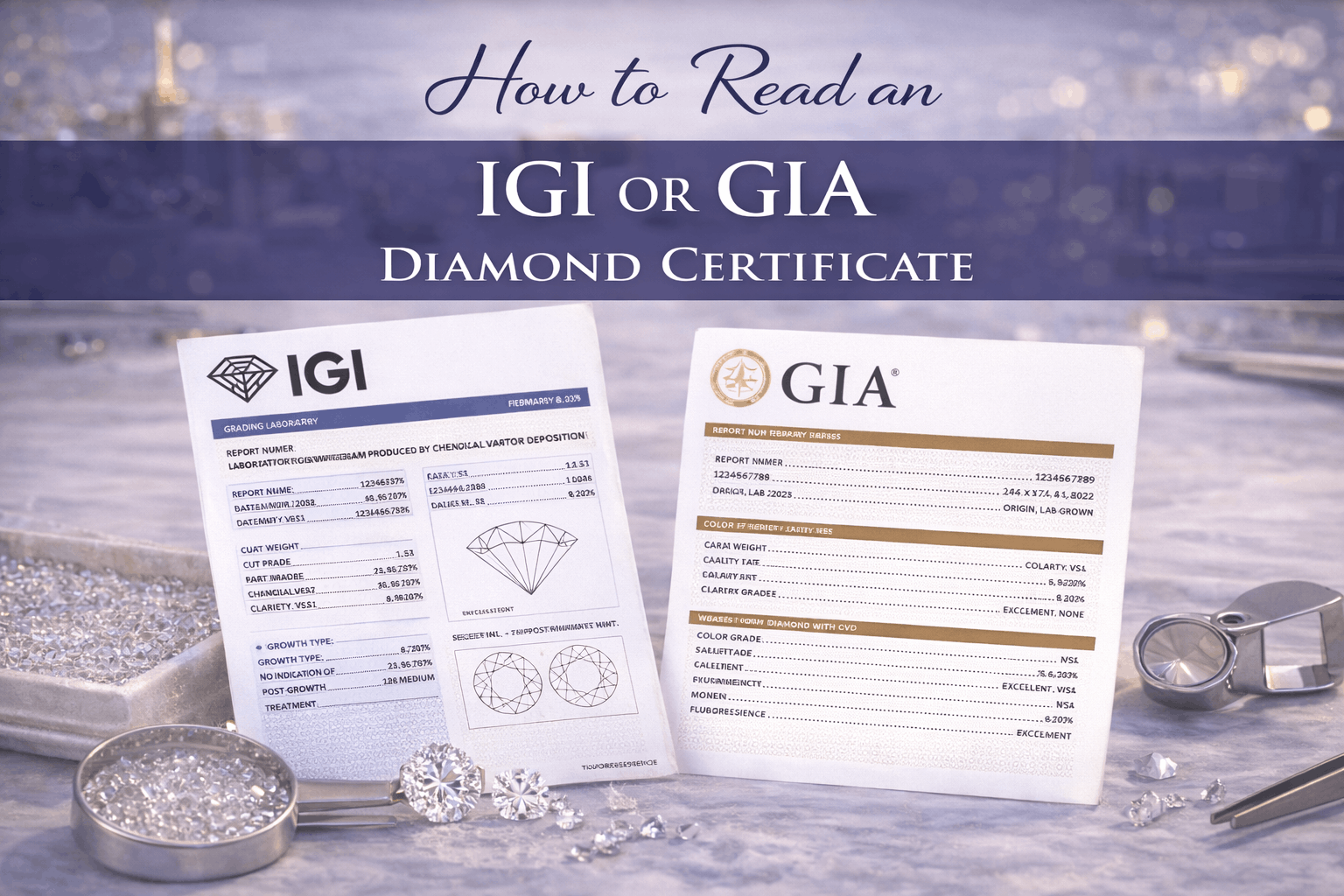
Layout at a glance: A GIA report uses a clean two-panel layout, grading data on the left and the proportions diagram and clarity plot on the right, printed on security paper with a fine guilloché border pattern. An IGI report follows a broadly similar two-column structure but places the growth-method and origin disclosure more prominently near the top of the identification block, and its header treatment and typography are visually distinct enough that an experienced grader can usually identify which lab issued a report from a few feet away, before reading a single word.
Security features: Both labs embed anti-counterfeiting elements — GIA reports carry a hologram and microprint lines; IGI reports include a QR code linked to the online verification database plus their own microprint and security screen. Neither relies on a single feature, which is exactly why cross-checking against the online database (next section) matters more than eyeballing the paper stock.
Lab-Grown Specialization: IGI has been certifying lab-grown diamonds significantly longer than GIA and remains the dominant body in the lab-grown market. GIA entered more recently with a distinct "Laboratory-Grown Diamond Report," printed on colored stock rather than white to make the distinction from natural reports immediately visible at a glance. When sourcing IGI lab grown diamond reports, you're working with the lab that helped establish the standard.
Report Detail: IGI reports typically include growth method and offer certification for finished jewelry, not just loose stones. GIA lab-grown reports also identify origin but present it differently, and historically offered jewelry certification later than IGI did.
Grading Strictness: GIA tends to apply slightly stricter grading, particularly for color and clarity. An IGI-graded G color may occasionally grade closer to H at GIA. This isn't a flaw — it's a calibration difference that experienced trade buyers factor into sourcing decisions, sometimes discounting IGI grades by roughly half a grade step when comparing across labs on the same shopping list.
At Guru Diam, both GIA and IGI certifications are available — retailers can specify their preference depending on what their customers trust and their market demands.
How to Verify a Report Number Against the Lab's Own Database
Never take a printed certificate at face value. Both IGI and GIA make online verification free and simple, and it should be a standing habit, not a step reserved for stones that look suspicious.
Verify an IGI Certificate
- Go to IGI's Verify Your Report page
- Enter the report number exactly as printed, with no spaces
- Compare every field the database returns against your physical document — shape, carat, color, clarity, and cut should match precisely
- You can also scan the QR code on IGI certificates for direct verification, which is faster on the floor with a customer waiting
Verify a GIA Certificate
- Go to GIA Report Check
- Enter the 10-digit GIA report number
- View full grading results — newer reports include a PDF image and photograph for side-by-side comparison
- Match every field against the physical document, not just the headline grades
A verification check that returns "no record found," or one where even a single field doesn't match the printed document, is not a clerical error to wave off — treat it as a reason to stop the transaction and ask direct questions before it goes any further. Every product page in the Guru Diam inventory includes a direct verification link for that stone, so this step is already built into your sourcing workflow.
Common Mistakes Buyers Make When Reading a Certificate
Most certificate-reading errors aren't about misunderstanding a single grade — they're about which fields get skipped entirely. The most frequent ones:
- Reading carat weight as a size guarantee. As covered above, weight and face-up size diverge whenever proportions do. Skipping the measurements line to jump straight to the carat number is the single most common shortcut that backfires.
- Chasing color and clarity grades while ignoring cut, polish, and symmetry. A D color, VVS1 stone with mediocre proportions can look flatter and less lively than a G color, VS1 stone that's beautifully cut. The 4Cs aren't weighted equally in how a diamond actually performs in the hand.
- Treating fluorescence as automatically negative. As covered above, faint-to-medium fluorescence is a non-issue for the vast majority of stones and can be a pricing advantage, not a defect to talk a customer out of.
- Never opening the clarity plot. Buyers who stop at the letter grade miss exactly where an inclusion sits, which is often more relevant to eye-cleanliness than the grade itself.
- Confusing a certificate with an appraisal. A grading report describes quality; it does not assign a dollar value. Quoting a certificate's grades as if they were a price guarantee sets the wrong expectation with a customer from the start.
- Trusting a printed document without checking the database. A certificate that's never been verified online is an unverified claim, no matter how official the paper looks.
- Assuming an overall cut grade exists for every shape. As noted above, fancy shapes don't receive one — buyers who ask "what's the cut grade on this oval" and accept a non-answer are missing the real signal, which is polish and symmetry.
Red Flags: When a Certificate Doesn't Add Up
Most certificates are exactly what they claim to be. But knowing what a problem looks like is part of reading one correctly. Watch for:
- A report number that returns nothing, or returns different specs. If the lab's own database shows a different shape, carat weight, or grade than what's printed, the document in hand doesn't belong to the stone being offered — full stop.
- Missing or mismatched laser inscription. If a stone is supposed to carry an inscription and doesn't, or the inscribed number doesn't match the report number, that's a physical-to-paper mismatch that needs an explanation before anything else happens.
- No origin or growth-method disclosure on a lab-grown stone. A legitimate lab-grown report always states its origin clearly in the header or comments. Silence on this field is not an oversight — it's a document that isn't doing its job.
- Treatment or enhancement language that's vague or absent where it shouldn't be. If a stone's price is well below what its stated grades would suggest, an absence of any comment about treatment is worth a direct question, not an assumption of good luck.
- A laminated or photocopied certificate with no verifiable security feature. Legitimate reports carry a QR code, hologram, or microprint that a copy machine can't faithfully reproduce. If you can't verify a security feature, verify the report number online instead — every time.
- Internal inconsistencies between sections. A proportions diagram that doesn't match the stated depth percentage, or a clarity plot with no symbols on a stone graded below Flawless, are signs the document has been altered or doesn't belong with the stone.
- A certificate from an unfamiliar lab presented as equivalent to IGI or GIA. Plenty of labs issue legitimate reports, but grading consistency varies widely outside the major labs. If a report is from a lab you don't recognize, verify its grading standards before pricing off it the same way you would an IGI or GIA report.
A Labeled Example: Walking Through a Sample Report
It's easier to apply all of the above with a concrete (illustrative) example in front of you. The specifics below are for teaching purposes only — not a real report number or an actual stone — but the layout mirrors what you'd see on an IGI Laboratory Grown Diamond Report.
- Report Number: a printed identifier at the top of the document (illustrative example only — always use the real number from the physical certificate)
- Origin: Laboratory Grown Diamond
- Shape and Cutting Style: Round Brilliant
- Measurements: 7.35 – 7.38 x 4.55 mm
- Carat Weight: 1.51 ct
- Color Grade: F
- Clarity Grade: VS1
- Cut Grade: Excellent
- Polish: Excellent
- Symmetry: Excellent
- Fluorescence: None
- Comments: Grown using the CVD (Chemical Vapor Deposition) method. Laser inscription matches report number.
Reading this the way the guide above teaches: the identification header confirms lab-grown origin before anything else is considered. Measurements (7.35–7.38 x 4.55 mm) confirm the stone faces up as a well-proportioned round rather than an unusually shallow or deep cut, consistent with the Excellent cut grade. Color F and clarity VS1 place it solidly in the near-colorless, eye-clean range that needs no disclaimers on the sales floor. Cut, polish, and symmetry all reading Excellent means this stone qualifies for the "Triple Excellent" designation covered earlier. No fluorescence removes one more question a customer might ask. And the comments field does exactly what it should for a lab-grown stone: it names the growth method plainly and confirms the physical inscription matches the paperwork — the two checks that matter most before this diamond ever reaches a showcase.

Guru Diam's Certification Practice
Every field covered in this guide is only useful if the certificate behind it is trustworthy. That's the standard we hold our own inventory to: every diamond in the Guru Diam inventory ships with an IGI or GIA certificate, and both GIA and IGI certifications are available depending on what a retailer's customers trust and what their market demands.
Our 11,000+ IGI- and GIA-certified lab-grown diamonds include full certificate details in our online inventory browser, with a direct verification link on every product page — so the check described above is already part of the sourcing workflow, not an extra step you have to remember. Need to see certificates in person? Visit our NYC or LA offices — we'll walk through every field together, on an actual stone, using the exact process in this guide.
Buyer Checklist Before You Sign Off
Before accepting delivery on a certified stone — your own inventory or a customer's special order — run through this list:
- Report number verified directly on the issuing lab's website, not just eyeballed against the paper
- Every field the database returns (shape, carat, color, clarity, cut) matches the physical document exactly
- Laser inscription checked under a loupe and matched against the report number
- Origin (natural vs. laboratory grown) confirmed in the header, not assumed
- Growth method noted for any lab-grown stone, with no vague or missing language in the comments field
- Treatment or enhancement disclosure reviewed — and any silence on treatment questioned if the price seems too good for the stated grades
- Measurements and proportions diagram checked against carat weight, not just the headline number
- Clarity plot reviewed for inclusion placement, not just the letter grade
- Security features (QR code, hologram, microprint) present and intact, not a laminated copy
- Cut, polish, and symmetry grades recorded together — especially for fancy shapes with no overall cut grade

Frequently Asked Questions
A diamond certificate (grading report) is an objective assessment of a diamond's characteristics issued by an independent gemological laboratory such as IGI or GIA. An appraisal, by contrast, assigns a monetary value and is typically used for insurance purposes. Certificates describe quality; appraisals estimate price.
Not always. GIA is generally considered slightly stricter, particularly on color and clarity grades. A diamond graded G color by IGI might receive an H from GIA. Both grading systems are respected and widely used — the key is understanding the calibration difference and pricing accordingly.
Yes. A diamond can be submitted to multiple labs for independent evaluation, and it will receive a different report number from each. However, this is uncommon in standard wholesale practice — most stones are certified once.
Yes. Both IGI and GIA clearly identify whether a diamond is natural or laboratory-grown. IGI prints this identification in the report header. GIA issues a separate report type — the Laboratory-Grown Diamond Report — for lab-created stones.
Enter the report number on the issuing lab's website. For IGI, use igi.org/Verify-Your-Report. For GIA, use gia.edu/report-check. Additionally, check that the laser inscription on the diamond's girdle matches the report number. If the numbers don't match — or if the certificate doesn't appear in the database — investigate further before buying.
Stop the transaction and treat it as a mismatch between the physical stone and its paperwork, not a minor discrepancy. Re-verify the report number on the issuing lab's website using only the number engraved on the girdle, and compare every returned field against the document you were given. If the inscription, the database record, and the printed certificate don't all agree, the stone and the paperwork should not be assumed to belong together until that's resolved with the seller directly.
Source with Confidence
Every field on a diamond certificate gives you information to buy smarter, sell more confidently, and answer any customer question with authority.
At Guru Diam, we make it easy to put this knowledge into action. Our 11,000+ IGI- and GIA-certified lab-grown diamonds include full certificate details in our online inventory browser, with direct verification links on every product page. No guesswork — just certified stones, ready to verify, ready to sell.
Need to see certificates in person? Visit our NYC or LA offices — we'll walk through every field together.
Browse Guru Diam's certified inventory →Related Reading
- IGI vs GIA Lab-Grown Certification — a deeper comparison of how the two labs approach lab-grown grading specifically.
- Lab-Grown Diamond Color, Clarity & Cut Chart (2026) — quick-reference charts for the grades covered in this guide.
- How Wholesale Pricing Works for Custom Jewelry vs Loose Certified Stones — how certificate grades translate into wholesale price.