

 Book Appointment



GIA vs IGI Certified Lab Grown Diamonds: What Every Retailer Needs to Know
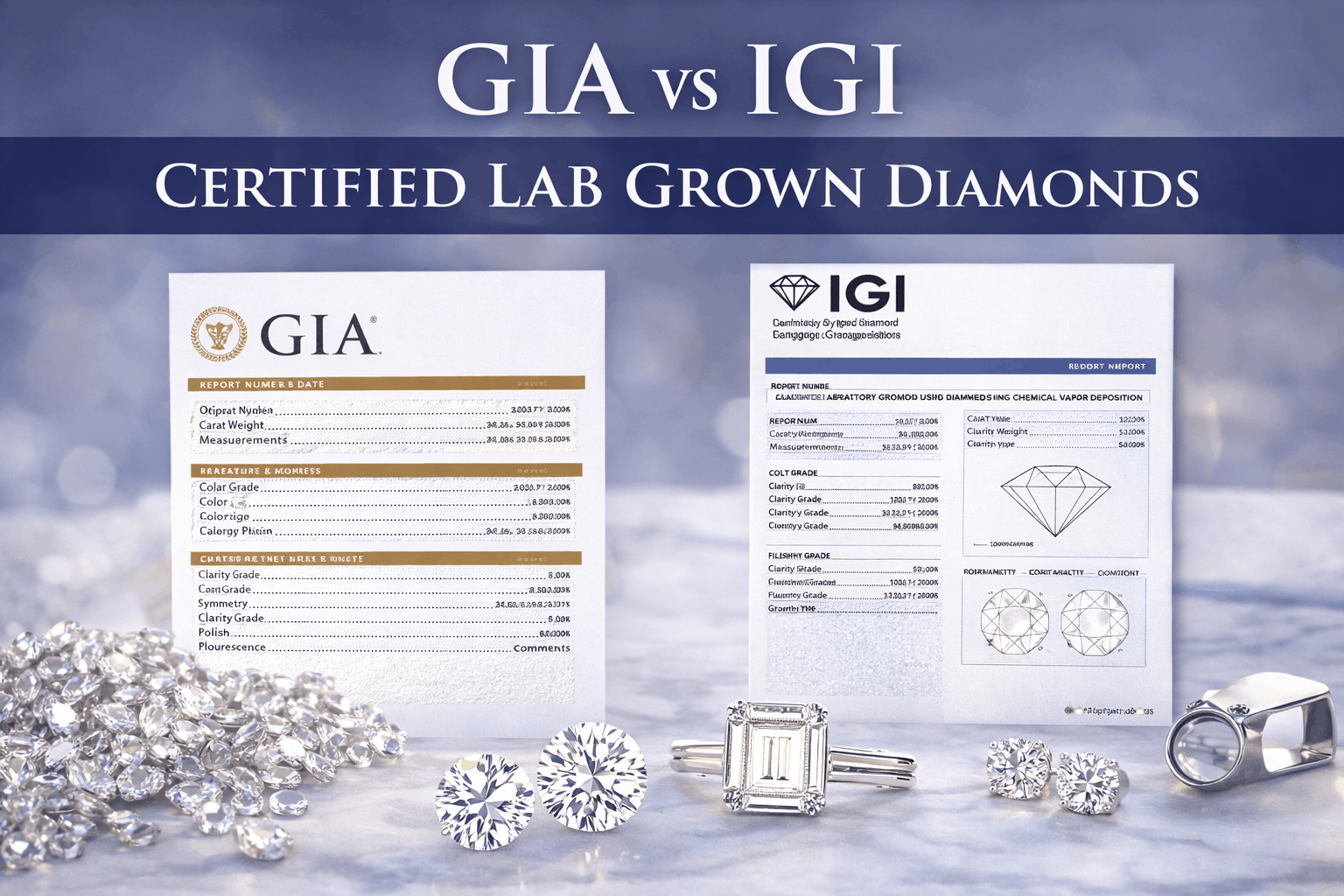
If you stock lab grown diamonds, your customers will ask about certification — and the GIA vs IGI lab grown diamond question is now one of the most common conversations happening across jewelry retail counters in America. The answer you give shapes their confidence, their purchase, and whether they come back.
As the lab grown diamond market pushes past $29 billion globally in 2025 and continues to accelerate, the certification landscape is evolving fast. GIA has overhauled how it grades lab grown stones. IGI continues to dominate lab grown certification volume worldwide. And retailers are caught in the middle, trying to figure out which reports to carry — and how to explain the differences to increasingly informed consumers.
This guide breaks it all down. No marketing spin. Just what you need to know to make smart purchasing decisions and sell with authority.
Why Diamond Certification Matters More Than Ever for Retailers
Certification has always been the backbone of diamond commerce, but it carries even more weight in the lab grown segment. Here is why: lab grown diamonds are chemically, optically, and physically identical to mined diamonds. Without a grading report from a recognized gemological laboratory, there is no independent way for a consumer to verify what they are buying.
For retailers, certification serves three critical functions:
- Trust at the point of sale. A recognized grading report from GIA or IGI eliminates the "how do I know this is real?" objection instantly.
- Pricing integrity. Certified stones command measurable premiums over uncertified inventory. IGI certified lab grown diamonds trade at meaningful markups because buyers understand that an independent lab has evaluated the 4Cs.
- Legal compliance. FTC guidelines require clear disclosure of lab grown origin. A grading report that specifies the growth method (CVD or HPHT) and confirms lab origin keeps you on the right side of regulation.
The bottom line: uncertified lab grown diamonds are harder to sell, harder to price, and harder to defend if a customer ever questions quality. Certification is not optional — it is infrastructure.
Understanding GIA Lab Grown Diamond Certification
The Gemological Institute of America is the most recognized name in gemology worldwide. Founded in 1931, GIA created the 4Cs grading system (cut, color, clarity, carat weight) that became the universal language of diamond quality. For decades, a GIA report was synonymous with the highest standard of diamond evaluation.
GIA's New Two-Tier System for Lab Grown Diamonds
In June 2025, GIA announced a major shift: it would retire the traditional 4Cs grading nomenclature for lab grown diamonds and replace it with a simplified two-tier system. The new GIA Laboratory-Grown Diamond Quality Assessment, which launched on October 1, 2025, classifies stones as either "Premium" or "Standard" — or issues no report at all.
What Qualifies as Premium vs. Standard
GIA Premium requires all of the following:
- Color: D
- Clarity: VVS or higher
- Polish and symmetry: Excellent
- Cut grade: Excellent (round brilliant only)
GIA Standard requires meeting these minimum criteria:
- Color: E to J
- Clarity: VS
- Polish: Very Good
- Symmetry: Very Good (Good permitted for fancy shapes)
- Cut grade: Very Good (round brilliant only)
Stones that fall below the Standard threshold receive no GIA assessment at all — and the submitter still pays a $5 evaluation fee.
GIA's Rationale
GIA's reasoning is straightforward. According to Tom Moses, GIA executive vice president, "more than 95% of laboratory-grown diamonds entering the market fall into a very narrow range of color and clarity". The granular D-to-Z color scale and the full clarity spectrum were designed for natural diamonds, which exist along an enormous range of characteristics. Lab grown diamonds, by contrast, cluster tightly in the near-colorless, eye-clean range — making detailed 4Cs grading less meaningful in GIA's view.
GIA Pricing
The GIA Laboratory-Grown Diamond Quality Assessment is priced at $15 per carat with a minimum fee of $15. A 2-carat stone costs $30. A 0.5-carat stone still costs $15. Each stone's girdle is laser-inscribed with "Laboratory-Grown" and the GIA assessment number. Existing GIA lab grown diamond reports issued before October 2025 remain valid.
Understanding IGI Certified Lab Grown Diamonds
The International Gemological Institute, founded in 1975, has built a different position in the market. While GIA has historically been the gold standard for natural diamonds, IGI moved aggressively into lab grown diamond certification starting in 2005 — years before the category reached mainstream acceptance.
That early commitment paid off. Today, IGI holds approximately 65% of the global lab grown diamond certification market, making it the dominant grading authority for the category. When a retailer or consumer sees a lab grown diamond grading report, the odds are strong that it carries an IGI logo.
How IGI Grades Lab Grown Diamonds
Unlike GIA's new simplified system, IGI continues to use the full 4Cs grading framework for lab grown diamonds — the same cut, color, clarity, and carat weight descriptors that the industry has used for decades. An IGI report for a lab grown diamond will show a specific color grade (D, E, F, G, etc.), a specific clarity grade (IF, VVS1, VVS2, VS1, etc.), and a detailed cut assessment.
IGI reports also document:
- Lab grown origin confirmation
- Growth method (CVD or HPHT)
- Laser inscription on the girdle
- Detailed measurements and proportions
- Inclusion plot (where applicable)
Why IGI Dominates Lab Grown Certification
Several factors explain IGI's position:
- First-mover advantage. IGI began grading lab grown diamonds in 2005, building institutional knowledge and market trust well ahead of competitors.
- Volume capacity. With labs across multiple continents — including a planned 214,000 sq. ft. facility in Surat — IGI can handle the enormous throughput that the lab grown market demands.
- Cost efficiency. IGI certification costs are approximately 25–30% lower than GIA for equivalent services, which matters at wholesale scale.
- Retailer familiarity. Most lab grown diamond inventory in the U.S., Europe, and Asia already ships with IGI reports, making it the de facto industry standard.
IGI's revenue tells the story: lab grown diamond certification now accounts for roughly 60% of IGI's total revenue, growing at over 50% CAGR. The company reported 21% year-over-year revenue growth in Q4 2025, driven by what CEO Tehmasp Printer described as "strong momentum" in lab grown certification.
GIA vs IGI: Side-by-Side Comparison for Retailers
Here is how the two certifications stack up across the criteria that matter most when you are making wholesale purchasing decisions:
| Criteria | GIA | IGI |
|---|---|---|
| Grading System | Two-tier: Premium or Standard (no 4Cs for lab grown) | Full 4Cs: detailed color, clarity, cut, carat grades |
| Grading Strictness | Conservative; stones often grade lower vs. IGI | Slightly more generous; consistent within its own system |
| Lab Grown Diamond Reports | Simplified quality assessment (launched Oct 2025) | Full grading reports with detailed specifications |
| Report Cost | $15/carat (minimum $15) | ~25–30% lower than GIA; varies by stone size |
| Turnaround Time | Varies by submission volume | Standard: 5–10 business days; Expedited: 1–3 days |
| Industry Recognition | Highest prestige for natural diamonds; evolving for lab grown | Dominant standard for lab grown diamonds globally |
| Laser Inscription | "Laboratory-Grown" + GIA assessment number | IGI report number; confirms lab origin |
| Growth Method Documentation | Yes | Yes (CVD or HPHT) |
| Best For | Retailers positioning top-tier lab grown as "Premium" | Broad inventory with detailed, familiar grading reports |
What the Table Means for Your Buying Strategy
The comparison is not about one lab being "better" than the other. It is about understanding which certification serves which segment of your business:
- If your customers ask for specifics — "Is this a D color? What's the clarity?" — an IGI report answers those questions directly with familiar terminology.
- If your customers value the GIA name — particularly those crossing over from natural diamond purchases — a GIA Premium or Standard designation carries weight and prestige.
- If you are optimizing margins — IGI's lower certification costs and the industry-standard pricing benchmarks built around IGI grades give you more predictable economics.
How GIA's New System Impacts Your Retail Floor
The shift from 4Cs to Premium/Standard is not just a grading change — it changes how you talk to customers about lab grown diamonds that carry a GIA report.
The Conversation Challenge
When a customer picks up an IGI certified stone, you can say: "This is a 1.5-carat, F color, VS1 clarity, excellent cut lab grown diamond." That is specific, comparable, and easy to understand.
When a customer picks up a GIA-assessed stone under the new system, you say: "This is a 1.5-carat lab grown diamond rated Standard by GIA." That raises follow-up questions: Standard compared to what? What is the actual color? What is the clarity?
For retailers who rely on detailed specs to justify pricing and differentiate inventory, this is a real operational consideration.
The Prestige Factor
On the other hand, GIA's brand equity is undeniable. For consumers who have been educated on natural diamonds — and who associate GIA with the highest standard of gemological authority — a GIA report still carries significant psychological weight. The "Premium" designation, in particular, signals top-tier quality in a way that resonates with high-end buyers.
GIA certified lab grown diamonds also command a price premium — typically 5–15% above IGI certified stones of equivalent quality — reflecting that brand recognition at the consumer level.
The Smart Retailer's Approach: Stock Both
Here is the practical reality: the retailers who are winning in this market are not choosing between GIA and IGI. They are stocking both.
Carrying diamonds certified by both labs gives you:
- Maximum flexibility. You can match the right certification to the right customer. The engagement ring shopper who knows GIA from their research gets a GIA report. The design-forward buyer who wants detailed specs and value gets an IGI report.
- Broader inventory options. Since IGI certifies the vast majority of lab grown diamonds on the market, limiting yourself to GIA-only inventory dramatically shrinks your selection. Offering both means you have access to a wider range of sizes, shapes, and qualities.
- Competitive differentiation. Many retailers stock only IGI. Offering GIA alongside IGI positions your store as more comprehensive and knowledgeable.
At Guru Diam , we carry diamonds certified by both GIA and IGI across our live inventory of over 11,000 certified stones — because we know retailers need options, not limitations. Whether your customer walks in asking for a GIA Premium round brilliant or an IGI certified F/VS1 cushion cut, you should be able to pull it from stock.
What to Tell Your Customers About GIA vs IGI
Your customers do not need a gemology lesson. They need confidence. Here is a framework for the conversation:
When a customer asks, "Which certification is better?"
Your answer: "Both GIA and IGI are respected, independent gemological laboratories. GIA is the most recognized name in diamond grading worldwide. IGI is the leading authority specifically for lab grown diamonds and provides detailed quality reports. The diamond's quality is what matters most — the certification confirms it."
When a customer asks, "Why does this one say Premium and this one says VS1?"
Your answer: "GIA recently introduced a simplified grading system for lab grown diamonds — Premium and Standard — because most lab grown stones fall within a narrow quality range. IGI still uses the traditional grading scale with specific color and clarity grades. Both reports confirm the diamond's quality; they just communicate it differently."
When a customer is comparing two stones
Focus on what they can see and what matters to them: brilliance, size, and value. The certification confirms the quality; it does not create it. Let the diamond do the talking, and let the report back it up.
Industry Trends Retailers Should Watch
The diamond certification landscape is not static. Here are the key developments shaping where this market is headed:
Market Growth Is Accelerating
The global lab grown diamond market is projected to grow from $33.54 billion in 2026 to $91.85 billion by 2034, a 13.42% CAGR. Approximately 70% of millennials and 80% of Gen Z buyers now favor lab grown diamonds, which means your customer base for certified stones is expanding rapidly.
Certification Penetration Is High and Rising
Diamond certification penetration is already at 65–70% industry-wide. For retailers, this means consumers increasingly expect a grading report with every purchase. Stocking uncertified lab grown diamonds is becoming a harder sell.
IGI and GIA Together Control the Market
GIA and IGI together hold approximately 80% of the global diamond certification market. Other labs exist, but buyer recognition and trust are concentrated in these two names. Stocking diamonds from both provides comprehensive coverage of what your customers will recognize and accept.
The U.S. Market Leads Demand
The U.S. lab grown diamond market reached $21.76 billion in 2025 and is growing at an 11.37% CAGR. American retailers are at the center of this growth — and certification is a non-negotiable part of the buying experience in this market.
Source Your Certified Lab Grown Diamonds from Guru Diam
At Guru Diam, we make diamond certification for retailers simple. Our inventory includes both GIA and IGI certified lab grown diamonds — over 11,000 stones in live inventory — so you never have to choose between certifications or compromise on selection.
What we offer retailers:
- Dual certification: GIA and IGI certified stones across all shapes, sizes, and quality tiers
- Live wholesale pricing: Real-time inventory with transparent pricing through our wholesale access platform
- Same-day shipping: Orders ship the same day from our New York location
- API integration: Connect your systems directly to our live inventory for seamless sourcing
- WhatsApp inventory alerts: Get notified when new stones matching your criteria hit our platform
- Expert support: Our teams in New York and Los Angeles are available to help you build the right inventory mix
Whether you are a single-location jeweler or a multi-store chain, having a wholesale partner who stocks both GIA and IGI certified lab grown diamonds means you are always ready for whatever your customer asks for.
Ready to browse? Access our live inventory and wholesale pricing today.
Frequently Asked Questions
What is the difference between GIA and IGI certification for lab grown diamonds?
GIA now uses a simplified two-tier system for lab grown diamonds, classifying them as either "Premium" or "Standard" based on an overall quality assessment. IGI continues to use the full 4Cs grading system — providing specific color, clarity, cut, and carat weight grades. Both are respected, independent gemological laboratories. GIA carries the highest brand prestige, while IGI is the dominant certification authority for lab grown diamonds with approximately 65% global market share in the category.
Are IGI certified lab grown diamonds less reliable than GIA certified ones?
No. IGI is a globally recognized gemological institute with over 45 years of certification experience. It was among the first labs to begin grading lab grown diamonds in 2005 and has since certified millions of stones. While grading philosophies differ slightly between labs — GIA tends to be more conservative, IGI slightly more generous — both provide accurate, independent assessments. Retailers and consumers worldwide accept IGI reports as a standard quality document for lab grown diamonds.
Why did GIA stop using the 4Cs for lab grown diamonds?
GIA stated that more than 95% of lab grown diamonds fall within a very narrow range of color and clarity, making the granular 4Cs scale — originally designed for the wide spectrum of natural diamond characteristics — less relevant for lab grown stones. The new Premium/Standard system launched on October 1, 2025. Existing GIA lab grown reports issued before that date remain valid.
Which certification should retailers stock — GIA or IGI?
The most effective strategy is to carry both. IGI certified lab grown diamonds represent the industry standard and give you detailed grading information that customers can easily compare across stones. GIA certification carries strong brand recognition, especially among consumers familiar with natural diamond grading. Stocking both certifications gives you maximum flexibility to serve different customer preferences and price points. At Guru Diam, we carry over 11,000 stones certified by both GIA and IGI for exactly this reason.
How much more do GIA certified lab grown diamonds cost compared to IGI?
GIA certified lab grown diamonds typically command a 5–15% price premium over IGI certified stones of comparable quality. This reflects GIA's brand recognition and higher certification fees ($15 per carat for the new quality assessment). For retailers, this means GIA stones can support slightly higher retail price points, while IGI stones offer better margin efficiency at volume. Carrying both lets you serve both segments of your customer base.