A jeweler who nails the price and the setting but blurs the word "diamond" has still failed the sale — the FTC does not grade on effort, it grades on whether a reasonable customer walked away confused about what they bought.
Why FTC Disclosure Rules Exist for Lab-Grown Diamonds
The FTC's Jewelry Guides (16 CFR Part 23) exist to keep one promise: a customer should never have to guess what kind of diamond they just paid for. The Guides are the FTC's interpretation of the general ban on deceptive trade practices as it applies specifically to jewelry marketing, and for most of their history "diamond" was assumed to mean a mined stone. That assumption broke down as laboratory-grown diamonds moved from a novelty into a mainstream wholesale category. In 2018, the FTC updated the Guides to address laboratory-grown and synthetic stones directly — dropping the idea that "diamond" inherently means natural, and requiring a clear qualifier whenever a seller markets a lab-grown stone using the word "diamond" at all.
The logic is simple and it cuts both ways. A customer who wants a natural stone and unknowingly buys lab-grown has been misled just as much as a customer who specifically wants lab-grown and gets a vague listing that could mean either. The rule protects the transaction, not one side of the market — which is exactly why it applies with equal force to retailers who sell lab-grown exclusively, lab-grown alongside natural, or natural exclusively but stock lab-grown melee as accent stones.
It's worth understanding what kind of rule this actually is. The Jewelry Guides are administrative guidance, not a statute passed by Congress — they describe the policies the FTC will use when deciding whether a jewelry marketing practice is deceptive under the broader FTC Act. In practice, that distinction matters less than it sounds like it should: the Guides function as the working compliance standard for the entire trade, because they tell you in advance exactly what the FTC considers deceptive before an actual enforcement action ever has to test the question. Treating the Guides as optional because they're "just guidance" is a mistake in both directions — it under-weights how consistently they get applied, and it misses that following them is also the cheapest way to avoid ever finding out how an enforcement action plays out.
What makes 2026 a harder year to get this wrong than 2020 is simple math: lab-grown has grown from a fringe category into a meaningful share of engagement-ring and fashion-jewelry sales, and price gaps between natural and lab-grown have widened, not narrowed. More inventory crossing more counters side by side means more opportunities for a rushed listing, a copy-pasted headline, or an untrained associate to blur the line the FTC drew. Regulators have also grown more comfortable treating jewelry marketing as an active enforcement area rather than a dormant one, which means the cost of an old habit — a headline that just says "diamond," a hashtag standing in for a real disclosure — is higher than it used to be.

What Disclosure Actually Requires at the Point of Sale
"Disclosure" is not a single line buried somewhere on a page — it is a standard that has to survive contact with every touchpoint a customer might see before or during a purchase decision. The FTC's test is whether disclosure is clear, conspicuous, and in close proximity to the word "diamond" wherever that word appears in a selling context. That standard plays out differently across four categories jewelers deal with every day.
Product Listings and Website Copy
- Lab-grown descriptor appears immediately before "diamond" in headlines, not just in the body copy or specs table
- Product category is clearly labeled (e.g., "Lab-Grown Diamond Engagement Rings," not just "Engagement Rings")
- Structured data and metadata carry the lab-grown designation, not just the visible headline
- Product photography and styling do not imply mined origin through language like "earth-mined look" or "just like nature makes"
Signage, Cases, and Price Tags
- Every case containing lab-grown inventory is labeled clearly, not just the case as a whole while individual pieces go untagged
- Individual loose diamonds and finished rings carry lab-grown identifiers on the price tag itself, not only on a paper insert that can be separated from the piece
- Staff are trained to say the words out loud — verbally disclosing status before a purchase decision, not after the sale is rung up
Invoices and Receipts
- Line-item descriptions use "laboratory-grown diamond" or an equivalent acceptable term, spelled out rather than abbreviated into something ambiguous
- Certificate type and report number are included on the line item, not just filed separately
- Metal type, setting style, and center-stone details are disclosed in full, so the receipt reads as a complete record rather than a partial one
Advertising, Email, and Social Media
- Print ads, catalogs, and mailers carry the qualifier with the same visual weight as the rest of the claim, not in fine print at a fraction of the size
- Promotional language does not imply false rarity for lab-grown product ("one of a kind," "rare find") when the actual value proposition is consistent supply
- Environmental and ethical claims are substantiated with specifics rather than left as an unqualified "eco-friendly" or "sustainable" banner
- Subject lines and headers reference the qualifier whenever an email is promoting lab-grown product, and personalized recommendation emails carry the same labeling standard as the product listings they draw from
None of this is exotic. It is the same discipline retailers already apply to price accuracy or return policy — just extended to a term that, for decades, nobody had to qualify.
Common Compliance Mistakes Jewelers Make — and How to Fix Them
Almost every compliance gap traces back to one of a small handful of habits, most of them inherited from a pre-lab-grown era of copywriting rather than any intent to mislead.
- "Cultured diamond" used alone. Wrong: "Our cultured diamond collection." Right: "Our cultured laboratory-grown diamond collection." The word "cultured" is only acceptable when immediately accompanied by an approved qualifier — on its own it reads as a euphemism, not a disclosure.
- Calling it "real" or "genuine." Wrong: "Real diamond — 1.02 ct" on a lab-grown listing. Right: "Laboratory-grown diamond — 1.02 ct." Terms like "real," "genuine," and "natural" should never describe a lab-grown stone without qualification, since they actively suggest mined origin to a customer who has no reason to read further.
- Hashtag-only disclosure. Wrong: a caption reading "Our newest engagement ring" with hashtags like #diamond #labgrown doing the disclosure work. Right: the caption itself states "Our newest lab-grown diamond engagement ring." Hashtags are searchable metadata, not a substitute for a clear statement in the copy a customer actually reads.
- Generic headlines with a buried qualifier. Wrong: a headline reading "2ct Diamond Solitaire" with the lab-grown disclosure sitting three paragraphs down in the specs. Right: "2ct Laboratory-Grown Diamond Solitaire" in the headline itself. Proximity is the whole test — a technically-present disclosure that a customer has to hunt for does not meet it.
- Inconsistent descriptors across channels. A listing that says "laboratory-grown" on the website, "lab created" on the invoice, and nothing at all in the Instagram caption creates exactly the kind of patchwork a regulator — or a confused customer — will notice. Pick one acceptable descriptor and hold it constant across every channel the product touches.
- Marketplace and syndicated listings that fall out of sync. A product description written correctly on a retailer's own site frequently gets clipped, shortened, or auto-translated when it's pushed to a marketplace, a comparison feed, or an international storefront — and the qualifier is often the first thing lost in the trim. Any syndication pipeline needs its own check that the disclosure survived the trip.
Compliant vs. Non-Compliant Language: A Side-by-Side Comparison
Seeing the same touchpoint written both ways, side by side, makes the standard easier to apply consistently across a team than a rule stated in the abstract.
| Touchpoint | Non-Compliant Example | Why It Fails | Compliant Alternative |
|---|---|---|---|
| Product headline | "1.50ct Round Diamond Ring" | No qualifier at all; reads as natural by default | "1.50ct Round Laboratory-Grown Diamond Ring" |
| Case tag | "VS1, G color — $2,400" | Grade and price with no origin identifier | "Lab-Grown Diamond — VS1, G color — $2,400" |
| Receipt line item | "Diamond ring, 1.5ct" | Ambiguous line item on the customer's permanent record | "Laboratory-Grown Diamond Ring, 1.5ct, IGI #123456789" |
| Social caption | "New arrival! ✨ #diamond #labgrown" | Disclosure pushed into hashtags instead of stated in copy | "New arrival: a lab-grown diamond tennis bracelet ✨" |
| Email subject line | "Diamond Studs, 20% Off This Week" | Promotional urgency with no category disclosed | "Lab-Grown Diamond Studs, 20% Off This Week" |
| Marketing claim | "Real diamonds, unreal prices" | "Real" directly implies mined origin | "Laboratory-grown diamonds, honest prices" |
| Appraisal document | "Diamond solitaire, appraised at $X" | Insurance and resale records inherit the ambiguity permanently | "Laboratory-grown diamond solitaire, appraised at $X" |
| Verbal counter script | Associate says "diamond" and moves straight to price | No verbal disclosure before the purchase decision is made | Associate states "this is a laboratory-grown diamond" before discussing price |

How IGI and GIA Certification Supports Compliance
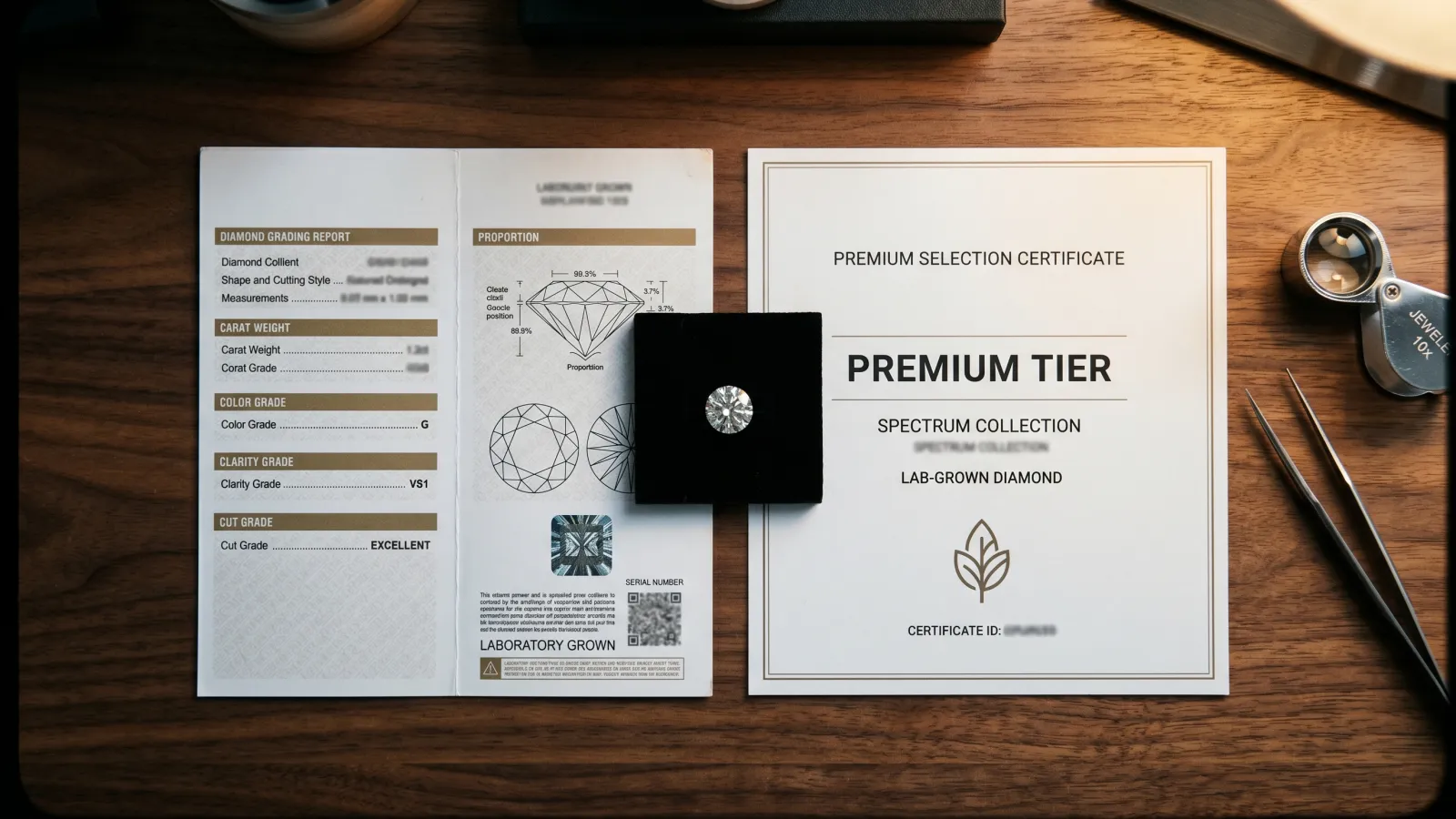
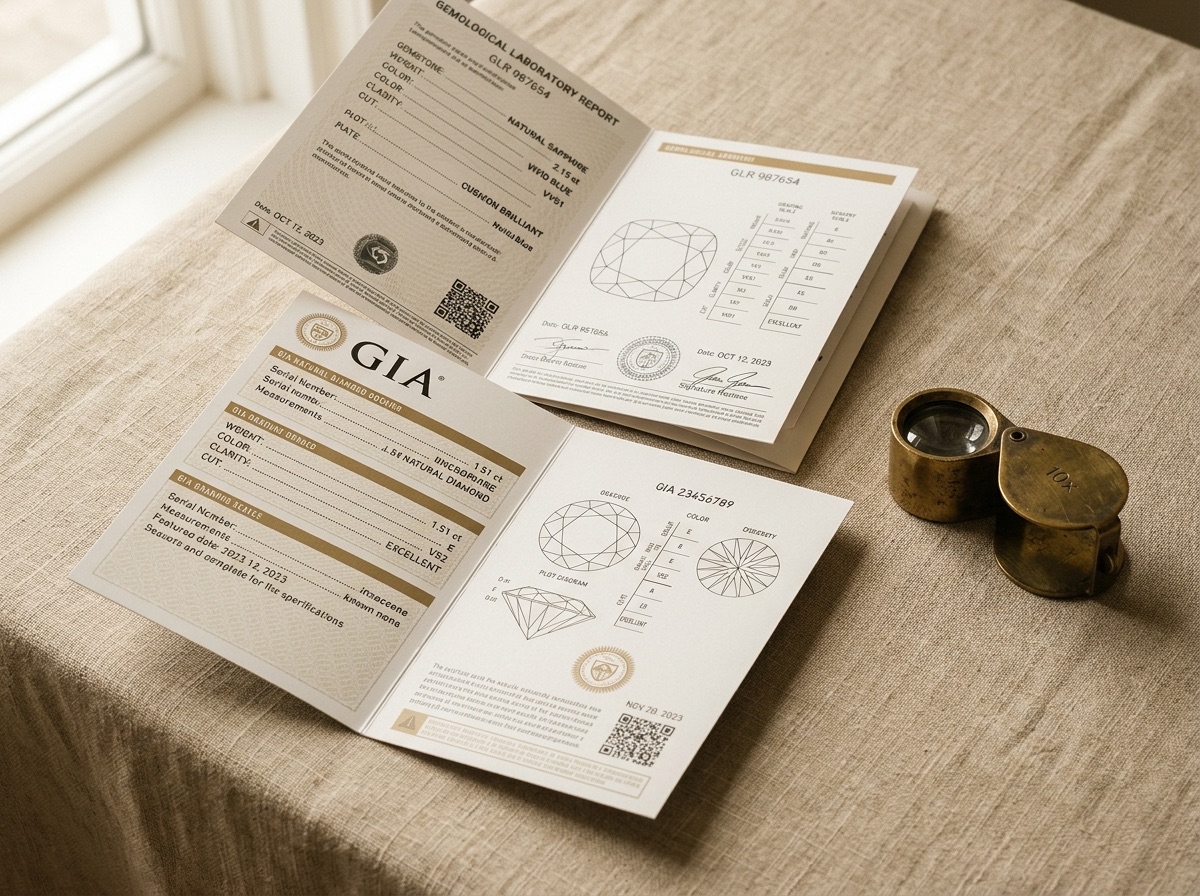
A grading report from IGI or GIA does something a marketing team can't fully replicate on its own: it states growth method as a matter of laboratory record, independent of whatever language a listing or a sales associate uses. Every report on a laboratory-grown stone identifies it as such — the report itself becomes a disclosure anchor that exists outside the retailer's own copywriting, which is exactly the kind of independent, verifiable evidence that matters if a disclosure question is ever raised after the sale.
That doesn't make certification a substitute for point-of-sale disclosure — the FTC's requirement is about what the customer sees and hears at the moment of the buying decision, not what's filed in a report they may or may not read closely. What certification does is close the loop: when a retailer's headline says "laboratory-grown," the case tag says "laboratory-grown," the receipt says "laboratory-grown," and the certificate number on that receipt traces back to a report that independently confirms the same thing, there is no point in the chain where a customer could reasonably claim confusion. Carrying the certificate report number through onto the invoice line item — rather than treating it as a separate document handed over almost as an afterthought — is one of the simplest ways to make that chain airtight.
Practically, this means a retailer's compliance posture is only as strong as the documentation their supplier hands them. A certificate that clearly states laboratory-grown origin, paired with an invoice from the supplier that already uses compliant language, gives a retailer a paper trail to point to rather than a policy they have to defend from scratch.
State-Level and International Considerations
FTC guidance sets the federal floor, but it isn't the only layer that matters. State attorneys general enforce their own consumer-protection and unfair-trade-practices statutes, and a misleading jewelry claim that draws federal attention can just as easily trigger a parallel state inquiry — particularly in states with active consumer-protection units. Some states have also layered additional disclosure requirements specific to gemstones on top of the federal baseline. Because these requirements vary and change over time, a retailer operating in multiple states — or selling nationally online — is generally better served by standardizing on the strictest applicable language across the board rather than trying to maintain different copy per jurisdiction.
International requirements add another layer for jewelers who buy, sell, or ship across borders. India's BIS IS 19469:2025 standard, effective January 2026, restricts the word "diamond" alone to natural stones and requires lab-grown product to be labeled "laboratory-grown diamond" or "laboratory-created diamond," explicitly banning softer terms like "cultured," "nature's," or "earth-friendly" for lab-grown goods. The EU's Due Diligence Statement on Diamond Origin, also effective January 1, 2026, requires traceability evidence — including a formal Due Diligence Statement — for both natural and lab-grown diamonds moving through the EU market. US jewelers exporting to the EU, or sourcing from wholesalers with EU-bound inventory, should confirm origin documentation directly with their supplier rather than assuming it's already in place.
Because state statutes and international rules are both narrower in scope and more prone to revision than the federal Jewelry Guides, treat the specifics above as a starting point for a conversation with counsel rather than a final word — particularly before finalizing compliance language tied to a single state or export market.
Whatever jurisdictions apply, the underlying discipline is the same: keep a dated record of the compliance language a business used at each point in time. If a claim about disclosure requirements is ever questioned months or years after a sale, being able to show what the applicable standard was and how the listing, tag, and receipt matched it at the time of sale is worth more than any amount of retroactive explanation.
The Practical Compliance Checklist for Your Retail Counter
The touchpoints above cover documents and channels. This is the version built for the physical counter, where most disclosure failures actually happen — not because anyone tried to hide anything, but because the words a busy associate defaults to are the words they've said for years.
- Build the disclosure line into the opening of the sales script, not the closing — say "laboratory-grown diamond" before the customer is emotionally committed to the piece, not after
- Physically attach lab-grown identifiers to the tag on the piece itself, not just to a case card that can walk off when a ring gets pulled for a closer look
- Set point-of-sale software to auto-populate the compliant descriptor on every receipt line tied to lab-grown SKUs, so front-of-house staff can't accidentally override it under pressure
- Include the certifying lab and report number on layaway agreements and trade-in offer sheets, not just on the original sales receipt
- Brief every associate — including seasonal and part-time staff — on the required verbal disclosure as part of onboarding, not as a one-time memo that fades from memory
- Review case photography before it goes on social media or the website; a shot styled to evoke a mined-stone aesthetic without a caption qualifier recreates the same problem as a headline with no qualifier
- Spot-check a sample of invoices and social posts quarterly against this list — compliance drifts quietly when nobody is looking, not all at once
How Guru Diam's Certification and Documentation Support Your Compliance
A retailer's disclosure obligations start with what arrives from the supplier, which is why the documentation a wholesaler hands over matters as much as the stone itself. Guru Diam provides certified grading reports from IGI or GIA on every stone, and both labs identify laboratory-grown status directly on the report — giving a retailer an independent record to stand behind rather than a claim they have to make unsupported.
Invoice line items already use the compliant "laboratory-grown diamond" descriptor rather than a bare "diamond" entry that a retailer would need to correct downstream, and certificate numbers are included so customers can verify a stone's report independently if they choose to. Retailers building their own product pages or case cards can draw on recommended, ready-to-use description language rather than drafting disclosure copy from scratch for every SKU — and the trade account portal keeps ready-to-copy product copy blocks on hand for exactly that purpose, so a compliant headline and description are one copy-paste away rather than a rewrite.
None of this replaces a retailer's own point-of-sale discipline — the verbal script, the tag placement, the receipt formatting are still the retailer's responsibility. What it does is make sure the paperwork a retailer inherits from their supplier is already correct, so compliance work starts from a clean foundation instead of a deficit.
The Risks of Non-Compliance
The consequences of getting disclosure wrong rarely show up as a single dramatic event — they accumulate across a few predictable categories.
- Regulatory exposure. The FTC can issue warning letters, open inquiries, and in more serious or repeated cases pursue formal enforcement action; violations of a final FTC order can carry meaningful civil penalties per violation.
- State-level action. State attorneys general can pursue parallel investigations under their own consumer-protection statutes, independent of whatever the FTC does federally.
- Private consumer claims. A customer who feels misled about origin has grounds for a refund demand, a chargeback, or in some cases a claim under state consumer-protection law — and a pattern of similar complaints raises the stakes considerably.
- Platform and marketplace risk. Advertising platforms and marketplaces enforce their own policies against misleading product claims, and a flagged listing can mean a paused ad account or a delisted product independent of any government action.
- Reputational damage. A single screenshot of non-compliant copy circulates faster and lasts longer than any correction issued after the fact, particularly in a trade where buyers compare notes.
- Downstream documentation disputes. An ambiguous receipt or appraisal follows the piece for years — into insurance claims, estate settlements, and resale — and an origin dispute that surfaces long after the sale is far harder to resolve than one caught at the counter.
None of these risks require intent to mislead — most compliance failures start as an old habit, not a decision. That is exactly why a written checklist, reviewed on a schedule rather than only after something goes wrong, matters more than good intentions alone.
Frequently Asked Questions
What are the FTC lab-grown diamond disclosure rules in one sentence?
The FTC lab-grown diamond disclosure rules require sellers to clearly state that a diamond is "laboratory-grown," "lab-created," or "lab-grown" every time the word "diamond" appears on a product listing, price tag, invoice, or ad — using the word "diamond" alone, without one of those qualifiers, is treated as deceptive regardless of intent.
Is it legal to call a lab-grown diamond a "diamond" in the US?
Yes, but it must include a qualifier like "laboratory-grown" or "laboratory-created" immediately before the word "diamond" — the word alone, without qualification, is treated as referring to a natural stone.
Can I use the word "cultured" for a lab-grown diamond?
Only when it's accompanied by an acceptable descriptor in the same phrase. "Cultured laboratory-grown diamond" is permitted; "cultured diamond" alone is not, since "cultured" by itself functions as a euphemism rather than a disclosure.
Do FTC Jewelry Guides apply to social media posts?
Yes — the FTC explicitly requires compliance across Instagram, TikTok, Facebook, and other social platforms, including influencer and affiliate content, and a hashtag alone does not satisfy the requirement.
Can I put the lab-grown disclosure in my website's FAQ page instead of the product page?
No. The FTC rejects that approach — disclosure has to occur at the point where a customer actually forms their purchase decision, and an FAQ or education page can supplement that disclosure but can't substitute for it.
What happens if I fail to disclose lab-grown status?
Potential consequences include FTC warning letters, state attorney-general investigations, consumer refund demands, platform enforcement action, and reputational damage that tends to outlast any single correction.
Does "synthetic diamond" count as proper disclosure?
Technically yes under the FTC Guides, but it's rarely used in practice because of negative consumer connotations. Most retailers standardize on "laboratory-grown" or "laboratory-created" instead, and consistency across channels matters more than which of the acceptable terms is chosen.
How should I label lab-grown diamonds on invoices?
Use "laboratory-grown diamond" as the line-item description, and include carat weight, the certifying lab (IGI or GIA), and the certificate report number on the same line rather than as a separate attachment.
Related Articles
- Lozenge Diamonds Wholesale Guide (Aug 02, 2026) — Wholesale lozenge (rhombus) lab-grown diamonds for Art Deco-style settings and accent work
- Fancy Color Heart Diamonds Wholesale (Aug 02, 2026)
- Matched Pair Step Cut Diamonds Wholesale (Aug 02, 2026) — Wholesale matched pair step cut lab-grown diamonds for stud earrings and symmetrical side-stone settings