
 info@gurudiam.com
 Book Appointment



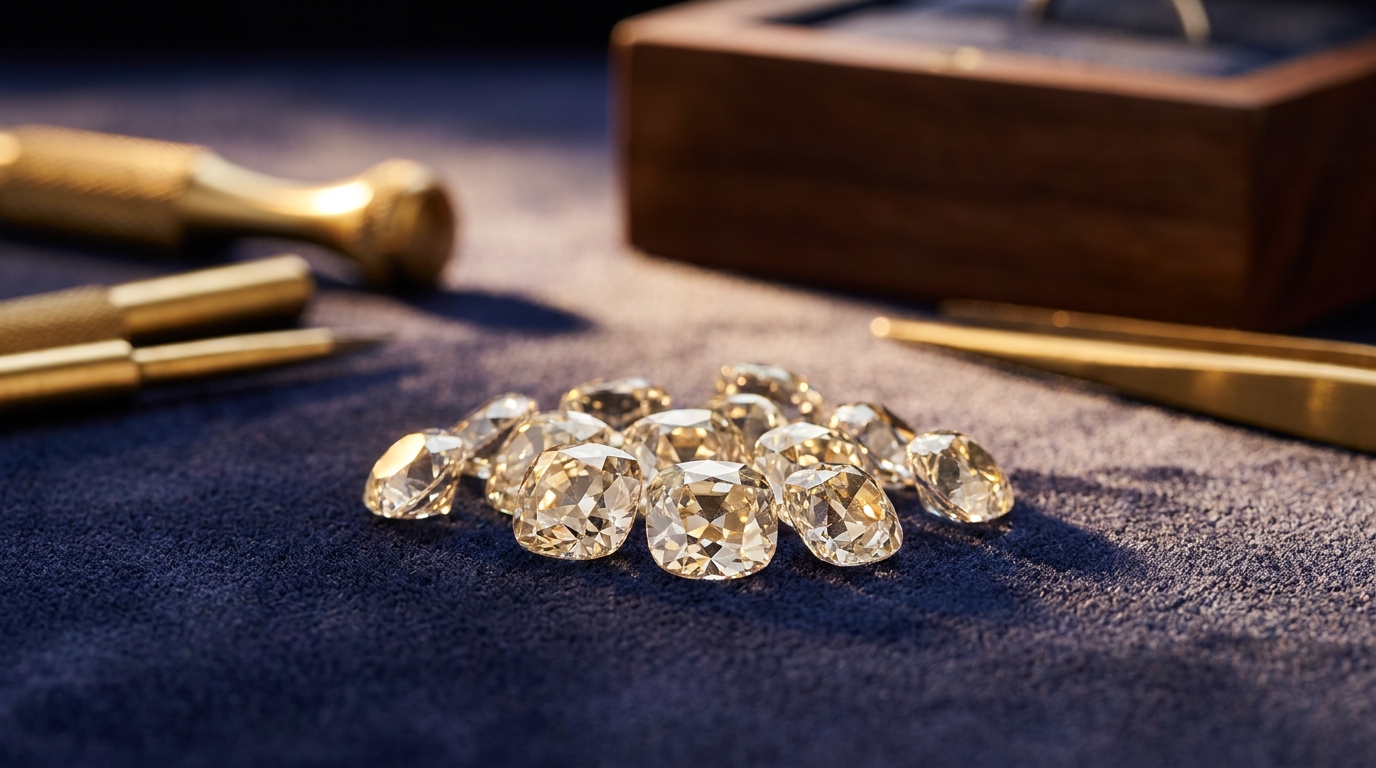
Antique-cut lab-grown diamonds reproduce historical cutting styles — small tables, tall crowns, deep pavilions, and broad, irregular facets — trading the calculated brilliance of a modern round for softer, more textured light return. For a jeweler building a vintage-inspired case, that difference is what separates a ring that looks new from one that looks found. Guru Diam produces and matches antique-cut lab-grown diamonds in-house, across the full family of historical styles, for trade buyers who'd rather work with one supplier than five.
What Makes a Cut "Antique"?
"Antique cut" is a trade term for a style, not a claim about the physical age of the stone. A lab-grown antique-cut diamond is newly grown material, faceted to reproduce proportions that predate modern cutting mathematics — it isn't an old stone, it's a new stone cut the old way.
Those proportions exist because diamond cutting changed once electric light and precision faceting equipment arrived. Before that, cutters worked rough largely by eye and by hand, prioritizing weight retention and a workable outline over calculated optical performance. The result is a recognizable set of traits: smaller tables, taller crowns, deeper pavilions, larger open culets, and facet patterns that are broader and less uniform than a modern brilliant of the same carat weight. In 1919, published "ideal cut" mathematics standardized the modern round brilliant around shallower crowns, smaller culets, and proportions calculated to maximize brilliance under bright indoor lighting. Everything cut before that standardization, and every stone intentionally cut to those earlier proportions since, is what the trade calls antique.
The practical effect shows up in how the stone reads across a room. A modern ideal cut throws sharp, concentrated fire. An antique cut throws broader, softer flashes — less sparkle, more glow — which is exactly the look vintage-bridal buyers are asking for when they say they want a stone with "character" rather than maximum brilliance.
It's worth separating that from "vintage-inspired," a term retailers apply to almost anything with a milgrain edge or a halo. A stone marketed as vintage-inspired usually keeps standard modern proportions and borrows only the surface details — the setting looks old, the cut math doesn't. A true antique cut changes the proportions themselves: the table, crown, pavilion, and culet measurements are different numbers, not just a different frame around the same stone. For a wholesale buyer, that distinction is the difference between stocking a genuine category and stocking a modern cut with vintage marketing language attached to it.
The Antique Cut Families: An Overview
"Antique cut" is an umbrella, not a single shape. It covers several distinct historical families, each with its own proportions, era, and best use — and trade listings often use the term loosely enough that a buyer can end up quoting the wrong family entirely. Here's the lineup.
Old Mine and Old European Cuts
These are the two dominant antique families and the ones most often meant by "antique cut" with no other qualifier. Old mine cuts run squarish-to-cushiony with an asymmetric outline, a high crown, a large open culet, and large, irregular, hand-cut-feeling facets that throw bold, blocky flashes. Old European cuts came later, with a rounder, more symmetric outline, a smaller culet, and tighter, more regular faceting that reads closer to a modern brilliant while keeping antique depth. For the full proportion-by-proportion breakdown and sourcing guidance on both, see the Old Mine Cut vs. Old European Cut wholesale guide.
Rose and Portuguese Cuts
A rose cut is flat on the bottom and domed on top, faceted entirely in triangular facets with no pavilion and no table — closer to a glimmer than a fire. It's the understated end of the antique spectrum and increasingly popular in minimalist vintage-bridal settings where a quieter stone reads more deliberate than a bright one. A Portuguese cut takes the opposite approach: an extra tier of facets on both crown and pavilion adds dramatic, layered fire, closer to the Art Deco-era end of the antique range. Depth on grading and positioning for both lives in the Rose Cut & Portuguese Cut wholesale guide.
Dutch Marquise
An elongated antique cut with a six-sided outline, pointed ends, and straight, angled sides — brilliant-faceted rather than step-faceted, which gives it more fire than its outline might suggest. It sits in a naming gap between the modern marquise and the hexagon family and gets confused with both often enough that it has its own dedicated guide: Dutch Marquise Diamonds Wholesale Guide.
The Art Deco Geometric Family: Coffin, Lozenge, Kite, and Hexagon
This is the strict-geometry end of the antique spectrum — shapes built for 1920s and 1930s design, where hard symmetry mattered more than curve. A coffin cut is a six-sided elongated shape, wider through the shoulders and tapering toward flat or angled ends rather than to a point; see the Coffin Cut Diamonds wholesale guide. A lozenge is a calibrated rhombus — four equal sides meeting at two acute and two obtuse angles — used almost exclusively as an accent or channel stone; see the Lozenge Diamonds wholesale guide. Kites and hexagons round out the family: a kite is a four-sided shape rising to a point, most often set flanking an emerald-cut or old-European center, while a hexagon runs six roughly equal sides and works as either a center or an accent. Both, along with trapezoids, half-moons, and criss cuts, are covered in the broader Fancy Shape guide for designers.
Where Trade Names Overlap
Several of these names get swapped for each other in casual trade conversation, and the mix-ups are common enough to cost a buyer money if they aren't caught before quoting. A Dutch Marquise is not a modern marquise — the modern shape is a four-sided pointed oval, while the Dutch Marquise is six-sided with straight angled sides, and the two get listed under the same search term often enough that a buyer expecting one can receive the other. "Antique cushion" is used loosely enough in retail listings to describe almost any cushion with a slightly higher crown, when a genuine old mine cut is a specific, more extreme proportion set, not a cushion with minor tweaks. And a Portuguese cut is sometimes mislabeled as an old European by sellers who aren't counting facet rows carefully — the extra tier on a Portuguese cut's crown and pavilion is the tell, and it's easy to miss without a loupe and a reason to look for it. None of this is intentional misrepresentation most of the time; it's just how loosely the vocabulary travels once it leaves a cutter's bench and reaches a listing page. Naming the shape precisely, and confirming it against the proportion data on the certificate rather than the headline, is the fastest way to avoid paying an antique premium for a stone that doesn't carry antique proportions.
Antique Cut Families at a Glance
| Cut family | Era / style | Outline | Faceting | Light behavior | Typical use |
|---|---|---|---|---|---|
| Old Mine | 1700s–1800s | Squarish cushion, often asymmetric | Large, irregular, hand-cut feel | Bold, blocky flashes | Centers, maximum vintage character |
| Old European | 1890s–1930s | Round, more symmetric | Regular, transitional pattern | Soft brilliance with antique depth | Solitaires, three-stone centers |
| Rose | 1500s–1800s | Round or freeform, flat base | Triangular facets, no table/pavilion | Understated glimmer, not fire | Minimalist vintage settings, accents |
| Portuguese | 1920s–1930s | Round, brilliant-style | Extra facet tier on crown and pavilion | Dramatic, layered fire | Statement centers |
| Dutch Marquise | Historical elongated brilliant | Six-sided, pointed ends | Brilliant-faceted | High fire for an elongated shape | Centers, elongated statement stones |
| Art Deco geometrics (Coffin, Lozenge, Kite, Hexagon) | 1920s–1930s | Strict geometric, angular | Step-cut or brilliant, shape-dependent | Architectural, shape-driven | Side stones, channel accents, geometric centers |
No single family is the "correct" antique cut — the right one depends on whether a buyer is chasing maximum vintage character, a quieter minimalist look, or a hard Art Deco geometry, and that's a design decision as much as a sourcing one.
Why Lab-Grown Made Antique-Cut Sourcing Viable Again
In natural material, antique proportions are expensive because the cutter has to fight the rough. A piece of mined rough has a fixed, natural crystal shape, and cutting toward a small table, a tall crown, and a large culet sacrifices carat weight that could otherwise be preserved by cutting toward a modern round brilliant or a shallow fancy shape instead. That weight-retention math is what kept deliberately "wasteful" antique proportions rare and expensive at any real scale in natural goods — every antique stone was, in effect, a cutter choosing style over yield.
Lab-grown CVD rough changes that equation because it's grown to a chosen size and shape rather than mined from a random crystal. A cutter can work with rough that's already suited to an antique outline instead of fighting a mined crystal's natural geometry, which means cutting toward an antique profile stops being a pure weight sacrifice and becomes closer to a stylistic choice. That's what makes it practical to hold antique-cut inventory across a range of sizes rather than treating every antique stone as a one-off special order, and to true-cut to a buyer's exact outline or proportion spec when a stock size doesn't fit a mounting.
The labor side of the equation moved too. Antique-style faceting relies on slower, more manual finishing than the largely automated bruting and faceting equipment built and tuned for modern round-brilliant mass production — a cutter is placing and adjusting individual facets by hand rather than running a stone through a jig calibrated for standard angles. As demand for antique styles thinned out through much of the twentieth century, the pool of cutters trained in those manual techniques, and the specialized tooling built around them, shrank along with it, which kept unit economics poor even when a workable piece of rough was available. A larger, steadier base of lab-grown antique-cut orders gives that skill set and tooling enough continuous work to be worth maintaining at scale, rather than treating every antique commission as a rare, expensive exception.
Certification Nuances for Antique Cuts
There's a gap in how grading labs handle antique and fancy shapes that catches buyers new to the category off guard: GIA and IGI only issue an official Cut grade for round brilliants. Every antique and fancy shape discussed above — old mine, old European, rose, Portuguese, Dutch Marquise, and the full Art Deco geometric family — is graded on Color, Clarity, Polish, and Symmetry, but gets no lab-assigned numeric cut score. There is no "antique cut grade" printed on a report, no matter how well-proportioned the stone is.
Because that number doesn't exist, the proportion measurements that do appear on the certificate — table percentage, crown angle, pavilion depth, girdle thickness, culet size — function as the real cut-quality proxy for trade buyers, read alongside the Polish and Symmetry grades. Those two grades deserve a second look on antique stones specifically: hand-finished antique work can carry a grade lower than a modern brilliant of comparable overall quality without that indicating a defect, since irregularity is often the intended look rather than a flaw to be corrected. Serious wholesale buyers ask for proportion diagrams or close-up photos alongside the report rather than relying on the grade line alone — that matters most on matched pairs, where outline and light behavior have to agree between two stones in ways a certificate summary alone won't show.
The two major labs don't lay out that proportion data identically — field labels and report formatting differ slightly between a GIA and an IGI report — but the underlying measurements are the same set: table percentage, crown angle or height, pavilion depth, girdle thickness, and culet size. A buyer who learns to read those fields on one lab's report can read them on the other without relearning the category, which matters for a trade that routinely handles both certifications side by side.
Pricing Factors Across the Antique-Cut Category
Price on an antique-cut stone rarely comes down to carat and color alone. Across every family above, the same handful of factors move the number:
- Rough yield / weight retention — even with lab-grown rough shaped toward an antique outline, tall crowns and large culets return less finished carat weight per unit of rough than a modern brilliant, and that shows up in price per carat.
- Hand-finishing time — irregular facet patterns and asymmetric outlines take longer to polish cleanly than a machine-faceted modern cut, and that labor time is priced into the stone regardless of where the rough came from.
- Matched-pair scarcity — a single antique stone is one sourcing problem; a matched pair or three-stone set multiplies it, since outline, table, crown height, culet, and light behavior all have to agree across stones. Matched sets carry a real premium over the sum of two singles priced separately.
- Size sensitivity — antique cuts are more available, and more reasonably priced, in smaller center-stone and accent sizes than in large stand-alone centers, where any proportion mismatch is far more visible.
- Polish and symmetry grade — a higher polish and symmetry grade commands a premium the same way it does on a modern cut, even without a cut grade to anchor the comparison to.
None of these factors apply as a fixed multiplier — there's no uniform "antique markup percentage" that converts a modern-brilliant price into an antique-cut price across the board. Two stones in the same family, at the same carat weight and color, can land at meaningfully different prices depending on how well the outline is retained, how clean the hand-finishing is, and whether the stone is being bought solo or as part of a set. Pricing an antique-cut stone is closer to evaluating the specific piece against these factors than to applying a category-wide formula.
Design Trends Driving Antique-Cut Demand
Vintage-bridal has kept growing as its own bridal category rather than a niche inside it, and that's the biggest driver behind renewed antique-cut demand. Mixed-metal designs pairing warm-toned gold with white-metal accents are showing up across independent jewelers' cases. Toi-et-moi and cluster-halo settings that showcase two or more antique-shaped stones side by side are moving from custom-only requests to stocked designs. Hexagon and kite side stones flanking an emerald-cut or old-European center have become a recognizable Art Deco-revival signature. And rose-cut accents are finding a second life in minimalist settings, where a flat, quietly glimmering stone reads as deliberately vintage rather than costume-like.
Signet-influenced engagement rings — a wider, more architectural band paired with a smaller antique center — are pulling buyers who want a vintage silhouette without a large stone budget, which puts smaller old European and rose-cut centers in more regular rotation than they were a few years ago. Colored-stone pairings alongside an antique-cut center, in a toi-et-moi or three-stone layout, are also gaining ground as buyers move away from a single round solitaire as the default engagement-ring format. For independent jewelers, antique-cut centers and accents are one of the more reliable ways to differentiate a case that would otherwise carry the same handful of modern shapes as every other supplier.
How Guru Diam Sources Across the Antique-Cut Category
Guru Diam produces and matches antique-cut lab-grown diamonds in-house across old mine, old European, rose, Portuguese, Dutch Marquise, and the Art Deco geometric family, maintaining 10,000+ loose stones in current inventory and cutting to a buyer's outline or proportion spec when a stock size isn't available. Matching for studs, three-stone rings, and accented mountings evaluates outline, crown height, table, culet size, and light behavior — not just carat and color — since two stones can share a grading report and still look mismatched side by side. All antique-cut stones ship IGI-certified as standard, with GIA available on request. For depth on a specific shape, the dedicated guides linked throughout this page cover proportions, grading, and positioning in more detail than a category overview can.
Trade buyers order through two US offices, both serving jewelers, designers, and retailers exclusively:
- New York: 36 West 47th Street, Suite 601A, New York, NY 10036
- Los Angeles: 607 South Hill Street, Suite #241, Los Angeles, CA 90014
Contact (212) 652-7108 for project consultation, certification preferences, or viewing loose stones.

A Buying Checklist for Antique-Cut Wholesale Buyers
- Confirm exactly which family you're buying. "Antique cut," "vintage cut," and "old cut" get used loosely in trade listings — ask for the specific name (old mine, old European, rose, Portuguese, Dutch Marquise, or a named Art Deco geometric) before quoting a price.
- Request the proportion measurements on the certificate — table percentage, crown height and angle, pavilion depth, culet size, girdle thickness — not just the shape name and carat weight.
- Ask for Polish and Symmetry grades specifically, since there's no lab-issued Cut grade for fancy and antique shapes to anchor a quality comparison to.
- For matched pairs or multi-stone sets, request side-by-side photos, not just two individual certificates — outline and light behavior have to agree, and a report alone won't show that.
- Confirm certification type upfront (IGI standard, GIA on request) so client-facing paperwork matches expectations before the stone ships.
- Ask whether a stock size exists for your specification or whether the order requires a made-to-order cut, and plan your sourcing around that answer.
- If sourcing for a signature or repeat collection, ask about consistency across production runs so future reorders match earlier stones.
Frequently Asked Questions
Are antique-cut lab-grown diamonds real diamonds?
Yes. Lab-grown diamonds are chemically, physically, and optically identical to mined diamonds — same crystal structure, same hardness, same fire. "Antique-cut" describes the cutting style and historical proportions applied to the stone, not the material itself. Guru Diam produces antique-cut stones via CVD with IGI certification, GIA available on request.
What is the difference between an old mine cut and a cushion cut?
Modern cushions prioritize optical brilliance with larger tables and shallower crowns designed for maximum light return under bright indoor lighting. Old mine cuts keep small tables, high crowns, and open culets for a softer, chunkier antique appearance. Both share a rounded-square outline but deliver distinctly different looks and light behavior.
Do antique cuts come with IGI or GIA certification?
Antique cuts ship IGI-certified as standard, with GIA certification available on request. The certificate documents color, clarity, polish, and symmetry, and confirms lab-grown origin for consistent client-facing presentation — remembering that fancy and antique shapes don't receive a lab-issued Cut grade the way round brilliants do.
Can antique cuts be matched for earrings or three-stone rings?
Yes. Matched pairs and side-stone sets are evaluated on outline, crown height, table, culet, and light behavior so the stones read as a deliberate set, since visual matching differs meaningfully from what a grading report alone can show.
What sizes of antique-cut lab-grown diamonds are available?
Antique cuts are carried across a range of sizes, from center-stone weights down to accent sizes for side-stone work. In-house cutting and a 10,000+ stone inventory make it possible to supply stock sizes or produce a specific proportion set to order when the stock range doesn't fit a mounting.
Is Guru Diam open to the public or trade only?
Guru Diam operates trade-only, serving jewelers, designers, and retailers. Trade buyers access stone review, matched-set requests, and made-to-order cutting through the New York and Los Angeles offices.
Related Articles
- Old Mine Cut vs. Old European Cut: The Definitive Sourcing Guide for Jewelers
- Rose Cut & Portuguese Cut Lab-Grown Diamonds Wholesale
- Dutch Marquise Diamonds Wholesale Guide
- Coffin Cut Diamonds Wholesale Guide
- Lozenge Diamonds Wholesale Guide
- Fancy Shape Lab-Grown Diamonds for Designers: Hexagon, Kite, Lozenge & Criss Cut
- Matched Pair Step Cut Diamonds Wholesale
- Fancy Color Heart Diamonds Wholesale